Rafael Nadal On the Defensive
Whether a player plays defense or attack is a question of belief.
Pete Sampras believed in his serve to such an extend that he attempted breaking only once per set at all. He knew that his hold-game was unshakable. It also explains why he went for second service aces when break-points down.
The Pistol might go down in history as the best first-strike player in tennis yet. Then there are the opposite of the Pistol. Those who believe in their consistency—ability to churn out groundie after groundie, and in their ability to retrieve balls.
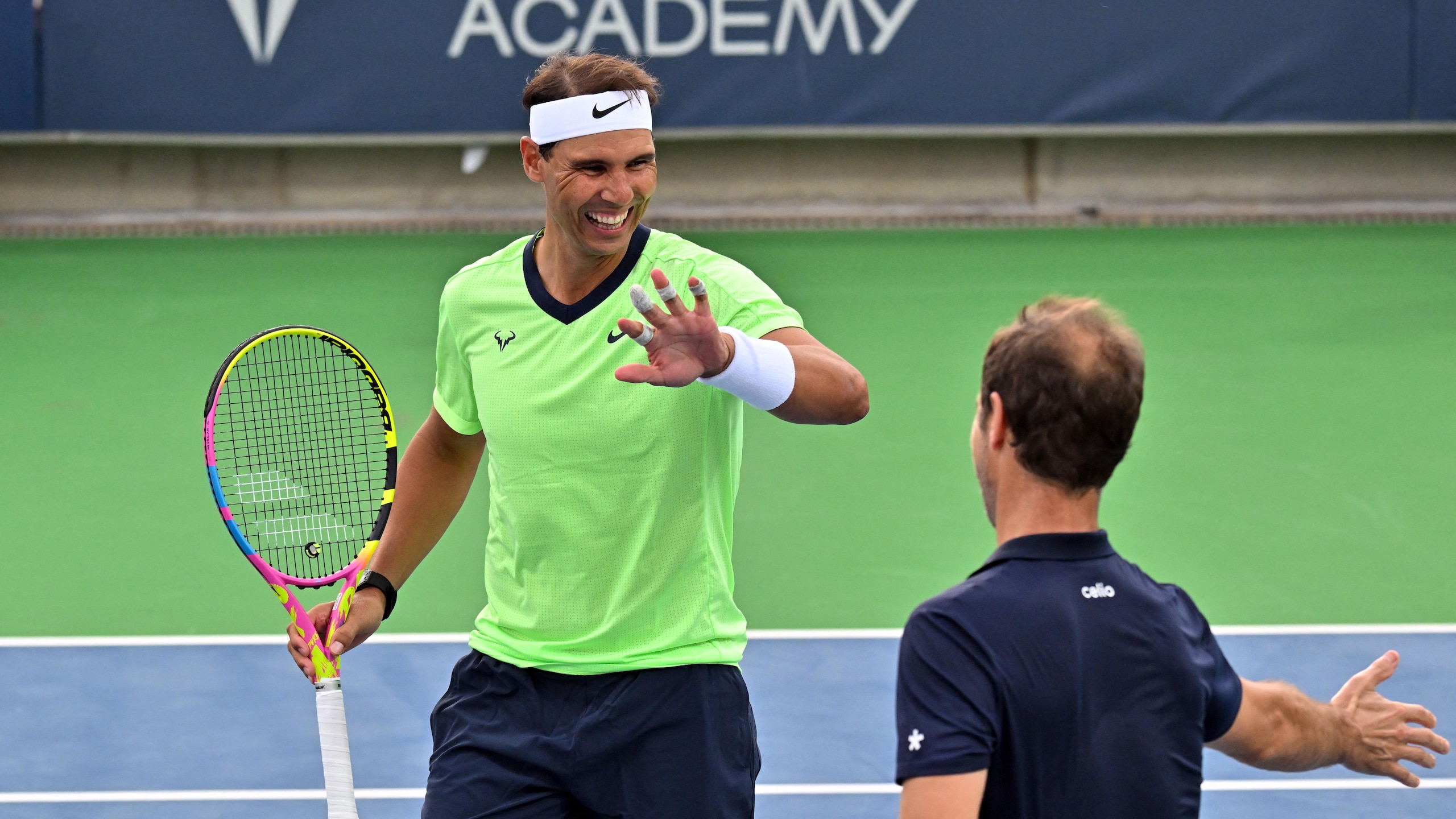


Among these there will be quite a few who mentally or physically construct their points, instead of being just totally passive. Like Rafael Nadal, and Andy Murray.
But each player has some breaking point. Beyond that threshold, he might not have enough with on the stroke received of what he needs to construct anything. It might just allow him enough to be able to run down and retrieve the ball. He turns into the other kind of passive defenders.
For Nadal, what he needs is time , and that threshold is breached when the pace, depth and height of the ball after bounce fall beyond some limits. Among defenders Nadal is not one who “feeds” off pace. He is not symbiotic.
Of course Rafael and his uncle Antony knew this. Which is why they were turning him into a better first-striker slowly but surely.
This was really possible in Nadal’s case, and still is. Rafael generates his own pace, just like an offensive baseliner does, though not anything like a Del-Potro because he mixes it up with a lot of spin. The only matter remaining was to correct the nature of his strokes—to direct the pace to earn points for him, rather than fatigue the opponent into submission.
He developed a flatter inside-out fore-hand that zips across more than loops into the court due to top-spin, started stepping into the court a bit more instead of running all over the place, developing the court-position required for aggression, and started pulling the trigger with his backhand down the line.
He was learning and learning very fast. He won the Wimbledon, the Olympic medal and the Australian Open—all considered to be foreign surfaces to him. He then also went on to put in his best performance in the season-beginning hard court season. He was adapting to faster courts very well.
Rafael’s motto has been always the same—improve as a tennis player and as a person with each passing day. It all seemed in place and working for him for quite a while.
But time would tell that he had left out one parameter from his equation—the fitness. His body—his knees—were at the receiving end of all the ferocious hard-work. He had to take a sabbatical.
A couple of months without tennis, unable to defend his Wimbledon crown, he returned to action in August. By this time a few players who were first-strikers by nature, of the style of Gonzales, had matured—Juan Martin Del Potro, Robin Soderling, Marin Cilic, who also stand much taller than Gonzo.
And Rafael seemed to have forgotten a bit during his leave–of-absence-due-to-medical-reasons, of all that he had learnt that won him the faster Grand Slams. He has fallen to precisely the three players mentioned above since in addition to the “allowable” defeats to Djokovic and Davydenko who is in the form of his life right now.
Apart from Cilic who he had never played earlier, Nadal has had a telling head-to-head against the other two, especially against Juan Martin, who he had tamed on fast-synthetic and slow-natural surfaces earlier, and who is now reversing the head to head.
He is dropping back on the court instead of stepping in. He is using top-spin to achieve depth and finding that the spin only grips the air during this time of the year, and not the earth. He is running like a rabbit finally losing the point anyway.
He is playing clay-court tennis on hard-courts, which plays especially well to a tall-first striker’s strength if the execution is not absolutely clinical.
For the casual tennis-fan however the most important thing is that he has stopped winning.
Questions are being raised as well as concerns about Rafael’s future. One cannot of course give an answer categorically since there is no real rule that lets one tell what it is that is at play. But it is second nature to us to attempt to find answers where there aren’t any.
For one, Rafa’s programme of conversion to a first-striker got rudely interrupted. He needs to go back and revise those lessons a bit—most importantly to generate depth off pace rather than using spin, and to play with lesser set-up stepping into the court.
The US Hard Court season never has looked good for the Spaniard. It is just that the expectations of the tennis-following populace increased beyond reason after he created such a huge lead at the top in the beginning of the year.
People started assuming that the only reason for his failures in the past had been the blows that his body had acquired over the year. Perhaps we are being too optimistic extrapolating his improvement at the beginning of the year to the end forgetting that the man had taken a break from tennis in the meanwhile.
It seems that he has cut down his body mass resulting in an inability to create depth even when the stroke is riding on spin, and especially on the run. Some point out that Rafa’s on-the-run transition is one of his most important weapons and losing that would do him a lot of harm.
The weight reduction, it has been said, is to ease up the load on his knees. If that is indeed the case, then it might not come back on his body. Or maybe he will cut down on matches rather than weight. In any case, it is not as if only body mass can help you generate depth. He used to depend on that factor earlier, and it needs some getting-used-to since it is a recent change to his physique.
There are also concerns being raised about Rafa giving up too easily. Well, pulling off victories from multiple match-points down is what he is still doing (here he erases 5 MPs for a 2-0 loss against Nicholas Almagro and goes on to win the match, Paris Masters, 2009).
And he is still playing tight and clinging on in the final set of most matches. Probably what appears as passivity is his realization getting reflected in his body-language that he doesn’t have the game, but only the mental toughness currently with him that could possibly take him through.
Perhaps Rafael will re-learn all that he has forgotten this year. Perhaps he will be back on track by time the time for Australian Open, the prospect of a fresh season freshening his belief too. Perhaps a few wins on clay will give him back his momentum.
Or it could also be that his break has given such a big lead to the rest of the competition that he will forever lag the field.
Whatever it is, Rafael’s fans can count on him doing one thing – to keep trying to improve, to keep fighting.
.jpg?w=2560 "Seahawks Chiefs Football")



.jpg?w=2560 "Latest Peyton-Colts Rumors")