
Remembering 10 Forgotten MLB Superstars of the '90s
It's absurd how many stars came through Major League Baseball in the 1990s. Even two decades later, names like Ken Griffey Jr., Barry Bonds, Greg Maddux and Randy Johnson still command reverence.
But we aren't here to talk about them today.
Rather, we had the idea to recall 10 superstars from the '90s who aren't as well remembered as they deserve. If we're being candid, that's really just another way of saying that we wanted to write about them because we rarely get a chance to do so.
We did have some ground rules, though:
- No Hall of Famers: Anyone who doesn't remember them can go to Cooperstown and read their plaques.
- No Major Award Winners: There's a certain legacy that comes from winning a Rookie of the Year, MVP or Cy Young Award.
- Numbers Must Hold Up: It's nice that Cecil Fielder hit a bunch of home runs in the '90s, but he also produced less WAR than John Kruk.
- No Albert Belles or John Wettelands: Things like stalking, DUI and indecent exposure and alleged child sexual abuse are not to be taken lightly.
Since we're here to remember and not to rank, we'll proceed in alphabetical order.
RHP Kevin Appier, Kansas City Royals and Oakland Athletics
1 of 10Accolades: 1993 AL ERA Title, 1 All-Star
Given that he made all of one All-Star team during the decade, it might be more accurate to call Kevin Appier one of the Unrealized Superstars of the 1990s.
The right-hander was one of only five hurlers to top 1,800 innings with a 130 ERA+ during the 90s. The other four? Oh, just Hall of Famers Greg Maddux and Randy Johnson and Cy Young Award winners Roger Clemens and David Cone.
Appier surely would have been more acclaimed had he been around during the Kansas City Royals' run as a superpower between 1976 and 1985. Alas, that era was gone and withered by the '90s. The Royals topped out at just 84 wins in 1993.
That's a shame, because Appier was a heck of a fun pitcher. His delivery was all elbows and knees, and he made mincemeat of hitters with a slider and splitter that were counted among the game's nastiest pitches.
Since retiring in 2004, Appier has kept about as low of a profile as the one he had in his playing days. The last time he was in the news was when he put his Kansas ranch on the market in 2016.
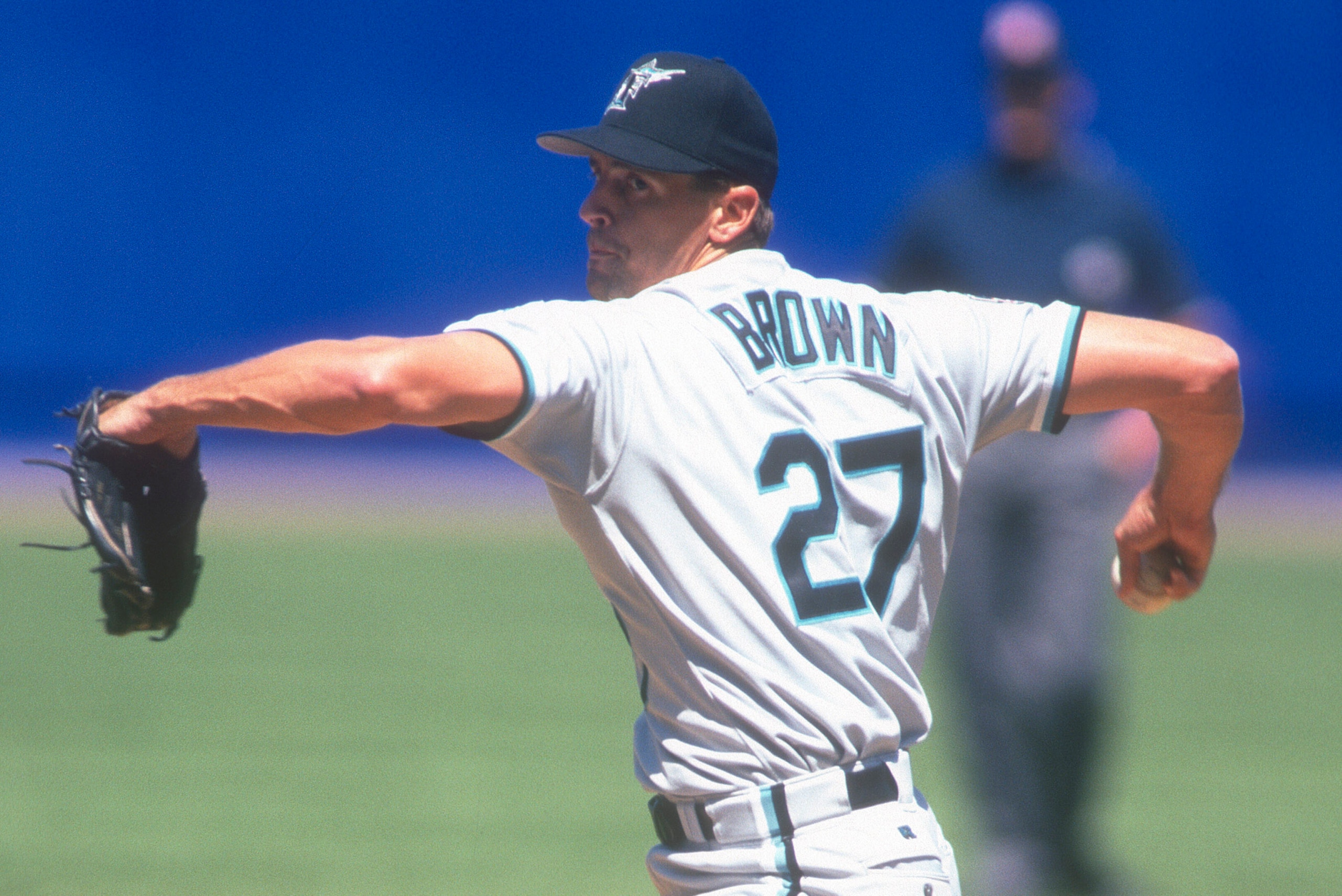
RHP Kevin Brown, Texas, Baltimore, Florida, San Diego and Los Angeles
2 of 10Accolades: 1996 MLB ERA Title, 4 All-Stars
Though it would require some logical leaps to argue for Kevin Brown as the best pitcher of the '90s, the Los Angeles Dodgers were right to make him baseball's first $100 million player in 1998.
Brown's record over the three previous seasons included a 2.33 ERA and only 626 hits allowed in 727.1 innings. More recently, he'd made a run at postseason history with a 16-strikeout performance opposite the Houston Astros in the '98 National League Division Series.
Brown missed out on the NL Cy Young Award all three years, but he came close in the voting in '96 (second) and '98 (third). If the voters had been keen to WAR at the time, he might have won the award both years.
The righty owed his success to perhaps the gnarliest sinker baseball has ever known. Suffice it to say there were times when he seemed to be throwing an actual bowling ball in the mid-90s.
Between his iffy statistical candidacy and his appearance in the Mitchell Report in 2007, Brown was nonetheless denied entry to Cooperstown in 2011. Yet he's kept busy since his retirement in 2005, particularly as a coach for one of the top high school baseball teams in Georgia.
LHP Chuck Finley, California/Anaheim Angels
3 of 10Accolades: 3 All-Stars
The greatest strikeout pitcher of all time? Well, there's obviously Nolan Ryan and Johnson. On a rate basis, there's also Craig Kimbrel and Aroldis Chapman.
When it comes to striking out four batters in a single inning, however, none of them has anything on Chuck Finley. The southpaw is the only pitcher in history to accomplish that feat three times.
That's the kind of thing that should be random, but it makes sense in Finley's case. His baseball journey started courtesy of a mid-90s fastball, yet it was more so his excellent curveball that made him one of the premier strikeout pitchers of the 1990s. Those 102 wild pitches throughout the '90s? Those were just collateral damage.
What Finley lacked in high peaks—1990 was the only year in which he earned Cy Young votes—he more than made up for with consistency. Only he and five others tossed over 160 innings annually during the '90s. He also tallied double-digit wins in all but one season.
Finley remained an effective pitcher through his final big league season in 2002. He's been absent from the spotlight since then, and he apparently has no relation to the "Chuck Finley" who checked over 2,000 books out of a Florida library in 2016.


CF Kenny Lofton, Houston Astros, Cleveland Guardians and Atlanta
4 of 10Accolades: 5 AL Stolen Base Titles, 6 All-Stars, 4 Gold Gloves
Kenny Lofton played for 11 different teams throughout his 17-year career in the majors, so he's admittedly not the most obscure character in the Baseball Cinematic Universe.
But for anyone who's on the younger side or who missed out on Lofton in the '90s, just know that he was truly one of the great players of the decade.
After breaking in with Houston in 1991, Lofton made an immediate leap to stardom with Cleveland in 1992 and maintained it through the '90s. By WAR for those eight seasons, he was the best position player not named Bonds, Griffey or Bagwell.
Though Lofton's speed was certainly his greatest asset, it was far from his only dimension. He was a pest of a hitter with a fantastic bat-to-ball skill and a good eye for the strike zone, plus decent power for a speedster. And in center field, he could cover any distance and scale any wall.
Lofton retired in 2007 and was unfortunately one-and-done on the Hall of Fame ballot in 2013. As for how he's kept busy, he actually has a handful of producing credits for TV and film through his production company.
RHP Dennis Martinez, Montreal Expos and Cleveland Guardians
5 of 10Accolades: 1991 MLB ERA Title, 4 All-Stars
Upon breaking in with the Baltimore Orioles in 1976, Dennis Martinez had an immediate claim to fame as the first Nicaragua native to play in the major leagues. But he initially struggled to find stardom, to a point where his first 11 seasons didn't even yield an average of 1.0 WAR.
Rather than flame out, he found another gear in the late 1980s and became one of the great hurlers of the early-to-mid '90s.
First for the Montreal Expos and then for Cleveland, Martinez excelled to the tune of a 133 ERA+ over 1,262.2 innings between 1990 and 1995. He beat out some real heavyweights in WAR over that span, including future Cooperstowners like Randy Johnson and Tom Glavine.
That Martinez did all of this between the ages of 36 and 41 is astonishing, and it was indicative of how much he was able to squeeze out of stuff that even he deemed to be only "decent." Never more so than on July 28, 1991, when he twirled the 13th perfect game in history.
The righty finally retired after his age-44 season in 1998. He's done a little bit of everything since then, including fundraising for front-line health workers in Nicaragua after the pandemic hit in 2020.
LHP Randy Myers, Cincinnati, San Diego, Chicago Cubs, Baltimore
6 of 10Accolades: 1990 NLCS MVP, 3 AL/NL Save Titles, 4 All-Stars
Think of the great relief pitchers of the 1990s, and the first names that come to mind are probably Dennis Eckersley, Lee Smith, Trevor Hoffman and Mariano Rivera.
There was also Randy Myers, who was so good that he thrice received votes for both the Cy Young Award and the MVP.
Granted, this has much to do with the questionable degree to which teams and awards voters valued saves in those days. Myers racked up 291 of those between 1990 and his final year in the majors in 1998, which ranked second behind only Eckersley for those nine seasons.
The lefty had two things in abundance: velocity and personality. To the former, he could run his fastball up around 100 mph. To the latter, he reportedly kept a stun gun and an inactive grenade in his locker and drove something that was said to resemble "a cross between a jeep and a tank."
Myers sounds like a guy who might have gone on to star in cheap direct-to-video action flicks. But in reality, his post-retirement life has consisted of work with a foundation for youth athletics and a variety of roles at his alma mater, Clark College.
1B John Olerud, Toronto Blue Jays and New York Mets
7 of 10Accolades: 1993 MLB Batting Title, 1 All-Star
From that paltry list of accolades, you'd swear that John Olerud was about as tragically unrecognized during the '90s as Keith Appier was. However, his peers respected the heck out of him.
Olerud even had the eye of hitting icon Ted Williams, as Williams' former teammate and longtime friend Bobby Doerr relayed: "Ted and I agreed that, if any kid has the combination of ability and personality makeup to hit .400 nowadays, it's John."
Olerud never actually hit .400, but he did come admirably close when he closed the 1993 season with a .363 average. He also had a .473 on-base percentage that year, making him one of only seven players who've hit those marks while also playing in over 150 games in a season.
Likewise, the sweet-swinging Olerud was one of only five hitters to exit the '90s with a .300 average and .400 OBP. Of the other four, three are in Cooperstown and another (rhymes with "Ponds") frankly should be.
Olerud continued to star into the 2000s, notably collective three overdue Gold Gloves in 2000, 2002 and 2003. He hung 'em up in 2005 and was named to the Canadian Baseball Hall of Fame in 2020.
RHP Jose Rijo, Cincinnati Reds
8 of 10Accolades: 1990 World Series MVP, 1993 NL Strikeout Title, 1 All-Star
Jose Rijo ranks only 15th in WAR among 1990s pitchers, but that isn't bad considering that he barely pitched in 1995 and didn't pitch at all between 1996 and 2000.
Between 1990 and 1994, the Dominican righty placed among the league's very best pitchers as he compiled a 149 ERA+ over 1,042 innings. He was also as responsible as anyone for the Cincinnati Reds' World Series run in 1990, in which his four postseason starts yielded a 2.28 ERA.
For Rijo, it was all about the slider. His was considered the best in the league during the 1990s, even ahead of the one belonging to future Hall of Famer John Smoltz. And Rijo made frequent use of his, throwing it for roughly half his pitches by 1994.
However, that might also have been his undoing. He needed to have Tommy John surgery in '95, and he wouldn't return to a major league mound until six years later in 2001.
Rijo's post-playing career has had ups and downs. In 2009, for instance, he was fired from his post with the Washington Nationals for reasons that were oddly relevant to his role as a consultant on the film Sugar.
3B Robin Ventura, Chicago White Sox and New York Mets
9 of 10Accolades: 1 All-Star, 6 Gold Gloves
Younger baseball fans might know Robin Ventura as the generally unsuccessful manager of the Chicago White Sox between 2012 and 2016. Or, less flatteringly, as the guy who once ate Nolan Ryan's knuckle sandwiches.
It's more of a kindness to remember Ventura as the best third baseman of the '90s. That's a status that WAR stakes for him, anyway.
Between 1991 and 1999, a standard year for Ventura included an average in the high .200s, an OBP in the high .300s and upward of 20 home runs. He especially had a knack for grand slams, hitting 18 of them to tie for fifth on the all-time list.
Meanwhile, defensive WAR pegs Ventura as one of the five best infielders of the 1990s. As then-New York Mets manager Bobby Valentine put it in 1999: "He's not flashy. He's just good. Brooks Robinson wasn't flashy either."
Apart from his stint as a manager on the South Side, Ventura has also worked as a television analyst since calling it a career in 2004. He's now an assistant coach and a haver of strong takes at Oklahoma State.
3B Matt Williams, San Francisco, Cleveland and Arizona
10 of 10Accolades: 1994 MLB Home Run Title, 5 All-Stars, 4 Gold Gloves, 4 Silver Sluggers
Like Robin Ventura, Matt Williams has a reputation that gets much better if you ignore his managerial career and focus on what he did as a third baseman in the '90s.
He was a different sort of player, though, particularly to the extent he relied on his power.
Only Williams and 10 other players hit at least 300 home runs during the '90s. He peaked with 43 through 112 games in the strike-shortened 1994 season. He had been on pace for 61, meaning he may well have broken the single-season home run record before Mark McGwire and Sammy Sosa did it in 1998.
Williams was also a well-regarded defender at the hot corner, where he more or less fit into the same good-not-flashy mold as Ventura. To wit, he didn't make more than 13 errors in a season between 1993 and 1999.
More than decade after his last season as a player in 2003, Williams won the NL Manager of the Year as the skipper of the Washington Nationals in 2014. He lost his job after a humbling 2015 season, but he's set to return to major league coaching as the San Diego Padres' third base coach in 2022.
Stats courtesy of Baseball Reference. Videos courtesy of MLB, via YouTube.



.jpg?w=2560 "Love's Body Already 'Tired'")

.jpg?w=2560 "Tyreek Deal May Come Soon")


.jpg?w=2560 "Ward Nearly Walks Out of Presser ▶️")