The Interpretation of Tennis: Roger Federer's Art
The tennis court has an area of roughly 195 square metres, with the net splitting the court in half.
The rules, along with the lines on and restricting the court, and the net, constrain the trajectories the ball can be imparted to, if one is not to forfeit the point being played.
The player guesses at the way he needs to move and strike the ball after picking one of these allowable trajectories, to achieve that trajectory.
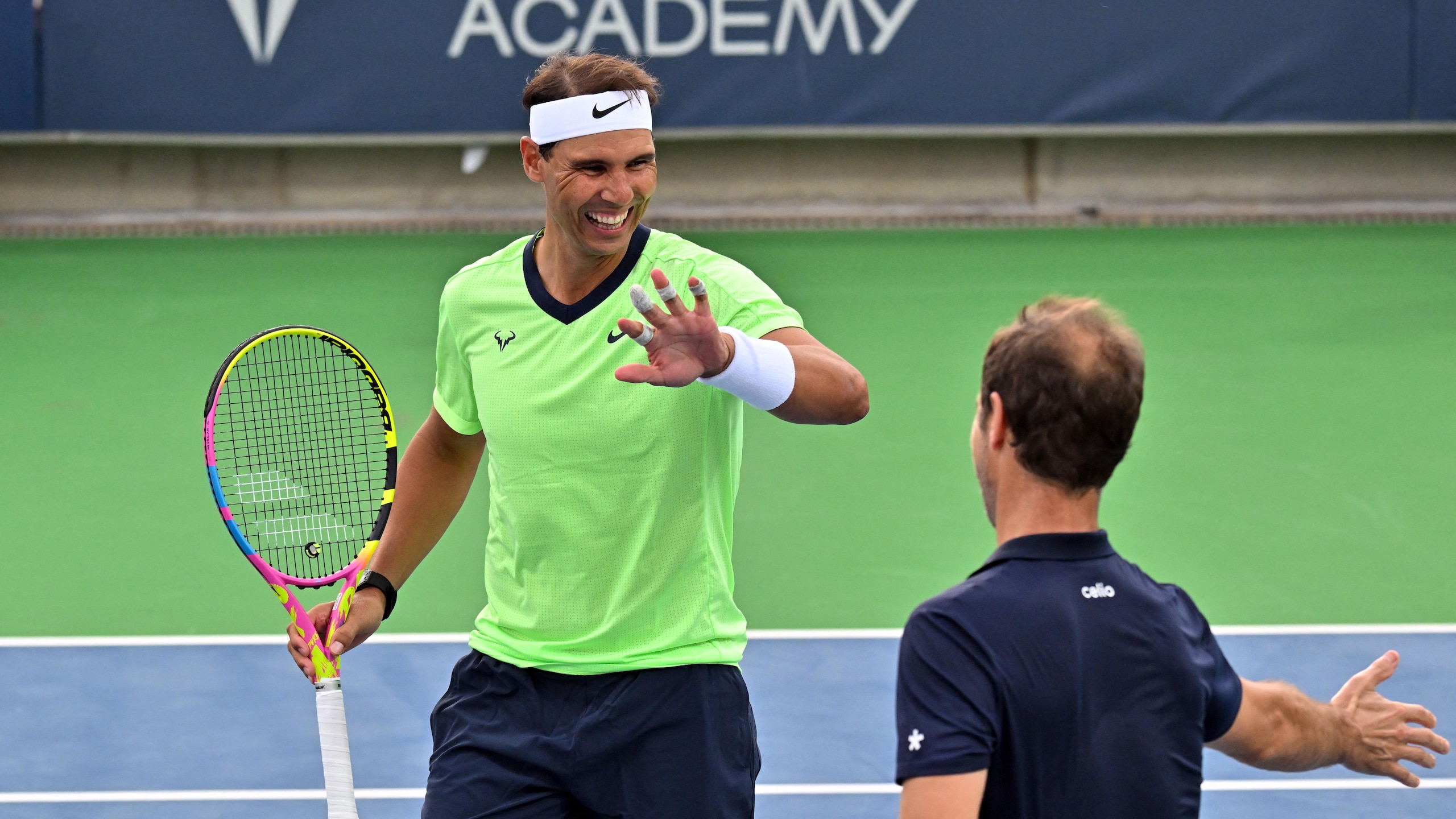


Well, of course what he can pick depends on what he gets from the other side of the court, his anticipation and ability. Sometimes he is not allowed to guess at all, as in the case of winners.
If his guess is wrong, he will end up imparting a different trajectory to the ball. If he is lucky this will still keep the ball in play. If not, he would forfeit the point.
Now it's time for the other player to start picking and guessing. The ball is literally in his court.
The picks, the guesses and the execution...that is where each player differs from the other. The way each player plays, then in essence is, an interpretation of the basic concept discussed above.
Roger Federer once mentioned that in his earlier years in tennis, he sometimes went for the "more beautiful shot" rather than the more effective one that would win the point.
In Federer's mind then, there are cases where the rules of the game are in disagreement with a sense of aesthetics.
Indeed, it is not surprising that this could be true since sensing aesthetics is a subjective experience, while rules are objective. At the same time, it is indeed awesome that this subjective sensation has an underlying universal coherence.
It is exemplified by how everyone on this planet thinks Federer's game is "beautiful." (I could have picked some great piece of art as well, but we are talking tennis here, are we not?).
It could have taken Federer a lot of work in bringing consensus between the rules of the game and aesthetics, and still preserve the astounding effects of the both a formidable all-court game and a wonderfully endearing aesthetic sensation.
For, the Federer forehand is at once the most devastating weapon in tennis, and one of the most visually endearing experiences ever.
On the one hand, the trajectory of the ball is one that even as a viewer (beholder?) one might not guess and which stings the opponent like a snake, and on the other, the seamless-ness of the movement of the trunk, limbs, and even the head and neck before the strike seem so coherent with each other, so coherent with the approaching ball, and the follow-through virtually looks like a brush-stroke that draws the path of the receding ball in the air.
The extremity of the racquet head seems to be the focal point of the movement, which again has been guessed based on the trajectory of the ball chosen for the shot being executed, around which the rest of the body moves in a pre-determined fashion, making no out-of-sync adjustments on the way, all of them in motion only to support the racquet head.
There are no parts moving "wrongly," with other parts moving in an attempt to cancel the effect of the botch-up of the first. All of them add up, nothing subtracts.
Just like in the case of dance, there are no parts of the body that move in an aimless manner, appearing irritating to one.
Every single movement is like notes from different instruments in a symphony, that nevertheless follow the conductor, which here is the racquet head.
A reason why Federer's game seems so endearing to the masses, other than its inherent beauty, could be that we have enough time to capture it, and digest it.
The movement is not lost in the midst of the ball flying all over the court. It even stands out sometimes as the sight that the flying balls are trying to create.
Federer moves into the shot earlier than other players do. And that he is able to execute it seamlessly means that he has a better anticipation.
His follow through also extends a bit more in time than other players. This is what gives us more time to capture it.
As the ball races past the opponent in dramatic fashion, the eye shuttles between the lingering follow-through of the masterstroke that created it and the baseline where the ball check-mated a befuddled opponent.
With the variety of shots that he has mastered, "Federer" is a cuisine that is endless in variety and impossible to resist and, precisely for this reason, one that most fans would want to taste at any tournament more than any other.
The Roger Federer Interpretation of tennis indeed does bring into mind a lot of other places where beautiful art is experienced.
One word to express it is "coherence," another is "beauty."
While psychologists and philosophers debate whether coherence is the what we experience as beauty or whether beauty is what, to the overtly analytic, brings to mind a notion of coherence, let's sit back and enjoy "a thing of beauty."


.jpg?w=2560 "Latest Peyton-Colts Rumors")