Physics, Metaphysics, or Tennis...or Random?
So complex, yet so simple. No, things don't work this way...
It is a guess. Yes, it always is. There is a conviction that makes one believe it is not a guess work, but a rational, a priori solution, while it is always verified by a posteriori experimental results.
It all is—science, life, sports, economics—all "intelligent" actions. For if it were not a guess, there would not be "wrongs," only "rights."
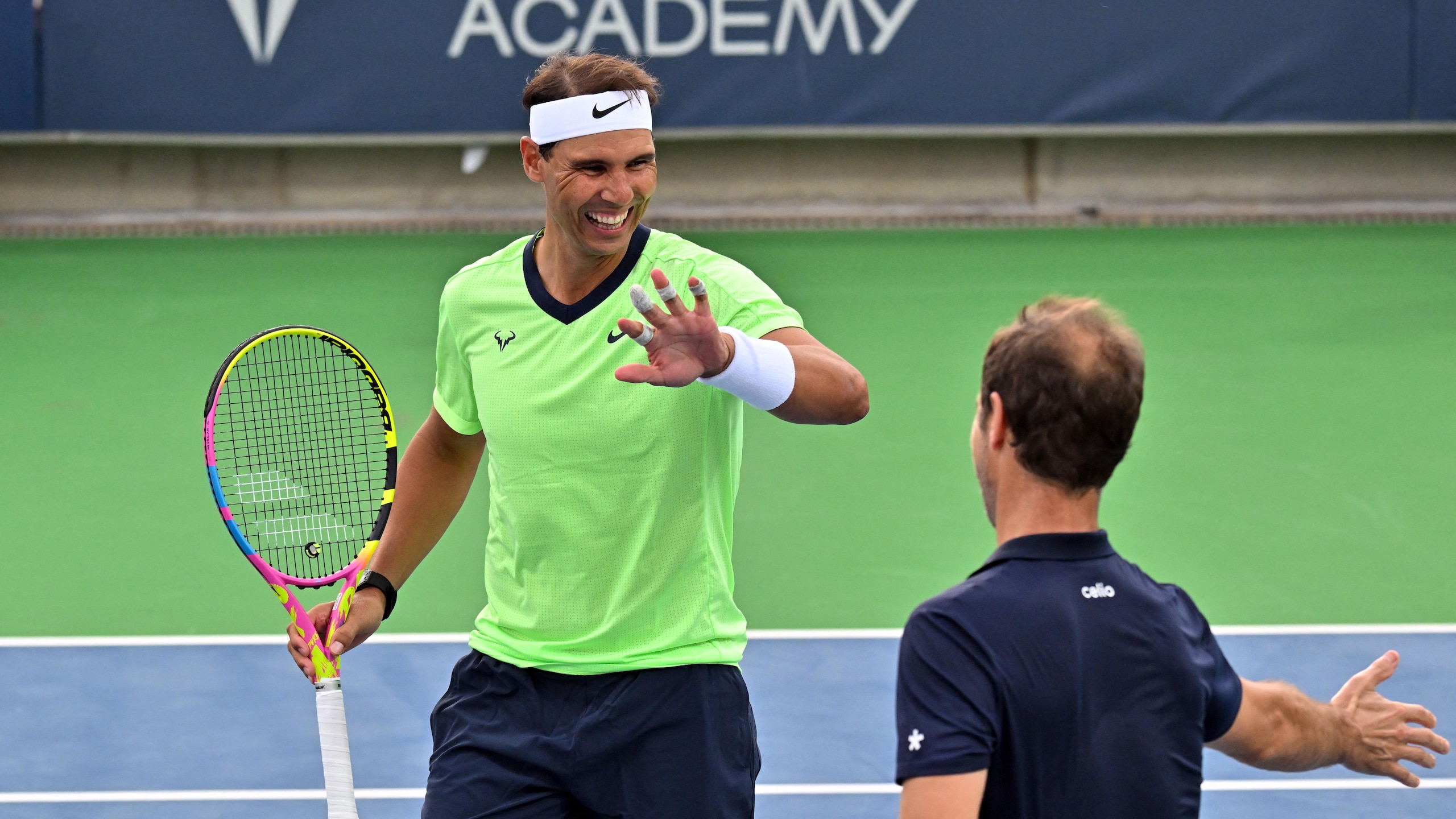


When one takes aim to hit that forehand, the mind estimates, rather than calculates. It sees a question asked of it; a problem to be solved.
Much the same way as it sees a new problem in Physics. It has to guess the right answer to a problem in Mechanics, the difference here being that it has to manipulate nature rather than analyze it.
It guesses at the dynamic configuration of the body, rather a continuum of static configurations required to tackle the problem.
The problem, in an over-simplified fashion, is to manipulate the body to send the racquet face at the ball in a controlled projectile motion, to accomplish a collision that would present nature with two momenta, which it would re-distribute in such a manner that, speaking at a higher level of abstraction now, would help one win the point.
Yes, in the microcosm of sub-conscious thought, winning is the only thing.
It is a guess work because the mind has no knowledge of the mathematical laws of nature. It has only the knowledge from experience—a knowledge that is again a perceived one, rather than a measured one.
The inputs are twofold. One, the physical; the other, the psychological. Two independent inputs, probably—if isomorphic physical quantities could be found, their dimensions would be different.
But then there would exist a mathematical function, implicit in the definition of the problem being solved, that would map these two into a single physical output left to the evaluation of nature.
In its entirety, it is finally an attempt to optimize an equation in which two functions enter, the mind and the body, both perhaps dependent on each other, to achieve a mathematical result, also a function.
The resulting function, and the co-efficient of dependency between the mind and the body varies from sport to sport. And with it, vary the weightage to be given to the physical and mental aspects.
There are sports that need more of the mental aspects, like chess, and then there are those that are finely balanced like tennis.
--------------------------
Mixing levels of abstractions is not a good manner of thought. And this is precisely what brings many attempts at thinking to a halt. Like this one, perhaps.
.jpg?w=2560 "Seahawks Chiefs Football")



.jpg?w=2560 "Latest Peyton-Colts Rumors")