2019 MLB Free Agency: Ranking the Top 10 Relievers on the Market
Though bullpens have been surprisingly sidelined during the 2019 postseason, relief pitchers are still going to be a hot commodity when the winter free-agent market opens up.
Despite combining for a record rate of 9.3 strikeouts per nine innings, relievers otherwise slumped to the tune of a 4.46 ERA in the regular season. That was their highest mark since 2000, and the struggle affected seemingly every team in the league.
It's against this backdrop that we've come to offer our rankings for the top 10 relievers who will be available this winter. These include neither players with options nor opt-outs. For the pitchers who did make the cut, we weighed present ability but more so potential upside in ranking them.
We'll proceed in order from worst to best.
10. Tyler Clippard, RHP
1 of 10
Tyler Clippard peaked as a two-time All-Star with the Washington Nationals between 2008 and 2014. In the years since then, he's basically been taking whatever work he can get.
There was nothing special about the work he did for four teams across 2017 and 2018. His tour with the Cleveland Indians in 2019, however, is one for the "Better Than You Think" file.
Though the 34-year-old struck out a modest 9.3 batters per nine innings, he racked up a 2.90 ERA with only 38 hits and 15 walks allowed in 62 innings. Batters simply had a hard time squaring him up. In terms of percentiles, both his exit velocity (98th) and hard-hit rate (95th) were in the upper 90s.
Perhaps spurred by his dwindling velocity, Clippard altered his fastball mix to feature fewer four-seamers and more two-seamers. Together with his changeup and splitter—which have similar movements but different speeds—he had a wider variety of looks to show hitters.
Thanks to these things, Clippard is at least fit for setup work.
9. Sergio Romo, RHP
2 of 10
Sergio Romo was one of the best closers in baseball in his heyday with the San Francisco Giants, but he's been more serviceable than exceptional in recent years.
To wit, the 36-year-old is coming off a 2019 season in which he posted a good-not-great 3.43 ERA and below-average 9.0 K/9 for the Miami Marlins and Minnesota Twins. He still works primarily off his notorious slider, but its trademark horizontal movement has become inconsistent.
But at the least, Romo still isn't one to hurt himself with free passes. He's walked 2.1 batters per nine innings for his career, and his 2.1 BB/9 in 2019 was well below the reliever average of 3.8.
Beyond that, just because hitters have a relatively easy time making contact against Romo doesn't mean they make good contact. His 84.6 mph average exit velocity ranked seventh out of all pitchers who had at least 150 balls put in play in 2019.
Lastly, the right-hander's once noticeable platoon split against left-handed batters has disappeared in 2018 and 2019. The extra trust he's been putting in his changeup is certainly a related story.
8. Craig Stammen, RHP
3 of 10
You probably haven't noticed how good Craig Stammen has been over the last three seasons.
After missing nearly all of 2015 because of forearm surgery and not pitching at all in 2016, Stammen bounced back with a 3.06 ERA across 209 appearances for the San Diego Padres between 2017 and 2019. As always, he's been a reliable source of ground balls.
Yet it must not be overlooked that the 35-year-old has also posted the best strikeout-to-walk ratios over his career over the last two seasons. Good command is nothing new for him, but the 92.8 mph he averaged on his fastball in 2019 was very much a new trick.
Stammen also doesn't traditionally come with a major platoon split. That's a credit to a repertoire that also includes a curveball and occasional changeups in addition to his heavily used sinker/slider combination.
Stammen isn't likely to get many looks as a closer on the open market. However, teams should feel comfortable viewing him as a candidate for setup work.


7. Collin McHugh, RHP
4 of 10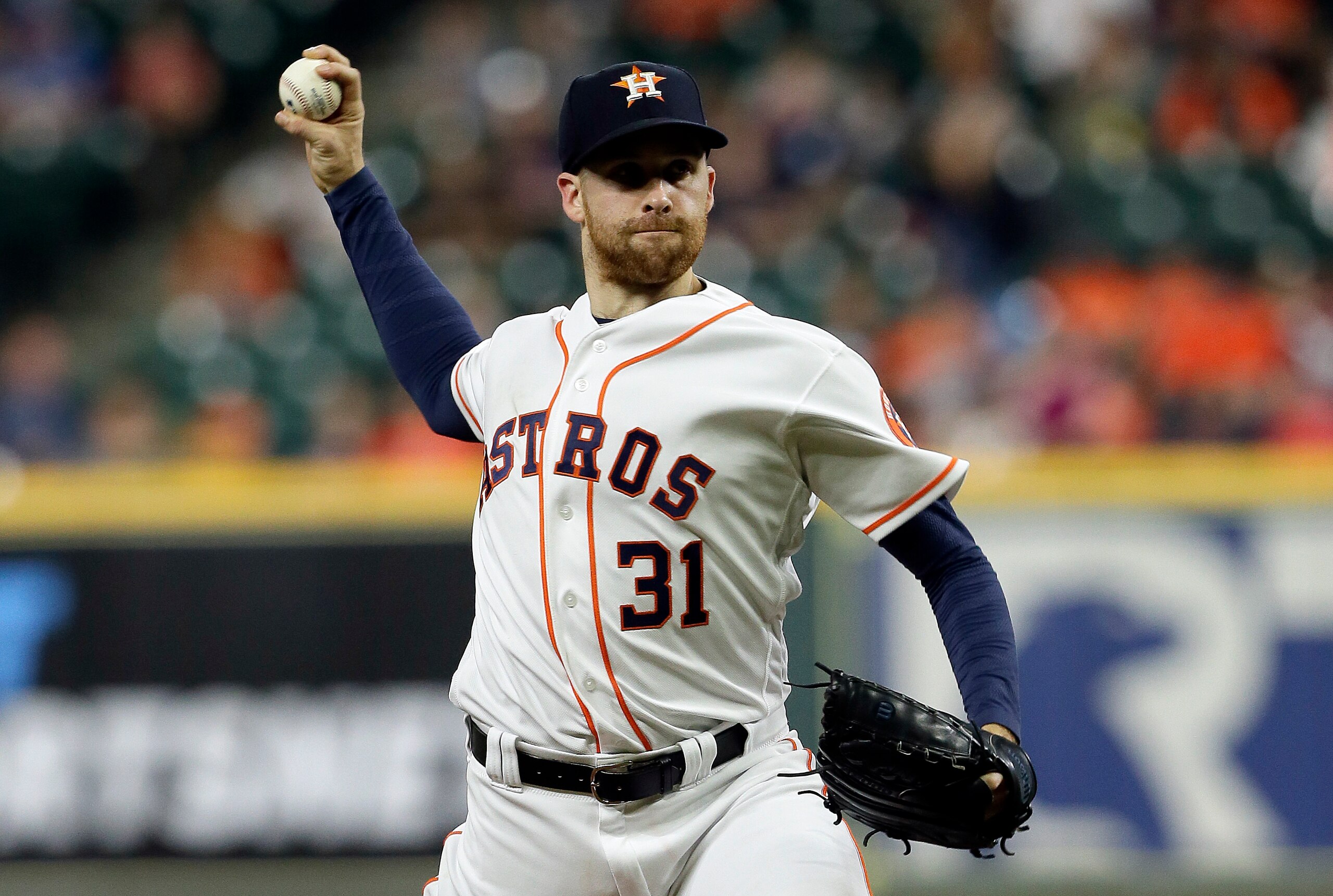
The major disclaimer here is that teams will have to take a good, long look at Collin McHugh's elbow in determining whether to sign him.
The 32-year-old first landed on the injured list with discomfort in his elbow back in May. He was back on the IL with the same discomfort in August, and he's been absent from the Houston Astros' World Series quest ever since then.
If McHugh does get a clean bill of health, however, he'll have plenty of upside to offer relief-needy teams.
When pitching out of the bullpen over the last two seasons, McHugh has posted a 2.21 ERA with an 11.4 K/9 and 3.1 BB/9 over 106 innings that have spanned only 85 appearances. He's averaged a pedestrian 92.0 mph on his fastball, but his diverse repertoire (he throws a four-seamer, sinker, cutter, slider, curveball and changeup) and elite knack for spin rate more than make up for that.
6. Dellin Betances, RHP
5 of 10
Speaking of outstanding relievers who were derailed by injuries in 2019, McHugh doesn't have anything on Dellin Betances.
The 6'8" right-hander couldn't even make his season debut until September 15 because of shoulder and lat injuries. Once he finally did, he suffered a season-ending injury when he partially tore his left Achilles tendon while celebrating a strikeout.
Because the recovery time for this kind of injury is measured in months and not weeks, Betances will likely have to choose between incentive-laden offers in free agency. And such offers should indeed be there, as teams surely know that few relievers are better than Betances when he's right.
All the 31-year-old did between 2014 and 2018 was post a 2.22 ERA and strike out 14.6 batters per nine innings. Though his control got away from him at times, he excelled at avoiding contact and at inducing soft contact even when hitters did get a bat on the ball.
Assuming Betances can indeed make a strong recovery, the tools that made all this possible—namely his high-90s fastball and sharp curveball—should be back in 2020.
5. Chris Martin, RHP
6 of 10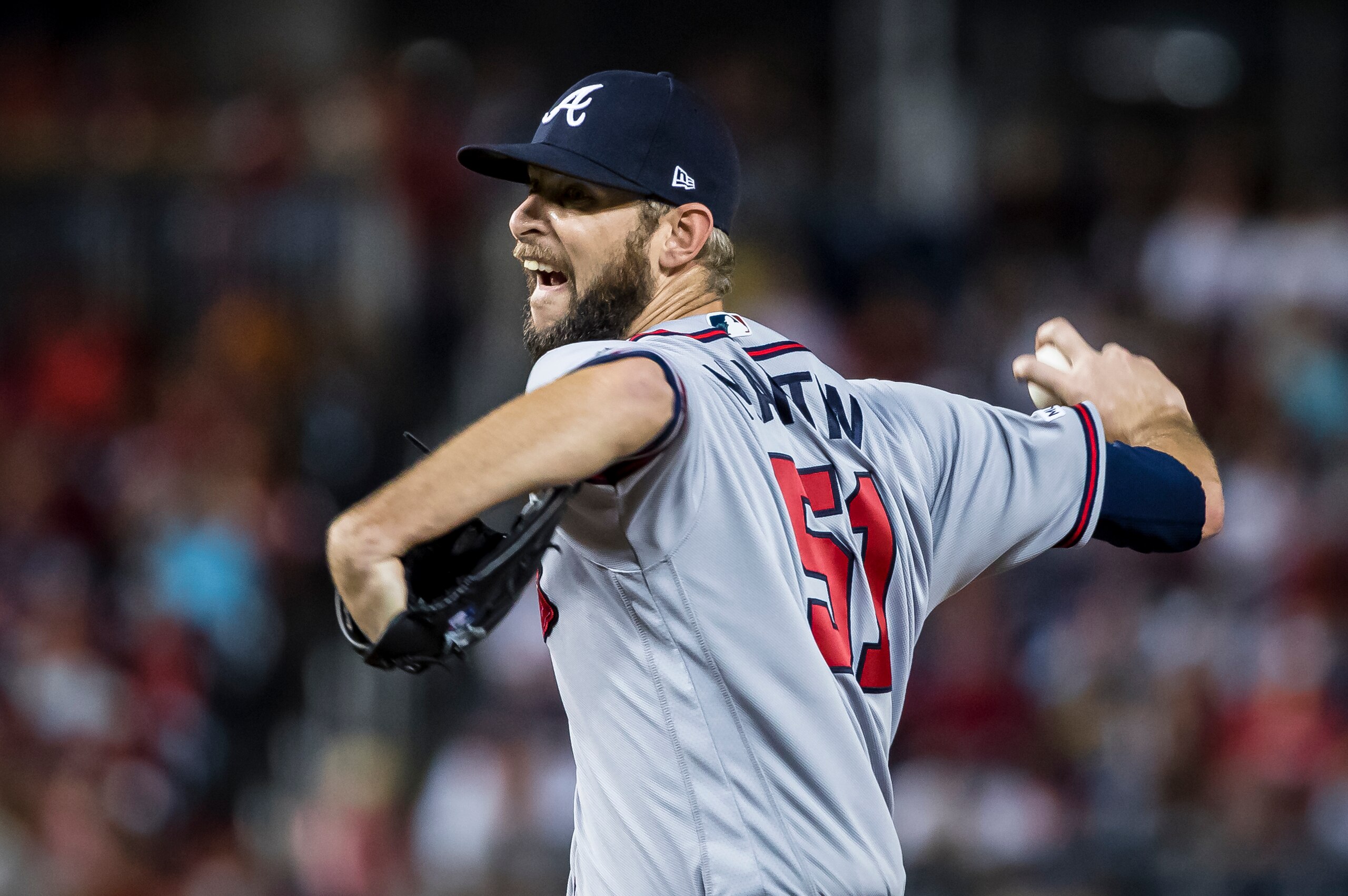
Chris "Not the Coldplay Guy" Martin vanished to go play in Japan in 2016 and 2017, and there was nothing spectacular about his return to MLB with the Texas Rangers in 2018.
But the closer you look, the more special his 2019 begins to appear.
The 33-year-old posted a 3.40 ERA over 58 total appearances, including a 4.08 ERA for the Atlanta Braves after they acquired him on July 31. Though he was prone to loud contact, his 13.0 strikeout-to-walk ratio ranks as one of the best ever by a relief pitcher.
That figure stems partially from Martin's capacity from pounding the strike zone, but the strength of his arsenal isn't to be underestimated. He worked at 95.7 mph with his four-seamer and sinker in 2019, and he also worked in a cutter, slider and splitter.
The last of those pitches hasn't been fully unlocked yet. Though it accounted for only 12.1 percent of Martin's offerings in 2019, the look of it and the .067 average against it suggest it deserves more play.
Any team thinking the same thing might also have it in mind to sign Martin as a closer.
4. Daniel Hudson, RHP
7 of 10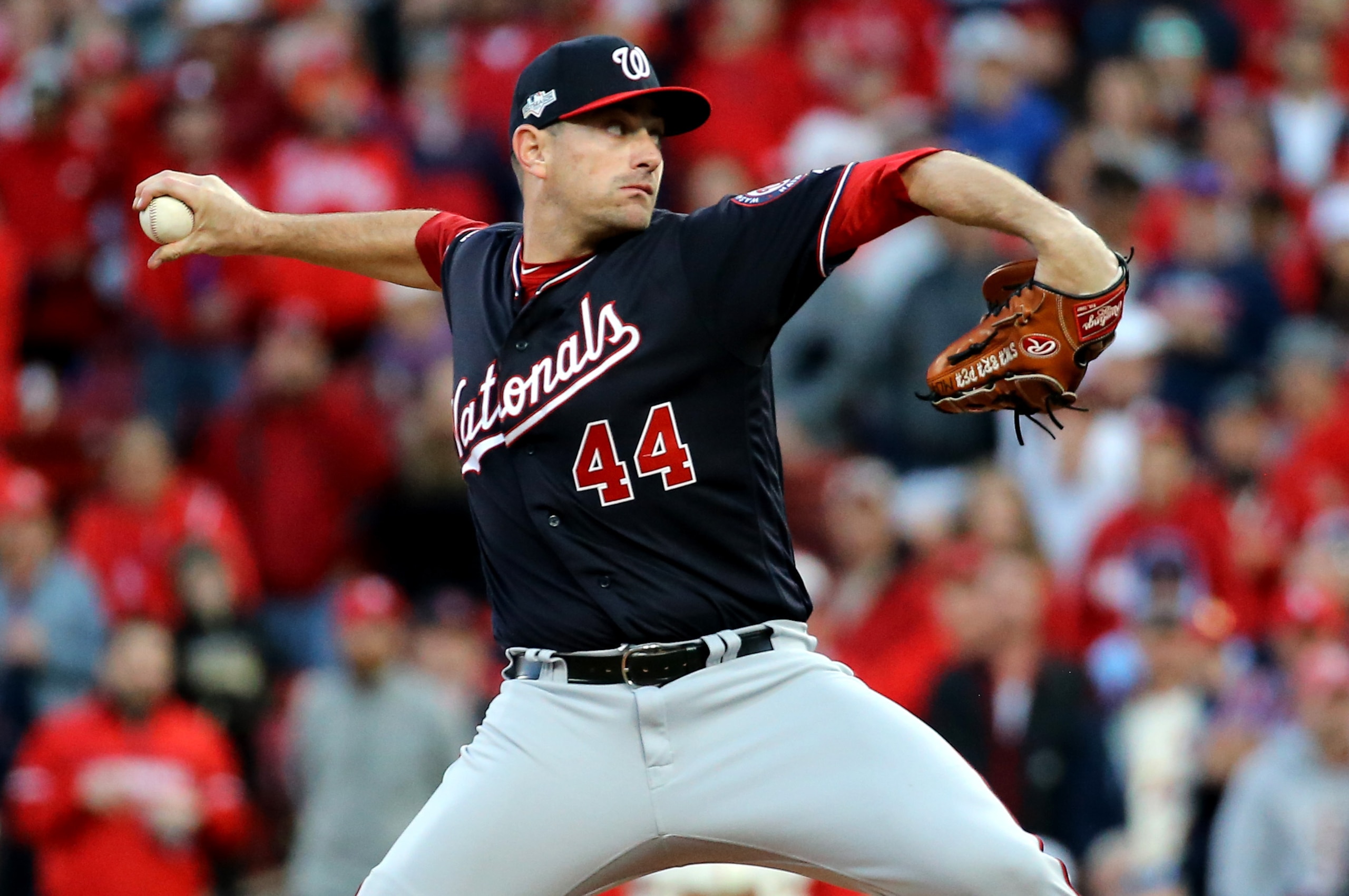
Daniel Hudson is a pitcher who's had two Tommy John surgeries and whose once promising career as a starter has devolved into a career as a generally good-not-great reliever.
Until now, that is.
The 32-year-old began his 2019 season with a 3.00 ERA over 45 appearances for the Toronto Blue Jays. Following a deadline-day trade to the Washington Nationals, he took off with a 1.44 ERA and an extraordinary 5.8 strikeout-to-walk ratio in 24 appearances.
More recently, Hudson has been upping his game in the postseason. He's made five appearances out of Washington's bullpen and allowed only four hits and two walks with five strikeouts.
Hudson is thriving mainly on the strength of a fastball that averages 96.4 mph and has climbed as high as 98.6 mph, with outstanding spin (91st percentile) to boot. He also features a slider that has better than average dropping action. Such things help make up for a struggle with loud contact that's not unlike Martin's.
Altogether, Hudson will enter the open market as a legitimate candidate to close games in 2020 and beyond.
3. Drew Pomeranz, LHP
8 of 10
Drew Pomeranz might prefer to market himself as a starting pitcher this winter, but he may not have many takers after the way he ended 2019.
After beginning his season with the Giants, Pomeranz went to the Milwaukee Brewers on deadline day and took off with a 2.39 ERA over 25 appearances—only one of which wasn't in relief. Best of all, he struck out 45 of the 100 batters he faced.
Lest anyone think it, Pomeranz didn't feast strictly on left-handed batters. On the contrary, lefty hitters actually had a higher slugging percentage (.394) against him than their right-handed counterparts (.293).
Unsurprisingly, the 30-year-old featured significantly better fastball velocity as a reliever (94.5 mph) than he did as a starter (91.9 mph). Said fastball also has palpable rising action, which works well in tandem with the elite drop he gets on his curveball.
This is to say there are good reasons that Pomeranz seemed to find his true calling with the Brewers. Teams should believe in his potential to keep it up over a larger sample size.
2. Will Harris, RHP
9 of 10
Will Harris joined the Astros in 2015 and promptly mastered the art of flying under the radar.
Over the last five seasons, the 35-year-old has done his thing to the tune of a 2.36 ERA and a 4.4 strikeout-to-walk ratio across 309 appearances. It's just been hard to notice because he's only occasionally closed games and because he's not the type of reliever who blows hitters away.
Harris is more about manipulating the baseball. Out of all hurlers who threw at least 750 pitches, he ranked 11th in average spin rate. Practically speaking, that allowed for better-than-average vertical and horizontal movement on both his cutter and his curveball.
Harris wasn't the best at stifling exit velocity (69th percentile), but he counteracted that by keeping the bulk of his batted balls on the ground. And while he typically has a reverse platoon split, neither righty nor lefty batters can claim much success off him.
Harris isn't necessarily closer material, but whatever team signs him should feel comfortable using him in a variety of late-inning roles.
1. Will Smith, LHP
10 of 10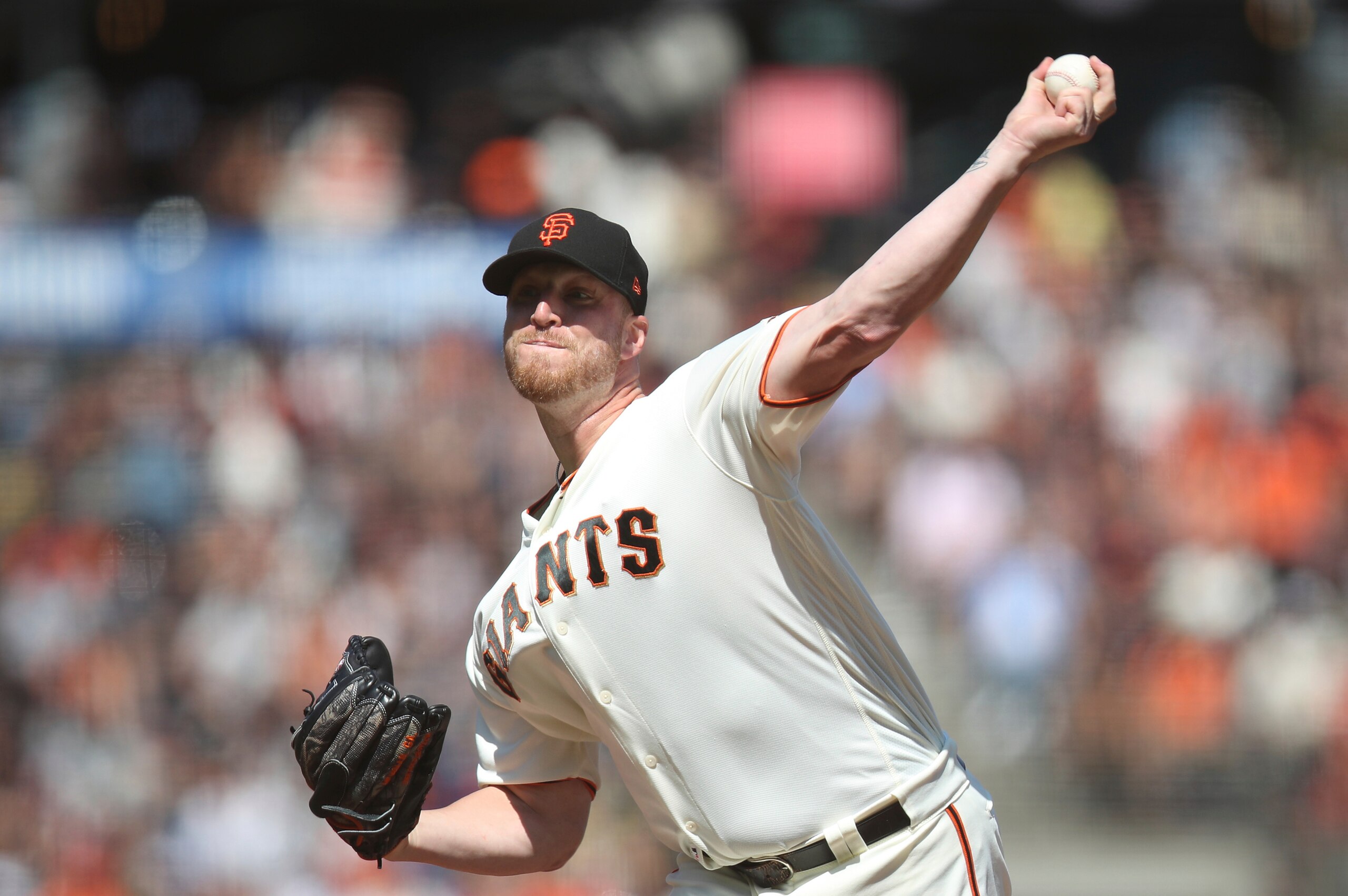
Frankly, it's hard to think of reasons not to list Will Smith as the best relief pitcher in the 2019-20 class of free agents.
This is not to say the 30-year-old is beyond reproach. He had issues with exit velocity (24th percentile) and hard contact (25th percentile) in 2019, as well as a significant platoon split. He's also only two years removed from Tommy John surgery.
Yet you can see Smith's quality in the 2.66 ERA and 4.6 strikeout-to-walk ratio he compiled with the Giants during the 2018 and 2019 seasons. It's also in simply how well opposing batters have hit him. He ranks sixth in expected production and seventh in actual production among relievers since 2018.
Smith averages a solid 92.7 mph on his fastball, yet it's really his slider and curveball that make his repertoire. Both have similar horizontal movement (see here and here), but their speed discrepancies can spell trouble for hitters.
If a team needs a closer, its first call should be to Smith.
Stats courtesy of Baseball Reference, FanGraphs, Baseball Savant and Brooks Baseball.


.jpg?w=2560 "Terrell Owens Being Sued for Defamation")
.jpg?w=2560 "CJGJ Shares Cryptic Post 🤔")