The Luckiest Play in the History of Louisville Basketball
Four decades ago, Louisville men's basketball was a plucky up-and-comer.
The annual late-December rivalry game with Kentucky didn't begin until 1983. There were no national championship banners hanging from the rafters of the KFC Yum! Center Freedom Hall. Denny Crum was merely a good coach who couldn't win the big one.
The Cardinals were to the 1970s what Gonzaga was to the 2000s: A program that rose to power by dominating what was typically a one-bid league, even though it was never enough to climb to No. 1 in the polls or achieve the ultimate goal of winning the national championship. Louisville did make it to two Final Fours before falling at the hands of John Wooden and the UCLA Bruins, but it had an overall record of 9-11 in the NCAA tournament from 1967 to '79.
.jpg?w=2560)
.png?w=2560)

That all changed when the Cardinals finally broke through and won the 1980 national championship.
Louisville slaughtered No. 1 seed LSU by a 20-point margin to reach the Final Four, and in classic sports-movie fashion, it had to go through an old nemesis to win it all. UCLA—where Crum worked as an assistant for eight years before getting the Louisville job—had knocked the Cardinals out of the tournament in 1972, 1975 and 1977, but Louisville beat the Bruins 59-54 in the championship game this time around.
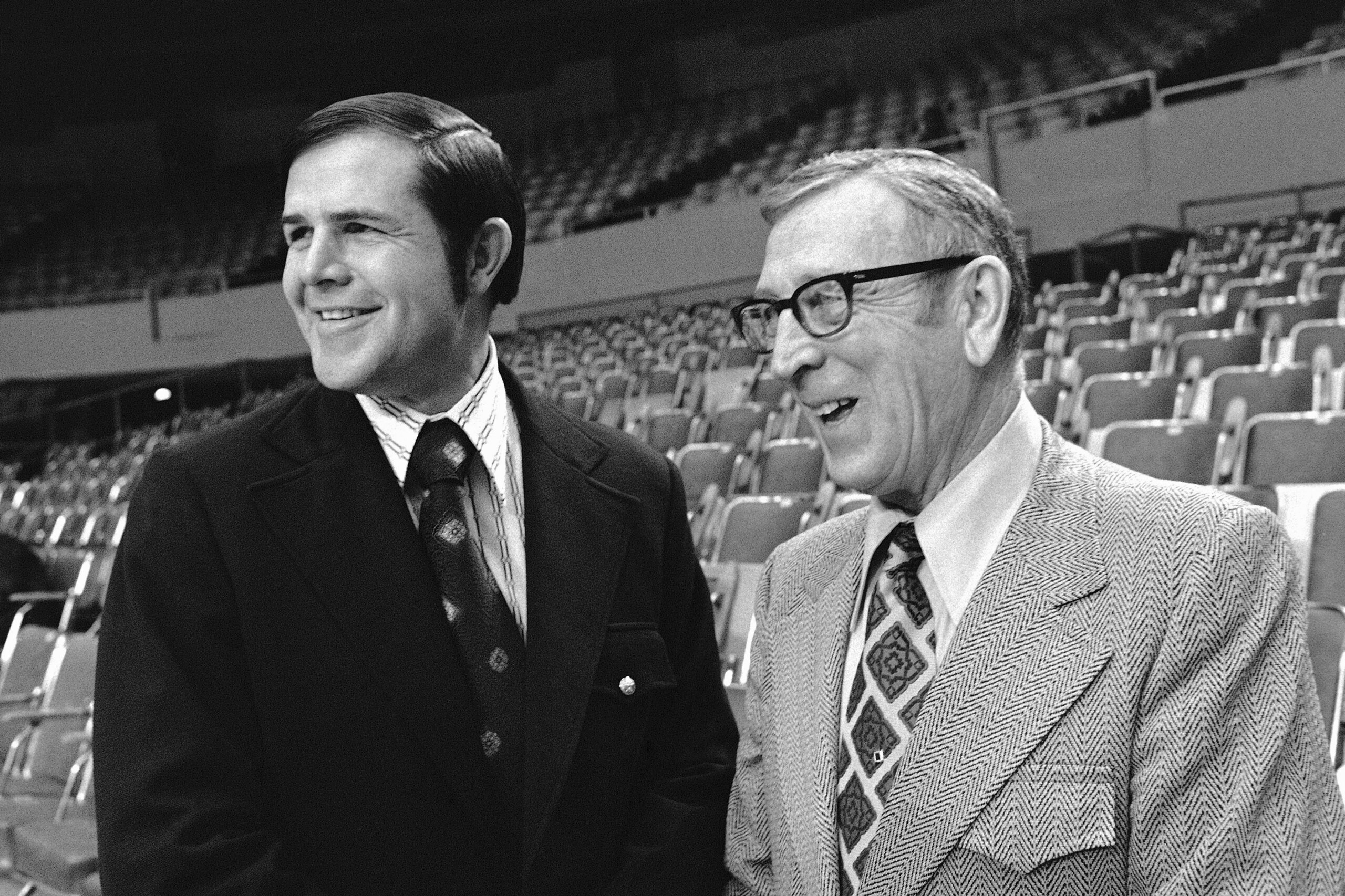
It was an amazing tournament run that damn near ended before it even started in Louisville's opener against Kansas State.
The Cardinals had beaten the Wildcats by a dozen points during the regular season, but Jack Hartman's team hit its stride at the exact right time. Less than two weeks after consecutive losses to Iowa State, Kansas and Nebraska, the Wildcats won three in a row against those same teams to secure the Big 8's automatic bid in the NCAA tournament. Once there, Rolando Blackman and Co. smoked Arkansas by 18 points in the first round.
By the time the Wildcats ran into No. 2 seed Louisville, they were ready to take on anyone. And they gave the Cardinals all they could handle, pushing the game into overtime, where 1980 Wooden Award winner Darrell "Dr. Dunkenstein" Griffith fouled out for Louisville with the game still tied.
Griffith was the heart and soul of that team, averaging 22.9 points, 4.8 rebounds and 3.8 assists per game. Though there were six players on that roster who eventually played in the NBA, just about everything ran through the senior guard.
With his services no longer available, Crum turned to scarcely used backup Tony Branch.
Branch had been a starter the previous season, but according to Sports Reference, he played just 91 minutes during the regular season and had made just nine field goals to that point.
To put those numbers in proper perspective, when Michigan's Spike Albrecht "came out of nowhere" to score 17 points against Louisville in the 2013 national championship, he had at least played 289 minutes and made 22 buckets prior to that game.
It would be an understatement to say that Branch was an unlikely candidate to save Louisville's season.
And yet, that's where the Cardinals turned with the game on the line, setting the stage for the luckiest moment in program history.

College basketball didn't institute a shot clock until 1985, so Louisville had (and used) the option to just play keep-away for the final two minutes of overtime. One errant pass or misplaced dribble could have sent the Cardinals packing prior to the Elite Eight for the fourth consecutive March.
But at long last, Branch had the ball with a few seconds remaining and made his move. He got to the free-throw line before somehow stepping through a double team and floating up his only field-goal attempt of the game.
If Branch missed, the Cardinals would need to play a second overtime session, that one entirely without their star player. They certainly still could have won the game with Griffith's 18 points, eight assists and six rebounds on the bench, but it would've been tough.
So in that moment, it all came down to the accuracy of a reserve who shot 36 percent during the regular season.
Branch's shot hit the front of the rim, the back of the rim, the backboard and the front of the rim again before falling through with no time left on the clock.
We can't find a clip of it since it happened almost 40 years ago in an early-tournament game, but it went a little something like Josh Framm making the game-winning bucket in the original Air Bud.
(You have no idea how long I've been waiting to work an Air Bud reference into an article.)
The rest, as they say, is history.
Louisville survived another overtime scare from Texas A&M in the following round, but it went on to win the title, made the Final Four in two of the next three years and won a second national championship in 1986.
Just like that, Louisville was one of the best programs in college basketball.
And it all started with a lucky bounce on a last-second shot from a backup guard.
Kerry Miller covers men's college basketball for Bleacher Report. You can follow him on Twitter, @kerrancejames.
.jpg?w=2560 "Aaron Donald Fights Bills OL😳")