

Life Inside and Outside of Camp Nou at a Politically Charged El Clasico
Some said this game didn't count for anything. Boy, they were wrong. Real Madrid came to Barcelona on Sunday to play at Barca's stadium, the Camp Nou. With only a handful of games left to play, Barcelona had already wrapped up the league, but there were things greater than titles at stake.
Barca's fans, which had flocked from around Catalonia to watch the game, were in no mood to see Real Madrid—who are on the cusp of winning a historic three-in-a-row UEFA Champions League crowns—come to their house and win. On the field, Barca's team was defending an unbeaten run in the league, a feat that hasn't been achieved in La Liga in 86 years
TOP NEWS
Live Highlights and Viral Moments 🍿

Final Men's Ballon d'Or Rankings 📊
Most to Blame at Man Utd? 😡
Off it, the political undercurrent that has defined this fixture for over a century is at boiling point. The push for Catalan independence in the region is at a delicate moment.
Last October, after the police used force during the day of a controversial referendum for Catalan independence, almost 800 voters were injured in polling stations around Catalonia, according to reports by BBC. Several Catalan political leaders are in prison, facing charges for sedition. Carles Puigdemont, president of Catalonia's parliament, is in exile.
Half an hour before kick-off, Adria Rion, a 23-year-old who travelled to the match from La Canonja, a small Catalan town about an hour's drive from Barcelona to watch the match with three friends, was adamant, too, that the game was politically charged. "It has a lot to do with Catalan independence," Rion said. "We hate Madrid. We hate Spain. F--k Spain." Rion was wearing a yellow Barcelona away strip. Barca's yellow strip is provocative for many Real Madrid fans and Spanish nationalists because it mirrors the "Senyera," the yellow-and-red-stripped colours of the Catalan flag.
"El Clasico is 50 percent football and 50 percent politics," said Ernest Pujadas, a 24-year-old Barcelona fan from Malgrat de Mar, a coastal town north of Barcelona. "As one famous writer, Manuel Vazquez Montalban, said: 'Barcelona is the unarmed army of Catalonia.' Because we don't have an arm,y if we go there to Madrid and we win, we can say, 'We are better than you.' This game here today is different than if nothing happened on October 1 [the day of the referendum]. This will be a really political El Clasico."
Pujadas' matchday started at 10 a.m. when his mates picked him up by car to bring him to the stadium to sort flags (doing running repairs if necessary), drums, sound equipment and the other paraphernalia that will be used by fans from Almogavers and other "penyes" (supporters' clubs) behind the goal in the north end of the ground. A glass of Vermut, a Catalan staple, follows around midday, to kick-start the day.

Pujadas is a blueblood. FC Barcelona has contested eight European Cup finals. His family has been at every one: His grandfather was at Berne (1961) and Seville (1986); his father at London (1992) and Athens (1994); and himself at Paris (2006), Rome (2009), London (2011) and Berlin (2015).
He went to his first Clasico at the Camp Nou back in the late 1990s. Former Barca star, Luis Figo's return to the Camp Nou as a Real Madrid player in 2000 and 2002 left memories he will never forget. He was six years old when he went to see Figo's first Real Madrid game in Barcelona in October 2000. He sat on his father's lap for the game. His grandfather sat beside them.
"My mother told my father: 'Please don't go with little Ernest, please don't go' but my father took me here. I was almost crying because I hated Figo—I hate Figo now and I will hate Figo in the future—but the atmosphere was like, 'OK, OK, what's happening here? What? What? What?' I was really shocked at the anger. I was just a kid. I remember the press had printed these fake "peseta" banknotes with face of Figo on them. During the match, they threw them at him."
It wasn't all they threw at Figo. Other items, according to the referee's notebook, included coins, mobile phones, half-bricks and a bicycle chain. Two years later in the same fixture, one fan threw a pig's head at Figo while he tried to take a corner. As Real Madrid's team coach entered the stadium for the match in 2002, fans stoned it, breaking its windows. This year, though, their team coach just had to endure some whistling.
Elsewhere on the streets that surround the stadium, Barca's hardcore fans were on manoeuvres. They shouted and pelted beer at Real Madrid fans they encountered. They also took several "scalps," as witnessed by B/R, the name given to hit-and-run attacks where the scarf or jersey of a rival fan is taken and burned.
"Yes—I was afraid," said one Real Madrid fan, whose scarf was stolen by Barca fans and torched with a cigarette lighter. Beer was poured over his head.
The Real Madrid fan—who asked to remain nameless—had travelled from Saudi Arabia for the match. It was his first Clasico. As he gathered himself on a street corner about 20 metres from the incident, he dried the sticky beer off his face and hair before crossing the street to reconnect with his friends.
Other Barca fans huddled around him and apologised for the ambush. One Barca fan offered to buy him a new scarf. "This isn't Barcelona," the Barca fan said.
The scalping incidents were isolated occurrences, however, and more bark than bite. There isn't a history of fans spilling bloodshed at Clasico fixtures over the last decade, compared to the violence endured during the heyday of hooliganism in the 1980s. Most Real Madrid fans roamed around the stadium casually and unmolested, as the city bathed in evening sunshine after an overcast morning.
There's a gentrified air about the vast majority of fans who pay ticket prices for the match that start at €140 per pop for Barca's "socios" (members), face value, and can cost four figures online.
Thousands of tourists descend on the stadium for the fixture. "It's pretty common that people come in Real Madrid colours. I've seen others here," said Kim Liechti, a 17-year-old guy from Berne, Switzerland, who is wearing a Real Madrid jersey. It's his second Clasico at the Camp Nou. "I don't think it's a problem. It wasn't trouble either last year. Some people look at you a bit strange, but that's no problem."

There is an energy outside the stadium that is infectious, particularly on Travessera de les Corts, a long street of bars on the bottom-side of the Camp Nou. Fans stand around drinking beer, chatting and singing. Earlier in the day, in plazas further from the stadium, flares are torched and launched into the sky by raucous Barca fans.
"We go to a lot of American football games at home but this is something totally different," said Jay Pateo from Houstan, Texas, who has travelled to Spain for the game with a friend of his from their days in college. "It's very loud here. People are in your face. We're kind of laidback in the United States. We got tailgating. We're eating. It's more mild-mannered. We're just parking our cars, camping out. Taking it easy for the whole day. But they're just more passionate about their sports here."
Inside the stadium, a couple of minutes before kick-off the whole stadium is turned into a flowerbed of Barca colours—blue, red and yellow—with the word "Campions!" written in Catalan emblazoned on one end, a triumphant reference to Barcelona's league-and-cup double in Spain this season, which is also painted in white letters on the halfway line on the opposite side to the teams' dugouts.
Pujadas and Barca's fans behind the goal at the north end of the stadium keep up a stream of songs all through the game. The singing is led by a guy on a microphone and two untrained guys on drums, one beside the guy on the mic in the front row who sees nothing of the whole match and the other drummer further up the terrace, who sees little of the game either because he has to stay glued on the guy on the mic for instructions.
They improvise the songlist, according to the mood in the stadium. When they hit a popular song—like their renditions of "Madrid, 'cabron' (bastard), say 'hi' to the champions," which every Barca fan knows, or the low groaning chant of "Messi! Messi!" close to half-time out of solidarity when their hero gets a yellow card for hacking down Sergio Ramos—the chants roll around the stadium.
Being a drummer is full-on. Pujadas did the job for two years but hung up his drumsticks last year. "It's really hard, playing all the match," he said. "I had blisters and some injuries in my hands. I remember going to university and having to do an exam after one match and saying to the professor, ‘OK just look at my hand. I cannot write.' He was a Barca fan. He understood."
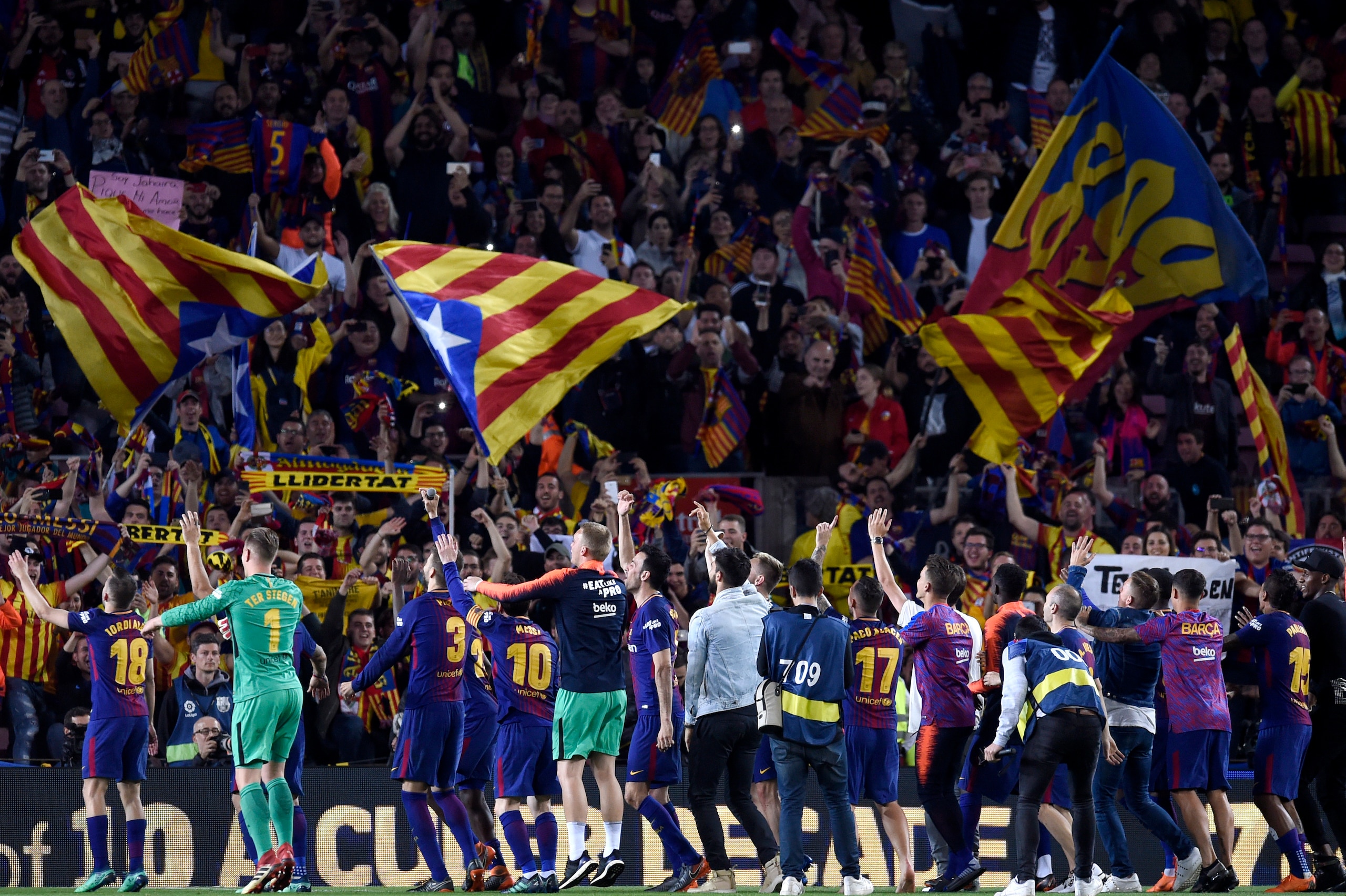
As is tradition at the Camp Nou for the last few years, on the 17-minute, 14-second mark—specifically chosen to tie in with Catalonia's National Day that marks a siege of Barcelona in 1714—fans chant "liberty" in Catalan. Also giant yellow banners with the words "Freedom" and "Llibertat" are unfurled for a couple of minutes over one of the hoardings along one side of the ground.
The match is an incredible affair. Blow after blow rains down on both goals. Barca race into an early lead. Cristiano Ronaldo equalises for Real Madrid in the 14th minute. Sergi Roberto, one of Barcelona's defenders, gets a red card on the stroke of half-time for lashing out against Real Madrid's Marcelo. In a crabby encounter, the ref also doles out eight yellow cards.
Again in the second half, Barcelona take the lead—inevitably through magic from Messi—but Gareth Bale draws the sides level with a clean strike 20 minutes later. The game ends 2-2. Fans struggle to draw breath. The game had everything, and of course, most sweetly for Barcelona fans, it had heroic resilience by a 10-man team. It fits with a political narrative in the region and maintains their "unconquered" league run, which Monday's Catalan sports newspapers pick up on.
At the end of the night, B/R asked an exhausted Pujadas how he felt about the result: "Really good!" he said. "Really, really good!"
All quotes and information obtained firsthand unless otherwise indicated.
Follow Richard on Twitter: @Richard_Fitz

.jpg?w=2560 "Chiefs Giants Football")
.jpg?w=2560 "5 Teams Eyeing Jonathan Taylor")

.jpg?w=2560 "Jonathan Taylor Landing Spots 📍")
.jpg?w=2560 "Baker Gets Glove From Rays 🧤")

.jpg?w=2560 "NFL investigating Eagles")

