

Biggest Questions Still Surrounding Top 2018 NFL Draft Prospects
The completely flawless and perfect prospect doesn't exist in the 2018 NFL draft.
Some come tantalizingly close, and finding their weaknesses means putting the tiniest details under a microscope. That's true for running back Saquon Barkley and defensive end Bradley Chubb, two of the safest picks who are both likely to be off the board in the top five.
For others the concerns are more obvious, with risk and reward needing to be weighed evenly. Quarterback Lamar Jackson oozes with athletic potential, but is he accurate enough? Will fellow passer Sam Darnold cut down on poor decisions at the next level? And will size concerns limit cornerback Denzel Ward?
At least one question follows every top prospect, even with less than a month remaining until the first round on April 26 at AT&T Stadium in Arlington, Texas. Here's a deeper look at the doubts and hurdles the brightest names still have to overcome.
Sam Darnold, Quarterback
1 of 10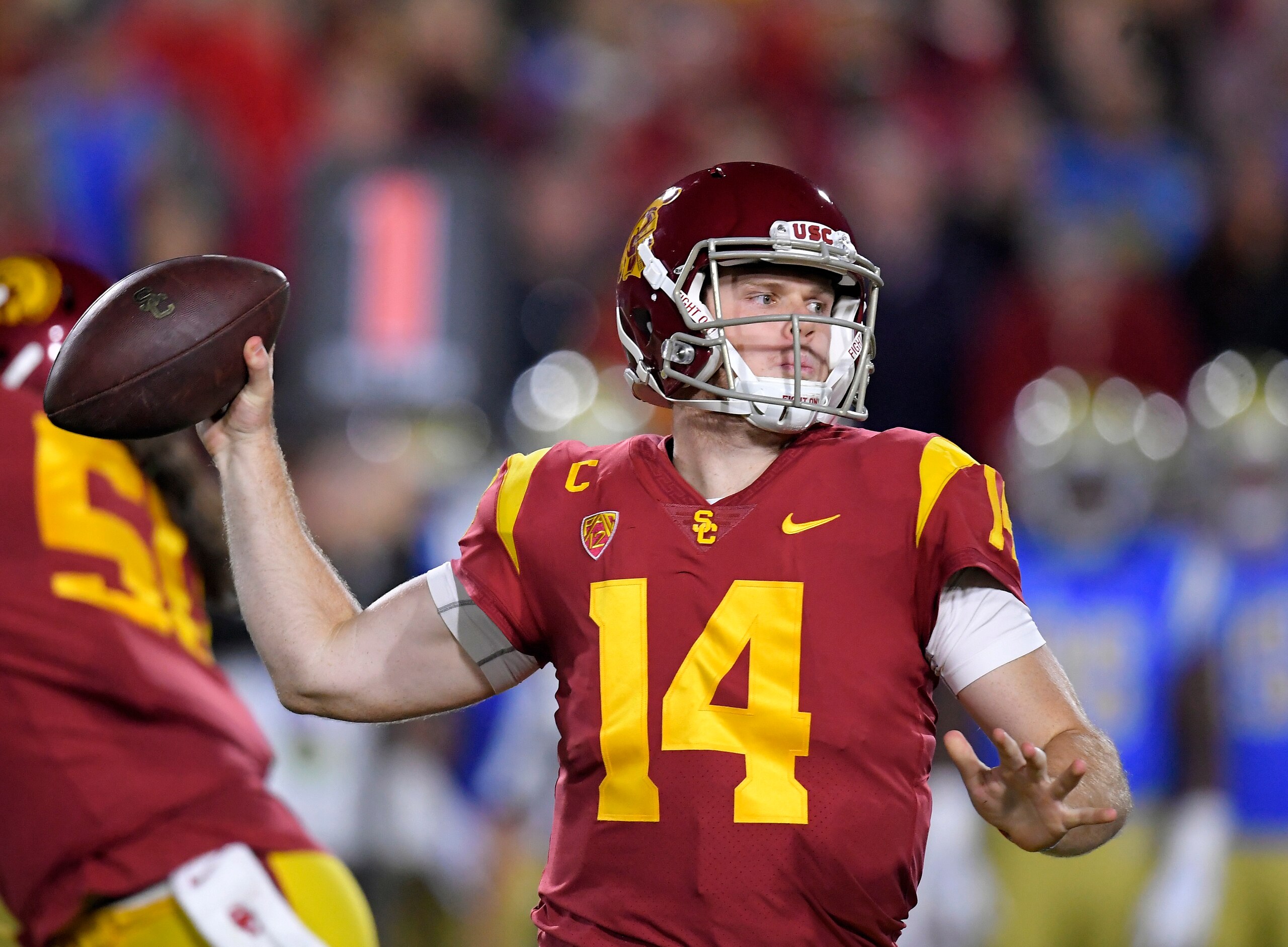
It feels like Sam Darnold is trending toward solidifying himself as the top overall pick. NFL.com's Daniel Jeremiah talked to several teams at USC's pro day and would be surprised if the First Team All-Pac-12 passer isn't the first player selected on April 26.
However, buried somewhere beneath all the praise and Darnold's building buzz are concerns that won't go away quite yet.
The first regards his decision-making, which was sporadic throughout the 2017 season. Sure, Darnold averaged 8.6 yards per attempt and finished with a passer rating of 148.1 during his final collegiate year. But he also threw 13 interceptions and fumbled 12 times, losing nine. He needs to show better ball security at the next level.
Other negative reviews concern his mobility and labored footwork.
"There's mixed feedback on Sam Darnold's throwing session from NFL teams on hand," wrote Tony Pauline of Draft Analyst following USC's pro day. "There were some beautiful passes and there were a number of balls that got away from him. There was concern that Darnold was slow setting up in the pocket and really did not get depth on drops. While he threw some tight spirals, a number of passes came out of his hand funny and the throws wobbled. And this was before the rain came."
Darnold is still the best quarterback prospect in a talent pool filled with upside elsewhere. But even he isn't flawless.
Josh Rosen, Quarterback
2 of 10
Josh Rosen is one of the most polished pocket passers in the draft after shining at UCLA. At 6'4", 226 pounds he has the body and arm to power the ball downfield, which he displayed repeatedly while averaging eight yards per attempt in his collegiate career.
The primary concern still hovering around him, however, is his lack of mobility, and how much he struggles under pressure.
Rosen was sacked 26 times during his final season with the Bruins. That came following an injury-shortened 2016 season after surgery on his throwing shoulder to repair soft-tissue damage.
Rosen will never be the scrambling type. That's evident while watching his film—and a glacially slow 4.92 seconds in the 40-yard dash.
The list of quarterbacks who have had success but could still lose a race to a sloth is long. Rosen doesn't need to win footraces or be a blazing sprinter.
He does, however, need to be comfortable under pressure, because he's about to see plenty of it while standing in an NFL pocket. And that's where some red flags start to poke out.
His completion percentage is already a little suspect after connecting on 60.9 percent in college. To compare, that's four points lower than Darnold's 64.9 percent.
That dip in accuracy is largely a product of how Rosen reacts amid chaos. As NFL.com's Lance Zierlein noted, "Rosen completed just 42.4 percent of his throws at UCLA when forced to move.
If he doesn't improve in that area, Rosen could flounder as an NFL quarterback.
Josh Allen, Quarterback
3 of 10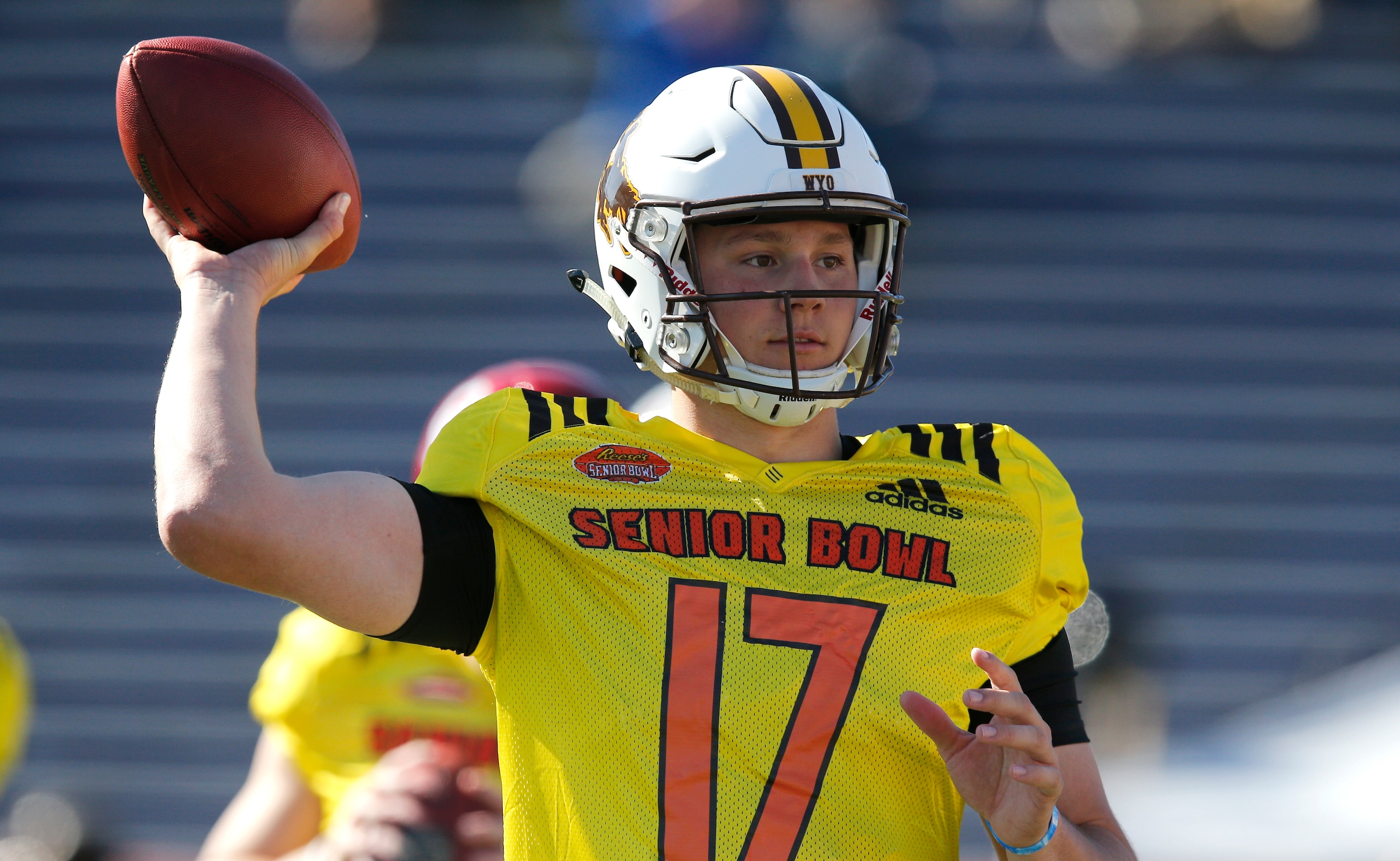
Josh Allen is polarizing because of his lack of accuracy, a fundamental flaw that's difficult to fix at the next level. Just ask Jake Locker.
He's still appealing because he has both the size and towering height (6'5", 233 lbs) to, in theory, excel as an NFL quarterback. And of course a catapult-like arm is attached to that massive quarterback body.
But having a powerful arm means little when you're completing only 56.2 percent of your 365 attempts, as Allen did for Wyoming. It would be easier to stomach if Allen's inaccuracy was limited to a specific area of the field, pointing to perhaps a delivery or mechanics issue that could be smoothed out over time.
But as Pro Football Focus' Josh Liskiewitz noted, Allen sprays balls pretty much everywhere. He completed a mere 13 of his 42 throws in 2017 on balls that traveled 20-plus yards downfield. He also connected just once on 13 deep tosses to the right of the numbers.
Hold on though, because as Liskiewitz wrote, it gets worse.
"When eliminating drops, throwaways, spikes, balls batted at the line of scrimmage and throws knocked off the mark by a hit absorbed during the throw, Allen completed just 65.7 percent of all of his throws, which ranked 86th in the country among draft-eligible quarterbacks."
The physical tools Allen has been blessed with have almost assured him of being a top-10 pick. But the general manager who makes that pick will have a jittery trigger finger due to his accuracy woes.
.jpg?w=2560 "Rams Raiders Football")

.jpg?w=2560 "Steelers Saints Football")
Baker Mayfield, Quarterback
4 of 10
Baker Mayfield is a sprinting, throwing and scoring factory of fun.
He lit up the field for the Oklahoma Sooners for four seasons. The 22-year-old's time ended with the Heisman Trophy in 2017, which came after he completed 70.5 percent of his throws for 4,627 yards, 43 touchdowns, just six interceptions and a passer rating of 198.9. Oh, and he also ran for 1,083 yards and 21 touchdowns in his career.
Mayfield is a well-rounded athlete who will give an offensive coordinator a chance to be creative. But to be successful Mayfield will have to overcome two of the hurdles that follow quarterback prospects every year during the predraft buildup.
We often hear about the curse of the small quarterback, and similarly, the struggles of adjusting after playing in a spread offense. Mayfield has to deal with both of those criticisms.
Mayfield stands 6'1", which puts him on the lower end of the height spectrum for quarterbacks. However, he'll be taller than the Seahawks' Russell Wilson (5'11") and the Saints' Drew Brees (6'0"), two NFL passers well-known for breaking through height barriers.
Any rigid stance on quarterback height around NFL front offices may be overblown old-school thinking anyway. As Cleveland.com's Rich Exner noted in a 2017 study that looked back on the previous 20 seasons, the difference in passer rating between shorter and taller quarterbacks is negligible at best.
But Mayfield's development after playing in a spread offense that created lots of wide-open throwing lanes still causes concern.
Lamar Jackson, Quarterback
5 of 10
Lamar Jackson is the quarterback lottery ticket of the 2018 draft.
The 2016 Heisman Trophy winner has been followed by Michael Vick comparisons, including one made by, um, Michael Vick.
Vick spoke to NFL.com's Move the Sticks podcast in February and reflected on one of Jackson's best performances: a 2016 win over Florida State in 2016 when he ran for 146 yards and four touchdowns, and also passed for 216 yards and a touchdown.
"I could not believe what I had seen," Vick said. "I could not believe the things he was able to do. It was a spitting image of me."
The Vick comparisons can be both a compliment and an insult.
Like Vick, Jackson can sting teams with both his strong arm and quick acceleration to sprint downfield. He ran for 4,132 yards over three seasons with the Louisville Cardinals, and accounted for 119 touchdowns (50 of which came as a runner).
But also like Vick, Jackson often struggles with his accuracy, leading to the belief he may face a steep, or even impossible, adjustment to life in the pocket as an NFL quarterback.
Being comfortable making throws from the pocket is an essential skill in the NFL. That's true even for the most athletically gifted quarterbacks, and Jackson completed just 57 percent of his pass attempts.
He makes NFL-caliber throws, often on attempts that come with a high degree of difficulty. But the consistency simply isn't there, and his touch seems to go away on routine plays.
As PFF's Steve Palazzolo observed, Jackson ranked at the bottom among the top six draft-eligible quarterbacks on "open" throws (attempts that weren't heavily contested).
"It's easy to be wowed by what he can do," wrote Palazzolo. "But also frustrated by the number of throws [when] he lacks good ball location or outright misses his receivers."
Derwin James
6 of 10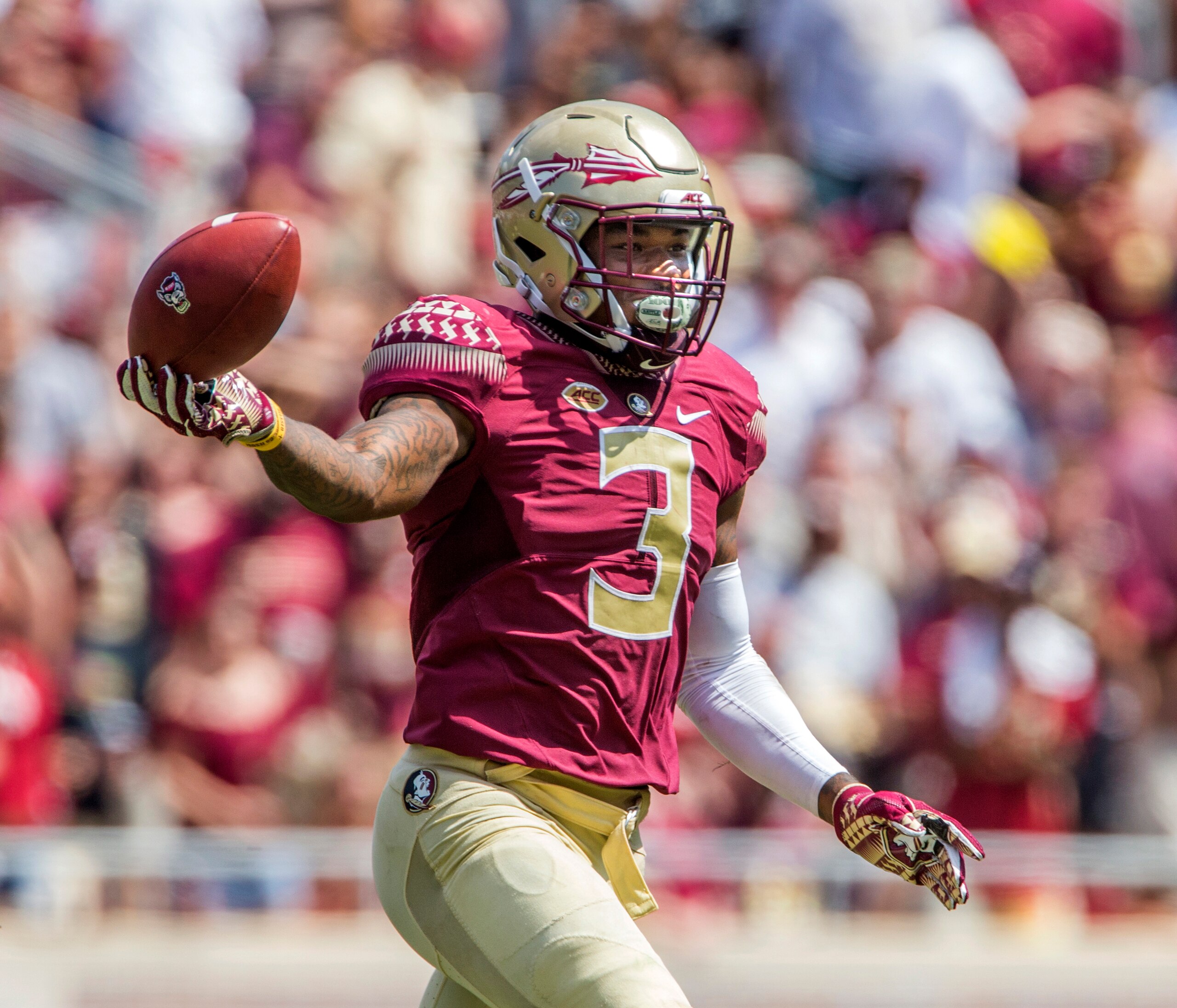
The Seattle Seahawks at No. 18 have been a common mock-draft destination for safety Derwin James. Connecting those dots isn't tough: The Seahawks may soon need a safety with Kam Chancellor's long-term future in doubt, and James plays a lot like the guy he would be replacing.
A hard-hitting human missile who swarms to the ball, James should be the first safety off the board. Both NFL.com's Albert Breer and Bleacher Report's Matt Miller slotted him to the Seahawks, while others believe he could instead be a top-10 pick.
He packs a heavy punch at 6'3" and 215 pounds, with a 40-yard dash result of 4.47 seconds. Even better, James continued to torch the combine with his vertical jump of 40 inches, broad jump of 132 inches and 21 bench-press reps.
The concern, and what's leading to the split opinions on his potential draft position, is how well that athleticism will translate to an NFL field.
"Some see a guy who's more athlete than player, and point to effort issues last year," Breer reported.
Feeling some uncertainty regarding his transition to the NFL is understandable. It's a feeling that grows the higher up we go in the draft as teams consider investing a top-10 pick to secure James' services. After all, James did play just 26 college games due to a knee injury suffered in 2016.
But there's plenty of game film showing James has both the bulk to defend tight ends and the quickness to match up well against slot receivers. He was used all over the defensive backfield by Florida State and allowed a catch rate of just 43.6 in coverage during the 2017 season, per PFF, while also recording 84 tackles.
Saquon Barkley, Running Back
7 of 10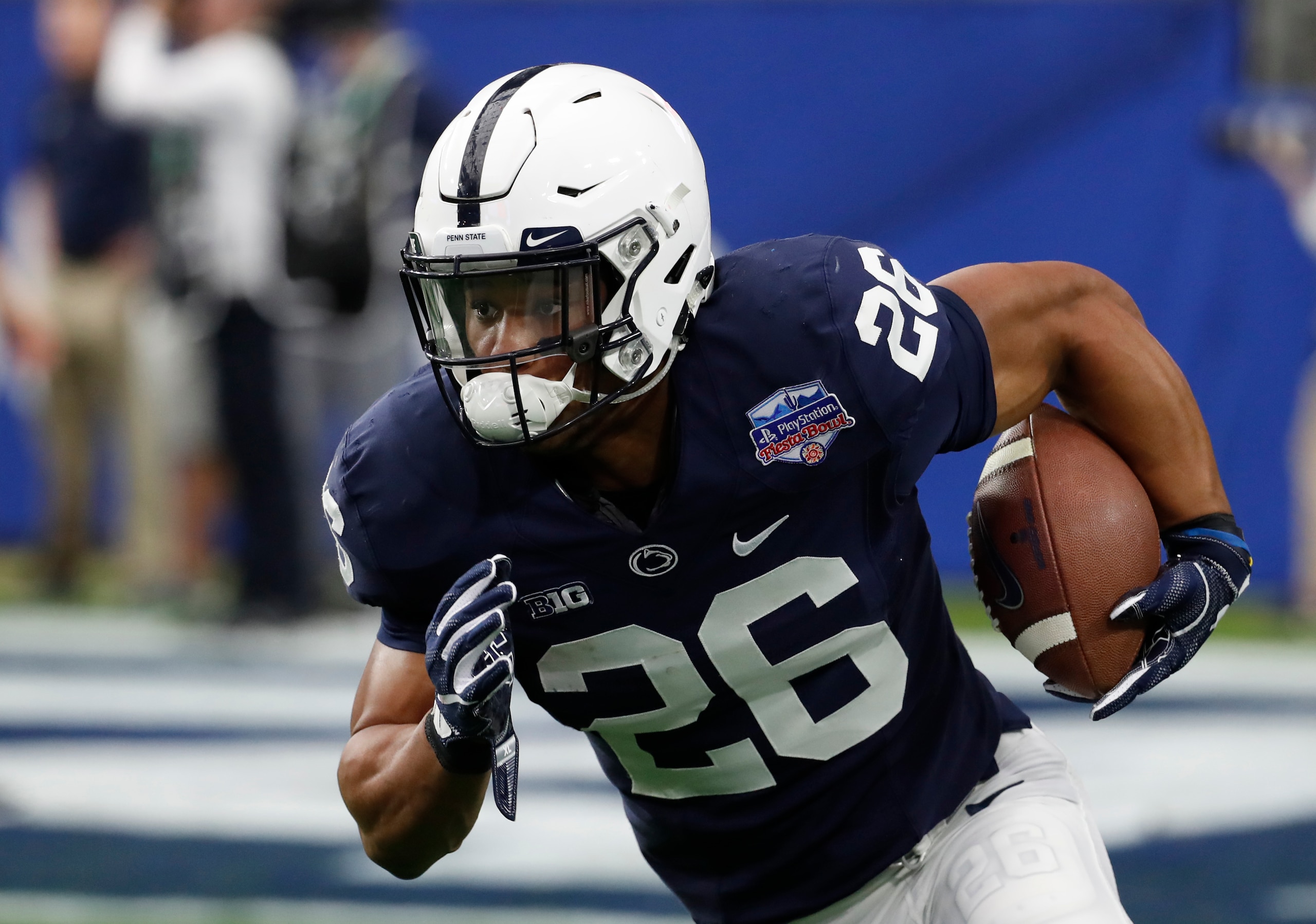
Trying to pinpoint the weakness or question still following Saquon Barkley feels like locating one specific snowflake sitting on top of a mountain. Sure, it's there, but good luck.
Somehow Barkley needed just 4.4 seconds to run the 40-yard dash at the combine, even while weighing 233 pounds and standing 6'0". His rare combination of power and speed led to an average of 1,679 yards from scrimmage per season over three years at Penn State, along with 51 total touchdowns.
But there is one habit he needs to kick in the NFL. And if he doesn't, his career could get off to an unexpectedly rocky start.
Barkley has a tendency to bounce to the outside or search for the home-run play. That's understandable to some degree; he smacked the equivalent of football dingers often while averaging 5.9 yards per carry in 2017. However, even a runner with unique physical ability needs to know there are still times when it's wise to plow forward and be satisfied with, say, a four- or five-yard gain.
Those runs aren't as sexy, but they're critical in the effort to march down the field or keep possession later in the game with a lead. Barkley can put his offense in a deep hole when he insists on searching for chunk gains and only chunk gains.
As PFF's Sam Monson noted, Barkley can sometimes make poor decisions when a play has broken down or he's faced with heavy traffic in front of him right away. When he was contacted at or behind the line of scrimmage in 2017, Barkley averaged just 0.46 yards per carry, which ranked 57th out of 58 qualifying running backs in the draft class.
Overall, Barkley more than makes up for any lost yards with his effectiveness and versatility as a runner and pass-catcher, but his decision-making needs to improve.
Denzel Ward, Cornerback
8 of 10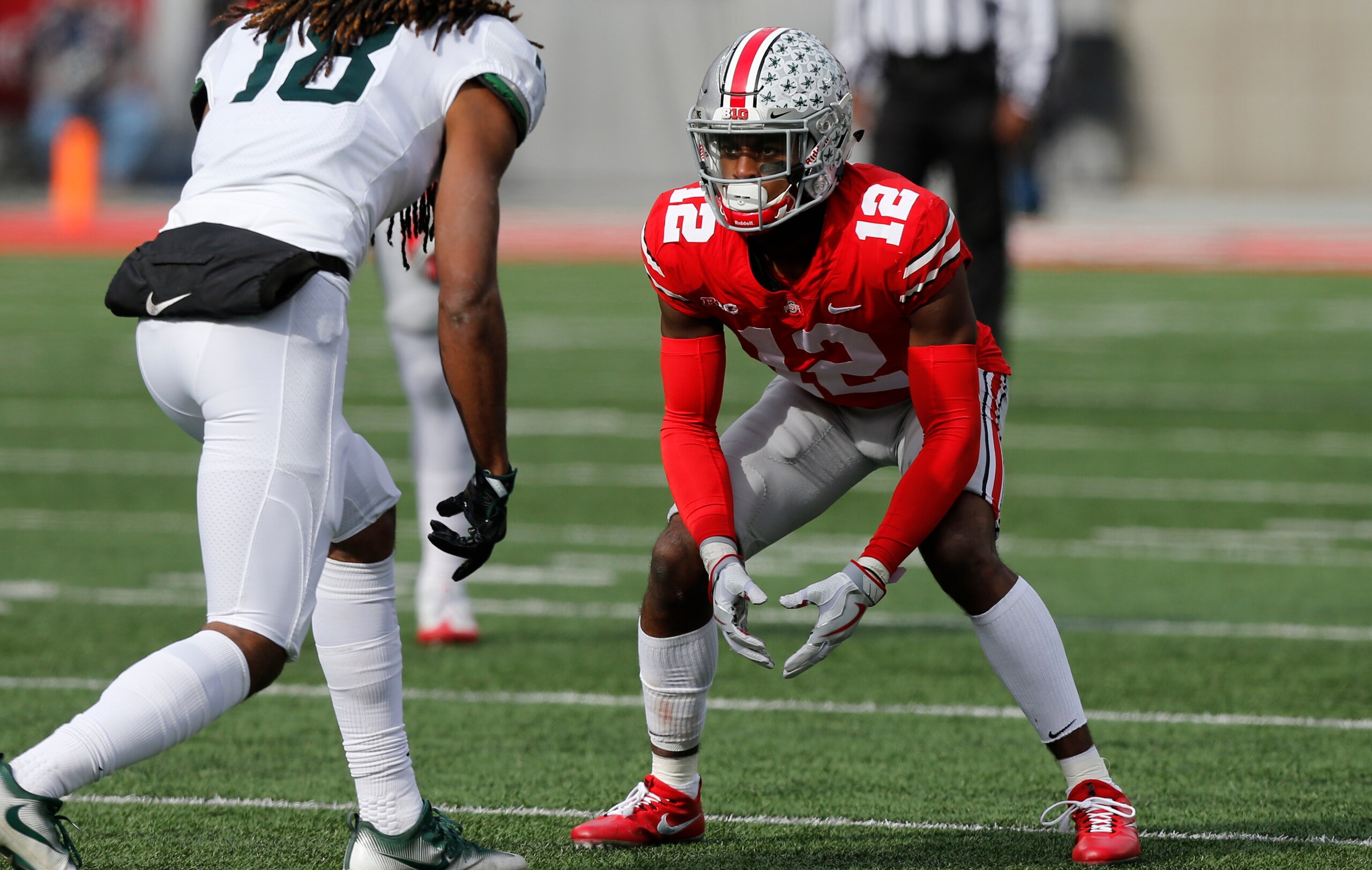
Denzel Ward has been called the 2018 draft's best cornerback, a label most recently applied to him by Miller. After he allowed just 35 receptions in 2017 on 100 targets in coverage, per PFF, it isn't hard to see why he's earned that tag.
His 15 passes defensed in 2017 largely came through an abundance of closing speed. Ward posted a 40 time of 4.32 seconds in Indianapolis, which tied for first among all players.
However, he is a little undersized by the modern standards of the NFL cornerback, standing at 5'10" and weighing 191 pounds. That could cause problems against the fast-moving human skyscrapers populating NFL wide receiver depth charts. Ward will have to adapt and learn how to still win physically.
But after he roasted the combine while also showing his explosiveness with a broad jump of 136 inches and vertical of 39 inches, it's likely Ward will just lean on natural athleticism to compensate for any size differences. That approach sure seemed to work well at Ohio State, and it's likely to again in the NFL.
Bradley Chubb, Defensive End
9 of 10
Similar to Barkley, finding a weakness still dogging defensive end Bradley Chubb requires a whole lot of squinting. That's especially true during a time when it feels like every talent-evaluator is gushing over his speed around the edge and powerful hands at the point of attack.
Bruce Feldman of SI.com even spoke to several NFL executives and scouts who viewed Chubb as a better prospect than 2017 No. 1 overall pick Myles Garrett. That's quite the compliment, and it's not a stretch after Chubb's 20 sacks and 44 tackles for a loss over his final two seasons at NC State. He's a possible top-three pick after the New York Giants created a need at defensive end by trading away Jason Pierre-Paul.
So with that in mind, nit-picking of Chubb is largely is system fit. Although he's agile and explosive, his top-end speed may leave him exposed at times if he's used as a 3-4 outside linebacker and asked to dropped into coverage. He ran a 4.65 in the 40-yard dash.
But Chubb should focus almost solely on being a pass-rusher and making the opposing quarterback hate his job. He's really good at that, and at 6'4" and 269 pounds he has imposing physical abilities. The 21-year-old posted a 10-yard split time of 1.63 at the scouting combine, which showed his short-area burst to turn the corner and matched Garrett's split from 2017.
Minkah Fitzpatrick, Safety
10 of 10
Minkah Fitzpatrick is highly versatile and defines what it means to be a movable chess piece.
At 6'1" and 201 pounds, he can move throughout the formation, with the size to match up well in the slot, the ball skills and instincts to thrive as a safety and the hard-hitting nature to step in as a linebacker against the run. He finished his time at Alabama with nine interceptions (six coming during a standout 2016 season), 24 passes defensed and 16.5 tackles for a loss.
His versatility may have limits, though, which leads to the main question still attached to Fitzpatrick.
The 21-year-old had a solid combine performance and posted a 40-yard dash time of 4.46. That's sufficient speed but less than spectacular, and it could put a lower ceiling on his effectiveness when used as a cornerback.
But that ceiling is still sky high even if it's knocked down a peg or two. That's why Miller predicted Fitzpatrick will land with the Tampa Bay Buccaneers at No. 7 overall in his latest mock draft.
.jpg?w=2560 "Cowboys Packers Football")




.jpg?w=2560 "🚨 Week 8 AP Top 25 Poll")