
NFL Draft 2018: Stock Up, Stock Down Post-Combine
The 2018 NFL Scouting Combine wrapped up after five days in Indianapolis, leaving teams with an enormous amount of information to sift through as they build their big boards. Between the on-field drills and behind-the-scenes discussions, some prospects' draft stocks may swing wildly based on their performances at the combine.
Players can overcome a bad combine or flame out after a great one, but where a player gets drafted often determines how long they have until a team gives up on them. The higher the initial investment, the more likely it is for a player to stick around.
Among the 300 players who attended the combine, the following 14 either significantly helped or hurt their respective draft stock. The eight risers mentioned will aim to continue building off of their positive momentum, while the six fallers must do their best to stop their sudden drop.
Stock Up: Courtland Sutton, WR, SMU
1 of 14
After three years of dominating competition in the American Athletic Conference, SMU receiver Courtland Sutton left no questions regarding whether he was at least a Day 2 prospect in the 2018 draft.
The 6'3", 218-pound "X" receiver managed a gaudy 195 receptions, 3,220 yards and 31 touchdowns throughout his four-year college career despite not playing alongside a stellar quarterback, and the manner in which he physically manhandled defensive backs was even more impressive. Still, he had to show he was more than a big body at the combine, as the field was filled with similar body types and play styles.
Sutton left no doubt that he is the premier big-body receiver prospect in this year's crop after posting elite athleticism numbers. His change-of-direction and lower-body explosion out of cuts were a question mark until he had a three-cone time of 6.57 seconds and finished in the 84th percentile of SPARQ, per PlayerProfiler.
Sutton still needs to improve upon his route running, but the combine proved he has the requisite tools to do so. Thanks to his athleticism, production and quality film, he likely locked in his status as a top-40 prospect with his unexpected combine performance.
Stock Down: Orlando Brown, OT, Oklahoma
2 of 14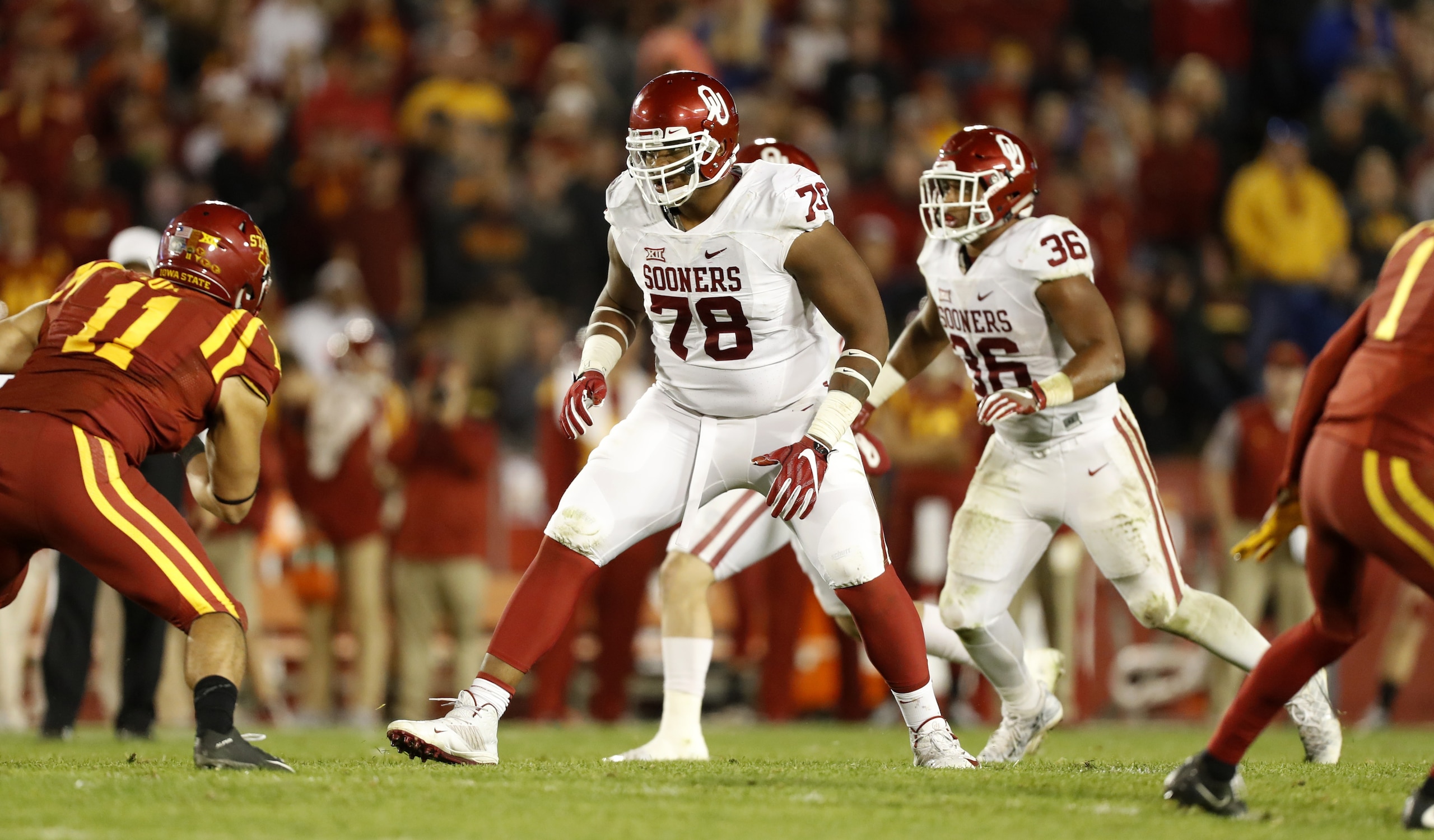
After a miserable combine performance, Oklahoma offensive tackle Orlando Brown can only hope NFL teams fall in love with his tape.
The 6'8", 345-pound All-American was an excellent pass-blocker throughout his career. While nobody expected him to display rare physical athleticism at the combine, he couldn't afford to be historically awful.
Alas, Brown finished with the third-worst vertical and broad jump, the fifth-worst 40-yard dash and the eighth-worst 10-yard split among all prospects at the combine over the last 20 years, according to Zach Whitman of 3SigmaAthlete.com. He also had the fourth-lowest bench press total among offensive linemen who wound up being drafted. The only drill he didn't tank was the three-cone, with a near-average 7.87 seconds.
Pass-rushers continue to dominate NFL blockers because of their athletic advantage, and no edge player is less athletic than Brown. He compensates as much as he can with his unusual length and power, but teams will no longer be interested in taking that risk in the first round.
Stock Up: D.J. Moore, WR, Maryland
3 of 14
Without a clear top overall receiver in this class, Maryland dynamo D.J. Moore may have claimed that throne with his combine performance.
Measuring taller, thicker and faster than expected, Moore's film looks even better with that context added. The 6'0", 210-pounder is versatile in his usage, as he's able to play both inside and outside and is a legitimate downfield threat.
The best on-field comparison to Moore is a mixture of Roddy White and Golden Tate. He boasts tremendous balance and power to fight through would-be tacklers on screens and underneath routes to grind out more yardage. He's also a deep threat with his 4.42 speed and ability to accelerate on double moves. He's close to a complete package athletically, as he finished above-average on everything aside from the three-cone drill.
Moore's explosion off the line can be especially troublesome for cornerbacks. In each of his three best games of the year (against Northwestern, Texas and Penn State), he quickly ate up space and created separation on his routes. NFL offenses are prioritizing shorter throws to keep efficiency high, and Moore will benefit from the league's continued evolution.
.jpg?w=2560 "Rams Raiders Football")

.jpg?w=2560 "Steelers Saints Football")
Stock Down: Arden Key, DE, LSU
4 of 14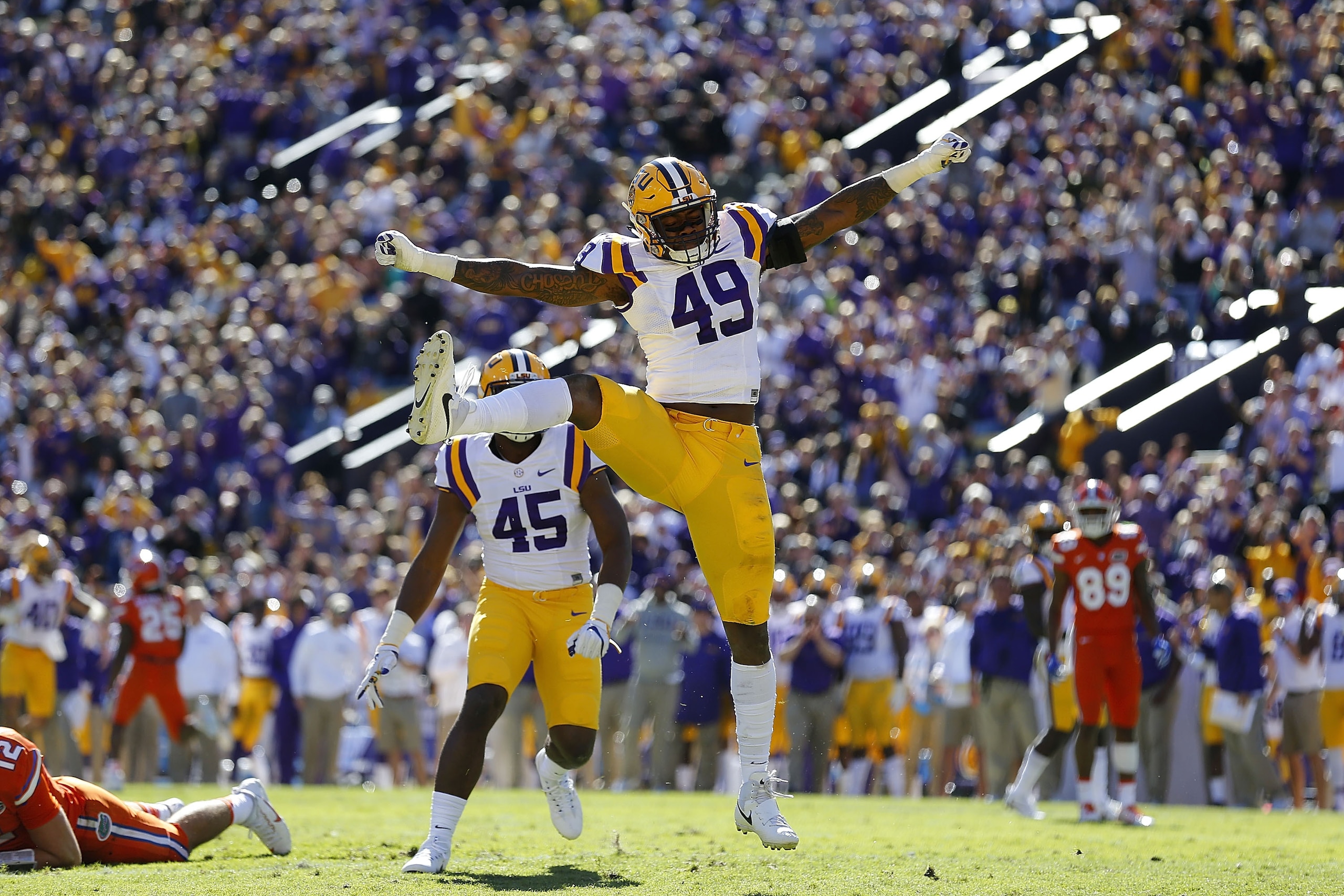
LSU star defensive end Arden Key has endured a tumultuous year, and the combine offered little reprieve.
After a breakout 2016 season, Key stepped away from the program over the summer, struggled with his weight and was inconsistent during the 2017 season due to injuries. He did complete some of the combine elements, such as the vertical and broad jump, three-cone drill and 20-yard shuttle, although a knee injury may have contributed to his middling results, per NFL Network's Kimberly Jones.
Key revealed to NFL.com's Chase Goodbread that he weighed as much as 280 pounds at LSU this past year, 42 pounds more than the 238 he weighed at the combine. He has long been a slender player, which helps his speed but has made his run defense suspect. He likely needs to be closer to 250 pounds to be a more complete, every-down player.
While other edge-rushers had great workouts in front of teams and peers, Key was limited, much like he was for several games this past season. He still must prove he's reliable in addition to what sort of physical talent he is. For a player often mocked in the top five a year ago, he has almost surely slipped to a Day 2 prospect, and he'll have to sell NFL decision-makers on who he is as a person.
Stock Up: Royce Freeman, RB, Oregon
5 of 14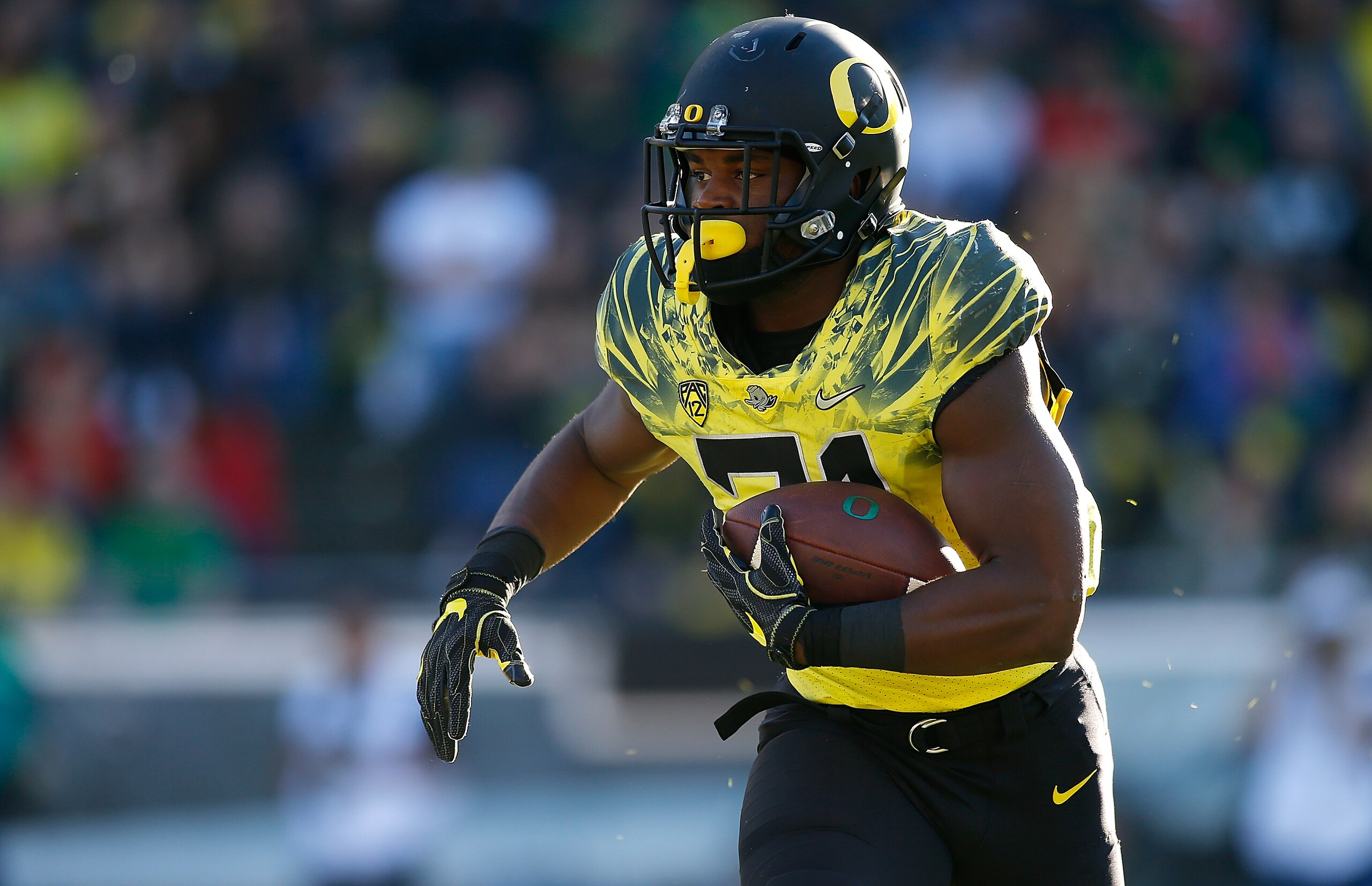
The combine was bound to help flesh out some of the running backs bunched together in the Day 2 mix.
Among those prospects, the biggest beneficiary of this year's athletic testing was Oregon's Royce Freeman. His decision to return for his senior season after an injury-riddled junior year was justified both on the field and with this combine performance, raising his stock at the right time.
Freeman is hugely built at 5'11" and 229 pounds, but he doesn't play like a plodder. It's can be a negative that his power doesn't always match his frame, but he's much more nimble than a back like Jeremy Hill or Andre Williams. His ability to change directions quickly and accelerate was verified at the combine, where he landed in the 72nd percentile in the three-cone drill and 71st percentile in the 20-yard shuttle, per Mockdraftable. That would be a good result for a small, shifty back, let alone a massive one like Freeman.
Freeman may wind up being one of the top five backs selected, making him a potential second-round pick. He's proved capable of being the lead back, as he totaled 947 rushes for 5,621 yards and 60 touchdowns at Oregon, but he was also versatile enough to catch 79 passes for 814 yards. He's a better athlete than all running back prospects aside from Saquon Barkley and Nick Chubb, and he compares to Carlos Hyde on the field.
Stock Down: Jordan Lasley, WR, UCLA
6 of 14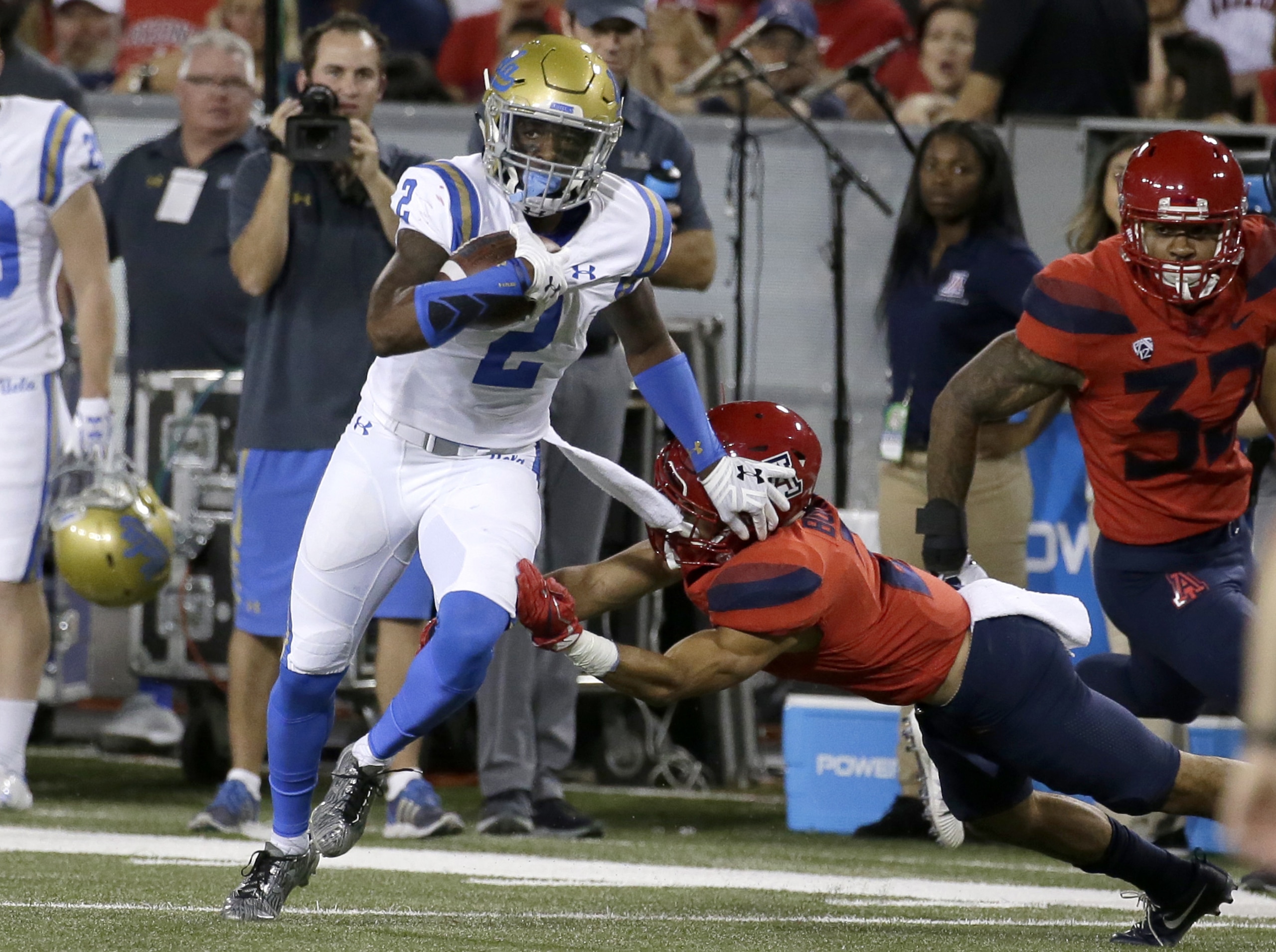
Every year, there's an abundance of average-sized receivers who lack one great athletic trait to separate themselves from the pack. Unfortunately for UCLA junior Jordan Lasley, his disappointing results in the explosion drills at the combine put him squarely in that category this year.
Lasley was a wild card coming into the event because his production seemed overlooked in receiver rankings. The 6'1", 203-pounder was quarterback Josh Rosen's most productive receiver in 2017, but he's a below-the-rim receiver lacking the twitch or burst to consistently win there in the NFL.
Lasley was limited to nine games and did struggle with drops—which reappeared in the positional drills at the combine—but he also had seven 100-yard games and two 200-yard games. While Pac-12 defenses aren't always the best competition to judge against, he stood out with the ball in his hands more often than not.
UCLA's pro day will be Lasley's last chance before the draft to show more reliable hands and get better jump results. His 4.5-second 40-yard dash is acceptable and looks consistent with his tape, but the rest of his profile screams "just a guy" as of now. Leaving UCLA and Chip Kelly a year early to be a Day 3 pick is far from an ideal outcome.
Stock Up: Bo Scarbrough, RB, Alabama
7 of 14
As defenses become more versatile and filled with hybrid players built to win on speed, offenses have the opportunity to counter before the defenses fully catch up. That's by finding unique, big-body backs in the mold of Derrick Henry and Jordan Howard, particularly on Days 2 and 3 of the draft.
Alabama's Bo Scarbrough has been a household name in college football over the last few years because he looks like a defensive lineman playing running back. He's been solid on the field, but several injuries also limited his exposure.
He wasn't expected to be more than a giant power back as he entered the NFL, but he had some of the best jumps at the combine in recent history. He scored above the 90th percentile in both his vertical and broad jumps, per MockDraftable, and his 11'4" broad jump was the best of any running back since Justin Fargas in 1999.
His speed for a 6'1", 228-pound back was stellar, with a 4.52 40-yard dash. He's a freight train in the open field, perfect for outside-zone and power-blocking schemes. Even if he isn't a threat to make defenders whiff, he's going to punish them with a head of steam. Scarbrough is a potential offensive weapon at a great value in the late Day 2 to early Day 3 range.
Stock Down: Akrum Wadley, RB, Iowa
8 of 14
Prior to the 2017 season, discussions about Iowa running back Akrum Wadley ranged anywhere from future Day 2 pick to at-worst third-down back specialist, a la Damian Williams or Theo Riddick. His springy legs and ability to jump-cut his way out of a group of defenders was effective at Iowa. The question was whether his explosiveness would stand up against NFL talent.
Unfortunately, his stock took a major hit at the combine, as the 5'10”, 194-pound back failed to show the explosiveness that would dispel concerns.
That doesn't mean Wadley won't find success in the NFL, but his 32" vertical jump highlights a poor lower-body muscle set that helps backs dig into the dirt and drive forward. His 4.54-second 40-yard dash was fine, but speed wasn't an issue for him on film.
Wadley may now fall to the late Day 3 range or even go undrafted. While others around him are bigger, faster and more twitchy, he's more suited for a depth role who rarely pass-blocks. There aren't many roster spots available to those types of backs.
Stock Up: Allen Lazard, WR/TE, Iowa State
9 of 14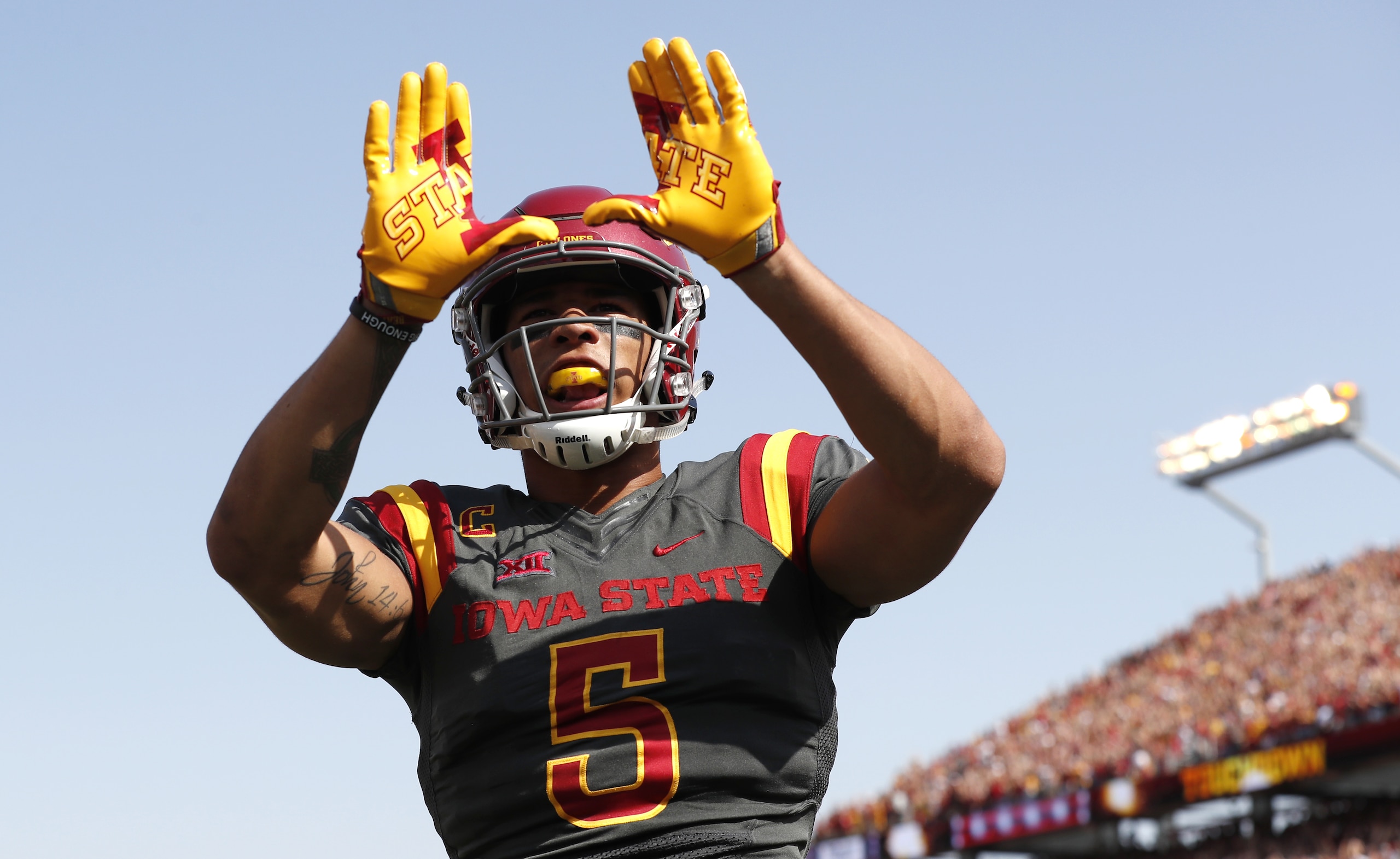
A gifted red-zone threat and jump-ball master, Iowa State receiver Allen Lazard did as much as he could to prove he's more than just a big frame.
On film, Lazard struggled to consistently separate from defenders, and his 4.55-second 40-yard dash backed that assessment up. But the rest of his workout showed an explosive player who should be able to win at the catch point and give his quarterback a large catch radius with which to work.
Lazard told Mark Emmert of Hawk Central that he'd be willing to move to tight end if asked to, and he fits well as a hybrid due to his 6'5", 227-pound body and impressive 38" vertical to go over defenders. He won't be a downfield burner who excels at running away from corners or even most safeties, but he's a mismatch on linebackers and has too much size for most defenders to handle.
The third round could be the sweet spot for Lazard. After putting up 241 catches, 3,360 yards and 26 touchdowns in four seasons at Iowa State, he has the reputation for playing well against top competition and finishing difficult plays. Teams will buy into him making a bigger impact than a similarly built Jaelen Strong because of the difference in explosiveness.
Stock Down: John Kelly, RB, Tennessee
10 of 14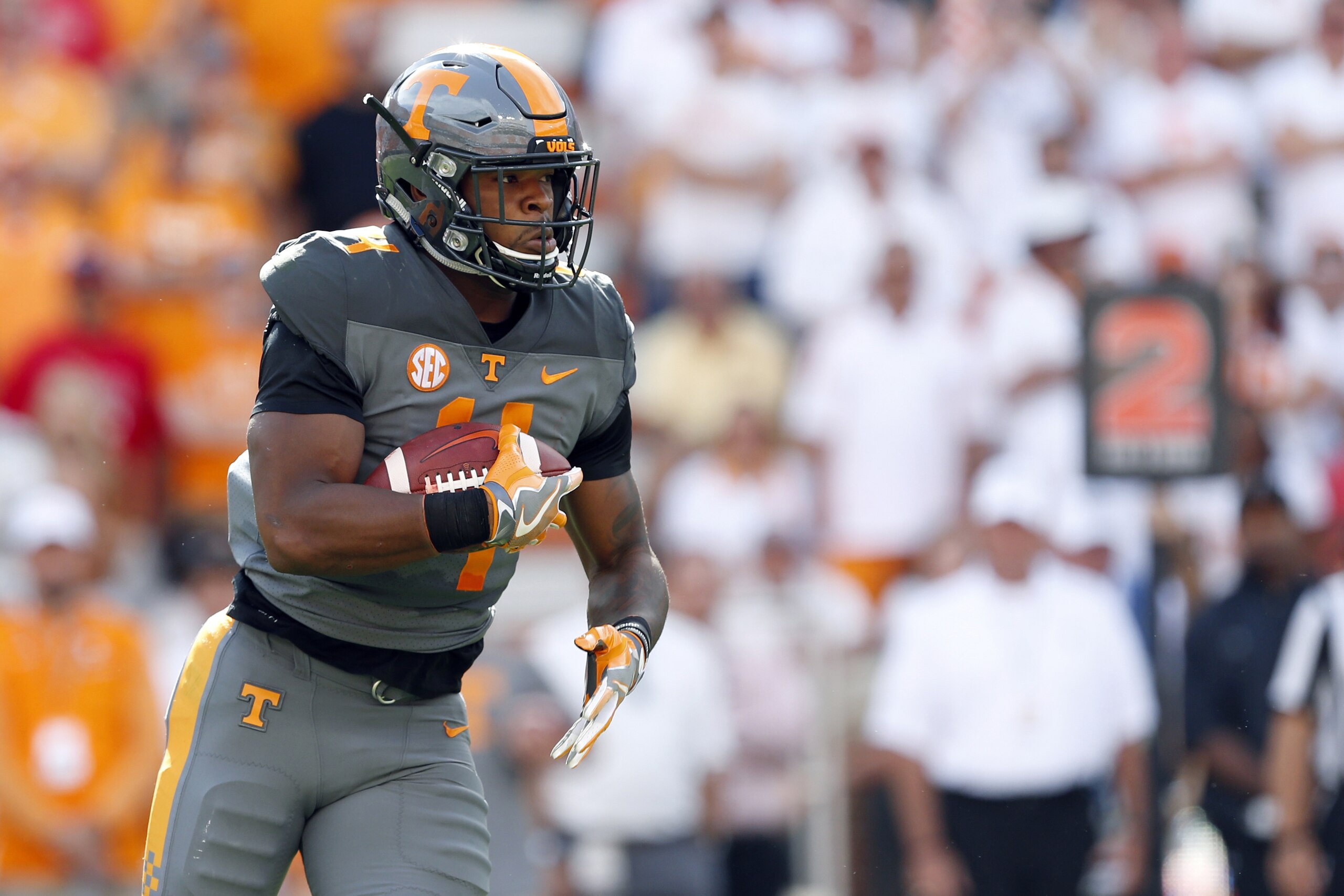
Flash back to one year ago when another Tennessee running back, Alvin Kamara, went to the 2017 combine and showed elite change-of-direction ability and explosion in his testing. Though he was still underdrafted, Kamara's lack of collegiate production was easier to overlook because of his athletic upside.
This year's Volunteers back, John Kelly, needed to do the same to keep up in a deep crop of talented backs. Instead, he failed to show even average quickness and change-of-direction ability, notching a three-cone time of 7.13 seconds and 20-yard shuttle time of 4.51 seconds.
Heading into the combine, Kelly appeared to be a potential sleeper to do well. The 5'10", 216-pounder plays with solid strength and can make defenders miss in open space, but it now seems unlikely that will translate into more than a depth role early in his career.
Kelly's top athletic comparisons include Georgia Southern's Adrian Peterson in 2002, Eldra Buckley of Tennessee-Chattanooga in 2007 and Nick Maddox of Florida State in 2003, per Mockdraftable. He may wind up being a late Day 3 pick with poor athleticism and production counting against him, even though his film is favorable.
Stock Up: Josh Sweat, DE, Florida State
11 of 14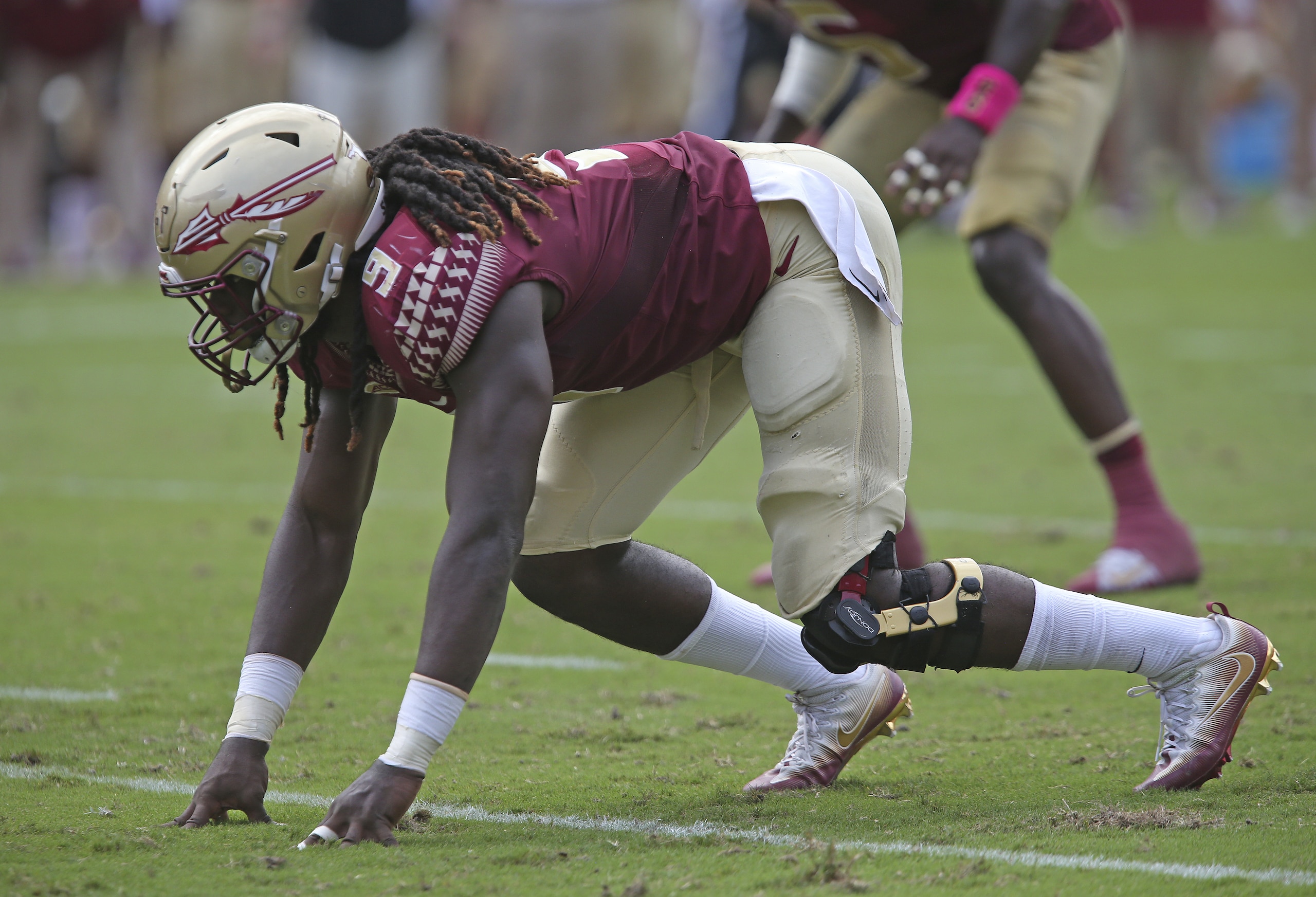
Numerous pass-rushers ran well and showed promising athleticism at the combine, but enigmatic edge threat Josh Sweat from Florida State was the biggest winner.
Sweat comfortably led all edge-rushers with his 39.5" vertical jump, finished third with a blazing 4.53-second 40-yard dash and had great length with 34 ⅝" arms. Not too shabby for a player who claimed he "almost lost" his leg in 2014, per Bob Ferrante of 247Sports.
The combine matters more for pass-rushers than it does for any other position. Although not every great athlete becomes a quality NFL contributor, most productive edge-rushers are great athletes. Sweat is a project, but he has boosted himself into the early Day 2 conversation with his dominance at the combine.
Sweat possesses a great first step and can immediately gain the upper hand on offensive tackles, but he struggles to string moves together to take advantage. He must learn to have a plan to attack his blocker instead of only relying on his speed. Considering his upside as a speed-rusher, he'd be a worthwhile second-round pick.
Stock Up: Oren Burks, LB, Vanderbilt
12 of 14
One of the more athletic linebackers to be selected on the first two days of the 2017 NFL draft was Vanderbilt's Zac Cunningham. His versatility was paramount for the Houston Texans this past season.
This year, Oren Burks of Vanderbilt will likewise shoot up draft boards after his stunning workout.
At 6'3" and 233 pounds, Burks dropped jaws as he placed in the 90th percentile or higher in both of his jumps and his three-cone drill, per MockDraftable. His speed left no questions either, as he posted a stellar 4.59-second 40-yard dash and a 4.15-second 20-yard shuttle. He's strong and fast, which is perfect for the hybrid-centric NFL.
Teams will now go back to Burks' film to see if the athletic testing matches what he showed on the field. He wasn't the biggest producer at Vanderbilt, but he also was not a true middle linebacker. Burks is an upside pick with several years of experience in the SEC, and he likely solidified his status as a Day 2 pick for linebacker-needy teams such as the New York Giants, Miami Dolphins, Green Bay Packers or New England Patriots.
Stock Down: Tarvarus McFadden, CB, Florida State
13 of 14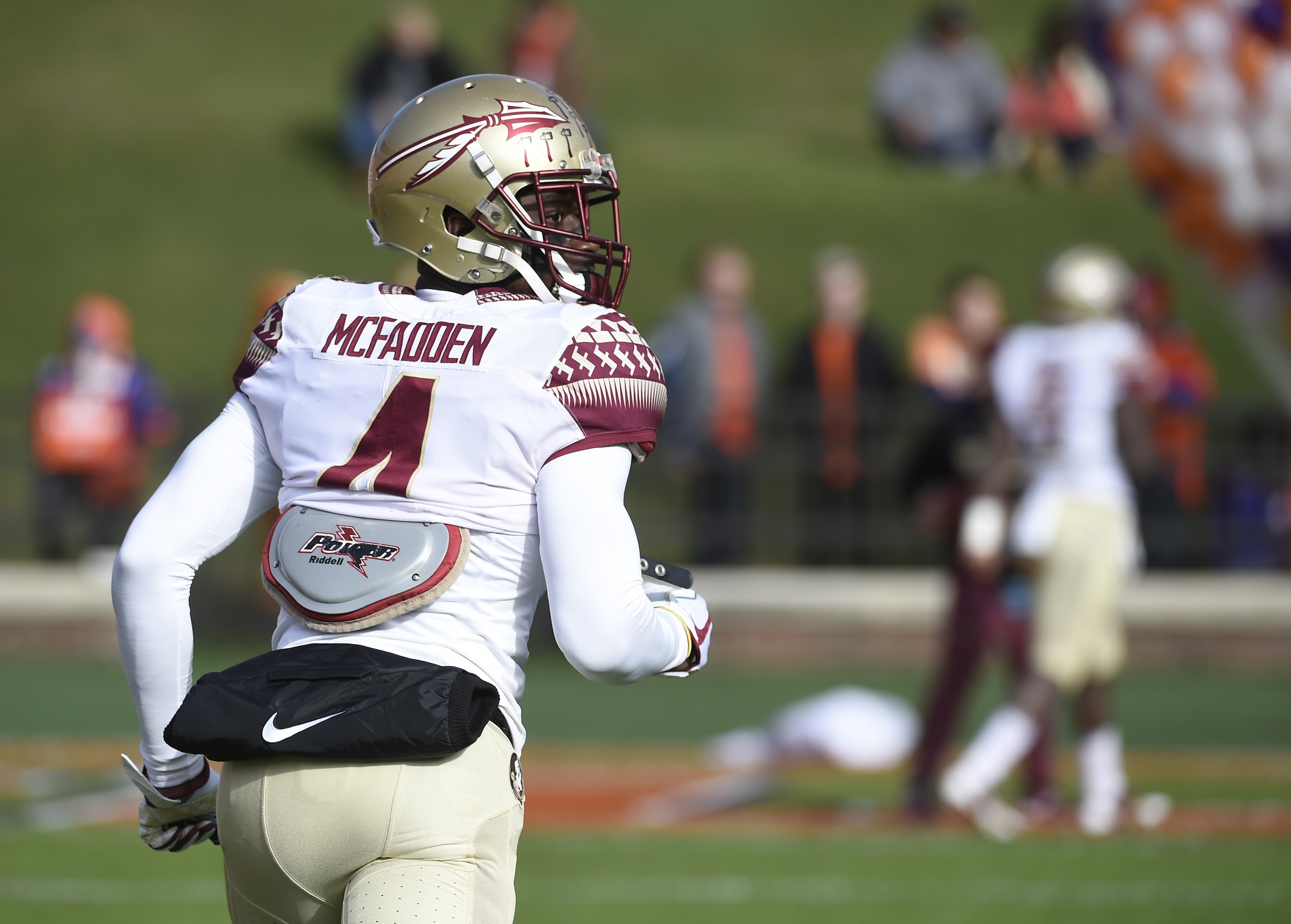
The defensive back group as a whole ran well Monday, with several corners and safeties at least meeting expectations in the 40-yard dash and explosion drills. But unlike former Florida State teammate Josh Sweat, Tarvarus McFadden seemed to labor through his run, finishing with a subpar 4.67-second 40-yard dash.
The 6'2", 198-pound cornerback continues his downward slide after a promising 2016 season where he had eight interceptions. He was far less productive in 2017, finishing with zero picks.
Zone-heavy schemes can help mask a cornerback's lack of straight-line speed, and McFadden has the length to help him compensate for being slow, but few teams will be willing to entertain drafting him before Day 3. Teams like Carolina, Detroit, Tampa Bay and Pittsburgh would make sense as far as schematic fits.
McFadden must continue to improve his play strength and be more aggressive when engaging receivers at the line of scrimmage. His length and ability to jump were never in question, and he solidified his vertical explosiveness by posting a 38.5" vertical jump. However, it's impossible to feel confident in his draft stock as similarly sized corners posted much better run times, presumably pushing McFadden down the board.
Stock Up: Shaquem Griffin, LB, UCF
14 of 14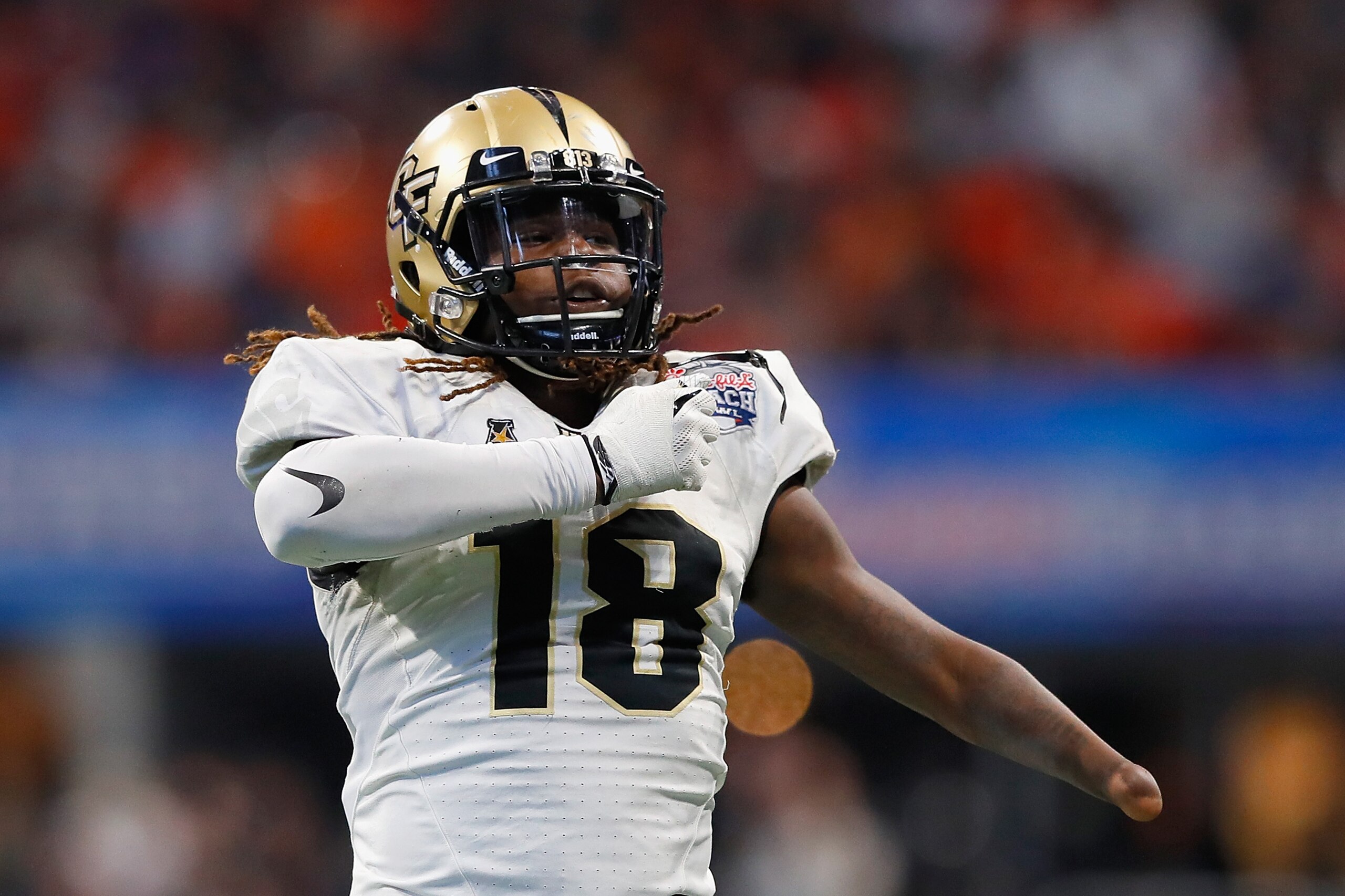
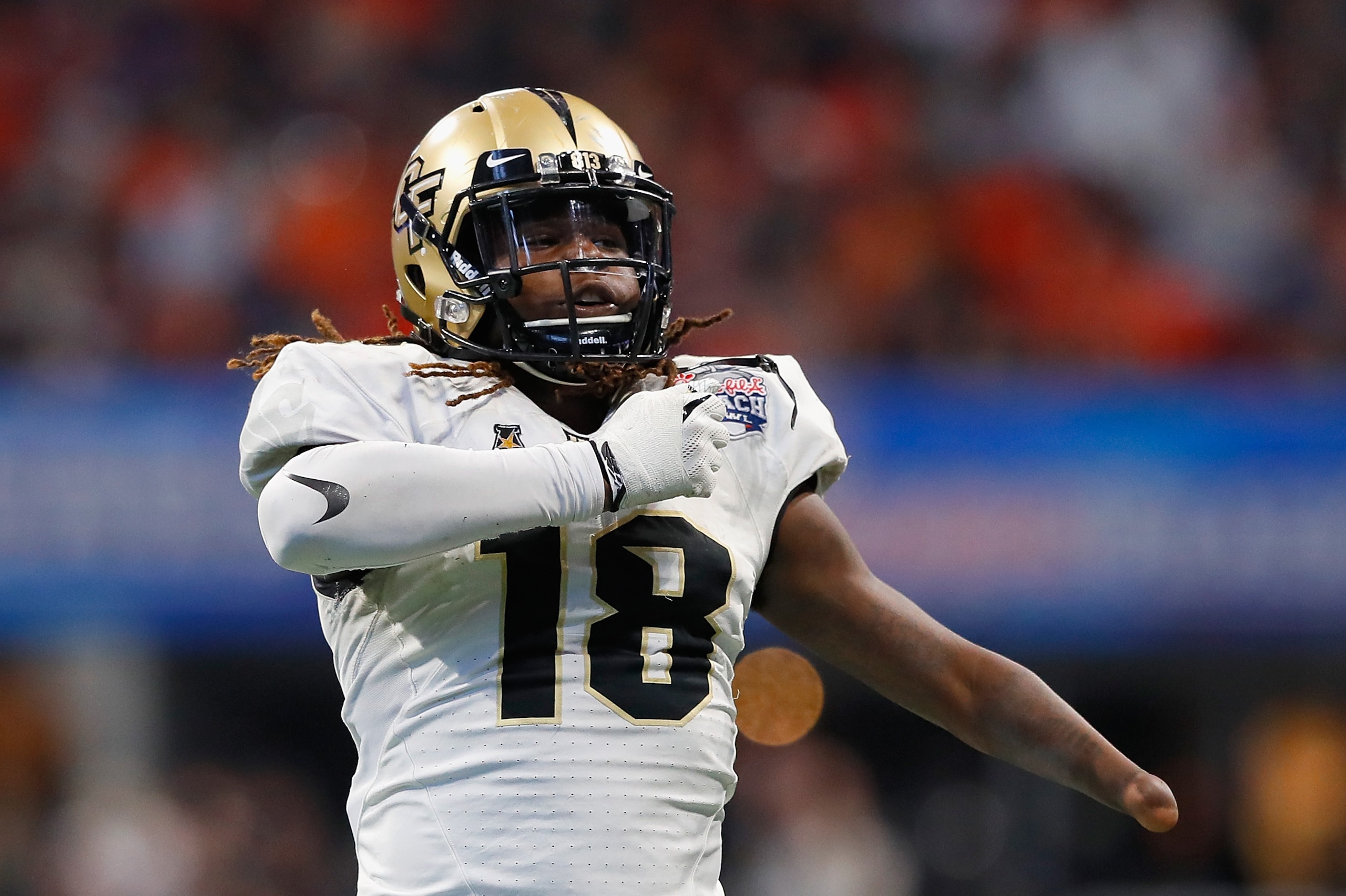
The star of the combine was UCF linebacker Shaquem Griffin. The twin brother of current Seattle Seahawks cornerback Shaquill Griffin, Shaquem nearly broke the internet when he matched his brother's 4.38-second 40-yard dash time despite being 227 pounds.
Griffin was already known for being a terrific leader at UCF. He was also one of the best defenders in college football over the last two years despite losing his left hand as a child.
Questions remain about how high Griffin should be drafted and what his NFL role will be, as he's more of a chase-and-run weak-side linebacker or even potential edge-rusher than a true middle linebacker. But he proved his athleticism and speed at the highest level, notching the fastest 40-yard dash among all linebackers since 2006.
Griffin might have been a late Day 3 pick due to concerns about how he'd play with only one-hand. His 40-yard dash and impressive 20 reps on the bench press should only reinforce what the film showed: Griffin brings more than just athleticism and skill to his team. He may be considered in the late Day 2 to early Day 3 range after his combine breakout.
.jpg?w=2560 "Cowboys Packers Football")




.jpg?w=2560 "🚨 Week 8 AP Top 25 Poll")