Comparing Jose Mourinho's Chelsea Champions with Antonio Conte's Title Hopefuls
Jose Mourinho says Antonio Conte's table-topping Chelsea side are a defensive team.
Speaking after watching his Manchester United side defeat Watford 2-0 on Saturday, the former Blues boss suggested Chelsea are getting too much credit for the way they play football.
"Chelsea are very good defensive team," he told BBC Sport (h/t Goal). "They defend very well and with lots of players, and I think in this situation a very defensive team wins the title with counter-attack goals and set-piece goals, so I don't think they will let it slip, but football is football."
It's led to claims from some, including Manchester United legend and Sky Sports pundit Gary Neville, that Mourinho is jealous of what Conte has achieved thus far at Stamford Bridge.
"He's probably envious, probably saying it as a compliment, because when I watch Chelsea they look balanced to me, the right mix of what you would like," Neville said on Monday Night Football (h/t MailOnline).
"I've never watched Chelsea this season and thought they were really boring. I've seen them go away to City and be absolutely outstanding, I've seen them be resilient when they needed to be, I've seen them play great football."
So are Chelsea boring? Are they a defensive team? Is Mourinho right to criticise them?
Comparing Mourinho's Premier League-winning Chelsea side from 2014/15 with Conte's title hopefuls, Bleacher Report delves into the debate.
Goals
1 of 4
What is the simplest way to judge a team's attacking prowess? Well, the goals they score is the best place to start.
After 25 games in 2014/15, Mourinho's eventual champions had scored 55 Premier League goals. Right now, Conte's side are just behind them with 52.
It's not so simple to suggest Mourinho edges the entertainment argument with that statistic alone, however. There are other factors we must consider in terms of how attacking one side is compared to the other, such as how the goals Chelsea have scored are divided between their home and away fixtures.
At this stage in 2014/15, it was close to being even, with 29 at home compared to 26 away. That suggests Chelsea rarely change their style, operating the same way wherever they play, as teams set up in a particular way in an attempt to stifle them going forward.
Under Conte, it's more telling. At home, Chelsea have scored 33 times this season, with just 19 on their travels. If home sides are more attacking, those on the road are more defensive, yet Chelsea are finding ways to break them down more effectively.
For a counter-attacking side, we would expect that figure to work in the opposite way, where they wouldn't be as strong in the scoring charts. It's the home teams that are traditionally more adventurous in attack, leaving them at risk of being hit on the counter. For Chelsea this season, it doesn't appear to be the case.
By that measure, if Chelsea adopted a predominantly counter-attacking strategy, their goals return would be much higher on the road because of the space their attackers could exploit. And for a side boasting Diego Costa, Eden Hazard and Pedro, Chelsea have the firepower to be effective in that style.
In reality, we're seeing something different to what the goals tally under Mourinho suggests.
Set Pieces
2 of 4
Maintaining the notion that goals add value to a team's perceived entertainment, set pieces play their part.
The more set pieces contribute to an overall tally, the more we can suggest that a team struggles to break down their opponent and score from open play.
In 2014/15, Chelsea's set-piece tally contributed to 19 of their eventual 73 goals. That's just over a quarter.
After 25 games this season, Chelsea have scored 12 goals from set pieces—a tally that represents 23 per cent of their return for the season thus far.
What that tells us is Chelsea are more fluid in open play. They're breaking teams down more effectively, despite the figures only being marginally different.
However, breaking down how those set pieces are scored allows us to delve a bit more into the story.
Mourinho's side scored from 10 corners in 2014/15, whereas Conte's Chelsea have only found the back of the net five times. Mourinho's team were more direct.
Despite having 13 games left in the season, Conte's Blues have three goals from crossed free-kicks compared to four from Mourinho's team after 38 matches.
Chelsea in the present are being more inventive. Scoring less direct goals from free-kicks suggests they're working on more ways to break down opponents, practicing set-piece routines to be more effective.
There's much more to Conte's Chelsea at set pieces than simple deliveries from corners and shots on goal from free-kicks.
Defence
3 of 4
Chelsea are playing with less defenders under Conte this season than they did with Mourinho. Or are they?
The 3-4-3 means Conte's side has three officially recognised defenders in the team, whereas Mourinho's preferred 4-2-3-1 of 2014/15 had one extra.
Throw in the wing-backs from Conte's system and there's an argument to suggest there are five, but it's how they are deployed that is vital here.
Marcos Alonso and Victor Moses work in such a way that they defend higher up the pitch. It's with a view to pushing opponents back into their own half, but it's also to provide a more efficient transition when Chelsea win back possession.
The full-backs in Mourinho's Chelsea were never offered that freedom. While Moses and Alonso must buy into the team's defensive ethic, their place in the system still comes with more freedom going forward.
Branislav Ivanovic and Cesar Azpilicueta were forced to remain deeper, the latter especially who was playing out of position at left-back.
We can see the impact that had on their performances in an attacking sense as Alonso and Moses have been involved in 11 goals already in the Premier League this term, compared to the combined tally of 12 for the entire 2014/15 season where Ivanovic and Azpilicueta are concerned (Ivanovic contributed nine of those).
Based on their average contribution to 0.44 goals after 25 games, we can expect Moses and Alonso to contribute a tally of around 17 goals this term.
The point is, Conte's defensive setup is as much about attack as it is what happens in the Blues' defensive third. We can't say the same for Mourinho, who would always put defence first.



Defensive Midfielders
4 of 4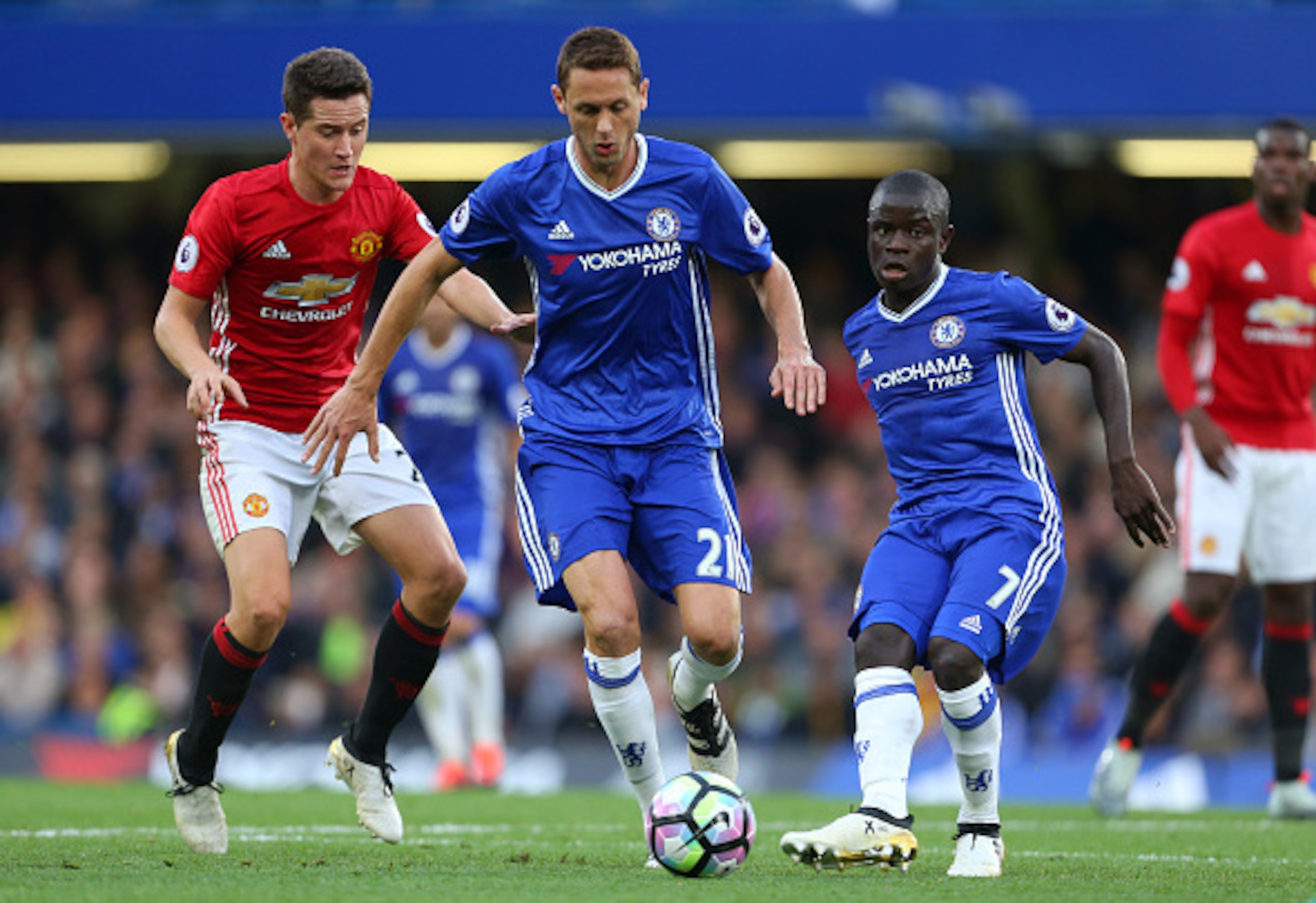
On paper, Mourinho wins the debate here. He played with two central figures in 2014/15, as Conte is now, but Cesc Fabregas was Nemanja Matic's partner. Now it's N'Golo Kante as the Serb's other half.
Fabregas is more attack-minded, whereas Matic operates with defence first, attack second. It's the same for Kante.
This season, the former Leicester City man averages 3.6 tackles per game, with Matic much lower on 1.8.
Compare that with the stats from 2014/15 and Chelsea were doing much more defending. Matic made an average of 3.6 tackles per game, with Fabregas surpisingly high at 2.6.
That season, the Spaniard made the fourth-most tackles on average in Chelsea's team. Matic now remains in the top five for the Blues, but across the board Chelsea are doing less defensive work, playing more offensively than Mourinho's team of champions ever did.
For instance, staying with Matic, he has six assists in the Premier League already this term. In 2014/15, he managed just three for the whole season. The Serb is also getting fouled more now, suggesting he is in possession and attacking opponents more than he did under Mourinho.
Chelsea's defensive principles in the middle of the park remain the same under Conte, yet we're seeing a different approach and one that isn't focused on containment.

.png?w=2560)




.jpg?w=2560 "Jonathan Taylor Landing Spots")