

Is a Football Purist Like Pep Guardiola Always Going to Split a Crowd?
Insouciance is about as well-received in Germany as it is in England. It was at the tail end of Pep Guardiola's time as coach of Bayern Munich that he engendered an unprecedented level of ire from the Bavarian press when he mused: "I would rather be remembered for the football my teams play than for the trophies I won. In the end, titles are numbers and numbers are boring."
The classic raison d'etre of the football purist was never likely to sit well in Germany, even if Guardiola was speaking from the rarefied perch of someone in possession of as many prizes as plaudits. In that sense, Guardiola is an anomaly. A purist, in any field, by the very nature of what they are trying to achieve tends more often than not to be a glorious failure than specialist in success.


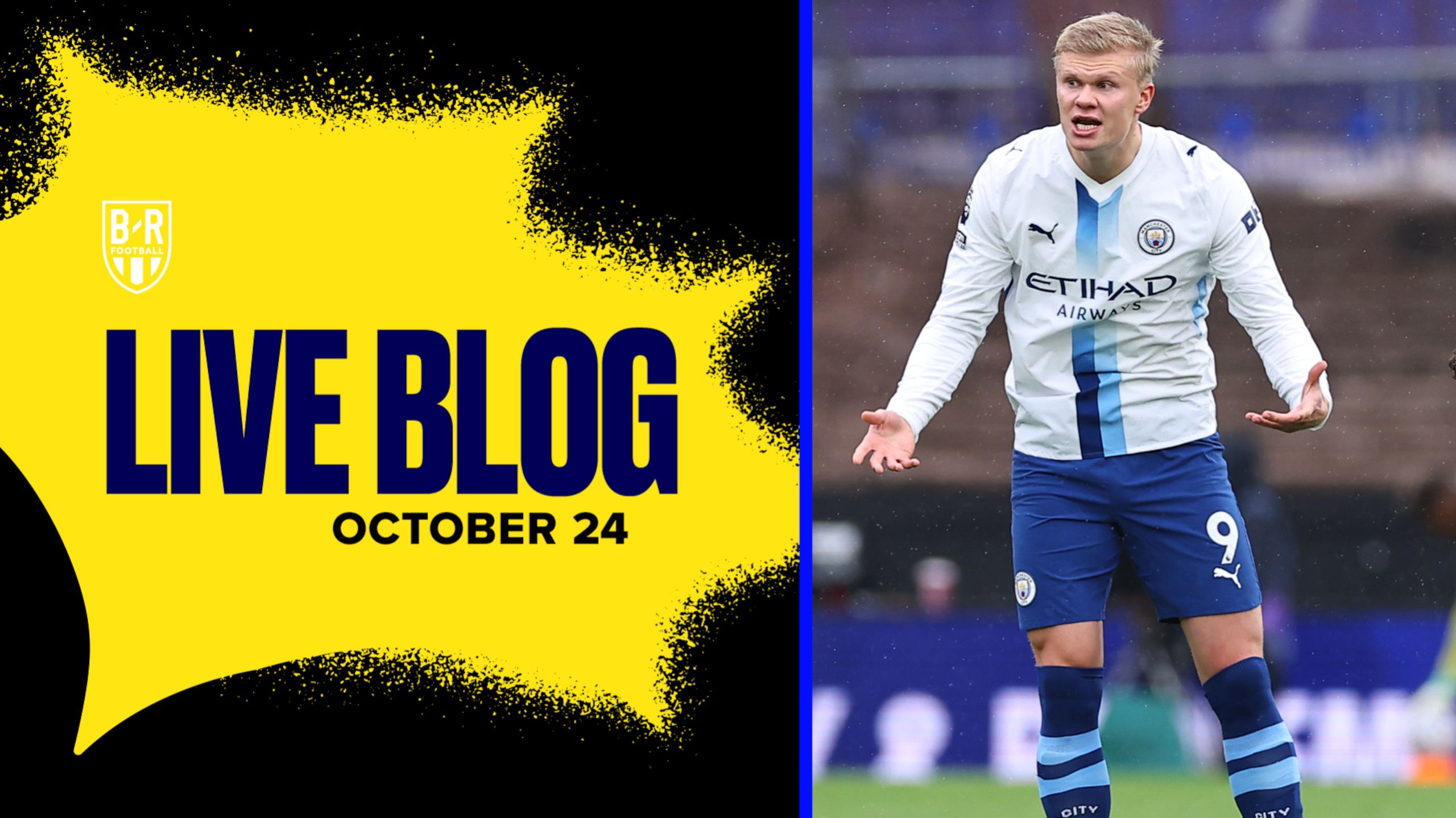
Guardiola is a poet who outsells Dan Brown.
By virtue of their shared philosophies and respective ages, Arsenal boss Arsene Wenger should be a Yoda-like figure as Guardiola acclimatises to life in England, Manchester and the Premier League.
There will be respect between them when Manchester City host Arsenal on Sunday, but after 21 trophies in seven seasons as a manager, Guardiola is obsequious in the presence of no one, save perhaps his late mentor and idol Johan Cruyff.
Wenger will have to make do with a handshake.
The numbers looked more bleak than boring for Guardiola last weekend. A 4-2 defeat for his Manchester City side at Leicester City was perhaps the moment when the last remnants of devout goodwill left over from a start to the campaign that procured 10 consecutive victories in all competitions, was vitiated to the point only his acolytes would use it to excuse a run of just four victories from the 15 games that followed.
A midweek win over Watford, just a fourth in 11 Premier League matches, was just what the doctor ordered; a serious knee injury to Ilkay Gundogan was most definitely not. The German must have been a window cleaner in a previous life, with a sideline in breeding black cats.
Post-match Saturday seemed an importune time, then, to don a philosopher's hat—which incidentally complemented his turtleneck with no little elan—when sat facing a rabid English press pack ready to pull apart every verbal morsel offered with the ravenous gluttony of a street cat thrown a chicken wing. Guardiola tossed them a whole chicken, with sides.
If ever there was a time for extolling hollow platitudes this was it. When he came out with what he did it's a wonder the League Managers Association didn't suspend him for setting a bad example to his peers. At 45 and already assured a place front and centre in any tome published, or still to be written, on the history of modern football—to his eternal credit—Guardiola has less time for platitudes than he does goalkeepers kicking the ball long from their hands.
When informed his players had failed to win a single tackle in the opening 35 minutes at the King Power Stadium, he met the revelation with barely a shrug. He'd have been more irate on discovering the water he was drinking was tap rather than bottled.
"I am not a coach for the tackles. I don't train for tackles. What are tackles?" said Guardiola, per The Independent's Steve Madeley.
To see one of the last bastions of English football being two-footed by a coach who claims to not even know what bloody tackling is, reduced a succession of pundits to a state of barely suppressed delirium.
Stan Collymore labelled him "beyond deluded" in his Daily Mirror column, which must have led to quite the repair bill when he presumably returned home and bricked his greenhouse. The window fitters had just finished a job at Peter Schmeichel's gaff after he had called Guardiola "a very arrogant man," according to the Metro.
Guardiola's distinct "otherness" has fuelled so much suspicion on English shores it's easy to see how there may be an element of truth to the famous apocryphal tale of Hartlepool locals, at the time of the Napoleonic War, putting on trial the sole survivor of a shipwrecked vessel washed up on the beach. It was a monkey wearing a uniform. They hung it on the grounds it may have been a French spy.
They had never previously seen either a Frenchman or a monkey. English football has never seen anything quite like Guardiola.
The drollest of putdowns (see below) left Collymore so apoplectic he's almost certainly going to bound onto the touchline at the Etihad on Sunday wielding a steel chair in the style of a WWE wrestler.
"Pep Guardiola when asked about criticism from Stan Collymore... (via @jonnysmiffy) pic.twitter.com/oyQgb3zRdh
— Oddschanger (@Oddschanger) December 13, 2016"
Still, it's interesting in light of a tsunami of criticism, Guardiola conceded prior to the Watford game to questioning his methods and being under pressure. It was a concession very much out of character and at odds with the haughtiness he showed at the weekend, per the Telegraph:
"Football does not exist as a long project. You have to win immediately and if you don't win, you are in trouble.
[...]
The boss and the chairman are going to decide.
[...]
I thought it would be shorter to adapt here, maybe it will be longer, but I’m pretty sure it will happen.
"
Rory Smith wrote an erudite piece in the New York Times this week—even if, to this author's sensibilities, it was a touch one-eyed—in which he decried English football's strained relationship with Guardiola.
Smith wrote: "In defeat, or even the absence of victory, Guardiola—more than any of his peers—is reproached not just for his professional decisions, his tactics and team selection, but for his personal flaws, too, as if the number of games City loses is directly proportional to the number of character failings its manager possesses."
The glee with which Jose Mourinho's purported disenchantment with life living in a hotel, away from his wife and family, was reported and subsequently mercilessly mocked on social media, would give cause for the Manchester United manager to argue Guardiola has been treated with kid gloves in comparison.
Smith argues Guardiola is not just competing against the rest of the Premier League, but English football in all its ingloriousness, and maybe even Englishness per se: "Should he thrive, it would not just represent the triumph of his philosophy, but also the failure of so many of the tenets that are central to England's identity."
Unquestionably, there are those who want him to fail on the grounds of a warped, borderline jingoistic pride in the Premier League. To his detractors, he's too sophisticated, too clever by half, too sure of his methods, too good-looking, too casual, too intense, too chippy, too contrary, too bloody foreign.
Yet there's arguably a throng just as hearty in number desperate for Guardiola to succeed on the grounds he's sophisticated, clever, sure of his methods, good-looking, casual, intense, chippy, contrary and gloriously bloody foreign. And if he could prick the Premier League's self-absorbed, self-contained, self-congratulatory, little Englander masturbatory bubble by winning it at a canter there'll be champagne corks flying in every hipster haven from Manchester to Maidenhead.
There has been as much criticism for the criticism written about him, as there has been criticism.
Guardiola's absolute disinclination to pacify those with an obsessive fixation on getting him to concede the Premier League is more intense or more competitive than either La Liga or the Bundesliga is admirable, even if nodding subserviently while popping a dummy in the mouth of those that repeatedly ask the question would save everyone the tedium of listening to him sidestep it on a weekly basis.
A tendency to place everyone who consumes the game into a warring fraction, either in camp modern football or camp old football, means nuanced discussions are rendered obsolete too often. After the Leicester game last week, I wrote: "To question any aspect of Guardiola's makeup as a manager is to invite a withered look usually reserved for suspected 'out' voters at dinner parties."
Yet it's possible to be simultaneously unsure about the work he has done thus far in England and not own any Roy Chubby Brown videos.
The interesting thing with the fallow period City are going through is a lot of their problems, at least on the surface, seem to be of Guardiola's design. There's little dispute a vast majority of the unorthodox decisions he has made have yet to bear fruit.
That's not to say they won't, but constant rotation of both players and systems at the back (he has yet to name the same defence in consecutive games this season) has led to 25 goals being conceded in the past 16 matches. His Bayern Munich side ceded 17 league goals in the whole of last season; this term, City have let in 19 in 16 Premier League matches.
When alternating between a 3-2-4-1 and 4-2-3-1, often in the same game, it's hard to say who's more confused—the person responsible for trying to work out City's formations for TV graphics, or the players themselves.
No Premier League manager has made more than the 55 personnel changes Guardiola has made to date in the league. If he rotates any more, there's a chance assistant coach Brian Kidd could start on Sunday in place of the suspended Sergio Aguero.
The converted Aleksandar Kolarov is no more a top-class central defender than Vincent Kompany is a reliable one, while John Stones' agent has doubled his client's earnings via You’ve Been Framed. Pablo Zabaleta will never be Philipp Lahm or David Alaba, while Claudio Bravo better prove quickly he's as good with his feet as his manager says he is because he's god-awful with his hands.
John Carlin, in a profile of Guardiola for the Financial Times in 2013, wrote:
"Intense and driven, his continuing zeal for his work derives from a perception that he has a duty not only to satisfy fans' lust for victory but to raise football to an art form.
That is what he achieved at Barcelona and the belief that he can replicate it elsewhere is what has made him into the most sought-after commodity in the world's biggest sport.
"
In that first sentence, Carlin gets to the nub of Guardiola, even if it may have rung even truer had it read: "…derives from a perception he has a duty not only to raise football to an art form but to satisfy fans' lust for victory."
It's as though he sees himself as a guardian of football first and foremost, then secondary as a guardian to the club that pays his wages. He makes Wenger look like Tony Pulis in the purity of his vision. Like Cruyff, if it came down to it, style trumps trophies every time. They are, after all, only a number. And as Plato said: "A good decision is based on knowledge and not on numbers."
Guardiola's father, Valenti, showed prescience in an interview with the BBC in February, when he predicted his son would have to work hard to convince an English audience of his unique style of football and methods:
"He has this attitude to football as an art form. Not just to win, but to win in a distinctive way that entertains the public.
The style of football I see in England, I doubt he has that in mind I mean, the football is very different. For that reason, I think he will have to change the mindset of English football.
"
The problem with art in relation to sport is that more often than not, it's a solitary pursuit. Guardiola talks like an artist in that he often alludes to his vision; it's never the club's vision, or the team's vision, or the supporters' vision—it's always his own. In the same way, a painter picks up a brush and thinks of his subject and not the audience, so does Guardiola.
Whether that's a good thing is a question of no little contention. That he would rather lose beautifully than win ugly is a sentiment that wins admiration from neutrals—less so, perhaps, the supporters of the clubs he manages. Not that Barcelona and Bayern Munich fans had too much to complain about.
Maybe football ground down to its purest form would eschew everything else around it, leaving just 22 players and a ball. Forget the crowd. There's a sense this is where Guardiola would be happiest, free to pursue his football utopia.
After beating Arsenal 5-1 when Bayern Munich manager in a UEFA Champions League group game last season, Guardiola said, according to the Guardian: "What I want, my desire, is to have 100 percent possession."
It was Aristotle who said: "There is no great genius without some touch of madness."



.jpg?w=2560 "Jonathan Taylor Landing Spots 📍")





