


Speculating about private conversations might often be a mugs' game, but it's reasonable to think that whatever Luis Enrique said at half-time on Sunday night at the Ramon Sanchez Pizjuan wasn't about the in-flight food awaiting his players on their trip home later in the night. Or at least that that's not what it began with.
When asked afterward about what went down at the interval, the Barcelona manager said his instructions related to a tactical switch involving Sergi Roberto. That might have been part of it, sure, but you suspect another might have been something along the lines of: Where has the old us gone? Have you forgotten who we are? You do know we're Barcelona, right?


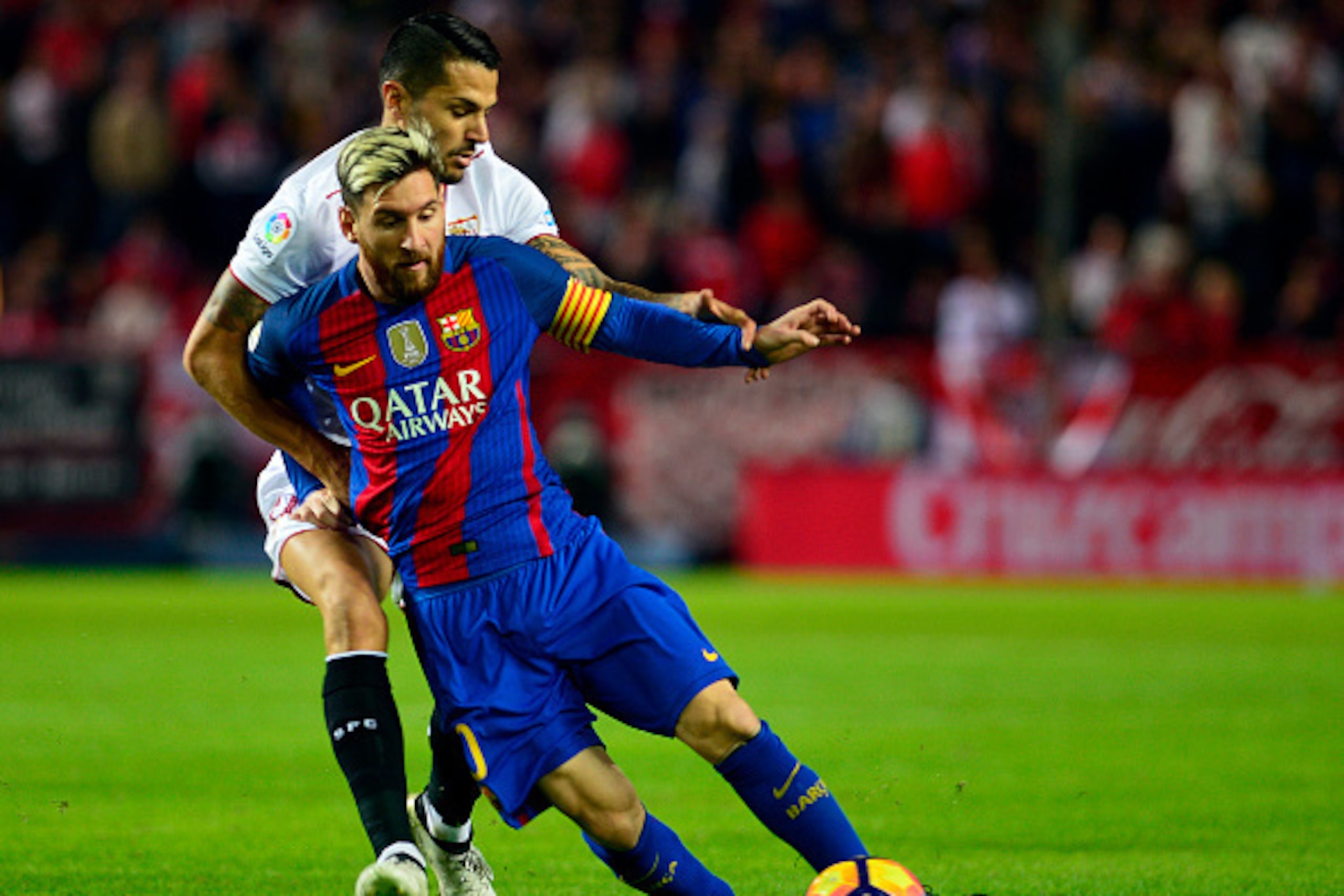
An hour later, it seemed that a little reminder was all they needed. In a furiously chaotic encounter in Seville under the lights of the Pizjuan, on a night when all those connected to the two clubs discovered that one's respiration sometimes needs a reminder of its own, Barcelona walked away with a 2-1 victory over Sevilla having essentially played two different games.
The first of those lasted 43 minutes and forced you to contemplate who was who. Sevilla dictated terms like a heavyweight, announcing their ascent emphatically once more. The second then spanned 47 minutes and restored each to their more customary roles, Barcelona roaring back, a Lionel Messi act standing at the divide.
It was spellbinding, but it was also difficult to know what to make of it. You don't normally associate Barcelona as a team with a split personality, but that's what this was like: two vastly different sides of the one outfit showing themselves in the space of two hours.
For the Catalans, on one level it's an issue that such a discrepancy was even evident. On another, though, the fact that a second side was seen might make Sunday in Seville a turning point in their season. It had been a while since we'd seen it, after all.
In the lead-up to the clash in Andalucia, Sevilla manager Jorge Sampaoli had told reporters his Sevilla had a "plan to stop Barca and another for Leo." Expressing one's formulation of a plan for Messi is often as convincing as a New Year's resolution made while clutching a 5 a.m. kebab, but it turned out there was something in Sampaoli's declaration of the plan for everyone else.
Until this weekend, Sevilla had been an enticing work in progress, but in Sunday night's first half they looked almost the finished article. Not even two minutes were on the clock by the time the hosts had taken their fourth shot on goal, and 15 minutes in, their 1-0 lead through Vitolo almost felt kind on Barcelona.
Instantly, the Pizjuan was whipped into a frenzy. The who's-who questions began. In midfield, Steven N'Zonzi looked more like Sergio Busquets than Sergio Busquets. Ahead of him, Vitolo looked more like Luis Suarez than Luis Suarez. Out wide, Mariano and Sergio Escudero briefly became Dani Alves and Jordi Alba.
This was the new Sevilla. Emboldened by a manager who thinks glass ceilings look better smashed to bits on the floor, they played with a swagger, a video game-like freedom, popping the ball around with flicks, layoffs and nutmegs.
Pablo Sarabia epitomised it best. When Luciano Vietto's delicate dink over the Barcelona defence found him through on goal, one touch and a shot would have done. Instead, he opted for a midair backheel. What followed was FIFA-style despair when the wrong button is pressed, but the audacity was reflective of the mentality: We're here to take you on at what you do.
Yet perhaps more striking than anything was Barcelona's role in it all. Following their collapse against Manchester City and their inability to establish control for large spells against Valencia and Celta Vigo, one expected the Catalans to make an early statement. Their pride had been dented, and their identity was being questioned. That was something to rebel against, but instead it was like they went along with it.
Conducting play, N'Zonzi was allowed as much time on the ball as he liked. As Sevilla moved forward, the skipping of one challenge was all that was needed to travel the full length of the pitch. From Barcelona—once the kings of suffocation, the ultimate machine in making an opponent feel inferior and powerless—there was no pressing, no repeated efforts and no coordinated plan for getting the ball back.
Those are the key themes of the discussion surrounding Barcelona at present. The concern is that they've lost focus on one of the pillars of their success; that a stylistic shift to something more volatile has gone too far; that the principles of the club's philosophy aren't being adhered to like they once were; that the Cruyffist sheen is diminishing.
For 43 minutes at the Pizjuan on Sunday, Barcelona almost seemed to confirm that. Then Messi changed the mood; changed everything.
The second half in Seville will be remembered as one of those Messi displays. Turning the tide, he was striker, winger and central midfielder all rolled into one, covering the length of the pitch as everyone else wilted, starting moves and finishing them.
Sport called it a resuscitation. Sevilla president Jose Castro told the media that the matter was simple: "The difference is that they had Messi and we didn't. They won thanks to him. Barca are one team with Messi and another without him." Most would agree, but it's only part of the truth and not all of it.
Beyond Messi, Barcelona are one team when they press and another when they don't. Sunday night showed the difference in one game.
Immediately from kick-off in the second half, Luis Enrique's men showed the sort of intensity without the ball they've been without for much of the season. Suarez and Messi were the catalysts for it, chasing down Adil Rami, Daniel Carrico and N'Zonzi in Sevilla's half. Denis Suarez and Ivan Rakitic then became a swarming second line, with the defence pushing up to complete the process. Javier Mascherano in particular was excellent covering holes when stepping up.
The result was the fracturing of Sevilla's system. The pressure exerted on them heightened anxiety on the ball, and as fatigue set in, the hosts' formation began to look split in two again, as it did during the early weeks of the season.
The numbers reinforced the point for Barcelona. Compared to the loss against City, the Catalans made almost three times as many interceptions against Sevilla, per WhoScored.com, and almost double the tackles. Part of that is due to having less of the ball, but it's also due to discipline, work ethic, the upholding of the system and a mind for the collective over the individual.
It's as though Sevilla's excellence pushed them into it: Confronted with another surging rival, away from home in a notoriously hostile stadium, losing a grip on the game, the certain desperation in the situation jolted Barcelona into action.
In doing so, it reminded Barcelona of the other side of their identity. Such a rediscovery could be the defining moment of their season.
Not Forgotten Amid the Hangover
- Diego Simeone said his team had no excuses, and he was right. On Saturday at Anoeta, his Atletico Madrid were comprehensively outplayed by Real Sociedad in a way we've rarely seen, going down 2-0 with what might have been their worst performance this calendar year. Things might have been different had Kevin Gameiro's first-half chip not hit the post, but thereafter Atleti were lethargic, toothless and passive. Or everything a Simeone team isn't.
- There's something quietly building at Real Sociedad, though. Saturday's win was their fifth in their last seven games, moving them up to sixth in the table. After a slow start to life under Eusebio, you can now see an identity or collective idea that's being embraced, one based around a high defensive line, pressure from the front and a desire to dictate.
- Again, what to make of Real Madrid? Sunday's 3-0 victory over Leganes was like so many of theirs this season: sluggish and predictable but decided by little flashes. Are they an accelerating diesel or a ticking time bomb?
- Malaga twice came from a goal down to defeat Sporting Gijon on Friday night, but the big story at La Rosaleda is Sandro Ramirez. The ex-Barcelona man has five goals in his last seven games.
- Two stunning strikes from Manu Trigueros and Roberto Soriano carried Villarreal past Real Betis and into third place in the table, ahead of Sevilla and Atletico. But their next fixture will tell us much more: Athletic Club Bilbao at San Mames.
- Real Betis: It's hard to imagine them being worse. There's no creativity or guile in midfield. No potency up front. No drive out wide. Nothing. And some of those who might be able to provide such qualities are stuck on the bench. Manager Gus Poyet told reporters on Sunday he's "calm" about his job situation, which can only mean he's got a very good pharmacist.

.jpg?w=2560 "NFL Paris Football")
.jpg?w=2560 "Trevon Diggs Cut by Seahawks")



.jpg?w=2560 "Jonathan Taylor Landing Spots")
