How to Judge an NFL Quarterback Competition
You’re at a job interview, and the usual nervous tics start. Your right leg keeps jittering as though you’re ready to take off. And there’s sweat. So much sweat.
But this isn’t a normal job interview. The sweat is dripping partly because of nerves, sure, but it’s mostly due to the sweltering midsummer heat. You’re outside in full gear sprinting, dropping back and throwing. You do it all again as critical eyes watch.
You’re an NFL quarterback, and in the early days of training camp, a competition for the starting job has begun. The winner gets a shot at glory. The loser gets to watch while he hears the play call through his earpiece. Plays he won’t execute.
.jpg?w=2560 "Colts Football")
.jpg?w=2560 "Commanders 49ers Football")
.jpg?w=2560)
Training camps usually start with that scene in late July for at least a handful of teams. This year may be the rare exception, with only the San Francisco 49ers holding a true competition at football’s most important position.
It seems Blaine Gabbert has a solid lead there. And in Cleveland, Robert Griffin III would have to bury himself in a sand pit to lose his grasp on the Browns' starting job. Mark Sanchez of the Denver Broncos is in a similar situation, though his grip on the gig may be a little more tenuous.
But let’s not allow our memories to be so short.
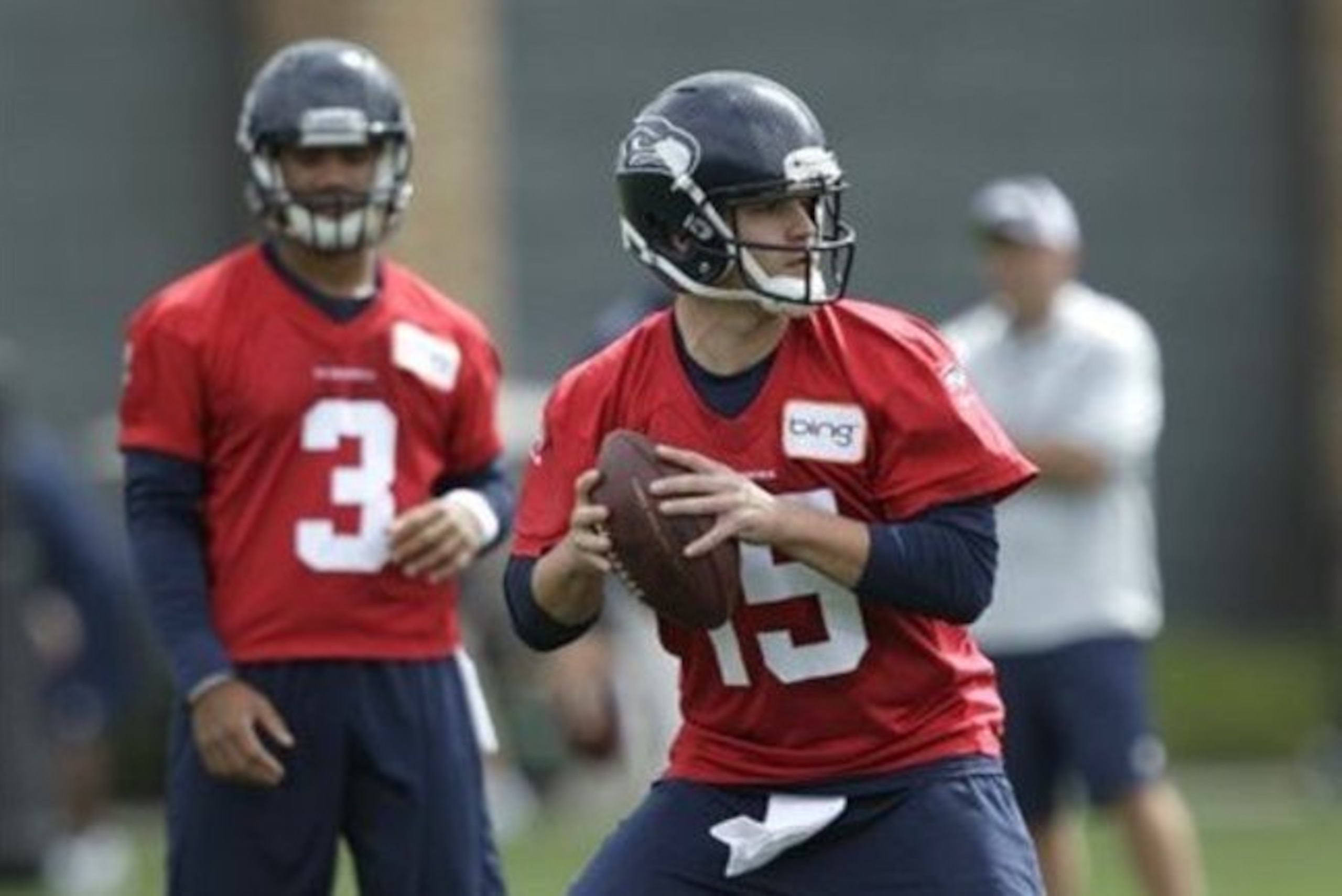
Please recall it was only a few years ago when a certain Seattle Seahawks quarterback—who’s appeared in two Super Bowls—had to secure his starting job against (big gulp) Matt Flynn and Tarvaris Jackson. We can laugh now at the mere thought of Russell Wilson having to hold off Flynn. So please also recall that Wilson was a third-round rookie, and Seattle had just given Flynn $10 million guaranteed. It was Flynn's job to lose, and he did just that.
Wilson’s growth since 2012 is just one example of how quarterback decisions made during training camp can either shape a franchise’s upward trajectory or lead to a job search for coaches and members of the front office.
There is a method behind the training camp chaos as the quarterback depth chart is assembled. One that features well-seasoned eyes scrutinizing while the bullets fly.
But what are those eyes looking at? How does the process of laying down the quarterback dominoes start when the intensity of training camp arrives? And what’s the tipping point during a quarterback competition when a group of coaches looks around, nods, then points to its guy?
It turns out coaches and coordinators are watching more than just those one or two arms in action. They’re watching how the candidates shape a team, and an offense.
Finding the intangibles
We live in an age of advanced stats. All of them—every number and morsel of information—should be embraced by coaches who face a quarterback decision. Doing anything else is shunning another tool and choosing to wither away in the darkness.
But something gets lost as we talk about metrics like passer rating, total yards through the air and completion percentage under pressure. We tend to scoff at the notion that intangibles exist.
We do that because intangibles can’t be quantified or put into a tidy box. In fact, essential traits like leadership or confidence are difficult to describe. Bill Lazor discovered that in 2004 when legendary Washington Redskins head coach Joe Gibbs shared some wisdom with him.
Lazor has been a quarterbacks coach at several stops and an offensive coordinator once during an NFL coaching career that started 13 years ago. In 2004, he was on the same sideline as Gibbs. The Super Bowl-winning coach told him to do something simple as the team tried to pick its starting quarterback between Patrick Ramsey and veteran Mark Brunell during training camp.
He wanted Lazor to watch the quarterbacks closely, of course. Then he wanted him to watch so much more.
“I remember during one of the preseason games Coach Gibbs told me to stand on the sideline and just watch this one particular quarterback when it was his turn,” Lazor told Bleacher Report. “When he went out there on the field I watched, and I saw everyone in the huddle become a better player.”

“It’s funny, because sometimes you want to break it down with sports science and analytics. There are many other ways to look at how a guy is performing, even in practice," Lazor said. "But there’s also something to a veteran coach like Coach Gibbs watching the effect a quarterback has on the whole team. That’s something really hard to quantify.”
This is the eye test, a process that can be dangerous due to the land mines of bias and sample-size deception. But leaning on what you see becomes an ill-advised method only if everything else is ignored.
Balanced thinking leads to an informed decision
Each situation presents unique challenges. The recipe that produces a quality quarterback decision calls for informed watching, tape study and statistical analysis.
But another key ingredient can only come through time.
“The wisdom of coaching the position for a while helps you in a few ways,” Lazor said. “One of them is in the meeting room. As you get to know the guys, how do they answer questions? How quickly do they catch on to what you’re trying to teach? How quickly when we’re watching video do they notice what’s different, or what the triggers are that they have to see? I think over time when you sit in the room with a bunch of different guys you create an ability to sense how fast they’re thinking and developing.”
The evaluation process can be slanted toward what you don’t see at home.
Throughout the preseason you, the fan sitting and working your couch groove into mid-November form, see brief flashes of each quarterback competing for a job. They’re on the field for a handful of snaps at first, and then a quarter or so later in August. During the true dead-heat competitions each candidate gets time with the first-team offense.
The coaches, meanwhile, probably spend more time with those quarterbacks in late July and early August than they do with their significant others. They’re testing physical attributes and throwing mechanics and simulating different game situations on the practice field.
They’re also poking at the quarterback’s football mind. Mentally processing an offensive scheme can carry just as much weight as physically executing it.
Look at Johnny Manziel’s failure in Cleveland. Long before the off-field exploits added up, he lacked mental ability and tried to compensate with physical flair. His spiral began with losing the starting job first to Brian Hoyer in 2014 and then to Josh McCown in 2015. It ended with a wasted first-round pick and Manziel becoming one of the worst draft busts in recent memory.
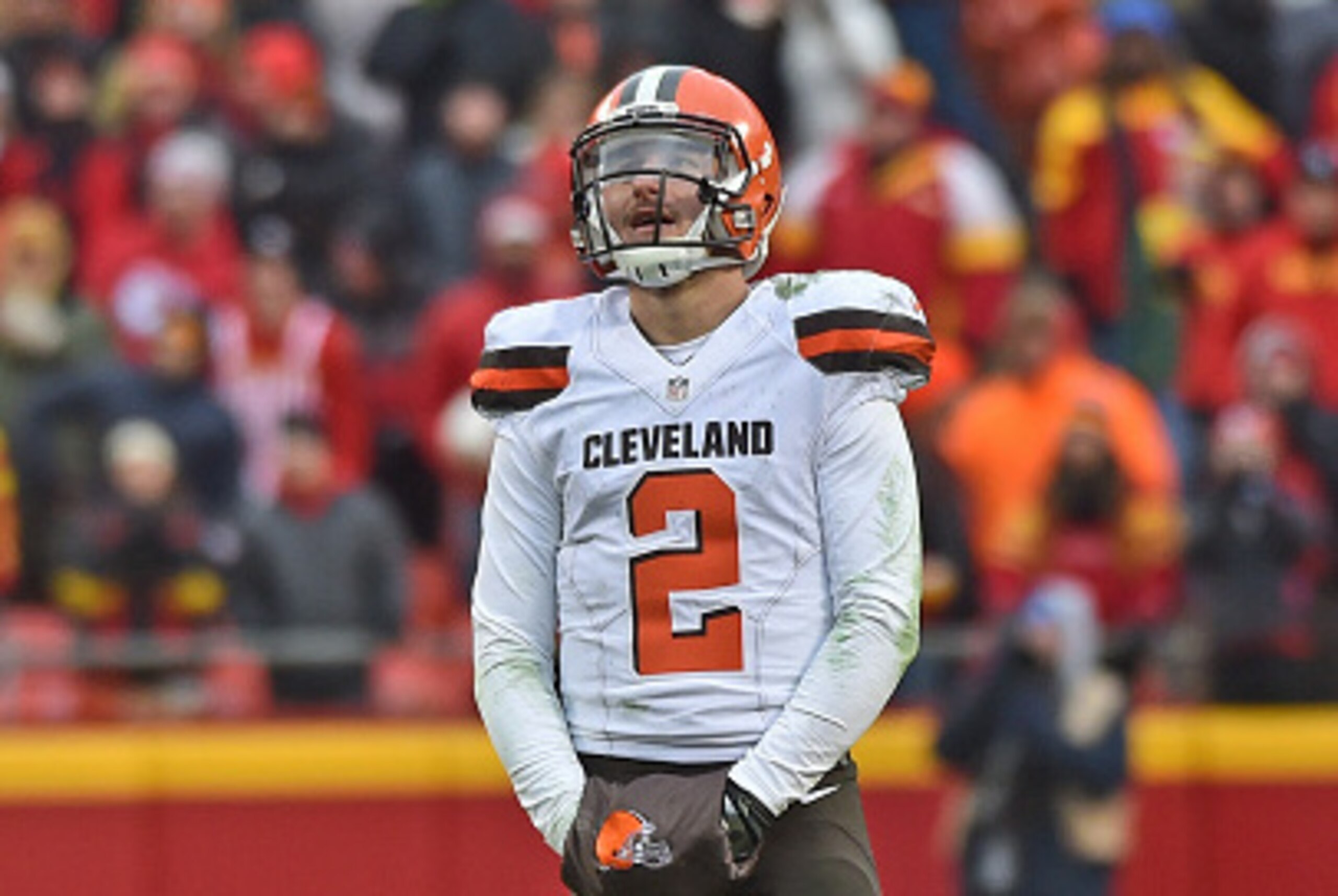
When he was a rookie, Manziel didn’t really compete against Hoyer. As former Browns head coach Mike Pettine told NFL Network (via NFL.com's Gregg Rosenthal) at the time, the true competition was between Manziel and the playbook.
Eventually the playbook won that battle, too, with Manziel becoming an example of another simple but fundamental truth Lazor outlined. What a coach sees on the practice field and in the film room is usually what they're getting on game day.
“It comes down to all the tiny details,” he said. “Is he getting the protection calls right? Is he getting the ball out on time? He can look great in seven-on-seven drills, but if he’s holding the ball too long, we have to realize that’s not going to happen during a real game.”
“That’s why there’s a balance between sort of a gut feel and overall sense of how a guy deals with his teammates and his leadership, and the details of grading him out and looking at his decision-making skills," Lazor explained. "If you get too caught up in the big picture and don’t pay attention to details, that can get you, too. There’s not one formula. You have to weigh everything.”
Even once everything gets its proper consideration, the process of evaluating talent often only takes you so far. The smart coach or coordinator isn’t rigid in his thinking and knows how to adjust his scheme to the personnel instead of doing too much of the opposite.
In the end, it’s about being flexible
In 2013, Lazor was the Philadelphia Eagles quarterbacks coach. As head coach Chip Kelly’s first year began, he had significant input into the decision between Michael Vick and Nick Foles.
It’s hard to imagine two more different approaches to the position. Vick will always be among the first names mentioned during rambling sports bar debates about the best running quarterbacks in league history. Foles, on the other hand, is your standard pocket statue.
The Eagles chose Vick, which seemed like it should have required little thought for Kelly’s brand of spin-cycle offense. Then, Vick struggled before suffering an injury. That reminded Lazor and Kelly that even the best decisions with the best intentions can fizzle fast.
Vick started the season's first six games, and Philadelphia won only two of them. Then it won eight of Foles' starts and clinched the NFC East.
That's why the training camp quarterback call is only a beginning. Swerving around the obstacles ahead means adapting to survive.
“Some of the things we did were exactly the same no matter who was in there,” said Lazor. “And some were a little bit different. But for me that was a real learning experience on how you don’t create panic on the team when you change quarterbacks, and at the same time you can have enough flexibility in your system that to the rest of the team it seems like you’re still calling the same offense. But you can really accentuate things that help the guy who’s in there right now be successful.”
“There was flexibility in the system, and the production is proof of that,” he added.
There's a balancing act to making the quarterback comfortable—whether it’s the one selected in camp or the one circumstances have left you with—while sticking to core offensive principles.
Changing the playbook can be a difficult mental tap dance for an offensive coordinator, but it's often a necessary one. There’s pride in that playbook, as the concepts within it double as a work portfolio or resume. Altering it drastically can feel like being a chef with three Michelin stars who's told to change his menu.
“But if no one is eating the menu, you have to change it,” said Mike Sherman, who was the Miami Dolphins offensive coordinator in 2012 when they had to choose between starting Matt Moore or going with then-rookie Ryan Tannehill right away.
“If you’re making eggs Benedict and everyone wants buttermilk blueberry pancakes, you better start making some blueberry pancakes,” Sherman said.
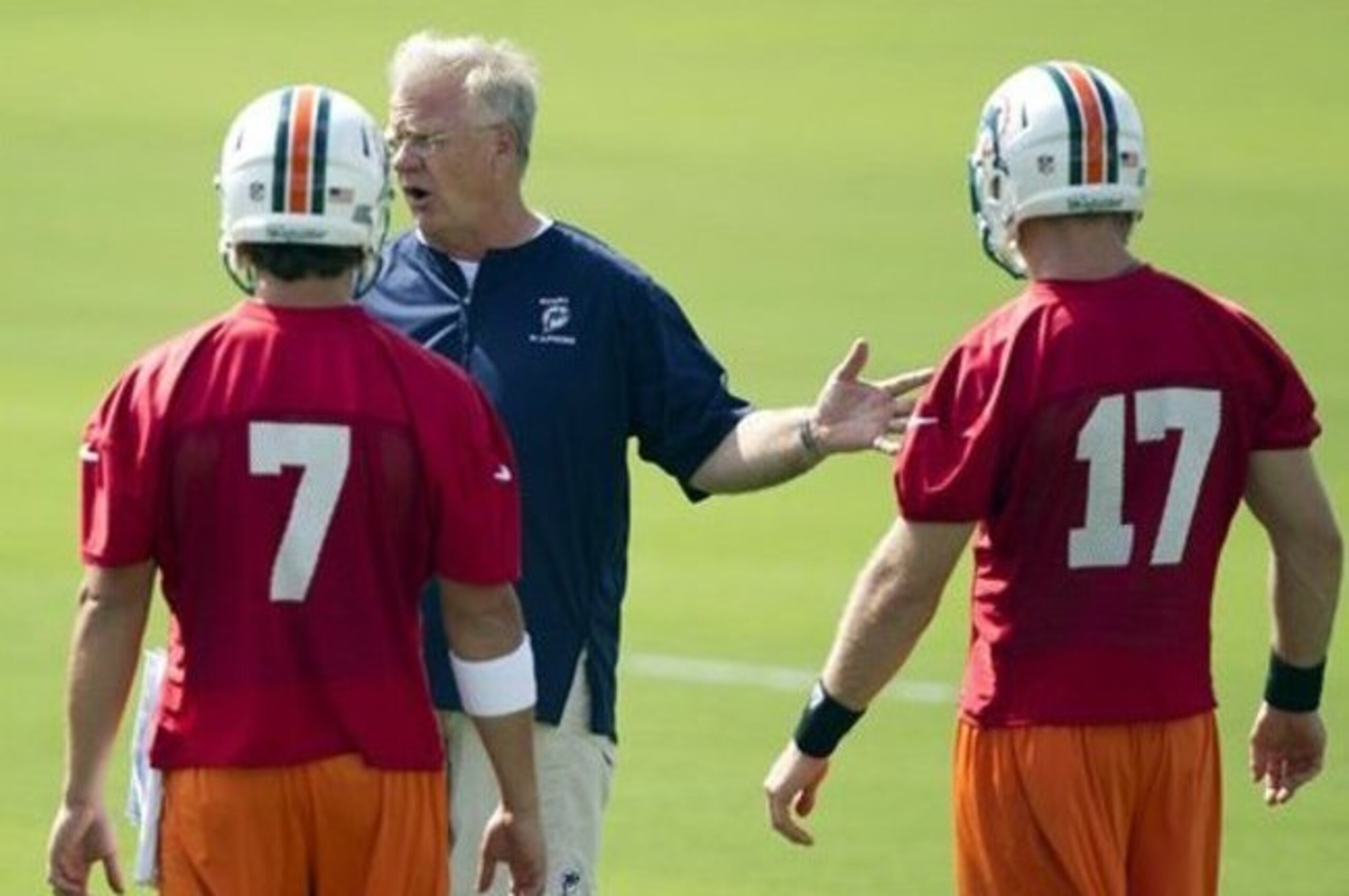
The decision Sherman wrestled with as part of that Dolphins coaching staff is familiar. Do you start the less talented but much more experienced veteran and use him as a bridge? Or is the first-round rookie ready?
The rookie usually gets the nod in this era of impatience at the position. General managers need an immediate return from a steep draft investment. That's increased the importance of tweaking what the young passer is working with to make him feel at ease.
“If he has to play so early in his career you better adjust that scheme so he has some success, and make sure not everything he does is brand-new,” Sherman added. “If every step he takes and every decision he makes is new, then he’s going to struggle. But if he has some familiarity with something—the terminology, or a route he can latch on to—then I think he’ll have a better chance at success.”
Time isn’t your friend at any point in the quarterback decision or evaluation process.
Coaches typically name a starter prior to the third preseason game, which is viewed as the regular-season dress rehearsal. They have about three weeks to make the most important decision of their season.
While doing that they’re trying to put a bright star inside as many boxes as possible. They’re hoping someone rises not just physically, but also mentally. They are digesting the minutiae offered by film study and advanced stats, and they're monitoring the intangibles often visible to only the trained eye.
Along the way there’s adjusting or retooling if the preseason decision wasn’t the right one. If the process is successful, then everyone involved gets to keep their jobs.
If it’s not, the quarterback search begins again—usually with new evaluators at the helm.
.jpg?w=2560 "DOLPHINS-AIKMAN")



.png?w=2560 "Week 8 Winners & Losers 📊")