

Diego Simeone and Pep Guardiola Meet Again in Battle of the History-Makers
There are countless different types of handshakes between opposing coaches at the start of a game. The warm embrace. The step on from that, stopping to shoot the breeze, as if they were fellow regulars in a bar. The brief, cordial, business-like salute. The briefest of eye contact, acknowledging the obligation of the ritual rather than enjoying it.
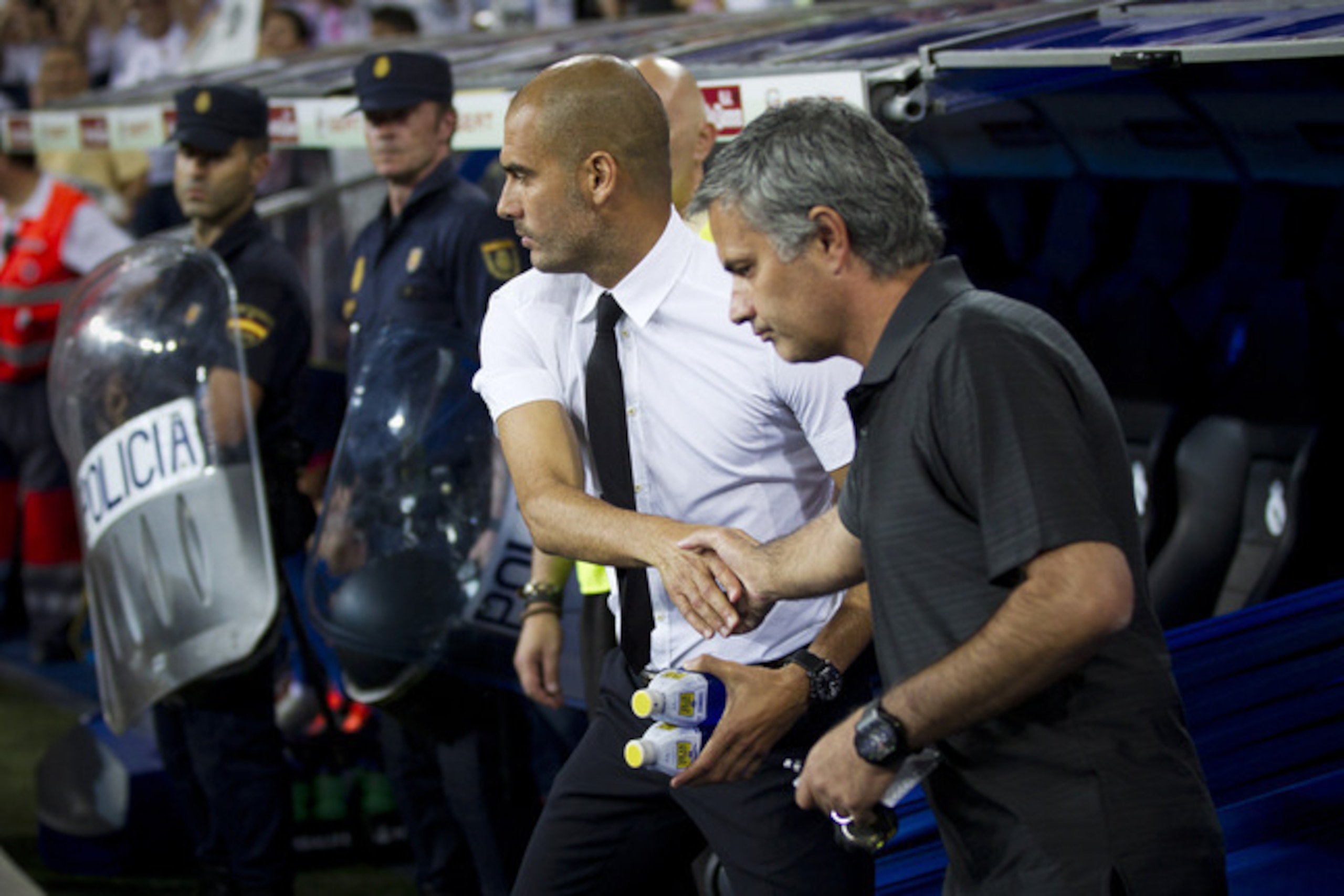
The moment when Diego Simeone and Pep Guardiola came together before kick-off at the Estadio Vicente Calderon last Wednesday was a curious one. They couldn’t help but be familiar with each other, but there was an element of anticipation—of recognition but inquiry—each trying to work the other out.

They’ve been two such prominent coaches in football’s elite level in recent years that it’s strange to register that they are virtual strangers, certainly in terms of facing each other on the bench, but the UEFA Champions League semi-final first leg between Atletico Madrid and Bayern Munich was only the second time they have met in their respective coaching careers.
Both were notable La Liga protagonists in the 1990s; Guardiola as the brain of Johan Cruyff’s Barcelona Dream Team, and Simeone playing the role of surprise goalscoring threat in the Atletico team that won the double in 1996 under Raddy Antic. "Cholo" had originally been summoned to Spain by Carlos Bilardo, arriving at Sevilla in the same summer as his compatriot, Diego Maradona.
Even if Guardiola was raised and Simeone imported—and the former was identified with architecture and the latter with demolition, as player as well as coach—they had plenty in common in terms of what they symbolised. As players, they were so strongly identified with the clubs with which they became Spanish champions that when they arrived back there as head coaches, it seemed pre-ordained.
That Guardiola took the helm of Barcelona’s first team, moving up from his successful charge of the B side, in 2008, seemed the most natural of fits. Let’s not rewrite history, though; if he is regarded as an innovator now, he was at least partly brought in as an in-house, safe pair of hands to bring stability to a dressing room that had become a mess.
Simeone had a similar steadying job ahead of him when he took the helm at the Calderon a few days before Christmas in 2011. He inherited an 11th-placed Atletico, 10 points from the Champions League places and just four above the drop zone, who haemorrhaged goals and had procured just a single point from seven La Liga away games.
He was a more experienced coach at first-team level than Guardiola had been, having already led Estudiantes and River Plate to titles. Yet he was arriving at a club which was a shambles on and off the pitch, and he had a transformative effect without time, huge resources or a pre-season.
Atleti finished up winning the UEFA Europa League in glorious style against Athletic Club Bilbao (coached by one of Guardiola’s mentors, Marcelo Bielsa) in Bucharest, and only missed out on a Champions League spot to Malaga on the campaign’s final day.
Those days in spring 2012 were significant ones. The sliding doors that would see Simeone and Guardiola move apart were already in motion.
On April 27, an exhausted-looking Guardiola announced his decision to quit. On May 9, Atleti won the Europa League. Sixteen days later, Barcelona beat Bielsa’s physically and emotionally spent Athletic 3-0 in the final of the Copa del Rey, held at Atleti’s Calderon home, for Guardiola’s 14th trophy of a breathtaking four seasons in charge.
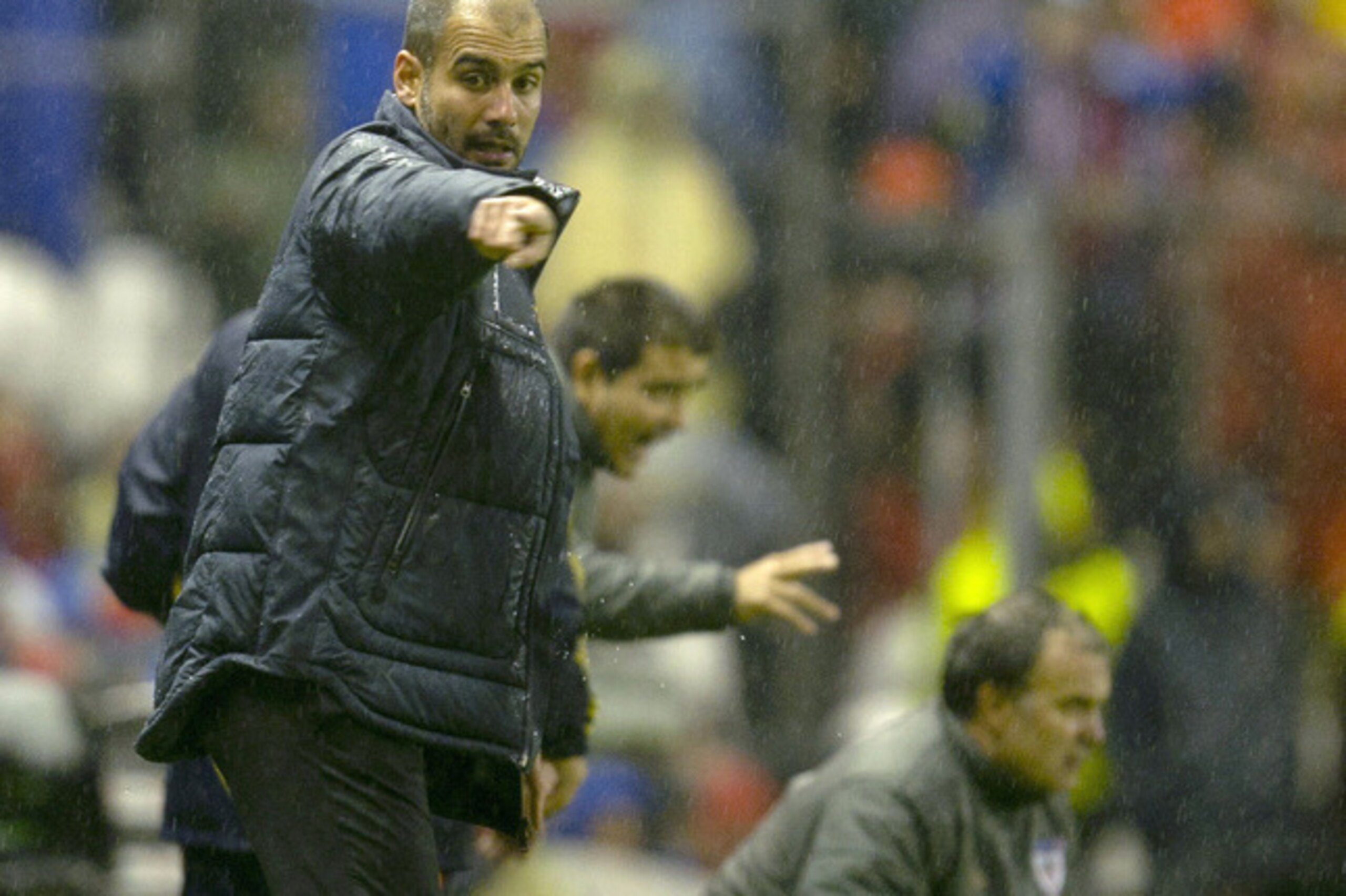
Simeone, it turned out, was barely getting started. It was a year after that before Atletico made their first real dent in Spanish football’s existing power base, overcoming Real Madrid in a fractious and thrilling Copa del Rey final at the Santiago Bernabeu Stadium.
By the time that Cholo’s greatest moment as Atleti coach arrived—the draw at Barcelona which confirmed Los Colchoneros as Liga champions of 2014—Guardiola had been gone from the Camp Nou for almost two years.
Seeing their coaching stars finally fully align should be fascinating. To read some assessments of their respective impacts on the game, you could be forgiven for thinking that it is good versus evil, with the Empire travelling to the Rebel Alliance with a one-goal lead to defend (and we really do mean defend) this week.
It’s a view reinforced by Xavi’s (negative) judgement of Atletico’s style under Simeone, as explained to beIN Sports’ Jorge Valdano in a recent interview, per AS.
If we go back to the one time Guardiola and Simeone faced each other as coaches in La Liga, in February 2012, the gulf in philosophy was already apparent. Read the Barcelona official site’s match report from then, and you’ll nod in familiarity with the claims of Atleti’s “ultra defensive” and “more physical approach."
Yet even if their styles are juxtaposed, it seems that there is a level of respect. There is unlikely to be the press conference fireworks of Guardiola’s frequent sword-crossing with Jose Mourinho—which reached its apex in 2011 with the clearly riled Catalan’s sweary outburst against the Portuguese, per the Telegraph—although we cannot rule out familiarity breeding eventual contempt.
They may not face each other again in the Premier League—despite intermittent speculation linking Simeone with a move to England, he is contracted until 2020 and unlikely to rush out on his club in the near future—but this season has continued to teach anybody who was unsure that Atleti are not an anomaly. They are here to stay and will continue to take their part in the sharp end of European competition.
That means that Simeone’s Atletico and Guardiola’s Manchester City could—and maybe even should—cross paths at some point over the coming seasons, perhaps multiple times, following on from modern European "clasicos" such as Barca and Chelsea, or Barca and Real Madrid on the continental stage.
What is plain, as they line up for their most important meeting as coaches yet, is that Guardiola and Simeone are both history-makers already, with much more still to write.


.jpg?w=2560 "Latest Peyton-Colts Rumors")


.jpg?w=2560 "Ugly Jets Scoring Stat 😳")
.jpg?w=2560 "Landing Spots for Trade Candidates 📍")