

Project QB Christian Hackenberg Won't Stop Jets' Ongoing Quarterback Carousel
When a team has been thirsting for a shiny new franchise quarterback, the worst sort of delirious dreaming can grab hold of decision-makers. That might be how Christian Hackenberg landed with the New York Jets.
He’s either the latest attempt at finding an early-round savior, as Geno Smith was three years ago, or he's the latest developmental project, just as Bryce Petty was in 2015. The truth lies somewhere in between, though he’s a little more Petty than Smith with a higher ceiling.
He also has more flaws, which go beyond glaring—they’re downright blinding. Oh, and Hackenberg has the added bonus of being more expensive than Petty too.
TOP NEWS
Contenders starting to separate themselves after Week 7
.jpg?w=2560 "Rams Raiders Football")
Raiders Could Start Mendoza

Geno Explains Wilson Exchange
The Jets used a fourth-round pick on Petty in 2015 (103rd overall), which was the appropriate price to pay for a passer who would need to be developed over several years and may still offer little even then. A Jets source told NFL Network’s Ian Rapoport a similar path lies ahead for Hackenberg.
“This is all about upside,” Rapoport reported shortly after the Jets announced Hackenberg as their second-round pick Friday night. “They believe in the talent, and they believe in the mental capacity he showed. This is a pick they’ve wanted to make for months. Their plan is to sit him and let him grow and be groomed.”
That would be a fine approach if the Jets and general manager Mike Maccagnan were bent on pursuing a pin-the-tail-on-the-project quarterback strategy while stockpiling Day 3 picks at the position. They’ll hit on one eventually, right? In the meantime Ryan Fitzpatrick—someone Rapoport said is probably re-signing, though ESPN’s Adam Schefter reported the two sides haven’t had a meaningful conversation in weeks—can serve as a capable bridge option.
But Hackenberg is a project who wasn’t selected in project quarterback territory. His services were deemed worthy of the 51st overall pick, making him the first passer off the board during Day 2.
That decision is curious at first. Then it’s confusing, and then you fight the urge to take a long walk deep into the night because nothing about quarterback evaluation makes sense anymore.
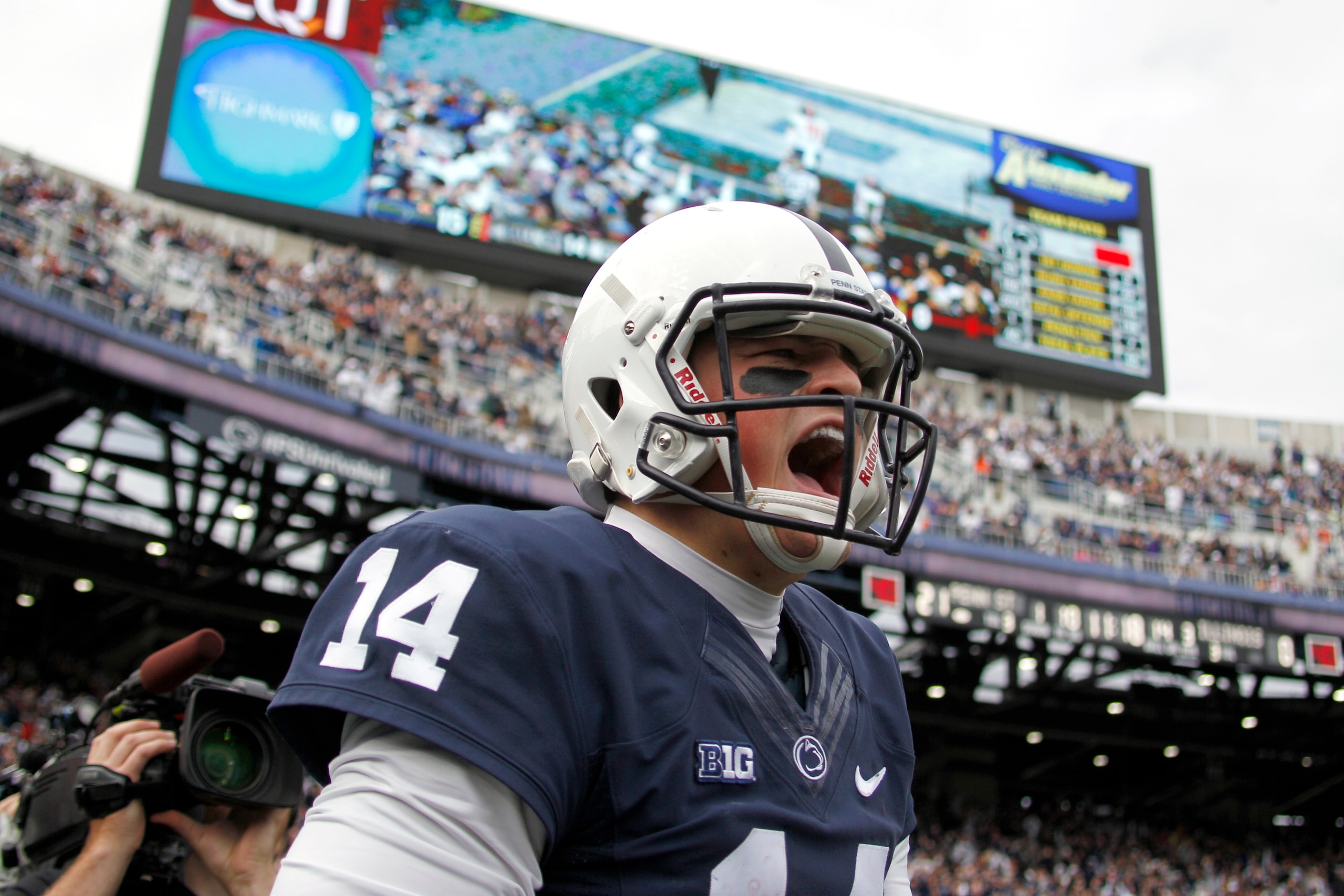
Confusion is a central theme with Hackenberg, and it’s hard to avoid it. He seemed destined for first-overall-pick consideration when a then-18-year-old freshman stepped into the rubble of Penn State’s post-sanction football program and thrived. His cannon arm jelled perfectly with Bill O’Brien’s pro-style offense, and having Allen Robinson as his primary source of wide receiver comfort didn’t hurt, either.
As a true freshman starter, Hackenberg launched sailing deep balls to the tune of 2,955 passing yards and a passer rating of 134.0, along with 20 passing touchdowns and 10 interceptions. A quick ascension into college football glory was surely ahead in the proceeding years.
Instead, Hackenberg’s play plummeted. And as Chase Stuart of FootballPerspective.com rightly noted, the end of that spiral isn’t in sight:
Hackenberg posted a still encouraging completion percentage of 58.9 during that one season working with O’Brien. Then he was suddenly lost when the quarterback whisperer bolted for the Houston Texans. He completed just 55.8 percent of his throws in 2014 and 53.5 percent in 2015.
The 21-year-old has attributes that glow. At 6’4” and 223 pounds, he’s a large-bodied quarterback, and the 2013 Big Ten Freshman of the Year has an arm so powerful it could rearrange fingers on the other end of throws.
Those qualities make him look like a quarterback. But looking like an NFL quarterback and playing like an NFL quarterback are two different things. That’s what separates projects from potential from Pro Bowlers. For Hackenberg to even get a whiff of the latter title, the Jets are assuming and hoping he overcomes a weakness that’s usually a quarterback poison pill: inaccuracy.
The thing about inaccurate passers is they typically don’t improve when the competition gets tougher.
The Tennessee Titans’ poor logic with Jake Locker serves as a cautionary tale. Locker was the eighth overall pick in 2011 after he completed only 54.0 percent of his pass attempts over four years for the Washington Huskies. His NFL career lasted four seasons, and he connected on 57.5 percent of his throws.
That investment in Locker stung much more because he was a first-round pick. The pressure on Hackenberg to shed his inaccurate and interception-scattering ways—he’s only one season removed from 15 picks and 12 touchdowns in 2014—isn’t quite that high. But it’s damn close, because even if we assume Fitzpatrick re-signs, the Jets still need a long-term answer at football’s most important position.
Saying that Hackenberg could halt a whirring quarterback carousel means believing he can reverse two years of sputtering in short order. It means convincing yourself he was the victim of a bad Penn State offensive line and a poor scheme fit for his final two seasons with the Nittany Lions.
That might partly be true, but those two outside factors alone aren’t enough to put second-round polish on a prospect better suited for the latter rounds.
Sure, Hackenberg was torpedoed too often and sacked a combined 82 times during the 2014 and 2015 seasons. But in 2015, he completed a pitiful 61.9 percent of his passes when facing no pressure at all.
As Sam Monson of Pro Football Focus observed, if that no-pressure percentage was Hackenberg’s overall completion rate, it would have ranked 44th in the nation. Monson also noted Hackenberg connected on 27.5 percent of his throws traveling between 11 and 20 yards downfield in 2015. The top QBs in this draft class hovered around 50 percent.
The Jets assessed Hackenberg and essentially came to this conclusion: He could revert back to the player he was in 2013, make us all forget two years of nightmare-fuel game tape and fundamentally change in a year or two.
That’s a standard gamble to make on Day 3. On Day 2, the Jets left Friday night drowning in risk and grasping at a mirage.
.jpg?w=2560 "Steelers Saints Football")




.jpg?w=2560 "🚨 Week 8 AP Top 25 Poll")