
2016 NFL Draft: Riskiest Prospects Likely to Land in Round 1
The 2016 NFL draft is finally here, and 31 players will hear their name called on Thursday night.
Some of these prospects will change the direction of their franchise, while others will inevitably turn into busts.
If teams could predict which prospects were going to turn into busts, then the term wouldn't even exist. But there are ways to sort out the prospects to determine which players are riskier than others.
For the purpose of this article, we'll refer to this as a prospect's "bust factor."
The following slideshow features seven risky prospects along with a bust factor grade assigned to estimate the risk involved. A player with a 10/10 bust factor would be a guaranteed bust, while a 1/10 would be among the safest picks in the draft.
When setting the bust factor grade, we'll focus on the odds that the player could become a complete failure in the NFL, or, more specifically, the odds that the player is not a starter by the end of his rookie contract (four or five years).
Kevin Dodd, DE, Clemson
1 of 7
There's a long list of one-year wonders who turned it on for their final collegiate season only to flop when entering the NFL. Kevin Dodd might be the next to join that group.
Dodd is 6'5", 277 pounds and moves extremely well for his size. In terms of physical build and ability, he's a prototypical NFL defensive end. So what took so long for him to get on the field at Clemson?
According to Clemson's team site, Dodd entered the 2015 season having played just 219 snaps over 24 games.
It's tough not to be a little skeptical when once the NFL paycheck is in sight, a prospect like Dodd suddenly comes from nowhere to generate 12.5 sacks and 24 tackles for a loss in one season.
To be fair to Dodd, he was partially blocked by 2015 first-round pick Vic Beasley. Maybe he was always capable of this performance, but the coaches just didn't want to take Beasley and Shaq Lawson off the field. But no matter the circumstances, there has to be some concern when drafting a player with such a limited track record of success.
Bust Factor: 3/10
Carson Wentz, QB, North Dakota State
2 of 7
It's been clear since the Senior Bowl that North Dakota State Bison product Carson Wentz's physical gifts are among the most impressive in this year's draft class. But arm strength and mobility don't guarantee success at the NFL level.
The major concern surrounding Wentz's transition to the NFL is how he will handle reading NFL defenses.
Wentz was a one-year starter in high school and started just over one year in college due to injuries shortening his senior year. There's still so much that he has never seen on the football field before.
If Wentz starts as a rookie, then opposing defensive coordinators will have no issue giving him complicated looks while disguising coverages.
That said, assuming Wentz lands in Philadelphia, the Eagles are in position to redshirt him for a least one season behind Sam Bradford and/or Chase Daniel. If Wentz learns how to read NFL defenses from the sideline and in the film room rather than on the field as a starter, then that will dramatically increase his odds of success.
Bust Factor: 4/10
Corey Coleman, WR, Baylor
3 of 7
There's no denying Corey Coleman's explosive talent. He racked up over 3,000 receiving yards during his three seasons at Baylor while averaging over 17 yards per reception.
Coleman benefited from Baylor's offense in terms of padding his stats and making a name for himself at the college level. But in terms of preparing for the NFL, Baylor is the wrong offense for wide receivers.
Baylor used Coleman almost exclusively on quick-strike passes near the line of scrimmage or on deep targets that were 30 or more yards down the field.
Pro Football Focus' Jordan Plocher shared an image of Coleman's targets from the 2015 season, which perfectly illustrated the lack of intermediate routes Coleman ran at Baylor.
Coleman clearly has the ability to develop into a more complete player, but there will be a learning curve for him in the NFL. Learning how to create separation from NFL cornerbacks won't happen overnight, and his rookie-year expectations should be set accordingly.
Bust Factor: 4/10


Darron Lee, LB, Ohio State
4 of 7
Ohio State Buckeyes' Darron Lee is a fascinating prospect, and his upside is as high as just about any defensive prospect in this class.
Lee was a quarterback and cornerback in high school, so the redshirt sophomore only has two years of starting experience in his role as a linebacker.
His lack of experience could be viewed as positive, indicating that he has plenty of room for growth, especially given his background as a cornerback.
However, there's no guarantee in the NFL that players will reach their potential. NFL coaches are so focused on winning now and keeping their jobs that sometimes player development becomes secondary. If Lee lands in a bad coaching situation, then it's possible that he'll never reach his ceiling.
The most notable issue Lee must fix is his tackling technique. As an undersized linebacker, Lee can't get away with his sloppy approach to tackling that he showed at Ohio State. Lee rarely squares up the ball carrier to deliver a finishing blow. He often attempts weaker arm tackles instead.
If Lee puts in the work and gets the support from his coaches, then he could reach his All-Pro potential, but he's probably a few years away from achieving that level of play.
Bust Factor: 4/10
Vernon Hargreaves, CB, Florida
5 of 7
The most obvious concern for Vernon Hargreaves is his size. He measured just 5'10" with 30 ⅝” arms at the combine, and he's entering a league that is increasingly favoring cornerbacks with length.
Hargreaves also lacks the elite speed to make up for his size, running just 4.50 seconds in the 40-yard dash at the combine.
With a lack of size and pure speed, Hargreaves doesn't have much margin for error in his game. He is usually technically sound, which is why he's still considered a first-round pick. However, there have been wildly inconsistent swings in his performance.
Hargreaves' career at Florida ended with a thud, getting burned multiple times by Michigan receiver Jehu Chesson, including this touchdown. Given Hargreaves' obvious talent, it's hard not to question his effort when mistakes like this pop up with no other explanation.
For Hargreaves to succeed at the NFL level, he'll need to be locked in at all times and eliminate the lapses in effort that appeared to plague him at times during his career at Florida.
Bust Factor: 5/10
Will Fuller, WR, Notre Dame
6 of 7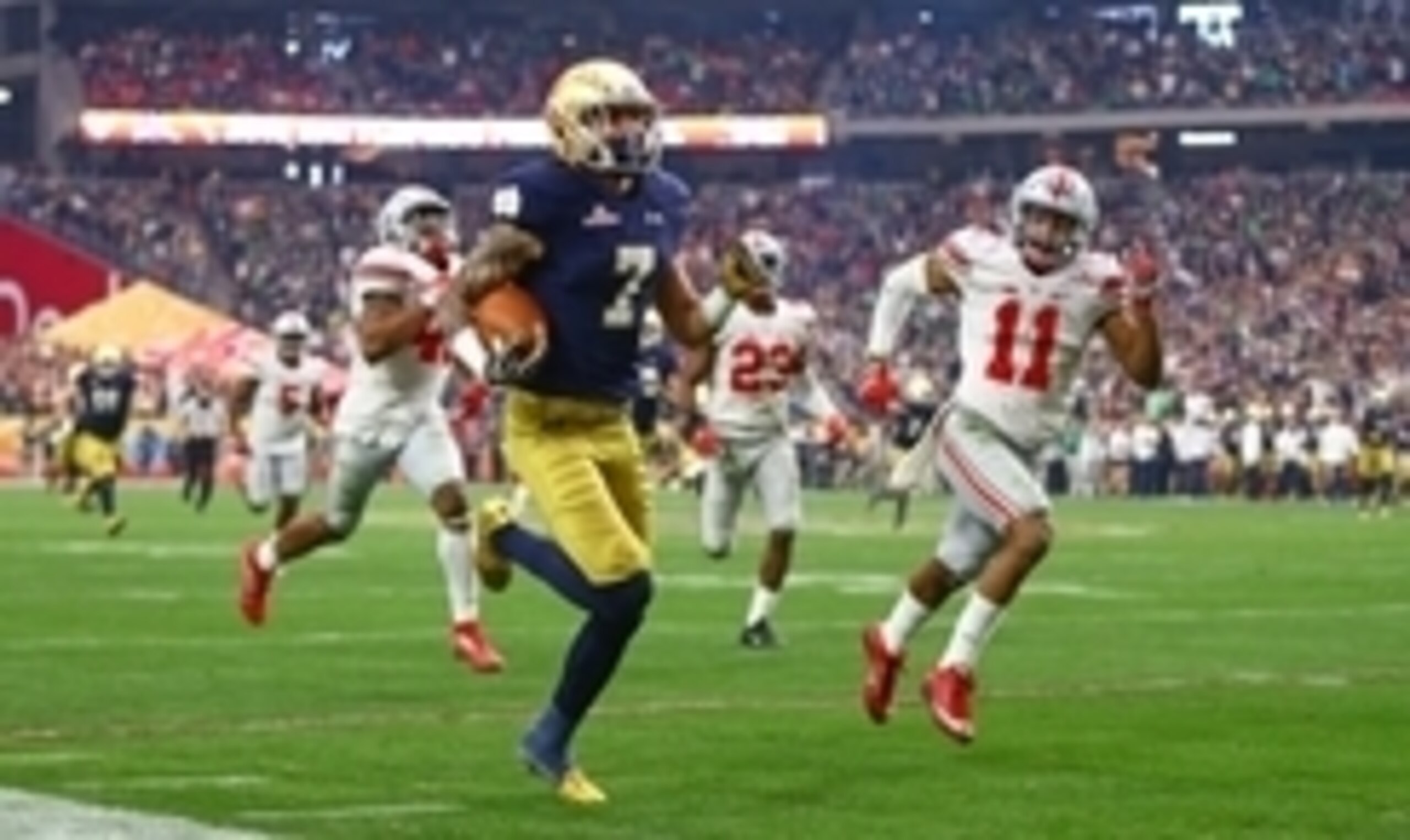
Will Fuller's hands are his most glaring flaw, and that alone could derail his NFL career. According to Jeff Dooley of Pro Football Focus, Fuller had a drop rate of 14 percent—the third-worst rate among receivers in this draft class.
Concerns about Fuller's game go much deeper than his inability to haul in the football, however.
Even if Fuller had reliable hands, he is an extremely one-dimensional player.
Fuller relies heavily on speed to create separation down the field, but if he doesn't create space, then his production dramatically drops off.
When going for contested targets, Fuller hauled in just 11 of 28 targets—a substantially lower rate than many other top receivers, according to CFB Film Room.
There is definitely value in speed, and Fuller will make an impact simply by forcing the defense to account for his ability to break free down the field. But if he fails to develop in other areas of the game, then can a team afford to keep him on the field as a starter?
Bust Factor: 6/10
Paxton Lynch, QB, Memphis
7 of 7
Paxton Lynch is fun to watch, but there is a long road ahead before he's ready to harness that playmaking ability and turn it into production at the NFL level.
If Lynch were to land in the right situation with a team willing to take two to three years to develop him from the bench, then concerns about his bust factor would diminish greatly. But that doesn't seem likely, as the Jets and Broncos—two teams in the market for a 2016 starter—are among the teams most often linked to Lynch in mock drafts.
Concerns about Lynch's transition to the NFL have little to do with his physical tools.
The issue Lynch needs to overcome is the Memphis Tigers' simplistic offense, which required very little of him in terms of decision-making skills before and after the snap.
Lynch is often seen locking on to a receiver rather than going through progressions, and he'll be easy for defensive backs to read in the NFL with his current approach.
Rookie quarterbacks who make a smooth transition to the league often shouldered much bigger mental responsibilities within their college offense—Andrew Luck being the classic example—and Lynch simply doesn't fit into that category.
Bust Factor: 7/10
.jpg?w=2560 "LA Premiere of \"Chad Powers\"")