

2016 NFL Draft: A Complete Look at This Year's Edge-Rushers
Even casual football fans know the difference between a first-round quarterback and a second-round quarterback. There is such a finite amount of talent at that position that the vast majority of elite prospects are selected early in the draft.
Though the position isn't discussed in the same manner, pass-rushers have the same type of splits. Between 2005 and 2013, 47 first-round pass-rushers have been drafted. Twenty-one of them, about 45 percent, have reached double-digit sacks in a single season. In the same time span, 32 second-round pass-rushers have been drafted, with only four, about 13 percent, ever reaching double-digit sacks.
Fifteen of the 47 first-round picks have posted multiple seasons of double-digit sacks, good for 32 percent, while only two of the 32 second-rounders, 6 percent, can claim the same. In the third round, that number is three of 26, 12 percent, but includes Justin Houston, a first-round talent who fell due to a failed drug test at the combine, and Justin Tuck, a first-round talent who was coming off a lingering knee injury.
In the fourth round, the successful double-digit sack artists dropped to two of 35, again around 6 percent. In other words, if you're looking at edge prospects, you're best served by focusing on the top of the draft.
According to Play the Draft, a website built on quantifying draft stock, 10 pass-rushers are slated to go in the top 50 picks of the 2016 draft. We'll break down the positives and negatives and give out comparisons for these prospects, in order of their FRX, which is essentially Play the Draft's over-under of when they will be drafted. There are also seven dark-horse prospects to keep an eye on as developmental projects or role players. After reading this, you'll be armed with all you need to know about the position heading into the draft.
Joey Bosa, Ohio State
1 of 11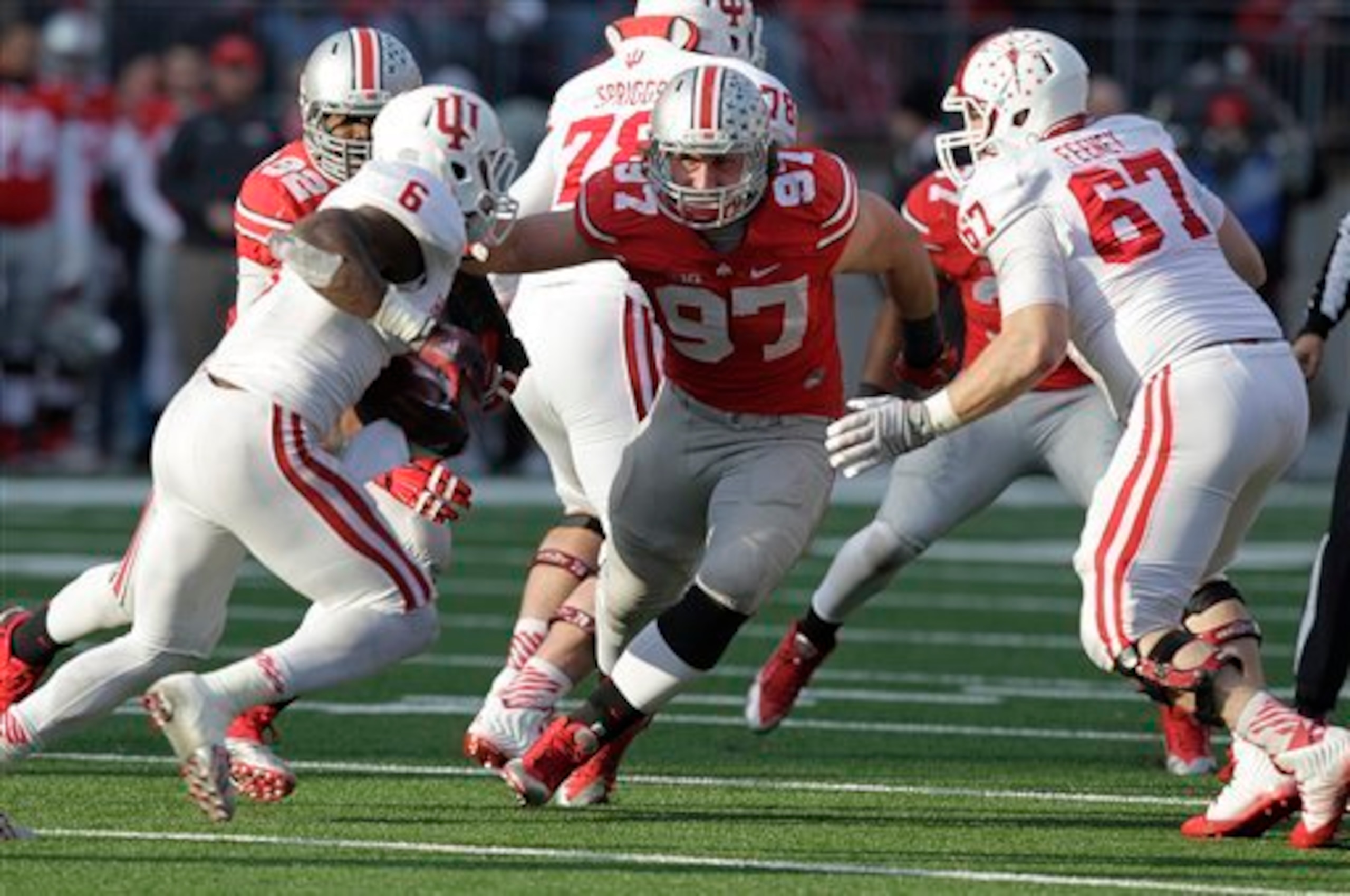
FRX: 5.1
Many will make a big deal of Joey Bosa's 4.86-second 40-yard dash, but that particular drill is the least important timed drill at the combine. The Ohio State product scored in the 90th percentile in the 20-yard shuttle and the 93rd percentile in the three-cone drill for defensive ends, per Mock Draftable.
Bosa, the son of a Miami Dolphins first-round defensive lineman and the nephew of another, has been a college phenom since his true freshman season with the Buckeyes, when he earned Freshman All-American honors. At 6'5" and 269 pounds, he's been on the NFL's radar for three seasons.
When he begins his first NFL regular season in September, he'll be 21 years old. Of the 54 pass-rushers drafted in the first round since 2005, only eight have been that young to start their professional careers. That list of names includes starter such as Robert Quinn, Shawne Merriman, Jason Pierre-Paul, Aldon Smith and Mario Williams and busts such as Jamaal Anderson, Aaron Maybin and Derrick Harvey.
As a run defender, Bosa is one of the better defensive end prospects in the draft class. He's not a one-trick pony like a Bruce Irvin; Bosa can play on all three downs for any defense, despite his age.
He's more of a length and strength pass-rusher with technical skills; he's more akin to Chandler Jones than someone who is going to earn Defensive Player of the Year nominations based on pure athleticism, like Julius Peppers did in his prime. That's more than fine.
Bosa may never put together a 15-sack season, but in this draft class, a player who can average seven to eight sacks over 10 years is worthy of a top-10 pick. Bosa was suspended to start the 2015 season, for reasons which still haven't been answered in public, but if he's a clean character player, his high floor will make him a prized prospect.
Production comparison: Chandler Jones, Arizona Cardinals
Shaq Lawson, Clemson
2 of 11
FRX: 13.2
Shaq Lawson is one of the more polarizing prospects in this draft class. To some, he's a top-10 player and the best pass-rusher in a relatively weak class. To others, he's not even the best pass-rushing prospect on his own college defensive line, as Kevin Dodd was the late breakout star of Clemson's playoff run.
Lawson has a weird build at just under 6'3" and 269 pounds. A stout player, he looks halfway between a 3-4 outside linebacker and an under tackle. That alone may turn off some people, but when you adjust for his size, he's fairly similar to Ezekiel Ansah athletically.
If you remember the narrative on Ansah, he was tabbed as "just an athlete" coming out of BYU, as his late-in-life transition to football meant that he only started a half a season for the Cougars before he had graduated out of the program. Still, he was drafted fifth overall in 2013 by the Detroit Lions based on his pass-rushing upside on paper.
Lawson isn't being awarded the same narrative. He's being viewed as an edge-setter who is a better run-defending 3-4 outside linebacker prospect than a pass-rusher. When you adjust for Lawson's size, though, you can make the case that no first-round pass-rushers other than Von Miller and Melvin Ingram, who both had double-digit sack seasons in 2015, were as elite overall in terms of athleticism as him since 2005.
Lawson's body type and defensive scheme, where he often read the offensive tackle to begin his get-off like a 3-4 defensive end does, may trick some people. Players accumulate tackles for a loss through explosive bursts off of the line of scrimmage and are less random than sack totals. Lawson led the FBS in tackles for a loss with 24.5 in 2015, his single year starting in college football.
As a player, he's similar to Frank Clark coming out of Michigan last season. Clark, buried in Seattle's depth chart, looked like a star in the preseason and was able to post three sacks off the bench as a rookie. If Lawson receives more playing time than Clark, don't be surprised if he's an eight-sack player in his first season. He's also a prospect who may kick inside to 3-technique as an interior pass-rusher, which may also be Clark's future, replacing Michael Bennett down the line.
Stylistic comparison: Frank Clark, Seattle Seahawks
Leonard Floyd, Georgia
3 of 11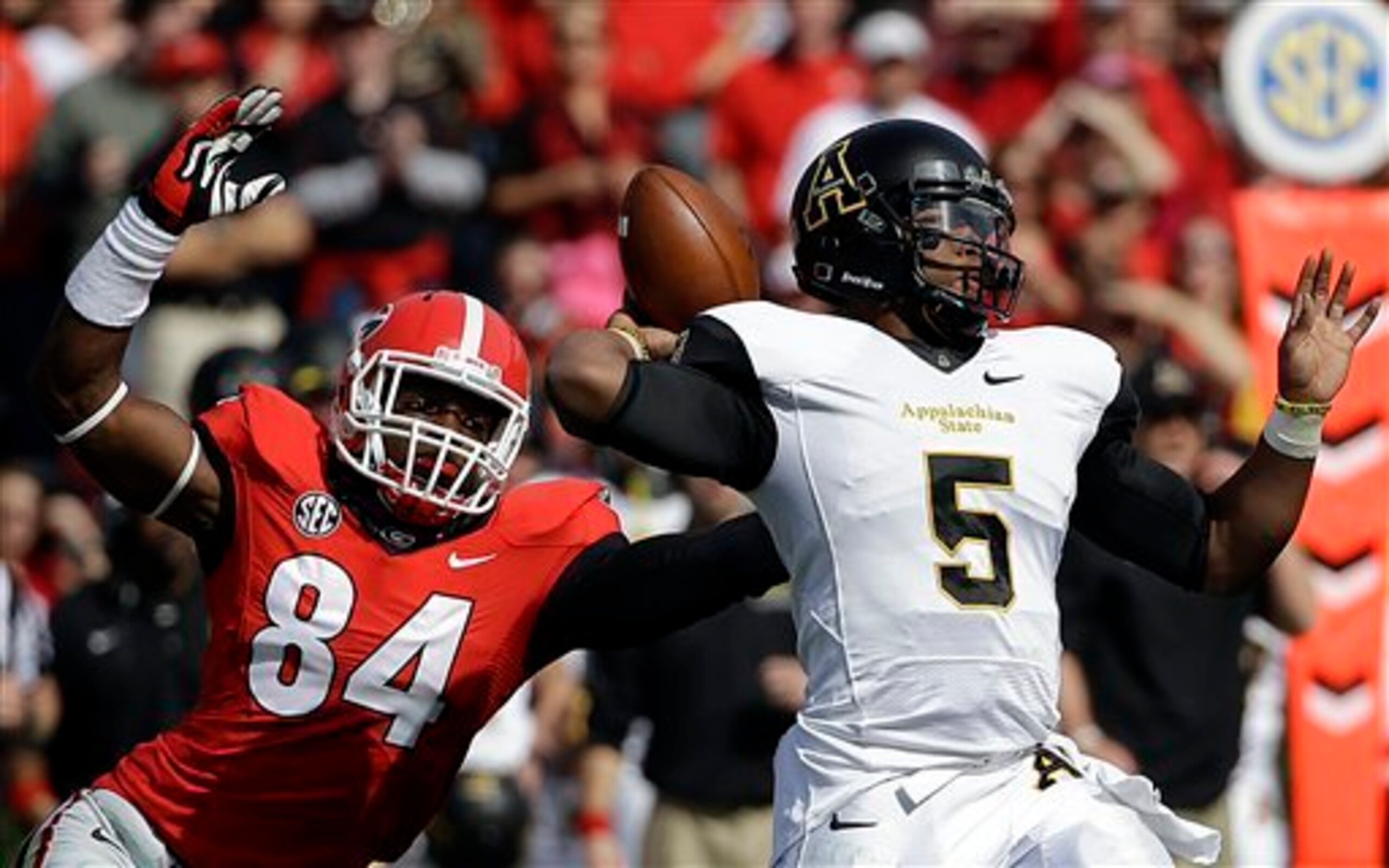
FRX: 17.4
If you want Leonard Floyd to make an impact as a pass-rusher, you're going to need to limit his reps on the edge. The University of Georgia realized this in 2015, when it moved him from 3-4 outside linebacker, a full-time pass-rushing position, to an off-the-ball linebacker role.
For the most part, defensive front-seven players are much better athletes than offensive linemen, both at the college and NFL level. Because of that, it's hard to play as a bookend, and, often, offensive tackles need to get in rhythm with a pass-rusher to successfully stop the defender's attempt at trying to ruin a play. This is where the Floyd evaluation gets tricky.
At 6'6" and 244 pounds, he looks like a receiver, not a defensive end. When bull rushing, he also looks like a receiver. His move is and always will be to bend around an offensive tackle, but without an effective, violent countermove, he's going to need to catch bookends off guard to get to the edge of them.
This is why an NFL team will need to limit his reps if it wants him to be a 10-plus sack player at any point in his career. He needs to surprise offensive tackles with his athleticism as a change-of-pace type of pass-rusher.
Ideally, he's a 4-3 outside linebacker who drops to defensive end on nickel looks, paired with a defensive end who kicks inside to 3-technique. That's the new pressure package in the NFL: take out the "Sam" linebacker and nose tackle. If a team already has a drop-down end, it can go from base defense to pressure looks by simply replacing a nose tackle with a slot cornerback, keeping the general personnel in the game. That's underrated.
Floyd is a quality football player, but he needs the right home. A player in recent years who was similar to Floyd was Dion Jordan coming out of Oregon. Unfortunately, the Miami Dolphins tried to make him into a full-time defensive end, where he couldn't thrive, and three different suspensions have kept Jordan off the field. At 26 years old, he has three NFL sacks.
The Jordan comparison isn't a death knell for Floyd's projection but rather a cautionary tale of how much fit can impact a player's career.
Athletic comparison: Dion Jordan, Miami Dolphins


Noah Spence, Eastern Kentucky
4 of 11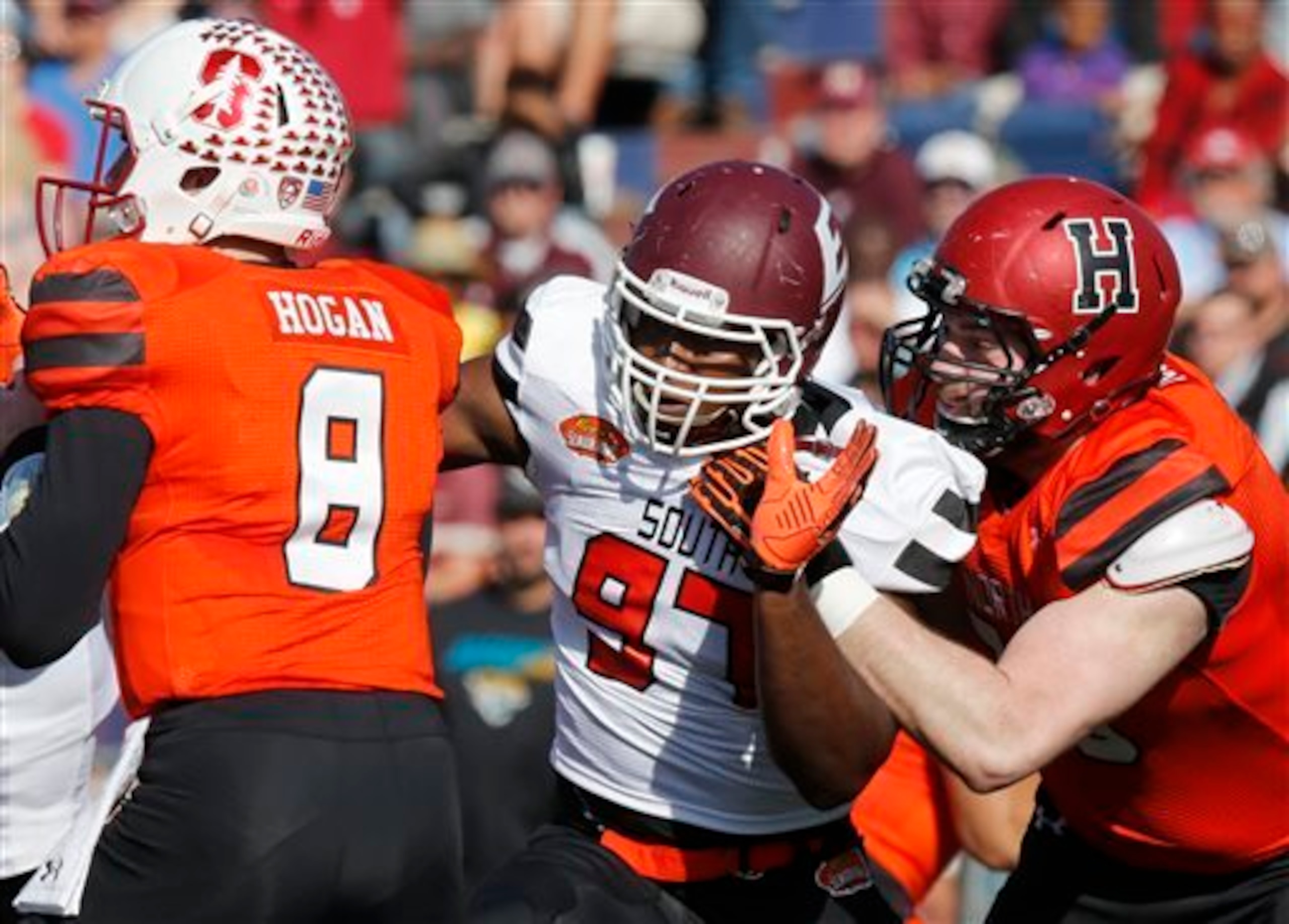
FRX: 31.1
Noah Spence could have played three years with Joey Bosa, had he not failed two separate drug tests. After being rated as the top defensive end recruit by 247Sports' composite rankings in 2012, Spence broke out with an eight-sack sophomore season, which was capped off by an Orange Bowl he wasn't allowed to play in.
That suspension eventually parlayed into a ban from the Big Ten. Spence flirted with the idea of turning pro as a true junior who hadn't played since the November of his sophomore season, his first year of significant playing time, but eventually he transferred to Eastern Kentucky on the recommendation of his former head coach Urban Meyer. But before he saw the field for the Colonels, he was arrested on public intoxication and disorderly conduct charges.
In the year since then, Spence hasn't had any public issues with his football program, school or the law. Still, his background at least warrants the question of whether he's worthy of a first-round pick.
Spence checked every box he could have at Eastern Kentucky. He thrashed FCS competition; when he faced Kentucky, an FBS school, he was the best player on the field. He even stood out at the Senior Bowl in Mobile, Alabama, where I was a firsthand witness.
The issue is, when you look at the offensive tackles in the NFL compared to who he's faced since his 2013 season ended abruptly, maybe one, Jason Spriggs of Indiana, is a likely NFL starter.
When you look at Spence's on-paper athleticism, which when adjusted for density matters significantly for pass-rushing prospects, he's good, not great. In fact, when you take in pro-day data, he's similar to Larry English, who, like Spence, beat up lesser competition in the MAC.
English was drafted 16th overall in 2009. In seven NFL seasons, he posted 12 total sacks and is currently a free agent. There are so many things going against the 6'2", 251-pound tweener that it's hard to consider him a first-round pick. Maybe a team desperate for a pass rush will take a shot at him in the second round, but the size-athleticism combo, potential character issues and level of competition questions are all concerning.
Athletic comparison: Larry English, former Tampa Bay Buccaneer and San Diego Charger
Emmanuel Ogbah, Oklahoma State
5 of 11
FRX: 31.8
Emmanuel Ogbah of Oklahoma State might be the fool's gold prospect of this draft cycle. If you look at his resume without context, he's an elite prospect. In his junior season with the Cowboys, he finished second in the FBS in sacks with 12.5. As a redshirt sophomore, his team opened up the season against Jameis Winston's Florida State team, which was coming off a national title, and he bugged the future first overall pick for 60 minutes.
Per Mock Draftable, his arm length is in the 95th percentile, and his 40-yard dash is in the 93rd percentile of defensive ends. At 6'4" and 273 pounds, he has a base-end frame.
Productive, athletic and big. Check, check and check. The issue is, when you turn on his tape, you're confused as to how he was able to bring in 12.5 sacks. There are times when he cleans up pressure from other Oklahoma State linemen, but he's not a high-motor guy, and he doesn't really "win" as a pass-rusher.
An NFC area scout was featured in Lance Zierlein's report on Ogbah for NFL.com, and his explanation of the Big 12 prospect sums up my thoughts on him: "He's stiff and upright so he has no counters as a rusher and then he doesn't even play hard all the time. If you are going to be the hulk, then play hard all the time."
As far as athleticism is concerned, Ogbah tested well in the 40-yard dash, but his agility scores were average. If you look back historically, a significant number of first-round busts at the position were fast but not agile. It rarely works the other way around.
So, he's big? In many ways, he's similar to a Kareem Martin or a Quinton Coples. Teams that like big base-end types may fall for the player, even to play 3-4 outside linebacker, but until he develops as a pass-rusher, he's not an impact player at the next level.
Athletic comparison: Kareem Martin, Arizona Cardinals
Jonathan Bullard, Florida
6 of 11
FRX: 31.8
If there's one candidate to be the defensive lineman selected way higher than anyone expects on draft day, it's Jonathan Bullard of Florida. First-step explosion is the most important trait for one-gap defensive linemen, and Bullard is only second to Mississippi's Robert Nkemdiche, who was once praised as a top-five pick before an Atlanta hotel episode.
Bullard's workout numbers may not look great as raw data, but he's a 285-pounder. When judged as a defensive end, there are few comparisons to his size, but names like Greg Hardy do pop up on Mock Draftable's "similar players" list. As a defensive tackle, though, he's an elite athlete.
Per Mock Draftable, Bullard's top active comparison is Sheldon Richardson, a Pro Bowl defensive end who saw some 3-4 outside linebacker looks at the end of his 2015 season. Another name on the list is Gerald McCoy, one of the elite 3-techs in football.
Bullard is never going to be an edge-bender, but he's violent as a 4-3 defensive end. He can luck into five or so sacks at that position alone on a yearly basis. His real value comes in as a hybrid player who can kick inside to defensive tackle on pass-rushing downs. While it seems like the Michael Bennett comparison is thrown everywhere this draft cycle, Bullard is one of the few players who it actually applies to.
He can't hang at defensive tackle for three downs, because he lives and dies with his first step inside, and losing a leverage battle on a run down can mean being double-teamed seven yards past the line of scrimmage. He's an outside-inside pass-rusher who can be an impact player with a creative defensive coordinator. For a new-wave team, it's within reason to think that after Ohio State's Joey Bosa and Clemson's Shaq Lawson, Bullard might be the third edge defender on a franchise's board.
Stylistic comparison: Michael Bennett, Seattle Seahawks
Robert Nkemdiche, Mississippi
7 of 11
FRX: 31.8
On draft day, Robert Nkemdiche may be a top-10 pick. He also may slip into the third round. He went to Mississippi as the biggest name in Rebels recruiting since Eli Manning, but his three-year career ended when he fell out of an Atlanta hotel window and was arrested for possession of marijuana.
There were times when he looked lethargic, showing no interest in beating double-teams. He was at Ole Miss to do his time between high school and the NFL, and he made his impact only in the backfield, not at the line of scrimmage.
On the other hand, there were games, like when he went against Alabama, where he played like his hair was on fire. If he put out a season's effort of games like he did against the Crimson Tide, when he beat every block, including double-teams, the Tennessee Titans might have kept the first overall pick and spent it on the SEC defender.
He's a young, freak athlete. In a league where under tackles like the New York Jets' Sheldon Richardson and the Green Bay Packers' Datone Jones are moving to the edge, Nkemdiche's potential to play outside right away is on the table. He did a little bit of everything for the Rebels, and playing him as a defensive end or outside linebacker on base downs and kicking him inside to defensive tackle in nickel looks allows him to take advantage of his athleticism while avoiding the double-team blocks that washed him out of plenty of plays in Oxford.
If he does line up as an edge defender, he'll join the names of Robert Quinn, Shawne Merriman, Jason Pierre-Paul, Mario Williams and Jamaal Anderson as athletic 21-year-olds drafted in the first round since 2005. Is he just another Anderson, or is he a Pro Bowl player like the other five names on the list? Nkemdiche is going to be as good as he wants to be in the NFL, which puts all 32 franchises in a "damned if you do, damned if you don't" situation.
Athletic comparison: Sheldon Richardson, New York Jets
Kevin Dodd, Clemson
8 of 11
FRX: 31.8
I'd be cautious of a players whose stock has been elevated significantly due to postseason games. Before the playoffs started, there was virtually no talk about Kevin Dodd of Clemson. When Aaron Brenner of the Post and Courier, a Charleston, South Carolina-based newspaper, wrote about potential Tigers underclassmen declaring for the draft on December 10, 2015, he didn't even mention Dodd.
Now, some believe that he's going to be the highest drafted prospect from the school. Why? Between the ACC championship game through the national championship game, Dodd posted 10 tackles for a loss and five sacks in three games, after posting 14 and 7.5, respectively, in the 2012 through 2015 regular seasons combined.
For reference, that's as an over-aged player who went to Hargrave Military Academy after high school, a prep school, instead of going straight to a university. Despite Dodd declaring as a junior, he did so as a redshirt junior who started his college career one year later than everyone else. He's a half a year older than Jadeveon Clowney, who was drafted two draft classes before Dodd will be.
The Clemson Tiger will enter his rookie season as a 24-year-old. Out of 54 pass-rushers drafted in the first round since 2005, only two, Ezekiel Ansah and Bruce Irvin, were older than 23 in Week 1 of their rookie campaign. Unlike Ansah and Irvin, though, Dodd wasn't an elite combine performer.
Dodd was on fire against Alabama in the title game, posting five tackles for a loss and three sacks, but one game does not make a first-round pick, and bringing in context for his performance clears up the perceived outlier.
He went head-to-head against Dominick Jackson, the Crimson Tide's clear weak link on the offensive line, while he played on a defensive line with Shaq Lawson, a potential top-15 pick, and D.J. Reader, a Senior Bowl attendee. Alabama plays a lot of single-back looks offensively, which means helping Jackson would either have had to have come from Derrick Henry, a Heisman-winning running back who had 158 rushing yards on the night including a 50-yard first-quarter touchdown, or from O.J. Howard, a tight end who recorded 208 receiving yards and two touchdowns as the championship game's MVP.
The fact that Alabama elected not to help the Jackson-Dodd matchup means that the staff didn't think Dodd's impact was enough of a difference to change the game, and it's hard to call Nick Saban and Lane Kiffin wrong when they left as victors.
Dodd is a fine prospect. At 6'5" and 277 pounds, he's a giant who can clean up sacks and will be a quality run defender in the NFL. His late hype after the postseason, parlayed by his size, reminds me of the rise of Margus Hunt. He was also an older prospect who dominated Fresno State in a 2012 bowl game, which burst him from a dark-horse player with plus size to the 53rd overall pick in the draft. In three years with the Cincinnati Bengals, Hunt has started zero games and has posted 12 tackles and 1.5 sacks.
Narrative comparison: Margus Hunt, Cincinnati Bengals
Shilique Calhoun, Michigan State
9 of 11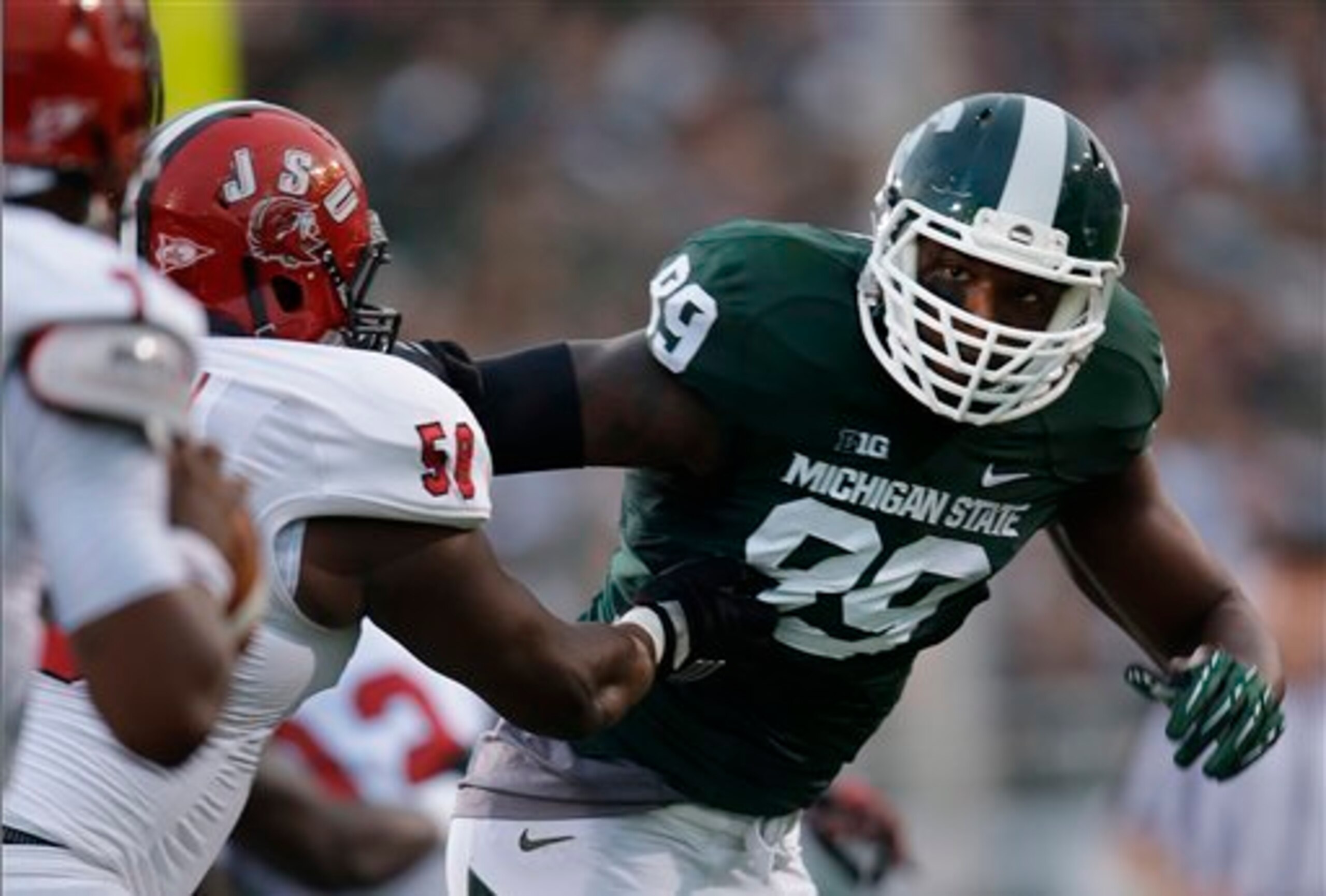
FRX: 49.4
One of the weirder careers in this class belongs to Shilique Calhoun. As a redshirt sophomore, he posted 7.5 sacks, earned All-Big Ten honors and was on some deep All-American lists. In the 2013 Rose Bowl, he dominated against Stanford's 6'7" Andrus Peat, who was the second bookend drafted in the 2015 draft class behind Miami's Ereck Flowers.
From there, though, Calhoun's college career plateaued. We've been waiting for him to take the next step for years, but he's just never been able to put it all together consistently. He's a streaky pass-rusher, netting 6.5 of his 10.5 sacks in his senior season over three games, including a 2.5-sack game against Central Michigan.
In that way, he's similar to Jacquies Smith, a speed rusher in Tampa Bay. Smith has posted 13.5 sacks in his first two years of playing time, but seven of them, more than half of his career total, have come in three of his 27 games played.
Despite his 4.82-second 40-yard dash and his 251-pound frame, Calhoun can still contribute at the next level as a pass-rusher, but his ideal role, at least early on, is going to be as the third man in a rotation. For a player who some thought had Aldon Smith-like upside early on in his career, that's disappointing. He's already 24 years old, so his potential is known.
If he's going to become a starter at the next level, he's going to need to be rebuilt as a more violent rusher. A recent player who did so is Aaron Lynch, who was a 3-4 defensive end at Notre Dame and then transferred to South Florida and reshaped his body. The San Francisco 49ers took Lynch in the fifth round and reshaped him again, and he's posted 12.5 sacks in two years with the team. Lynch just played his second NFL season at 22 years old, though, so he's two years younger than Calhoun is now.
Production comparison: Jacquies Smith, Tampa Bay Buccaneers
Kamalei Correa, Boise State
10 of 11
FRX: 49.7
Kamalei Correa is a trendy 3-4 outside linebacker candidate late in the process, but if you're seeking a 4-3 defensive end, you need to keep looking. In a 4-3 scheme, Correa plays more like a Sam linebacker, in the mold of Kyle Van Noy coming out of BYU, than a pass-rusher.
At only 243 pounds, he's not for everybody. Some 3-4 schemes may try to play him inside, but his 100th percentile three-cone and 94th percentile short shuttle, per Mock Draftable, will have most trying him on the edge before kicking him inside. Carl Bradford, who spent time at outside linebacker with the Green Bay Packers before moving to inside linebacker, is another player cut from the same cloth.
Despite Correa leading the Mountain West in sacks, he's not a developed pass-rusher at the moment. He's more of an athletic tweener who's best suited for an off-the-ball linebacker role out of the gate. Is a team going to invest a high pick on him and try to develop him as an edge defender? Draft day will answer the scheme projections for Correa, but the history of his type of linebackers hasn't been hitting recently.
Van Noy was drafted in the second round of 2014, while Bradford was taken in the fourth round of the same class. Together, they have one sack and zero starts over four seasons.
Stylistic comparison: Kyle Van Noy, Detroit Lions
Sleepers of Note
11 of 11
Kyler Fackrell, Utah State: Fackrell, a former high school safety, translates better as a drop end than a true pass-rusher in the NFL. A legit 6'5", the 24-year-old won't fit every defense, but he has a defined role in which he can thrive at the next level.
Jordan Jenkins, Georgia: Your typical jack-of-all-trades player. Unlike Leonard Floyd, Jenkins lined up as a true pass-rusher for his entire career at Georgia. Despite being a senior, whereas Floyd is a junior, Jenkins is still two years younger than his teammate at 21 years old.
Yannick Ngakoue, Maryland: Ngakoue declared as a true junior, and at 6'2" and 252 pounds, he's not the most menacing pass-rusher in the class. His 4.75-second 40-yard dash checks out with Sam linebackers and 3-4 outside linebackers. Don't be surprised if Ngakoue makes a nice career for himself in an Anthony Barr-type of role.
Charles Tapper, Oklahoma: As a sophomore, Tapper was considered one of the better young pass-rushers in college football. His 2013 campaign was highlighted by running down then-Alabama receiver Amari Cooper. The year after, though, Oklahoma moved into a two-gapping defense on the line, which nullified Tapper's best trait, his explosion. According to Mock Draftable, his 4.59-second 40-yard dash ranks in the 95th percentile of defensive ends, and his body type is comparable to Cameron Jordan, Preston Smith (who led rookies in sacks in 2015) and Robert Quinn. Tapper is one of the biggest boom-or-bust projects in the class at any position.
Stephen Weatherly, Vanderbilt: Weatherly is a junior declaration from Vanderbilt with an explosive 6'4", 267-pound frame, based on his combine and pro-day numbers. When watching him on film, though, it rarely flashes. Is he a lesser version of Bud Dupree or Danielle Hunter from a year ago? Will his resume of "underclassman," "athleticism" and "SEC pass-rusher" bait a team into taking him before the sixth round?
Alex McCalister, Florida: At 6'6" and 239 pounds, McCalister looks more like a receiver than a pass-rusher in his No. 14 Florida Gators jersey. He has insane dip-and-bend ability, which reflects on his 7.01-second three-cone drill and 4.00-second 20-yard shuttle, but that's his only move. If he fills a role as a limited pass-rushing specialist, earning his keep on special teams, he may have a shot to be one of the better role players in the league.
Tyrone Holmes, Montana: Quietly, Holmes led the FCS in sacks during his senior season at Montana and is also one of the best density-adjusted athletes in the draft class. After Shaq Lawson of Clemson, Holmes might be the No. 2 edge defender in terms of on-paper potential for his size. He's a nuanced pass-rusher who has quick countermoves, but he is going to be a specialist early on. In the same way that Jerry Hughes needed some years under his belt before his breakout, Holmes may be a late-career 10-sack defender.
.jpg?w=2560 "LA Premiere of \"Chad Powers\"")



.jpg?w=2560 "Landing Spots for Trade Candidates 📍")
.jpg?w=2560 "Ugly Jets Scoring Stat 😳")