Matching Best Scheme Fits for Draft's Top Tight Ends
Any team in search of a tight end in the 2016 NFL draft should set low expectations.
For the second consecutive year, the first round of the NFL draft will likely pass without a tight end coming off the board. In fact, it's possible that no tight end could be selected within the top 50 picks, which hasn't occurred since 1994.
That doesn't mean there isn't talent in this tight end class, however.
A handful of prospects could land within the top 100 picks, and a few of them have the potential to develop into long-term starters. But the prospects in this class with the highest ceilings are also the ones with the most limited immediate value.
Any team in search of a tight end from this class is going to have to either target a developmental prospect or one who is severely limited in one area of the game.
Here's a look at the few prospects with the potential to earn a starting gig at the next level, and the type of role they're best suited for in the NFL.
Hunter Henry, Arkansas
1 of 6
In terms of production, Arkansas' Hunter Henry stands head and shoulders above the rest of this year's tight end class.
Henry's role in the Arkansas offense expanded in each of his three years in head coach Bret Bielema's offense, culminating in 51 receptions for 739 yards and three touchdowns in 2015.
Unlike many of the elite tight ends in the NFL today, Henry is not an explosive athlete. However, he has great hands and is proficient at working the seam.
The biggest knock against Henry is his lack of pass-protection ability, and teams will view him as a liability in that area. Former NFL scout Bryan Broaddus didn't hold back in his assessment of Henry and called him a "terrible blocker."
Teams that rely on the in-line tight end to play a role in pass blocking may not view Henry as a viable option.
However, he could play a specific role as a pass-catching tight end in the NFL, in much the same way the Indianapolis Colts used Coby Fleener in recent years. The Colts primarily used Dwayne Allen as their in-line tight end and allowed Fleener to get more reps as a "move" tight end.
Henry could become a productive weapon in a similar two-tight end system in the pros.
Potential fits: Los Angeles Rams, Indianapolis Colts, San Diego Chargers
Nick Vannett, Ohio State
2 of 6
Nick Vannett is a tough prospect to evaluate because the tight end position has been a non-factor in head coach Urban Meyer's offense since he joined Ohio State.
In each of the past two seasons, the 6'6" Vannett caught just 19 passes, almost exclusively on targets within five to 10 yards of the line of scrimmage.
Vannett's limited role won't impact how the NFL views his upside, however. In 2015, former Ohio State tight end Jeff Heuerman, who caught just 17 passes his senior year, was a third-round selection of the Denver Broncos.
Despite his limited role as a weapon in the passing game, Vannett saw plenty of playing time for the Buckeyes and has experience lining up as an in-line tight end, in the slot and even out wide.
With his combination of size and athleticism, Vannett has value as an every-down tight end. He may not offer elite skills in any one area, but he can contribute as a blocker and has the skills to play a larger role in the passing game as well.
Potential fits: Atlanta Falcons, Chicago Bears, Dallas Cowboys
Austin Hooper, Stanford
3 of 6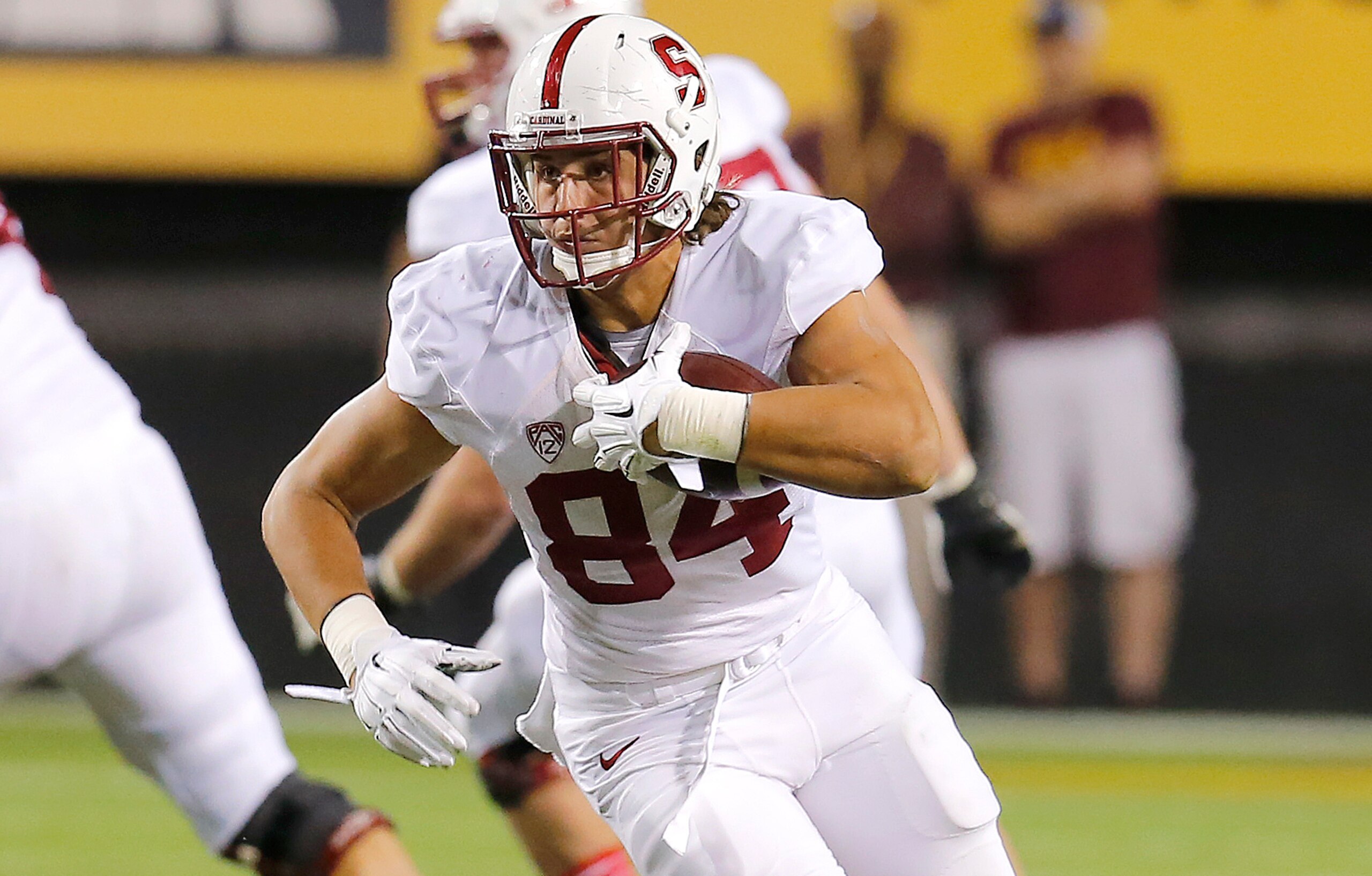
Stanford has developed into a tight end factory in recent years, and Austin Hooper is their next future pro.
Hooper is a redshirt sophomore who is still developing, especially as an in-line blocker, and he may not be ready for a significant role early in his pro career.
In terms of his Stanford predecessors, Hooper compares best to Coby Fleener.
Like Fleener, Hooper struggles as an in-line blocker and simply lacks the lower-body strength to anchor against stronger edge-rushers. However, he's an above-average athlete with a decent catch radius, giving him some upside as a receiver.
Hooper lacks explosive athleticism and won't be a downfield target, but if he can further develop the suddenness in his routes and cut down on his drops, he can become a reliable weapon on short and intermediate routes.
Teams with the most interest in Hooper will likely be those that already have a reliable in-line tight end but are looking for someone to develop as a weapon in the passing game.
Potential fits: Kansas City Chiefs, New England Patriots, Cleveland Browns


Jerell Adams, South Carolina
4 of 6
Jerell Adams enters the league with many of the same concerns as his fellow tight end prospects, but he does have one skill that sets him apart: speed.
Adams is one of the few tight end prospects in this class who can stretch the field, and his ability to attack the seam is a small notch above Hunter Henry.
However, Adams remains a project who still displays shaky routes and inconsistent hands.
Physically, Adams has traits that compare favorably to Jacksonville Jaguars tight end Julius Thomas. And like Thomas when he entered the league out of Portland State, Adams will be a long-term developmental project.
Teams interested in Adams will likely be limited to those in search of a Day 3 developmental prospect they can bury on the depth chart for a season or two.
Potential fits: Green Bay Packers, Tennessee Titans, New England Patriots
Tyler Higbee, Western Kentucky
5 of 6
Western Kentucky's Tyler Higbee was one of the fastest-rising tight end prospects this season, as the former wide receiver made significant strides in his first full season as the team's starter at tight end.
However, Higbee struggled to stay on the field in 2015. He missed time on two separate occasions with a recurring sprained knee.
The injury, which prevented Higbee from working out at the combine, complicates his evaluation. But if healthy, he's among the best athletes at the position in this draft class.
Higbee still plays the position like a receiver by running crisp routes and knowing how to position himself against coverage for contested catches.
The major weakness in his game, predictably, is blocking. He shows little power as an in-line blocker and should be used almost exclusively a "move" tight end in the NFL.
The knee concern likely pushes Higbee to Day 3, but he'll be among the prospects with the highest upside in the late rounds of the draft.
Potential fits: Arizona Cardinals, Denver Broncos, Jacksonville Jaguars
Ben Braunecker, Harvard
6 of 6
Harvard doesn't attract much attention from the NFL, but Ben Braunecker has a chance to be among the first tight ends off the board.
Against lower-level competition, Braunecker dominated in all aspects of the game. However, especially as a blocker, there are concerns with how he'll handle the jump to the NFL.
At 6'3", 250 pounds, Braunecker lacks the overwhelming size to allow teams to project a continuation of his blocking success as an in-line tight end. However, he also isn't undersized and could potentially remain effective once he adjusts to the increased size and speed of his NFL opponents.
As a receiver, Braunecker will likely be most valuable as a weapon on short and intermediate routes, as he lacks the speed to stretch the field. However, he tested extremely well in the agility drills at the combine and should be able to refine his technique to create separation on underneath routes.
Despite lacking elite skills in any one area, Braunecker offers versatility, and a team could potentially develop him as an in-line or "move" tight end.
Potential fits: Dallas Cowboys, Chicago Bears, Los Angeles Rams
.jpg?w=2560 "LA Premiere of \"Chad Powers\"")