

2016 NFL Draft: Immediate Roles for Top Defensive Linemen
With the NFL draft just over a month away, you're probably already familiar with the biggest names.
When it comes to matching a player with your team's biggest needs, however, it takes a lot more than simply knowing the top guys at each position, especially at a complex position such as the defensive line.
Scheme plays a significant role in how a team puts together its draft board.
Here's a breakdown of 10 of the most highly touted defensive linemen in terms of what role they can play at the next level.
Since we're specifically looking at defensive linemen, the focus will be on each prospect's role as a down-lineman, with the understanding that some of these prospects may also draw consideration from teams as 3-4 linebackers.
Joey Bosa, Ohio State
1 of 10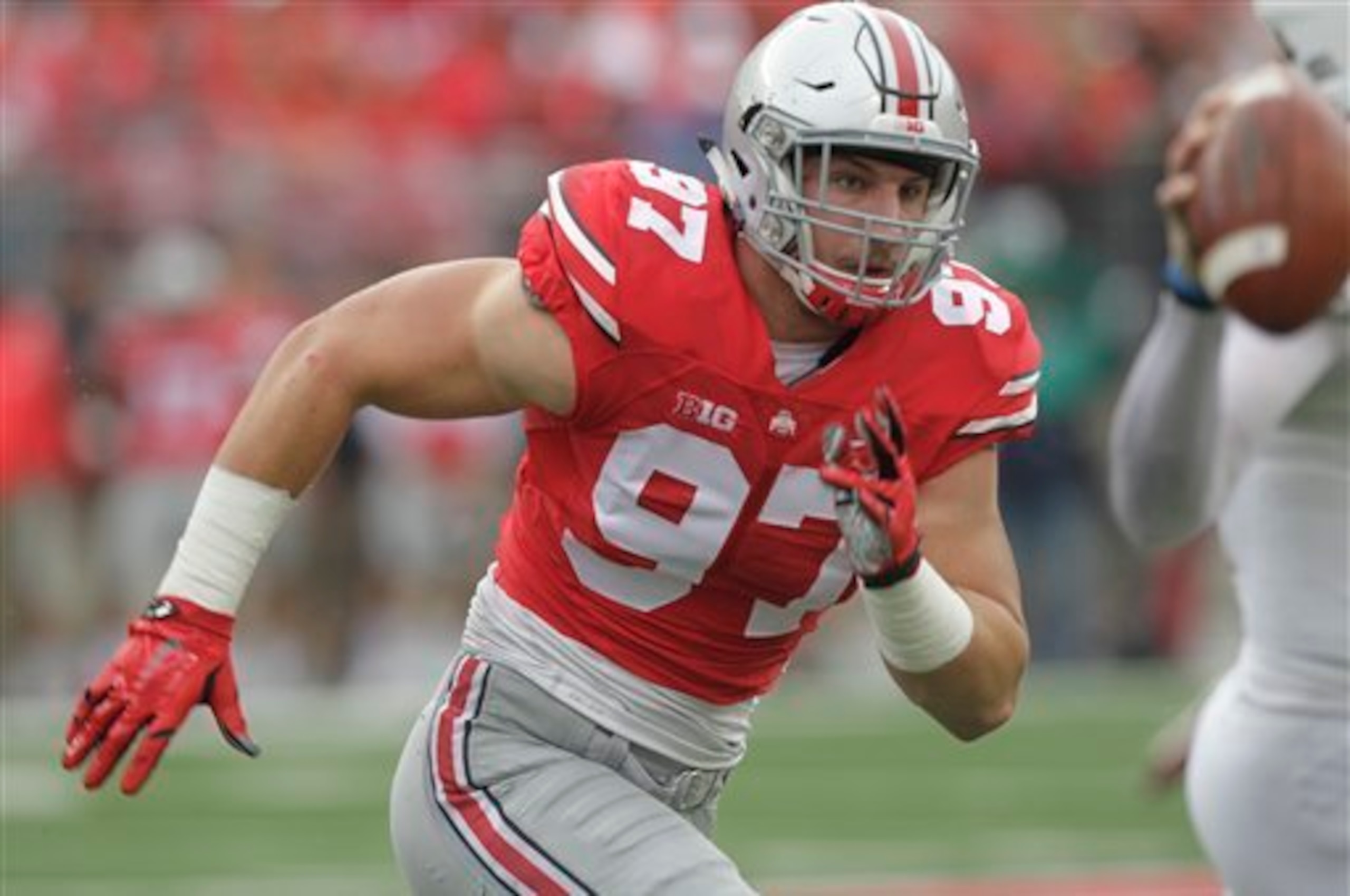
Joey Bosa played the left defensive end position at Ohio State and is best suited to remain in that role in the NFL.
While Bosa has the skills to be a productive pass-rusher in the pros, 4-3 teams generally prefer to have their speed-rusher on the right side to attempt to generate instant pressure on the quarterback's blind side.
Since Bosa wins more with power than pure speed, that makes him a better fit to stay on the left.
The fact that Bosa isn't an elite speed-rusher shouldn't take away from his status as the best defensive lineman in this class, however. Many pass-rushers who win with a combination of power and agility rather than pure speed have succeeded on the left side, such as Jared Allen and Julius Peppers.
DeForest Buckner, Oregon
2 of 10
At 6'7", 291 pounds, DeForest Buckner is an impressive physical specimen, and it makes him an extremely versatile prospect.
Oregon primarily set up in a 3-4 base in 2015, with Buckner lining up at defensive end. He has the size and strength to easily transition to the same role in the NFL.
In a 4-3 scheme, Buckner could play left defensive end or line up as a 3-technique tackle.
As a defensive end, he would be of most interest to teams who favor strength in the running game at that position. The Seattle Seahawks are an example of a team that is willing to give up some pass-rush productivity if they can start a dominant run defender like Buckner.
If he's shifted inside to the 3-technique tackle position, however, Buckner's quickness becomes an asset. He could emerge as a dangerous interior pass-rush threat in that role.
Shaq Lawson, Clemson
3 of 10
Shaq Lawson has the traits of an old-school defensive end who wins with pure power.
While he does have decent athleticism to bend around the edge, most of Lawson's quarterback pressures were generated with a combination of overwhelming power and a relentless motor.
Don't expect Lawson to be the type of pass-rusher who explodes off the snap and flies into the backfield. He just doesn't have that type of athleticism.
However, his combination of strength and effort wears on offensive linemen and he takes advantage when they slip up with a misstep in pass protection.
Although he played on the right side at Clemson, most teams will probably prefer to have Lawson in the left defensive end role in a 4-3 scheme in the pros.

.jpg?w=2560 "Cowboys Texans Football")
Kevin Dodd, Clemson
4 of 10
With Lawson manning the right side, Kevin Dodd lined up at left defensive end for Clemson in 2015. And there's no reason to project a move for him at the next level.
Like Lawson, Dodd isn't an explosive pass-rusher, but his strong upper body and long arms allow him to win with counter moves on his second effort.
At 6'5", 277 pounds Dodd has the build to add even more power to his game, and learning how to more efficiently convert speed to power will turn him into a consistent pass-rusher.
The biggest concern for Dodd in the NFL will be learning to cope with double teams if he lands in a defense where he's expected to be the primary pass-rusher. He greatly benefited from Shaq Lawson's presence at Clemson.
Sheldon Rankins, Louisville
5 of 10
Sheldon Rankins is a bit of an enigma as an athlete.
He doesn't carry his 299 pounds particularly well, but he moves like a man considerably smaller than his measurables would indicate.
As a shorter defensive tackle (6'1") with quick feet, it's easy to project him as a plug-and-play 3-technique in a 4-3 scheme.
His size allows him to easily play with good leverage, and his quickness allows him to shoot the gap in pass-rush situations.
Potentially, 3-4 teams could view him as an option at defensive end, but he would be most productive in all aspects of the game in a 4-3 system.
A'Shawn Robinson, Alabama
6 of 10
Just plug A'Shawn Robinson in at nose tackle and enjoy his production for the next decade.
Robinson played everywhere in Alabama's 3-4 scheme, but it's easy to see him transitioning into a role as a full-time nose tackle in the pros.
His biggest weakness in college was his lack of explosive athleticism, which showed up when Alabama used him on the edge. But Robinson consistently plays with the type of leverage and lower-body strength to anchor a line at the nose tackle position.
His upside might be limited but Robinson should be an immediate starter in that role in either a 3-4 or 4-3 scheme.
Vernon Butler, Louisiana Tech
7 of 10
Vernon Butler is an immovable object at the point of attack in the run game, making him ideally suited for the nose tackle position.
He can be plugged into that role, and his future team can expect immediate results.
However, Butler also shows some explosive athleticism in his game, closing quickly on quarterbacks and delivering big hits.
While it's easiest to project him as a nose tackle due to his size and lower-body strength, that role may actually undersell his potential contributions.
Butler should be viewed as a viable option as a 3-4 end, or even as a 3-technique tackle in the 4-3 as well. That type of versatility should draw interest from teams using multiple fronts.
Noah Spence, Eastern Kentucky
8 of 10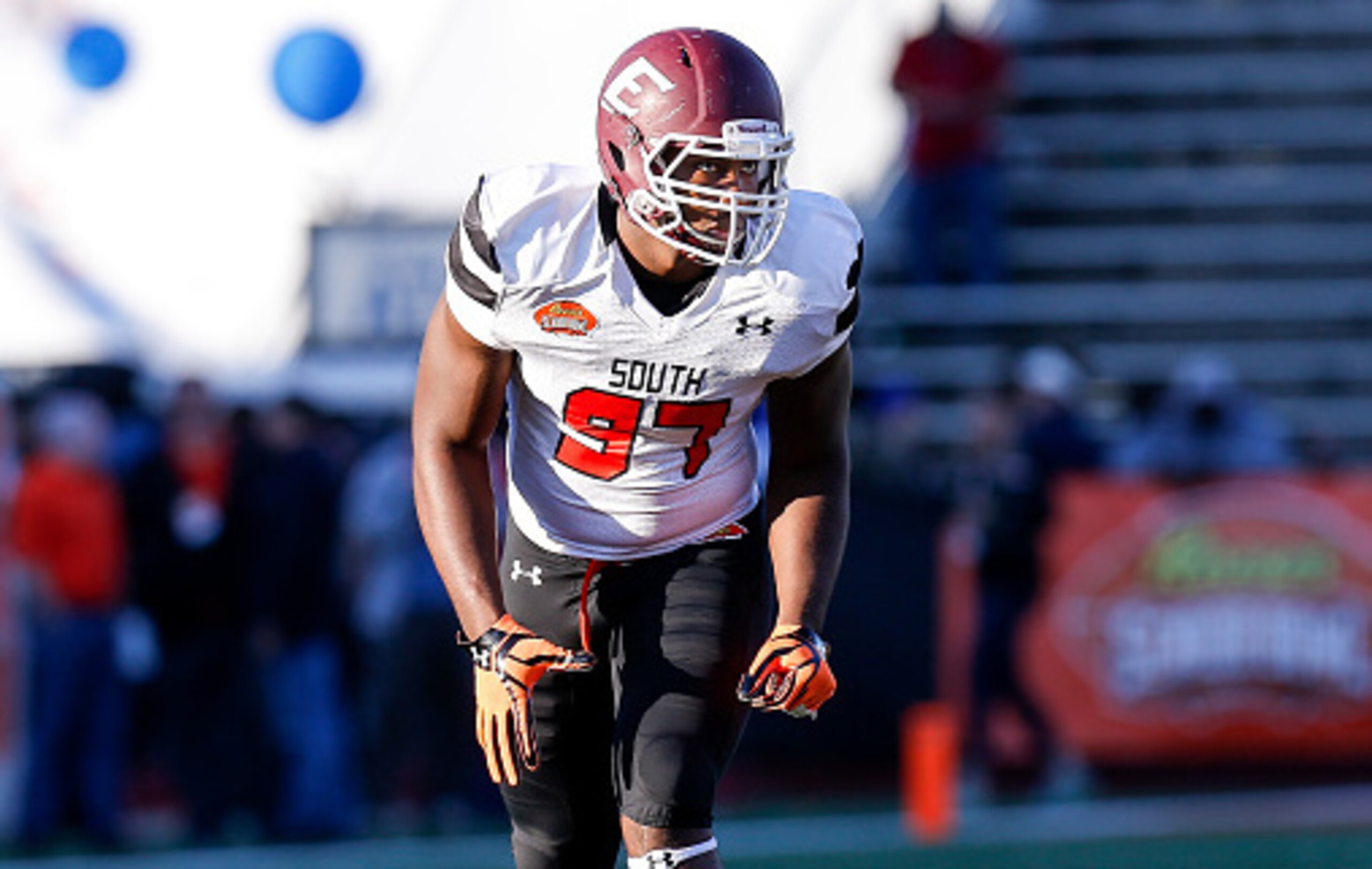
There's a good chance Noah Spence ends up playing linebacker in a 3-4 scheme, especially if he comes off the board in the first round.
However, his explosive pass-rush skills could draw interest from 4-3 teams as well.
If Spence ends up on the defensive line, it's unlikely he would be a starter early in his career.
Spence simply lacks the power in his game to be a three-down lineman in a 4-3 scheme, and he would be exposed at the point of attack against the run.
As a situational pass-rusher, however, Spence can excel immediately, regardless of the defensive front.
Shilique Calhoun, Michigan State
9 of 10
Shilique Calhoun falls into the same category as Spence, as a situational pass-rusher in a 4-3 scheme.
While there's no doubt Calhoun will immediately produce as an edge-rusher, he lacks the strength to hold up as a three-down lineman in the pros.
Even in college, Calhoun was often overwhelmed in the running game, even getting sealed off by tight ends at times.
Any 4-3 team drafting Calhoun will be doing so to use him in a situational role as a rookie, and hope to develop his strength and allow him to compete for a starting job down the road.
Robert Nkemdiche, Ole Miss
10 of 10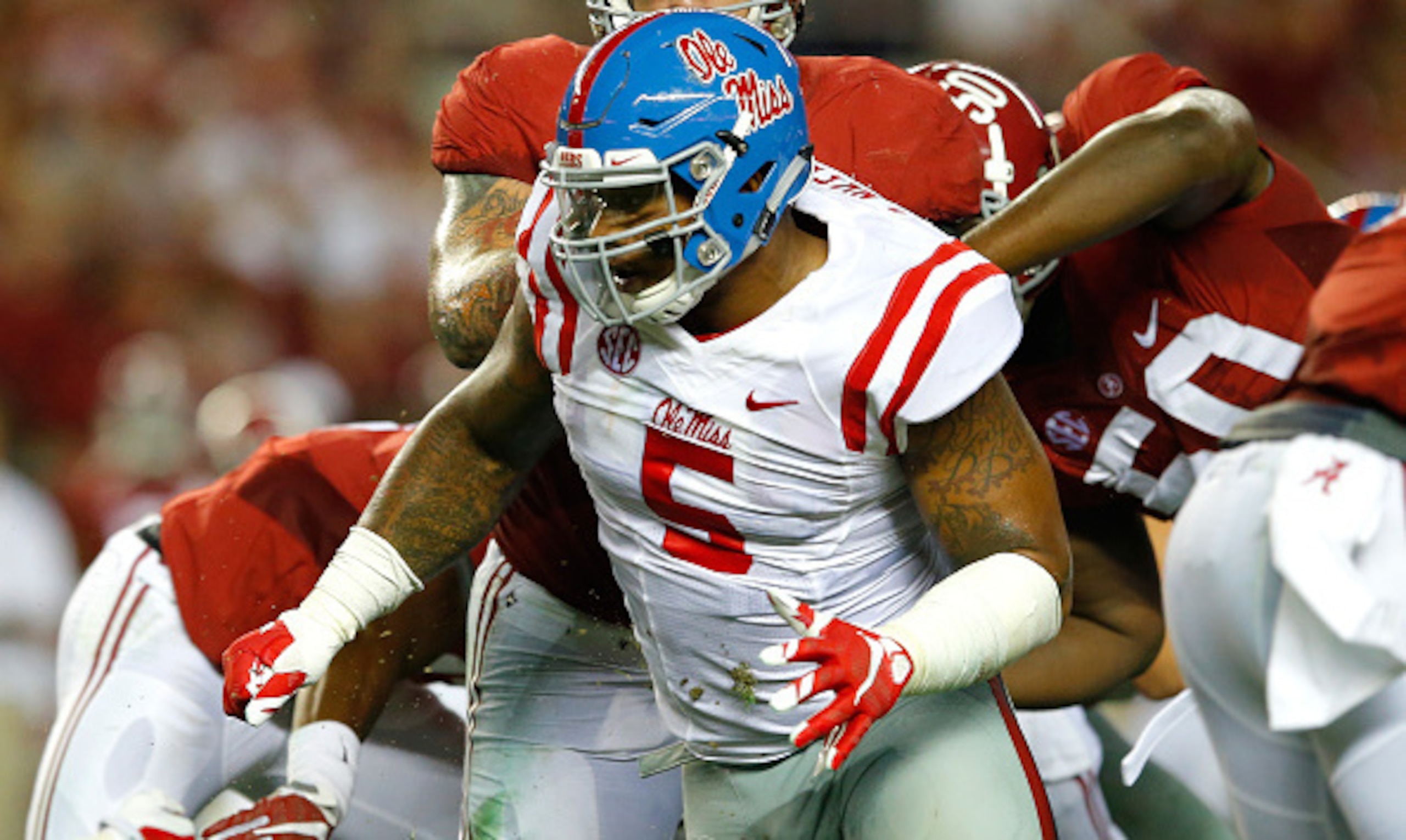
Putting Robert Nkemdiche's off-field issues aside, it's impossible not to be intrigued by his on-field potential.
Among defensive linemen, Nkemdiche has one of the most versatile skill sets I've seen since I started evaluating prospects in 2004.
While Nkemdiche primarily lined up on the interior at Ole Miss, he has the athleticism to potentially play left defensive end in a 4-3 scheme or defensive end in a 3-4.
Any defensive coach using multiple fronts will be fascinated by Nkemdiche's potential, and there's a good chance someone will still roll the dice on him early in the draft as a result.
If he lands with a 4-3 team, Nkemdiche will likely remain inside as a 3-technique tackle, where his blend of power and quickness can be unstoppable when he turns it on.
.jpg?w=2560 "Browns Jaguars Football")


.jpg?w=2560 "NFL Won't Fine 'Beverage' Celebrations 🍻")