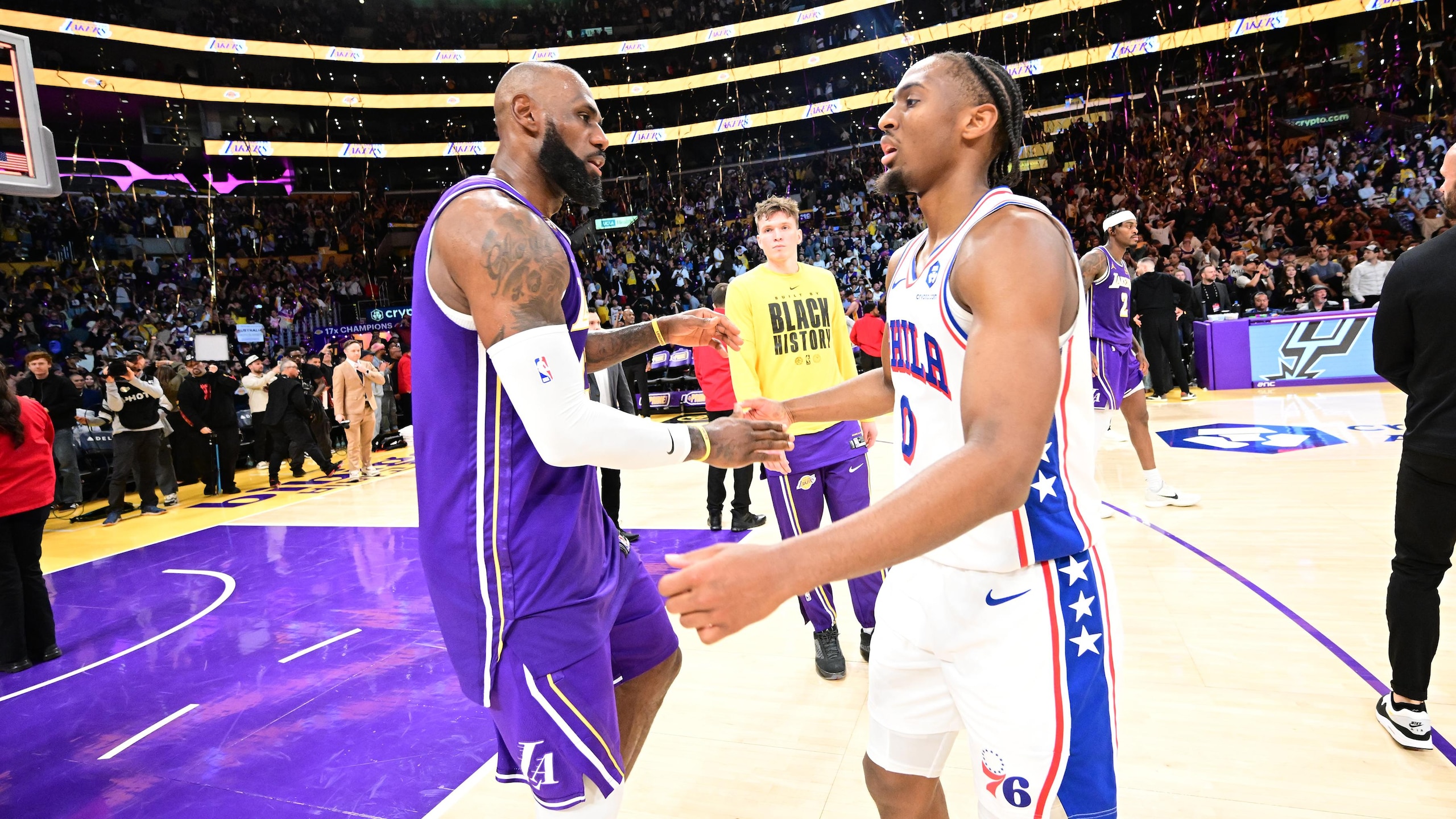
Cinderella with Swag: An Oral History of Florida Gulf Coast's Run as 'Dunk City'
Upsets are the defining element of the NCAA tournament. And not just upsets, but a certain weepy, Disneyfied upset that comes quaintly wrapped in amateurism and little-engine-that-could sentimentality. It's UCLA's death by a thousand backdoor cuts from Princeton in 1996, Gonzaga making the Elite Eight in 1999, Jim Valvano looking for somebody to hug in 1983. Everybody knows Cinderella when they see her.
What Cinderella had never been was a bunch of #DGAF dudes yacking on fools for two weeks.
That was, until 2013, when 15th-seeded Florida Gulf Coast became the most carefree underdog in the history of the NCAA tournament, a team perfectly suited to its time and place, a team without the good sense to be afraid.
TOP NEWS
Mavs' massive offer for Flagg card
.jpg?w=2560 "Browns Camp Football")
Browns Offered Team Legend Job
Ranking top 1000 players in NFL
A team now etched permanently on the Internet as "Dunk City."
So put on some Black Magic and Bambi and turn the speakers up, but don't look away or you might get dunked on. This is the story of Dunk City, as told by the men who lived it.
Chase Fieler, forward: In those two weeks that we were in the tournament, I felt like the country really thought that they knew us as people and got to know us so quickly, and a lot of that was through the way that we played and how much we enjoyed playing.
Brett Comer, guard: I think a lot of it had to do with the bond that we had with each other and the confidence that we played with, so we had that going for us, along with, I wouldn't call it showboating or cocky, but we liked to play with the fans involved. We liked to have the arena on our side. We liked to feel good about ourselves. We practiced every day at throwing lobs, so it's not like we were doing it just to be flashy. It's just what we did. It was part of our DNA, so, I think all that combined had the fans behind us loving the style that we played. We kind of brought a fun style back.
The Eagles' primary colors were cobalt blue and emerald green, a muted, vaguely tropical color scheme that made the team look like a program of modern vintage, which it is. The 2012-13 season was just FGCU's second as a Division I program. And Florida Gulf Coast had players on its roster older than the school itself, which was founded in 1991. The coach was 43-year-old Andy Enfield, who got his start in coaching selling instructional videos as "The Shot Doctor" and as recently as 2006 was vice president of a software startup. He'd been a legendary player at Johns Hopkins and had been an assistant coach in the NBA and in the ACC, so he wasn't a man without a resume. But look at it this way: In 2011, when a 20-year-old commuter school needed its first D-I basketball coach, Andy Enfield was just the man for the job.
And yet in spite of it, or maybe because of it, he was the source of the swag.
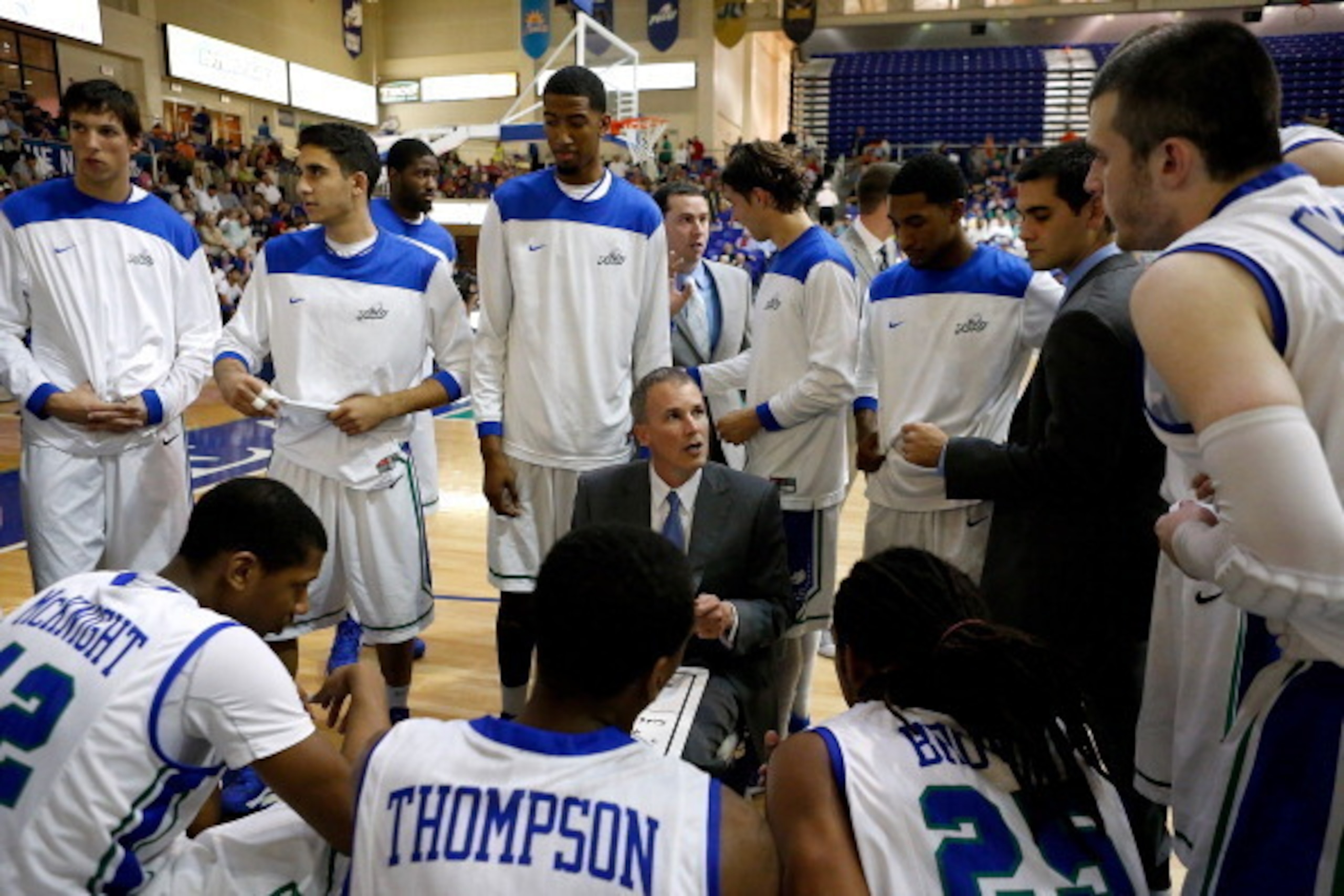
Fieler: A lot of it was Coach Enfield. He has a quiet confidence about him. He walks into a room and you can tell he just has this confidence to him, and he instilled that in us.
There was also the matter of the Eagles' masochistic schedule. To wit, the nonconference set included dates at VCU, at Duke, at Iowa State and at home against Miami. When you put a team on your schedule, you can't always predict how good it's going to be once you finally play the game. In this case, all of those programs were in great shape. VCU had gone to the Final Four in 2011, Duke was Duke, Iowa State won 23 games, and Miami won the ACC.
Marty Richter, assistant coach: We played a schedule that was really good. Those nonconference games prepared us to play a 2 seed, because we'd at least played Duke, Miami, VCU and Iowa State. Most 15 and 16 seeds are not as athletic as 1s and 2s.
David Moulton, FGCU radio voice: Andy has many gifts. One is that he is able to instill confidence without being cocky.
Sherwood Brown, guard: All those teams have been pretty successful in the tournament. Of course, Duke…just being able to play in that environment helped us a lot. Playing at VCU on the road. That was huge. Even though we pretty much got our tails handed to us that game, it was a real eye-opener for us early in the season to let us know that we had to get better. Playing against Miami...that just helped us boost our confidence, let us know that we actually could play with anybody.
There is a human tendency to romanticize the past, but FGCU's nonconference season couldn't have been much fun at the time. There was a win at home over Miami, but the Eagles lost to VCU by 23, to Duke by 21, to St. John's and Iowa State by 11. There weren't many indications the Eagles were the sort of team that might make a run in the NCAA tournament. They finished second to Mercer in the Atlantic Sun Conference but won the league's postseason tournament to earn an automatic NCAA bid.
So what does the NCAA selection committee do with a resume like that? It puts it on the 15 line against a team a lot of people will pick to win the whole shebang. No. 15 seeds had only won six games in NCAA tournament history, and none had ever made it out of the second round (round of 32).
Think of it this way: If Florida Gulf Coast and Georgetown had met in November, it would have been because Georgetown paid the Eagles to come over.
Michael Fly, assistant coach: We were playing quite a few guarantee games.
The matchup was a clash of styles. The ship John Thompson built at Georgetown is a tight one, and his son has kept up the ol' clipper. Georgetown is basically an '80s thing modeled after a '50s thing, while Florida Gulf Coast was the beta version of the newest thing out.
As the brackets were coming out, FGCU's coaches were quietly sizing up all of their potential first-round matchups. The other No. 2 seeds that year were Ohio State, Miami and Duke. The Eagles weren't likely to get spooked by anyone, but against Georgetown, there was a clearer path to victory.
Fly: From a matchup standpoint, there were things we thought we could take advantage of.
Moulton: Brett and Sherwood both, deep down, had great confidence. When they were playing well, they felt they were elite at their positions.
The Eagles led by two at halftime but had scored just 24 points and had no dunks. That meant Georgetown had successfully turned the game into a rock fight, even if it hadn't taken advantage. The Eagles saw an opportunity.
Fieler: We knew coming out of halftime, we had talked that we hadn't really gotten into the open court, so the more we could get that going, the better chance we'd have. In the beginning, Sherwood made some tough shots, Bernard [Thompson] made some tough shots, but the biggest thing is we were defending really well and trying to keep them from scoring. That kind of played into their hand in the first half, but in the second half, we were able to get a little bit more in transition and just play at a faster pace, even without the dunks. Just got them to play out of their comfort zone, and that's when we sparked our run. That's how we did a lot of the season: close, close, and then we go on a run just to get the little advantage we need to just keep playing.
Brown: We're an up-and-down team, so we take a lot of shots and play fast. Georgetown is more of a conservative team; they like to run the clock down. So we felt like as long as we could keep ourselves from inbounding the ball and slowing it down, then we had ourselves a good opportunity to win the game.
As the second half began, Georgetown's Otto Porter didn't think so. While FGCU was inbounding the ball, Porter walked up to Brown with something to say. From his courtside broadcast seat, Moulton witnessed their exchange.
Moulton: Otto Porter says to Sherwood, "I hope you had your fun, 'cause it's over." Sherwood looks at him funny, the way Sherwood does, and Otto says, "It's over."
Porter was wrong. FGCU went on a 21-2 run early in the second half. That run included two dunks by Eddie Murray, a fifth-year senior who had nine points and five rebounds off the bench, and Fieler's second dunk of the half—a two-handed flush that came off a nifty cut to the basket and a perfectly timed bounce pass from Comer.

Fieler pointed at Comer, Comer smiled and bounced and shook his head, and Florida Gulf Coast led Georgetown 52-33 with 12:29 to play.
At about that time, Porter was inbounding the ball on the same sideline, and Brown saw an opportunity.
Moulton: Sherwood looks at him and says, "Have you had enough?"
The idea of an upset became very, very real.
Brown: We just went out in that second half with a completely different attitude, from hoping we could be in the game to actually just taking over.
Fieler: Halftime we were talking and realized, We're in this game and we haven't even played our style. ... We hadn't really shown what we could do offensively. We weren't playing how we wanted to, so to see that we were still in the game and that close at that point—with all of those things going against us—we realized then that we were good enough to play with them and good enough to beat them. Just had to come out and switch some things up.
Comer: There was a point, I want to say a play in transition, where I pitched it back to Sherwood Brown and he hit a three and then we came back down and came off a flare and he hit a deep three—and then they called a timeout right after and we were up by 15 right there and felt good about ourselves and kind of thought, We're not talking about it; we're really doing it right now.
Bernard Thompson, guard: We could tell that they couldn't really do anything offensively because of our defense. We were just playing good defense. Granted, Otto Porter wasn't on his best game that day either, so it was just in our favor really.
Fly: Comer threw that lob to Fieler, and I was looking at our guys thinking, "We're starting to play like us. We played like that all year."

The fourth dunk of the game put FGCU up 19, but Georgetown was not going peacefully into the night. The Hoyas mounted a slow but steady comeback against a clock that wouldn't count down fast enough.
Richter: It wasn't like you were ever comfortable. The last four-and-a-half minutes, I felt like it took two hours. I felt like they scored every possession.
It took 10 whole minutes, but the Hoyas got FGCU's lead down to seven, 65-58, with 2:01 to play. Then came a dunk by Fieler that entered the Eagles into Internet and NCAA tournament lore.
The Eagles broke Georgetown's press, and now here was Comer, behind the Georgetown defense with a path to the basket. Fieler had inbounded the ball and gone unchecked on the weak side of Georgetown's press. He was a couple of steps behind the half-court line when the Eagles got the ball to Brown, and he could see what was happening. Fieler made a dead sprint to the rim, and then...
...a moment of ear-ringing silence...
...before the boom.
Comer: I feel like from that moment, we became Dunk City. Knowing that we won our first tournament game was at that moment.
Fly: If you watch the tape—a lot of times I'll squat on the sideline. From my angle, it looks like he threw it 30 feet in the air.
Richter: It's one of those things where, those two guys had such chemistry on the court that, to a normal person, you're thinking, "Oh my God—what are you doing?" To those two, it was just another play. They did it earlier in the year against Stetson.
Florida Gulf Coast had been playing that way all year, just not on television. A nation that, by and large, follows college basketball for three weeks in the spring, had discovered something. This was a team made for the YouTube era, the Vine era, the Twitter era. When Black Magic and Bambi posted a song titled "Dunk City" to YouTube with a compilation of the Eagles' dunks, the whole thing took on a life of its own.
ESPN was waiting for Dunk City to arrive back in Fort Myers. Good Morning America and The Today Show called. They were the biggest story in the country.
Moulton: I did 21 interviews between San Diego State and Florida. You name a market, I did it.
Fieler: During that run, I was on Twitter and Instagram, but I didn't have many followers or anything, but after the run, it just blew up. I played with a couple guys who remember watching it; and they didn't even watch it live, they just watched highlights on social media. And it would be even bigger now. Social media just makes everything at the palm of your hands and makes everything go worldwide so quick.
Brown: When I started playing overseas, guys would tell me that they remember our run and they remember me from playing on TV or whatever. So I can only imagine that in this day and age. It's only three years, but social media is just booming every single year. I can only imagine how many people would recognize our faces.
Thompson: It would be a lot more hype, just because there are new apps out like Periscope. Snapchat is more usable now, so I feel like we would've been Snapchatting and Periscoping everything, just to show people what we were doing all the time. It just gives people a chance to go behind the scenes and see what's really going on instead of you just watching me play basketball. I can give you an inside scoop.
Florida Gulf Coast made history two days later, beating San Diego State to become the first No. 15 seed to reach the Sweet 16. Dunk City threw down five dunks against the Aztecs, including an astonishing reach-back finish on a lob from Comer:

And also a knee-to-the-chest poster dunk by Fieler over San Diego State's Deshawn Stephens at the end of the first half:

FGCU was trailing at the time but won by 10.
Fly: We had a really confident group of kids. That was their nature. They sometimes believed they were better than their stats or ability showed. A lot of that came from Sherwood Brown. He was absolutely fearless.
Brown: We didn't really feel like an underdog, but just because of everyone in the nation telling us that we're an underdog, obviously if you hear it enough, you just go, "Well, I guess we are the underdog." But as a team, we felt like those games we should've won and we could've won if we played them again.
Bernard: We were just kind of happy to be out there. That was the thing. We were just having fun. But we were all competitors, so we weren't just going out there like, "Hey, we know we're gonna lose this game." We were just going there to compete, try to win and just have fun doing it, and I think our heart....we just wanted to prove to people that we could compete with those high-level schools. Because some of us being recruited, it was always mid-major. People didn't think we could play at that level, so we just had something to prove to people as well.
The run ended in Arlington, Texas, where No. 3 seed Florida held Dunk City to four dunks and just 50 points.
Fieler: It's hard to say we could have accomplished more, being the first team to ever do what we did, but I think we were good enough to beat Florida. They obviously outplayed us and deserved the win. They had a great team. You saw the next year they started the season like 15-0 or something, so they had great players. They just did what we normally did. They went on a run in the second half, and then we had to play catch-up while they played with the lead. Once they built that 10-point lead, it never really got worse than that, but we couldn't get within six points to where they had to get nervous. They were able to play comfortable. ... I think we were talented enough and playing well enough. We could have maybe gone to the Elite Eight or what have you, but looking back now—and we talked about it then—we weren't able to really realize what we had just done. It really continues to set in now. Last year when we were watching the tournament, it was crazy to think that I was in the Sweet 16. Things that we grew up doing, and then when we were part of it, it was surreal. Hasn't really set in yet. I think we were talented enough to go further, but Florida deserved It, and I'm pretty happy with what we were able to accomplish.
There are a lot of ideas about what it was about Dunk City, specifically, that Americans fell in love with. Everybody loves dunks, and everybody loves an underdog, but everybody who played on that team thinks there was something more to it.
It was the spirit of the thing.
Fieler: We were a team that no one really knew about, but they felt really quickly that they knew who we were and they could get a grasp for the type of people we were. And the story of how young the school was and everyone learned that the school was on the beach. There were articles playing up that we didn't practice on certain days so we could go to the beach. Just ludicrous things where someone probably joked about it and then someone read it and took it seriously. ... But in those two weeks that we were in the tournament, I felt like the country really thought that they knew us as people and got to know us so quickly, and a lot of that was through the way that we played and how much we enjoyed playing.
Brown: I think it's the fact that we all played for each other and played free. It's not like we played so serious...so it just looked like we were having a lot of fun out there. I think that's why much of America really enjoyed watching us play.
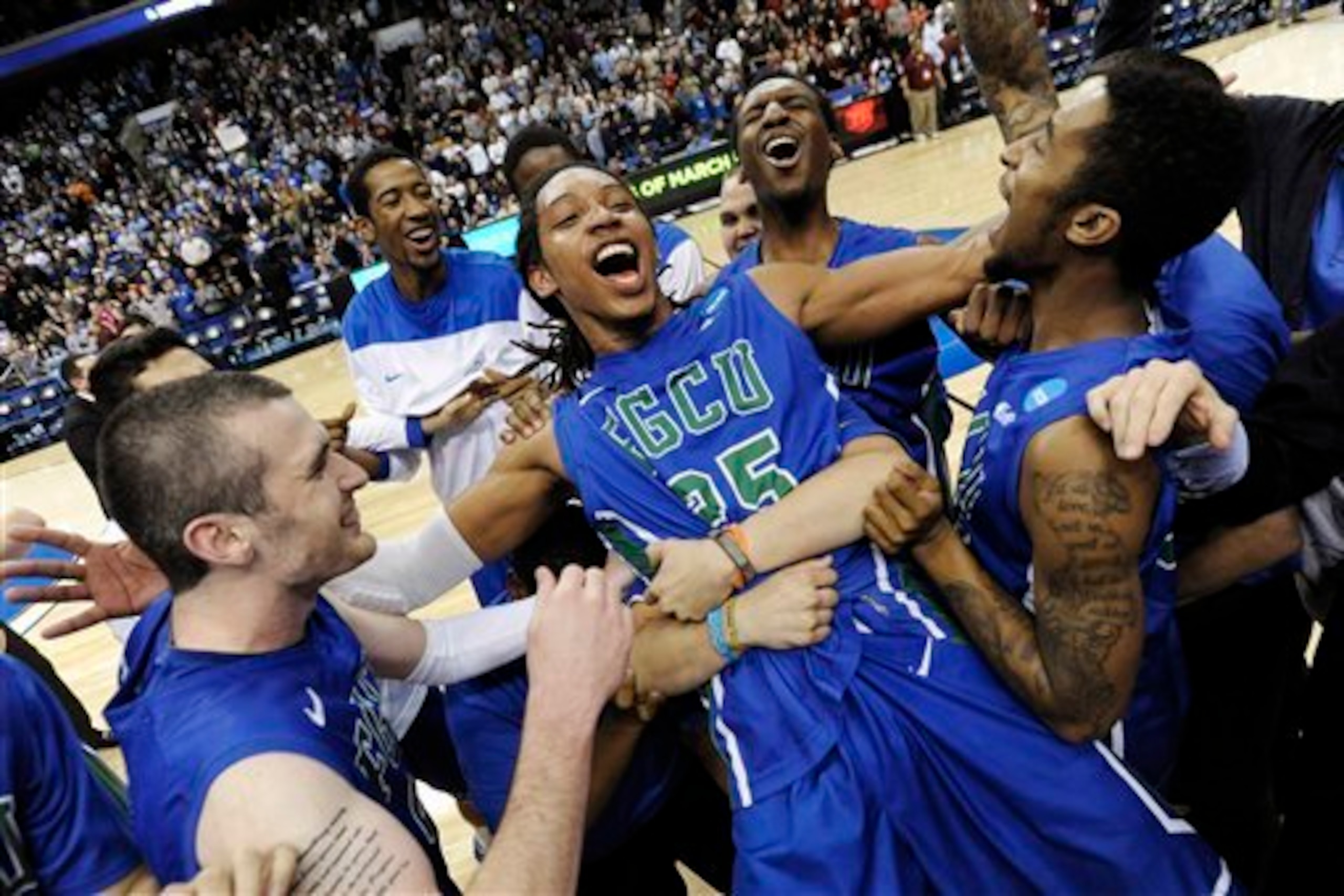
Moulton: Usually 15 seeds are cute little teams that aren't very athletic and play well together and hit shots. This was a team of guys who were not cute. I don't think we’d ever see a 15 seed play above the rim before. I think they were more athletic than Georgetown.
Dunk City has dispersed, now, to yack on fools from every corner of the globe. Brown is in Lebanon. Fieler is in the Netherlands. Comer is an assistant coach at IUPUI.
They miss each other.
Comer: The guy I miss most is Bernard Thompson. He's a guy I came into school with; he's a guy I graduated with. He's like a brother with me. I still talk to him almost every day. Definitely a guy I miss living around, being around and playing with for sure.
Fieler: Brett, unbelievable court vision, uncanny knack for throwing lobs, and timing and placement is great. Then you play with Sherwood and his energy and enthusiasm just rubs off on you, and his confidence. Bernard is the same way—just has this confidence. Silent killer. Just an assassin. But an incredible guy. The way that he plays does not match his personality at all. He's such a quiet person and great guy off the court, but then on the court, he's so confident and so smooth with the ball. And then Eric [McKnight], another big, just great athlete and shot-blocker. So hard to narrow it down. Just great players that I was fortunate enough to play with. I'd say it has to be Brett, just because I haven't played with a point guard yet with that ability to throw lobs. Playing with those guys was great, and I miss every minute of it. I wish I could play with them again.
Thompson: Eric McKnight, that's my guy. He just brings you energy on the court, plays defense. He just plays fun, likes to have fun on the court. I can always throw lobs to him. I just love the guy.
They left behind an imprint. When we look at the NCAA field every year now, we see maybe a hint of Dunk City here, a whisper there. There are upsets. There are Cinderellas. There are dunks.
But another Dunk City?
Comer: There's always been that talk every year: "Who's the next Dunk City?" There will never be another Dunk City. My junior-year team wasn't Dunk City. It was just that one special group of guys. The connection that we had with each other and the coaching staff and the community—that was the Dunk City team.
Tully Corcoran covers college basketball for Bleacher Report. Kerry Miller contributed to this story.