Kenyan Drake: The 'Other' Alabama Running Back in the 2016 NFL Draft
Buried deep in the dusty book of things your grandparents might often say is the one about giving an arm and a leg.
You know how it goes. Turkey breast wasn’t on sale at the deli as expected, so paying with money wasn’t enough. You paid with limbs. Specifically, your arm and a leg.
Former Alabama running back Kenyan Drake puts a different spin on an old expression.
TOP NEWS

Stephen A. Apologizes After Lane Johnson Comments
Ravens Trade for Eagles Pro Bowl OL 🚨
.jpg?w=2560 "Cowboys Texans Football")
Dak to Stroud: Get Some Wins 💯
“There aren’t a lot of people who can say they’ve given an arm and a leg to a game they love,” he told Bleacher Report.
Drake has come the closest to being a living idiom after two separate gag-inducing injuries. That’s why in the 2016 NFL draft he presents one of the ultimate stories of perseverance, and a deep-rooted desire to overcome football's gruesome nature reaching its peak. Twice.
All of his limbs are still in the proper working order now, and he’ll demonstrate that Wednesday while participating in Alabama’s pro day. He did the same at the NFL Scouting Combine, where the 6’1”, 210-pound multidimensional weapon needed just 4.45 seconds to run 40 yards.
That was the third-fastest time at his position, and he hammered home a simple fact we all knew well after his 96-yard kick return touchdown during the national championship game against Clemson. Drake is damn fast, and all it takes is one missed assignment, one edge that isn’t sealed or one broken tackle, and he’s gone.
Long gone.
Go ahead and watch that effortless speed again. Watch it a few times even, and gawk at an offensive talent who could become a bargain Day 3 pick. Daydream a little, and let visions of Drake streaking down the field for your local NFL franchise dance around.
Then remember that not too long ago another Drake highlight did viral laps around the Internet’s connecting tubes. This highlight ended in a helicopter ride to the hospital.
Giving a leg
Everything was going as planned for Drake to begin the 2014 season. As an emerging and explosive option in space, he had scored six touchdowns over just four games. Of those, three came during a Week 3 win over Southern Mississippi.
With the exception of Trent Richardson, the Crimson Tide running back factory has been pumping out quality NFL products for quite some time now. Drake had already made his splash and surely registered on the league’s scouting radar in 2013 when the then-sophomore was a blur, averaging 7.5 yards per carry. He finished that season with 829 yards from scrimmage while scoring nine times.
It seemed like a bounding leap would be coming from the athletically versatile Georgia native who was used as a pass-catcher, on special teams covering kicks and as a returner. We saw the seeds for that climb to another level during his early 2014 surge that included an 87-yard catch-and-run, one of the longest receiving touchdowns in the storied history of Alabama football.
Then, suddenly, with one twist and awkward tackle, Drake's season was over. Fair warning: Watching the video below as you eat may result in your lunch finding the bottom of a garbage can.
Anyone who has watched even a single football game knows the sport’s precision and athleticism can abruptly be countered by torn muscles and broken bones. Yet it’s still incredibly chilling whenever screams of agony can be heard on a game broadcast.
Looking down to see your ankle bent far against its intended design is, to say the least, a rather unpleasant experience. It would be natural to consider grand, long-term questions after the initial pain and shock subside. Questions like: Will I be able to cut and run at the same level? Will I ever be as explosive as I am now? Will I be able to absorb and power through contact?
Will I be the same football player ever again?
None of that entered Drake’s mind, though, because his long-term ambitions never wavered. Neither did his short-term goals, however unrealistic they may have been.
“I never questioned my ability to get back and play football again,” he said. “There were just question marks around the rest of that season.”
Drake didn’t play again in 2014, of course, and had to watch as his team went to the Sugar Bowl. He underwent surgery on his broken leg shortly after suffering the injury against Ole Miss.
Then he began a recovery process that restricted him to a knee scooter for one month. During that time he grew as more than just a football player.
“I was comforted every step of the way,” he said. “I was told initially it was going to be as bad as it ended up being timetablewise. But the lessons I learned about perseverance and the relationships you build in those times really taught me a lot about life in general.”
The blow of his broken leg could have been more damaging mentally than physically. Drake was rated as a 4-star recruit by Rivals.com, and he had patiently waited for his turn behind Eddie Lacy, then T.J. Yeldon. But he was still thought of so highly that as a true freshman in 2012 Drake received 42 carries, piling up 281 yards with five touchdowns (6.7 YPC).
Then, after his ascension continued the following season, it was time for the liftoff in 2014. Instead, Drake was doing more hobbling than tackle dodging.
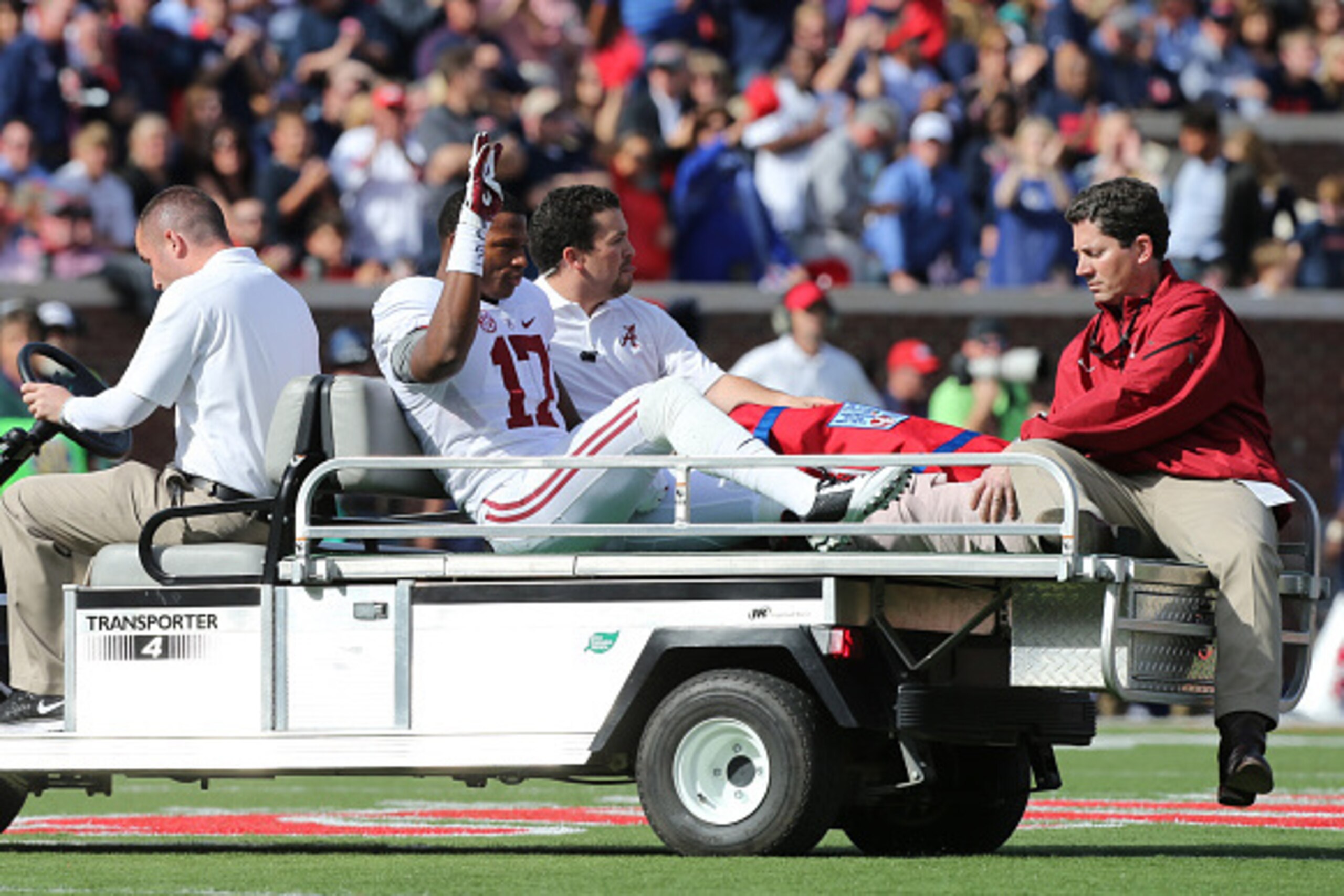
When you speak to him now, there’s no negativity in his voice while reflecting on the stomach-churning leg injury he endured. Instead only positivity flows, as the experience gave him an opportunity to develop in another way. One that wouldn’t have been available otherwise.
“I’m more of a person who leads by example,” he said. “So when I couldn’t be out there on the field with my teammates it was difficult. But it was just a process of understanding how to get outside of my comfort zone and lead from a different perspective. It gave me the leadership role I needed to progress to my senior season, when I could be trusted to step up in vocal situations while also leading on the field.”
“It was a matter of having those experiences to give me the ability to overcome the adversities I’ll continue to face throughout my career.”
Drake became a more well-rounded player and person when the game he had loved since being the fastest six-year-old in his neighborhood had been taken away. Often it feels like football doesn’t love you back, which is why his newfound perspective was needed again when another bone snapped.
Giving an arm
Drake estimates he was functioning at about 85 percent health six months after his leg surgery. He was able to participate in spring practice, albeit while wearing a noncontact jersey.
He was understandably apprehensive about getting knocked around once that jersey came off in summer camp. But he said it was “smooth sailing” after taking a few hits in practice.
Drake was feeling like himself, or at least as close to it as can humanly be expected less than a year after his foot and leg were mangled. He was back to being a multipurpose speed threat, which is why Alabama head coach Nick Saban sometimes deployed him on kick coverage. He could easily arrive first, and end the play first.
Which is what happened against Mississippi State in Week 11 of 2015. Unfortunately, Drake’s arm didn’t survive the encounter.
He was diagnosed with a broken arm, the second time in just over a year that a play ended with something shattered.
Once again, anger at that awful luck after two freak incidents would have been understandable. And once again, Drake didn’t have time for anger. There was a grind ahead.
“The recovery process needs to be taken one step at a time,” he said. “It’s a cliche maybe, but rehabbing injuries like the ones I had really epitomizes it. The injuries I had weren’t things I could get over in a few days.”
“I now have the clarity of understanding injuries aren’t something you’re going to get past easily. You have to put in the work to get the results.”
Drake punched his clock every day, rehabbing vigorously to return just three weeks after breaking his arm. He ran for 60 yards on only four carries against Michigan State during the first of Alabama’s two College Football Playoff games.
Then he erupted against Clemson, finishing with 196 return yards.
Drake erased any doubt that hovered after his two brutal injuries. And he showed his top NFL selling points—raw speed blended perfectly with enough tackle-breaking size—haven't gone anywhere.
Yet as draft season rolls along, it still feels like Drake is peeking out from a Heisman shadow.
Being the “other” Alabama running back
Derrick Henry, Drake’s backfield running mate during his senior season, casts one of the largest shadows around. It’s easy to start thinking darkness came early if you stand behind him for too long.
Henry is a walking mountain at 6’3” and 247 pounds. He bulldozed his way to 2,219 rushing yards in 2015, scoring an incredible 28 touchdowns. Henry earned his place in Heisman history with those nation-leading numbers, and then at the combine he continued to defy our assumptions about what large bodies can and can’t do. At that size, he ran the 40-yard dash in just 4.54 seconds.
Automatically there are questions attached to Drake regarding his ability to be a three-down back. Teams instinctively fear what they can’t prove, or what they haven’t seen. Which leads to the potential for murkiness.
Drake didn’t get an opportunity to be that workhorse running back at Alabama. Injuries clearly played a role, but the even greater factor throughout his time in Tuscaloosa was the Crimson Tide’s always-overflowing running back stable. He was sharing the backfield with first Yeldon and Lacy, and then later Henry.

So should he be punished for playing on a talent-rich college football powerhouse?
“At Alabama, if you’re not in that situation it’s not like you don’t get taught how to be a three-down running back,” said Drake. “People just watch film and say, ‘He didn’t get a chance to do it, so can he?’ But coaches teach you all aspects of being a good player. That’s what you practice for."
“You don’t say, ‘He’s not this just because he didn’t get a chance to do it.' That doesn’t make any sense.”
It’s true, that logic is flawed, though it might be a reality Drake faces. But if he’s a Day 3 pick and has to find other ways to contribute while waiting for an expanded backfield role, well, so be it.
“I have a lot of versatility which gives me added value, especially as a player who may not necessarily be a top pick,” he said. “Being versatile is how I’ll earn my spot in the league.
“From there my abilities and work ethic will allow me to become the player I want to be, and a player people respect for more than just his playmaking ability.”
Versatility and Drake’s athletic tools are certainly assets. The latter led to Reggie Bush comparisons during the Senior Bowl, according to DraftInsider.net’s Tony Pauline. Those stem from his burst through the hole and after the catch. He caught 46 passes for 570 yards throughout his college career, even while missing significant time.
“He catches the ball so well, and he excels on special teams both covering and returning kicks,” said David Ironside, Drake’s high school head coach at Hillgrove High in Georgia. “He can do such a wide variety of things, which is what makes him so appealing. On a small roster he’s a guy who can do a lot for you, and covers a lot of areas.”
To some degree, a fear of the unknown could trump the promise Drake has flashed as teams assemble their draft boards. He topped out at only 92 single-season carries in college, and as Rob Rang of CBSSports.com noted, he struggled during pass protection drills throughout Senior Bowl week. Ball security was also an issue for Drake when he fumbled once every 39.9 offensive touches at Alabama, per CBSSports.com's Dane Brugler.
So he has some areas in need of development then, along with a firm foundation of skills that can be built on and used in multiple ways. He’s also mature beyond his football years after already overcoming a possibly career-derailing injury.
There are a lot of items in the entire Drake package. Plenty of them should glow for a team in the middle rounds still trying to add a dynamic jolt to its offense and return game.
.jpg?w=2560 "Browns Jaguars Football")
.jpg?w=2560 "Vikings Football")