

Wendall Williams: The (Probably) Fastest Man in the NFL Draft
They say a lie can run around the world before the truth can put on its pants. Wendall Williams isn't quite that fast, but he just might be the truth.
The University of the Cumberlands wide receiver's regional combine performance sent shock waves through the NFL-watching world. His unofficial 40-yard dash time of 4.19 seconds, a too-good-to-be-true mark that sent #DraftTwitter into a frenzy, would be a scouting-combine record.
The week before, hundreds of the most renowned college athletes in the country, prepared by dedicated training facilities charging well into five figures, failed to collect the $1 million bounty on the 40-yard-dash record. Williams forked over just $150 for the privilege of lining up and running in Winter Park, Minnesota, and somehow that was enough: An unknown prospect from an NAIA school "nestled in the foothills of Daniel Boone country" had blown the doors off the combine-prep industry—not to mention the NFL scouting industry.


Williams' story drew immediate comparisons to Sidd Finch, the late, great writer George Plimpton's 1985 April Fools' Day hoax of a pitching prospect. Though Williams was not purported to have run in hiking boots or play the French horn, Williams is no hoax.
At Western Kentucky's pro day, a flu-stricken Williams proved his combine performance wasn't a fluke, and super-agent Drew Rosenhaus signed Williams on the spot.
Williams' athletic gifts have been obvious since shortly after he learned to walk. As a senior in high school, Williams had 28 touchdown catches for the state-title-winning Bishop Ludden Gaelic Knights. Eight years and four colleges later, the speedy 25-year-old has finally caught up with his destiny.
"With five older brothers," Williams told Bleacher Report, "growing up in sports was pretty much a thing I had to do." Williams had to be fast just to keep up. Of course, he wanted to impress his brothers every bit as much as they wanted to see what he could do.
"The first time he tried to flip...well, he tried to flip. He wasn't successful at it," Tarod Clarke laughingly told Bleacher Report. Clarke, Williams' oldest brother, watched a preschool-aged Williams get up on a table, hurl himself off and come down very, very wrong. "He actually broke a collarbone. He was out for a while. But as soon as he healed up, he was back to jumping and flipping."
"With me and my brothers, it was sports all year 'round," Clarke said. "It was school, homework, then off to practice. It was very busy." Many of the brothers did a little of everything, from track to wrestling; Williams and Clarke's brother, Jamar Clarke, played college and minor league baseball.
Williams always had speed, which was useful for getting away from angry older brothers after he'd pushed one too many of their buttons.
"I used to get chased out of the house, off the porch, by my brothers," Williams said, laughingly. "I used to jump clear off the porch—not off the steps, but all the way off the edge—hit the ground running and run all the way up to the top of the hill. I don't know if that's why I'm fast today, but I remember a lot of running away from my older brothers because they got tired of me and wanted to beat me up all the time."
Playing against other kids his age, though, Williams' lack of size kept him from standing out. That changed once he hit high school and a long-awaited growth spurt.
"Once he hit 11th grade, he just exploded with pure athleticism," Clarke said. "The first time I saw him dunk, in ninth grade, it was just a regular dunk. But when I caught a high school game of his, he went up for a dunk...and I didn't think he was ever going to come down. It shocked me."
The following year, Williams established himself as an elite athlete: He was named first-team All-State in football and ninth-team All-State in basketball, and he made sectionals in track. Yet, his poor grades scared off any major-college interest.
"Coming out of high school, I was just immature," Williams said. "I kind of thought my athletics would take me where I wanted to go."
"He didn't do much homework," Clarke agreed. "He was just so focused on sports, on being a professional athlete. A lot of kids don't understand: Your grades will help you get into college, will help you get to the next level. I don't think he knew how important it was, so he kind of put it on the back burner. He was always smart; he just wasn't focused on the right things."
Williams went to a junior college, Morrisville State, and played football that fall semester. He didn't like it there, though and transferred to Onondaga Community College back in Syracuse.
"I was still pretty immature," Williams said. "I went to school but didn't do anything in class. I just kind of went, showed up and did nothing. I was still on a learning curve with my academics and what I wanted to do in life." Williams practiced with Hudson Valley Community College that spring, but hadn't accumulated enough credits to play as a sophomore that fall.
So he went home and got a job driving a truck. He was as far from the NFL as he could be.
"Honestly? I think he was depressed for a little while," Clarke said. "Things weren't going his way, and I think he knew he had more. He was destined to be better and more rounded than what he was at that point, and I don't think he was satisfied with what he was doing."
"Everybody thought he was wasting his shot," Clarke continued. "Everybody thought he was a great talent." Their mother called a mentor of Williams', Will Dowdell, a local middle school vice principal. She said Williams had been just sitting around, wasting his talent. Dowdell called Williams up and took him out to dinner.
"You're not done yet," Dowdell told Williams. The two laid out a plan that could get him back on the road to the NFL. The first step on that journey was Herkimer Community College, where Williams could run track and play basketball.
"He gives a lot of thanks to the people around him," Clarke said. "But the kid got his head on straight. We always knew he could do it, but he just needed to mature a little." Both Williams and Clarke point to being able to hang out with his older brothers and their friends as a guiding light; Williams could see all the big kids he grew up with maturing into young men.
At Herkimer, Williams won six junior college national titles in track and field, led the basketball team to the national junior college championship tournament and was named to the NJCAA DIII all-tournament team, per the school's official website. Best of all, he was awarded the Chancellor's Scholar Athletic Award by SUNY chancellor Nancy L. Zimpher.
Williams was back on the major-college radar, and he started receiving interest from Division I schools. But having graduated high school in 2008, his NCAA eligibility was nearly exhausted. He still had several semesters of NAIA eligibility left, though. University of the Cumberlands track coach B.J. Temple gave him a call.
Temple, as he told Bleacher Report, was just doing his due diligence; the Binghamton, New York, native saw the times Williams had turned in at Herkimer and knew he'd run faster in Kentucky "just based on weather alone."
"Once we started researching and looking at what he accomplished before," Temple said, "then obviously he became a special recruit."
Williams was glad for Temple's interest, but wouldn't run track for him unless he also had the chance to play high-quality football. Temple had good news: The Cumberlands Patriots had made the NAIA postseason in football in 2012 and went to the title game in 2013. Head football coach Matt Rhymer agreed to offer Williams a dual scholarship, and Williams gladly accepted.
His arrival on campus in Williamsburg, Kentucky, was a bit of a culture shock—or maybe a lack-of-culture shock.
"It's totally different from where I'm from," Williams said. "It's very slow-paced; there's not that much to do. There's a Wal-Mart, really, in town," apparently the highlight of Williamsburg's cosmopolitanism.
The remote setting, Williams found, allowed him the space to grow into his own man.
"It kind of kept me grounded," Williams said. "It's a religious school. There was no room for me to be out partying; there's no partying on campus. It's a dry county, so there's no alcohol around there...it kind of kept my focus where it needed to be."
"It took about two days of practice," Temple said. "The first day, they're just doing physicals and stuff like that. But the first official day, I started getting texts from the coaches like, 'This kid's good. This kid's really good.'"
"He was a mature kid, had a good work ethic," Rhymer said. Williams' athletic gifts were obvious, but his practice habits and coachability stood out, too. "When Wendall got here, he had very much decided it was a make-or-break moment for him, and I think he took advantage of it. Very smart, mature, unselfish."
That unselfishness was tested in those early days of practice, when teammates said Rhymer had just replaced John Bland as head football coach months before. As a wide receiver, the triple-option offense deployed under Rhymer would dramatically limit Williams' opportunities; he'd be run blocking on most plays and just going deep on most of the rest.
According to Temple, Williams was told about the offensive scheme before arriving, but Williams said he had no idea how limited his role would be. Either way, Williams decided not to let that frustration show—or hold him back.
"I took it with a grain of salt," Williams said. "I took it in stride. I just made the best of the opportunity I had." Williams' game-changing ability was instantly apparent.
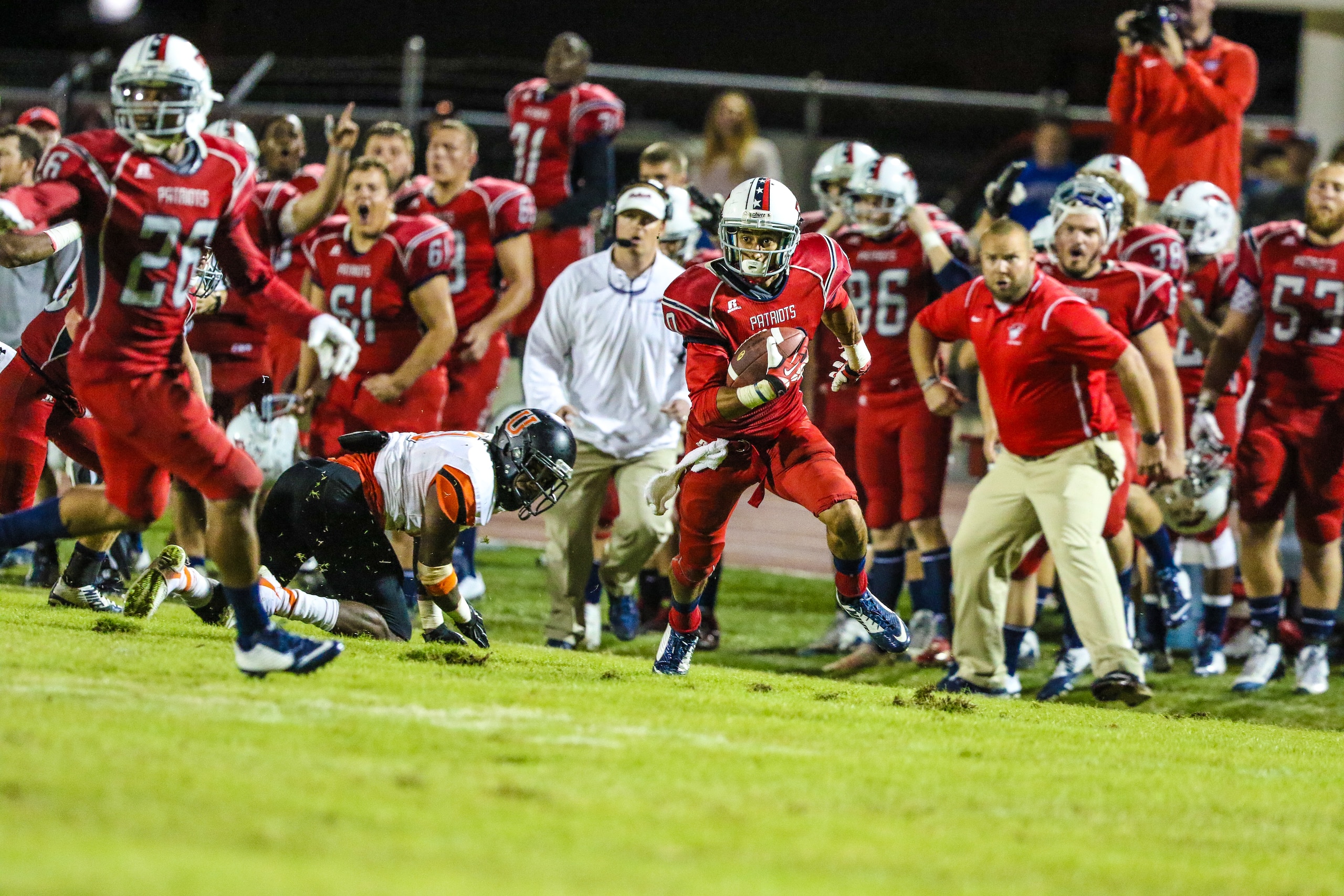
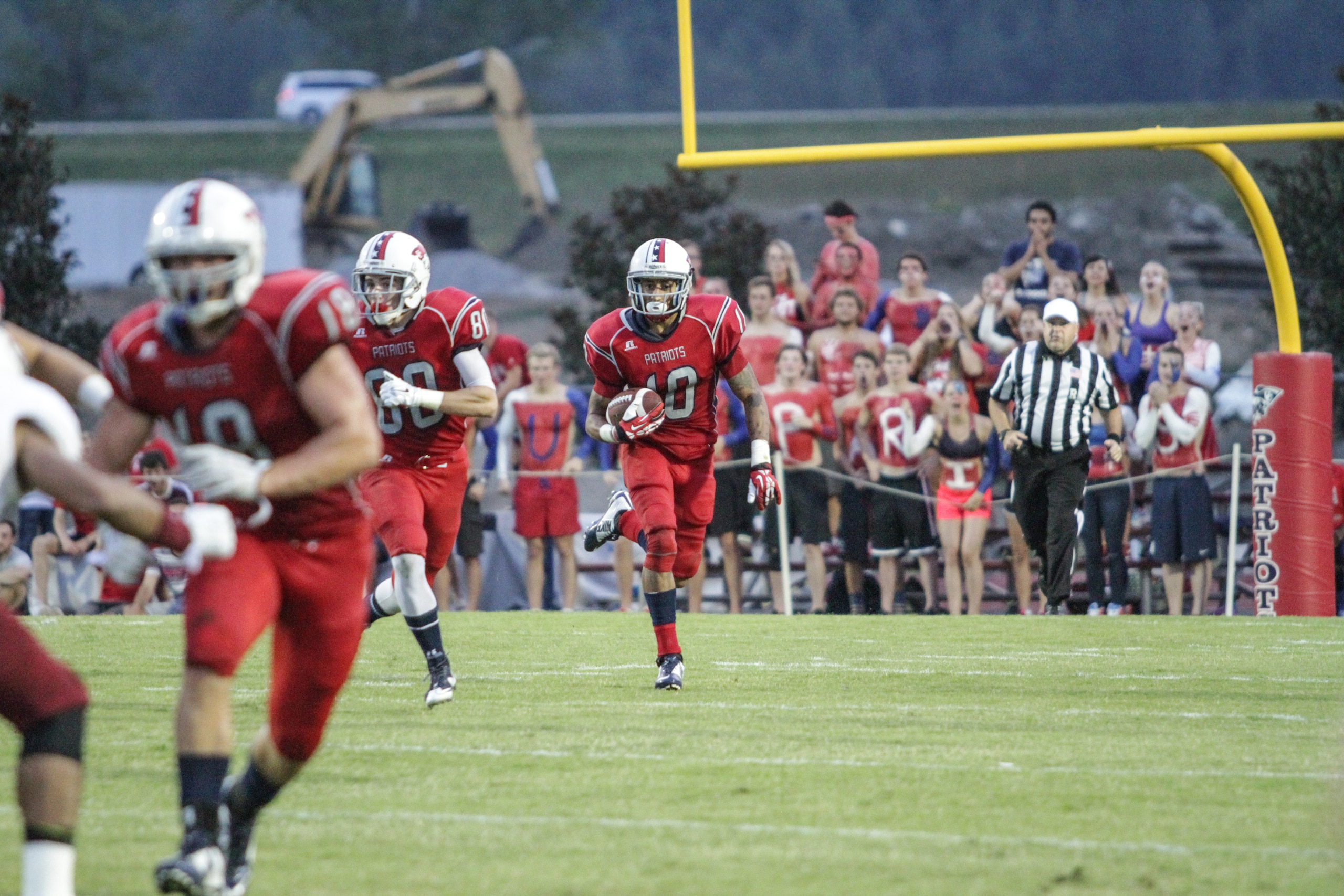
Whether on kick returns, reverses or the rare deep pass, Williams made magic almost every time he touched the ball. As fans of the Madden video game series might put it, Williams was a human money play:
According to both Rhymer and Temple, Williams wasn't just a sparkplug on the field but also a great guy to have around the Cumberlands athletic program.
"He has a great personality," said Rhymer. "He's an energy creator; he makes the environment better. He's just a good guy."
After two seasons, playing nine of 10 games his first and starting all 10 games his second, Williams finished with 783 yards and 11 touchdowns on just 31 receptions, and 329 yards rushing and four touchdowns on just 18 carries. His senior season, he averaged a ludicrous 30.1 yards per touch on only 2.2 touches a game.
"It's kind of surreal," Williams said about taking it to the house every third time he got the ball, "but it's reality." In track, Williams was no less outstanding: He was an NAIA All-American in the 100-meter dash, 200-meter dash and long jump, and won the NAIA national title in the long jump.
Of all of Williams' qualities—his raw talent, his sponge-like coachability, his drive to compete—Temple found Williams' gratefulness the most endearing.
"A lot of athletes are appreciative of the opportunity here, but it's usually after they've been and gone," Temple said. "Literally, we were driving back from Georgia Tech, and it was late at night. Wendall was sitting on the passenger side, and he just takes his earbuds out and says, 'Hey, Coach.' I'm kind of startled, because it's 11:00 at night, and he just says, 'Thank you, Coach, I appreciate it.' I'm like, 'For what?' and he says, 'For taking me to this meet.'
"I was like, 'Oh, no big deal.' It's no big deal for me, you know, for me it's just I'm-doing-my-job kind of stuff—but for him, he's on a journey."
When Williams' journey finally took him to the Minnesota Vikings' practice facility, his future career in football—not to mention his entire young life—was on the line. What was he thinking as he stepped onto the field?
"Being in there, warming up, running around and stuff, I felt at home. It wasn't nerve-wracking for me, I wasn't overwhelmed. It had been so long, me thinking and dreaming and wanting to be there. I was just like, 'I'm here.' I'd discussed this. I'd prepared for this. I'd played it through in my mind about 10 million times. All I had to do was just go be myself and leave it all on the field."
Temple and Rhymer had no doubt Williams would have an excellent showing at the combine; Temple said they'd consistently timed his 40-yard dash in the 4.2-second range. When it came time for Williams to run his 40-yard dash, he knew exactly what he could do.
"Everything I went through was to prepare me for this moment," he said. "This is what I'm meant to be doing." He took his place and took off.
"Going through training," Williams said, "I started developing a muscle memory, feeling when I have a good start and a good finish. At the end of my 40, I felt like I had that. I knew I would get a decent time." His time was a lot better than decent.
"We had a break, and some of the guys were checking their phones and talking about, 'Hey, people are saying someone here got a 4.19, and it had to be you.' I wasn't even trying to listen to them because I still had to run routes." After the 40-yard dash, the receivers had to weigh in; NFL scouts cornered Williams and peppered him with questions. Several said they'd like to talk again when he was finished.
Williams was then told to run his routes immediately, so the scouts could watch.
"They kind of singled me out," Williams said, but he didn't mind the extra pressure. "I was so in the moment. I was like, 'Yes. I needed this; I want this.' I couldn't have painted the picture any better. It was meant to be."
Williams went out and ran routes with the tight ends, then came back to talk to the scouts. When the other receivers queued up to run, Williams says he was told, "[You] can untie your shoes; [you're] done for the day." While Williams was soaking it all up, Twitter was blowing up.
"The guys were telling me, 'Your stuff is going viral!' When I picked my phone back up, I had 181 text messages. I was like, 'This. Is. Crazy.'" Still, Williams fought to keep his emotions in check.
"The reporters came up to me and were like, 'You just ran a 4.19, how does it feel?' I was like...'Uh, I still have to talk to you guys, I still have to maintain focus; I can't really celebrate.'"
The buzz was tempered slightly when Williams' official laser-timed mark was 4.32 seconds. Still, per NFL.com, that was just 0.01 slower than Georgia's Keith Marshall, the fastest runner at the 2016 national combine. Further, Williams' 45" vertical jump would have been far and away the highest in Indianapolis this year—and per NFLCombineResults.com, tied for the third-highest ever recorded.
Williams knew testing like the most explosive player in the draft wasn't the end of his journey. In a way, it was just the beginning.
Williams still had a pro day to do, as well as private workouts for whichever teams wanted to see him. He went back home and began working out with his brother, Jamar Clarke, the ex-ballplayer who owns the Flight Room Fitness training facility:
Williams was invited to Western Kentucky's pro day, and the Indianapolis Colts scheduled a private workout with him. Then one last roadblock came between him and his lifelong dream: a severe case of the flu, which hampered his workouts and caused him to lose a little of his hard-earned weight.
When Colts wide receivers coach Lee Hull arrived in Syracuse to work Williams out, the receiver wasn't nearly at his best. Williams still relished the opportunity and gave it everything he had. With limited experience running the full route tree, working one-on-one with an NFL receivers coach was invaluable.
"I was deathly sick through the whole thing," he said. "But I enjoyed every minute of it. It was a great experience."
Williams turned NFL heads again at his pro day, but this time it was before he ran a single drill. He was signing representation papers with Rosenhaus:
Williams has an incredible highlight reel, eye-popping measurables and major league representation. But will he get an opportunity to perform in the NFL? And, if he gets there, how good can he be?
Temple and Clarke both report Williams had never engaged in a serious training regimen before arriving at the Cumberlands; he'd never seriously weight-trained or tuned his diet, let alone use the kind of world-class facilities and trainers top D-I players have access to. Even as a raw athletic talent, Williams is still raw.
"There's still some uncertainty for me," Rhymer said, about just how high Williams' ceiling as a football player is. "We tried to showcase him the best we could in the framework of what we do, but you get him in the right coach's hands, utilize his strengths and abilities? He can play football at the next level; I really believe that. And his kick-return abilities are...I mean, he's extremely fast, and he's faster with the ball. When he catches the ball and hits a crease, he's really, really hard to catch."
Williams is used to outrunning a field full of guys bigger than he is.
"I remember playing toss-up football," Williams said. "My brothers would throw it directly to me, just so they could see me run around and try to hit me. It's kind of crazy, because I think it leads up to what I'm doing today, outrunning everybody on the field."
Like every NFL hopeful, Williams says he'd appreciate the "blessing" of being drafted—but in terms of his career, he doesn't really care.
"I just want the opportunity to kick the door down."
.jpg?w=2560 "LA Premiere of \"Chad Powers\"")



.jpg?w=2560 "Landing Spots for Trade Candidates 📍")
.jpg?w=2560 "Ugly Jets Scoring Stat 😳")