
The Best Franchise Building Blocks in the 2016 NFL Draft
Sometimes, the most valuable draft prospects aren't picked in order of next-level impact. How many times have we seen a run-of-the-mill quarterback get drafted before a Pro Bowl talent? NFL teams consistently draft the same players over and over, because the market tells them that's how it has always been done.
Franchises allow potential cornerstones to fall away every draft, and every draft, the same teams seem to clean up in the first round. Someone will fall to the Baltimore Ravens' pick at sixth overall and have a 10-year career. And so it is written.
In this class, there are seven players who stand head and shoulders above the rest. These are potential All-Pro prospects who should be at the top of everyone's watch list and shouldn't make it out of the top 10.
There are two quarterbacks, one offensive lineman, one defensive lineman, one pass-rusher, one linebacker and a defensive back, so at every level on both offense and defense, there's room for massive improvement in this draft class.
We'll break down who these players are and what they can contribute to a team during their rookie contracts. You don't have to wait until late April to learn the names of these future franchise-changers.
Laremy Tunsil, OT, Mississippi
1 of 7
It's hard to make the case that there's a more complete player in this draft class than Laremy Tunsil. A former blue-chip recruit, Tunsil made the most of his three years in Oxford, Mississippi, completely dominating the SEC, college football's most praised conference.
The left tackle had to miss half of his true junior season in 2015 due to an investigation regarding improper benefits, but the NCAA's quest to keep up the facade of amateurism won't affect his professional draft stock.
Not when his first two games back involved winning one-on-one matchups with two of the top pass-rushing prospects of the 2017 class. Both Myles Garrett of Texas A&M and Carl Lawson of Auburn were basically shut out when a fresh Tunsil got his hands on them.
This whole draft cycle, you're going to hear about Tunsil being the next Jonathan Ogden, the next elite bookend, the best college tackle since Joe Thomas. All of that is true.
If you're looking for someone you can slot in at left tackle and not worry about for seven or eight years after he's adjusted to the pro level, you're going to want to trade up for Tunsil, because he doesn't come around more than once a generation or so.
The Tennessee Titans hold the first overall pick in the draft, and they are building around Marcus Mariota, their sack-and-fumble-prone quarterback, in an attempt to save their franchise. With Taylor Lewan and Tunsil as supporting pillars around Mariota, the identity of that offense could be secured for a decade.
If for some reason Tunsil slips by Tennessee, expect phones to be ringing off the hook in Cleveland, the franchise that holds the second overall pick and the best left tackle in football. There is going to be, and there should be, a chase for this 6'5" pass-blocker.
Joey Bosa, EDGE, Ohio State
2 of 7
Laremy Tunsil should be the first non-quarterback off the board this season, but Joey Bosa has a giant lead over anyone on the defensive side of the ball. Like Tunsil, Bosa has been a known commodity from the moment he stepped on Ohio State's campus. As a true freshman, he had 7.5 sacks and 13.5 tackles for a loss.
He improved every season, declaring as a true junior. Now, the trendy comparison is to J.J. Watt, the league's top defensive lineman, who looks like the 6'5" pass-rusher. Their games are different, though. Height doesn't always equal arm length, and Watt's reach for an interior defensive lineman is very impressive. Bosa is better suited as a true edge defender in 4-3, not a 3-4.
The best comparison for Bosa is actually Cameron Jordan. Jordan started his career as a 3-4 defensive end, but the New Orleans Saints have since switched to a 4-3, which resulted in Jordan's double-digit sack season in 2015.
Bosa isn't going to bend the edge like Von Miller, but he is going to consistently break down a pocket and perform as an above-average run defender at the next level like Jordan or Cameron Wake do. Most likely, he'll end up as a left defensive end in an even-front defense, since his height and ability to cover ground make him an odd fit in a 3-4 defense and his frame is 20 pounds away from holding up as a 5-technique.
He also has the ability to drop down as an interior defensive lineman during pass-rushing situations, a role players like Michael Bennett have now made a mainstream position. Overall, Bosa is a player who is going to have a hard time getting off the field. He does so much in every facet of the game that it's hard to imagine him not becoming an eight-sack or so lineman by 2017.
Myles Jack, LB, UCLA
3 of 7
Myles Jack is the curve ball of the 2016 class. Is he a top-five talent? Yes. Is his position one that runs at a premium at the next level? No.
How high can an off-the-ball linebacker go? More importantly, how high can a recovering off-the-ball linebacker go? Last season, Todd Gurley, another player recovering from a knee injury at a non-premier position, went in the top 10. It's not a stretch to imagine that Jack, who left school and started training and recovering like a professional after his meniscus tear in September, could have a similar fate.
It's easy to say that linebackers have little to no impact on NFL win shares, but in today's evolved NFL, you need a superhuman linebacker who is not only great in the run game, but can help in coverage.
New England has Jamie Collins. Denver has Brandon Marshall. Pittsburgh has Ryan Shazier. Kansas City has Derrick Johnson. Carolina has Luke Kuechly. Arizona has Deone Bucannon. Green Bay has Clay Matthews. Seattle has Bobby Wagner.
Every team in the divisional round of the playoffs has one of them, and Jack is a franchise's chance to snag one in the 2016 draft. Not only was he the Pac-12 Freshman of the Year on both sides of the ball (also contributing at running back), but as a sophomore, he was the Pac-12's best defender over Leonard Williams, the former USC defensive lineman drafted sixth overall by the New York Jets last season.
He truly does play like a Wagner clone. Teams like Seattle and Carolina have such good coverage from their linebackers that the zone drops their defensive backs take are much smaller than the NFL average.
Now, Jack alone won't make a pass defense flawless, but his impact in coverage should be viewed in the same way an elite bookend's impact is viewed in pass protection. Having that one consistent rock would make everyone else's life a lot easier.

.jpg?w=2560 "Steelers Saints Football")
.jpg?w=2560 "Rams Raiders Football")
Jalen Ramsey, DB, Florida State
4 of 7
Jalen Ramsey's position is going to be a topic of discussion for the next few months. In 2014, as a true sophomore, he put up elite film as a safety. In 2015, at cornerback, a position of more down-to-down impact, he looked like just another defensive back prospect. So will an NFL team kick him back as a high safety after seeing him play on the boundary?
History doesn't seem to agree with that line of thinking. The NFL is so desperate for cornerbacks to keep up with the unreal receiver talent over the past several years that they are willing to do anything to get them.
Green Bay drafted Damarious Randall, an Arizona State safety, in the first round last season and moved him to the boundary. Tony Lippett was primarily a receiver at Michigan State, but the Miami Dolphins drafted him to play defense in the fifth round in 2015.
Sam Shields, who played receiver for four years at Miami, was an undrafted free agent after playing football for the Hurricanes and now holds a contract at cornerback similar to that of Earl Thomas, the most talented free safety in the NFL.
You can't build around Ramsey as a cornerback. He projects to be a decent starter there, and at 6'1" with projected 4.4 speed, it's going to be hard to pass him up at the position. But he's the best safety prospect we've seen since 2010, when Thomas and Eric Berry both went in the first round.
For a team like the Jacksonville Jaguars with a Cover 3- or Cover 1-heavy scheme, nabbing a talent like Ramsey as a single-high free safety can completely change a defense's entire look.
With him, cornerbacks could play on islands outside since the middle of the field would be secure, and a strong safety could drop into the box for run support or to take away quick passes to slot targets or tight ends, usually easy hot routes against a blitz.
Paxton Lynch, QB, Memphis
5 of 7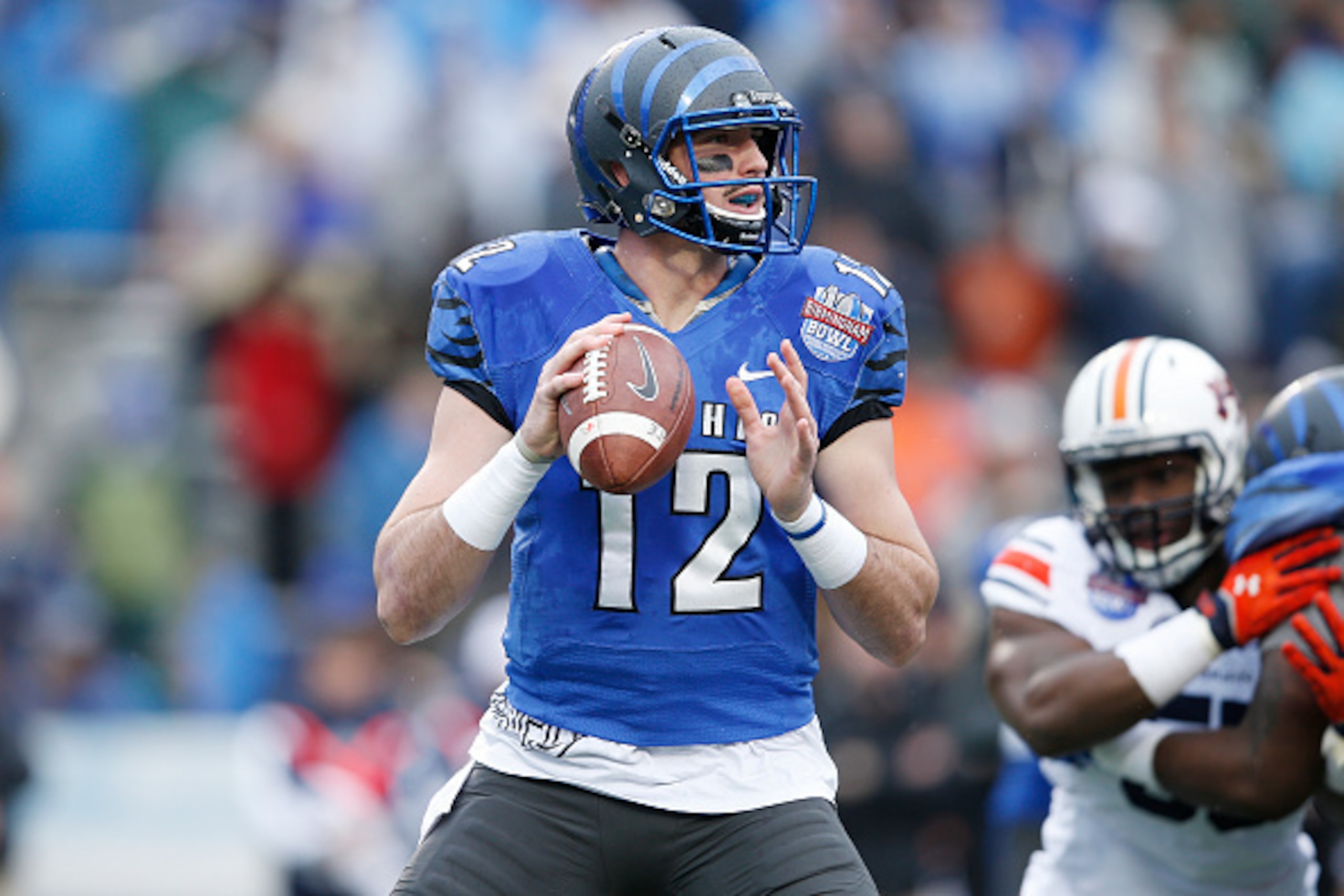
There may only be one quarterback drafted in the top 10 of the 2016 class.
Somehow, the Cleveland Browns are the only team that both needs a franchise passer and finished with double-digit losses in 2015. Unless a team like the St. Louis Rams, Houston Texans or Denver Broncos ends up leveraging its way up in Day 1, the Browns appear to be the only organization who need to take a swing in the first third of the round.
This is unfortunate for the NFL as a whole, as Paxton Lynch of Memphis could be a special one. He was listed at 6'7" and 245 pounds as a redshirt junior last season with the Tigers. He not only has the arm and touch to complete some of the most difficult throws in the sport, but his Aaron Rodgers-like mobility allows him to extend plays well beyond their original design.
Lynch's drawback is his college experience. He played in a mid-major conference, only facing two squads with blue-chip recruits in his final year with Memphis. The results were mixed, as Memphis shocked the world by beating Ole Miss but were also destroyed by Auburn in the Birmingham Bowl.
In the bowl, Lynch completed only 43.2 percent of his passes for an average of 2.86 yards. He didn't exactly leave college football on a high note, and his screen-heavy system already had some second-guessing his regular-season numbers.
Lynch isn't going to be ready immediately, especially if he's drafted into a quick-strike system like new Browns head coach Hue Jackson ran as the Cincinnati Bengals offensive coordinator.
You might have to sit Lynch for a season, but if his trigger is quickened, he has Cam Newton playmaking potential. He has the same type of upside as a Marcus Mariota, who was drafted second overall in 2015 behind Jameis Winston, but his control of the deep ball is already better.
Patience is going to be the key to developing Lynch into a franchise leader, but he's the type of draft pick who gets everyone in your franchise a raise if he "hits."
Robert Nkemdiche, DL, Mississippi
6 of 7
From a raw talent perspective, Robert Nkemdiche might be the third-best player in the draft behind his former teammate Laremy Tunsil and Ohio State's Joey Bosa. From a physical standpoint, he's as close as a prospect is going to get to J.J. Watt for a while.
At the SEC level, he dominated everyone in front of him when the lights were on. Too often, though, he seemed to be going through the motions when facing lesser opponents.
For the most part, it looked like he was ready to leave college as soon as his three years were up, as he was planning on going pro before he even landed on campus. Last year, you could say the same thing about Arik Armstead, who was drafted 17th overall by the San Francisco 49ers.
At only 21 years old, Nkemdiche—who can play defensive end in either a 3-4 or 4-3 defense and line up as a 3-technique defensive tackle—has a high ceiling. It shouldn't surprise anyone if he has an Aaron Donald-like combine in the coming months.
With that said, at his age, he also comes with baggage. His brother, Denzel Nkemdiche, another Rebels defender, had multiple off-field issues while at Ole Miss. Until recently, trouble had been isolated on his end of the family. In December, though, the younger Nkemdiche fell out of a fourth-story hotel window in Atlanta, resulting in an eventual drug arrest when police found marijuana in his room.
Is Nkemdiche going to be a player you constantly have to worry about when he's not in the facility? Is he the interior defensive line version of Aldon Smith, an elite football player who can't stay out of trouble? Only time will tell, but the defensive tackle's tape talks.
Jared Goff, QB, California
7 of 7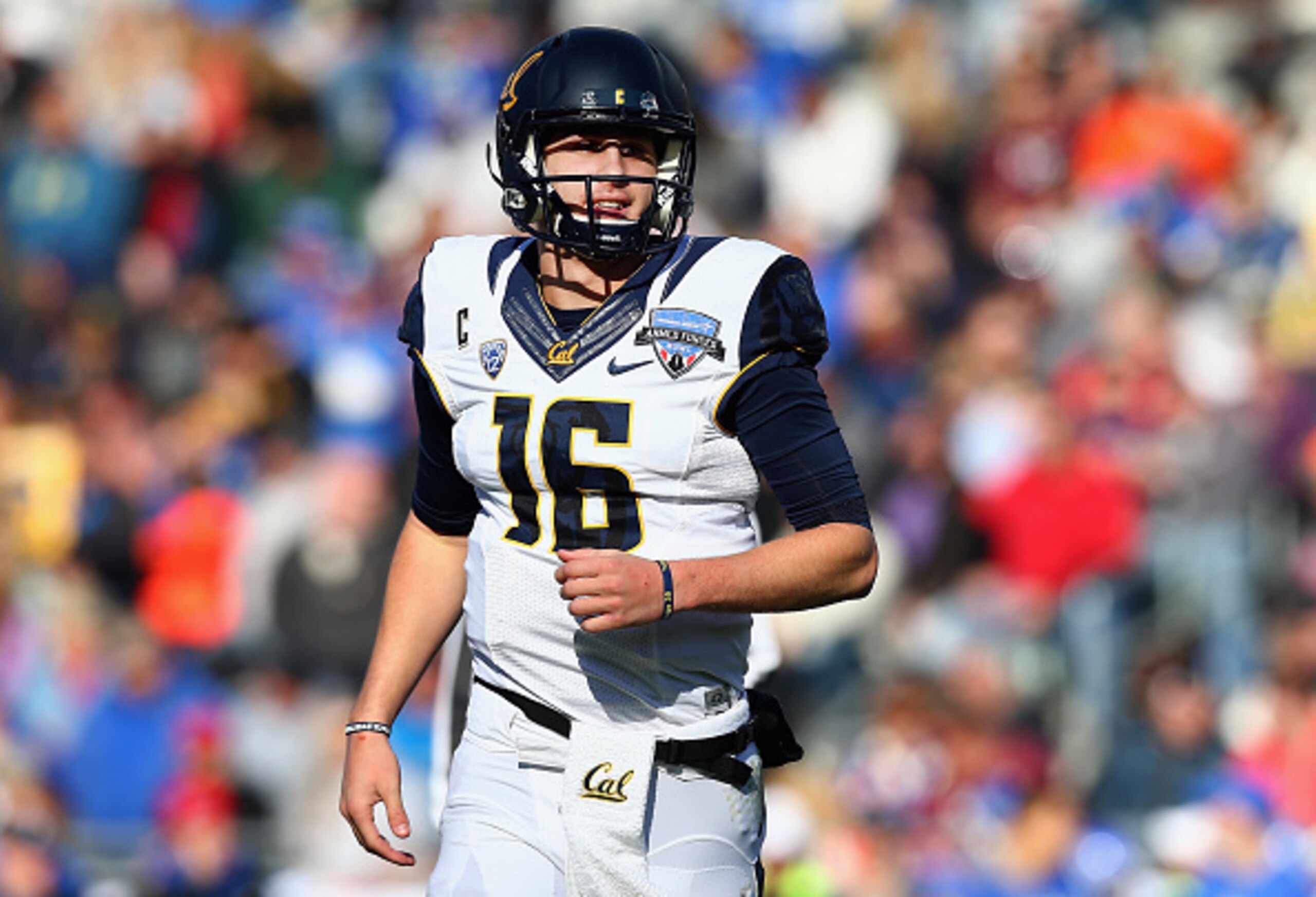
While Paxton Lynch is the dream passer for a vertical style offense in this class, Jared Goff is your West Coast savior. At California, he played in a system tabbed as the "Bear Raid," Golden Bears offensive coordinator Tony Franklin's spin on the Air Raid offense. The system has roots in Texas, but it's been spreading west to programs like Washington State and California recently.
The offense looks almost nothing like an NFL system. Goff is always in the shotgun, and he rarely makes line calls. This is nothing new, as Franklin's offenses have been known to utilize the center to both call the cadence and make line adjustments, while the quarterback communicates with receivers pre-snap. Think of it this way: Goff has been playing in a fast-break offense his whole career.
One benefit to being born in those conditions? Mentally, Goff can always find the open receiver. He quickly goes through reads, which is a product of playing in a scheme designed to get the ball out of a passer's hand as quickly as possible.
Some will question what the upside of Goff will be, as he lacks an elite arm, but he isn't limited by any stretch of the imagination. Think of him as a mix between Teddy Bridgewater and Chad Pennington, two first-round quarterbacks who were able to lead their teams into the playoffs early in their careers.
With Chip Kelly posted in San Francisco, it wouldn't be a bad fit if Goff ended up moving a few miles south to play for the 49ers. If coaches are trying to establish systems, Goff is the perfect plug-and-play passer who they won't have to worry about freelancing.
If you're able to secure a consistent passer under a rookie contract, as opposed to the alternative of paying him $20 million a year, you're securing about $15 million in cap room to spend on other parts of the roster. That alone is a tremendous advantage.
.jpg?w=2560 "Chiefs Giants Football")
.jpg?w=2560 "Titans Ravens Football")
.jpg?w=2560 "🚨 Week 8 AP Top 25 Poll")

.jpg?w=2560 "Packers Safety Slams Refs 🤬")