

Chelsea's Opponents Dynamo Kiev Playing for Country as Well as Club
When you’re having a tough time in life, there’s almost always somebody around the corner that has it tougher.
With his Chelsea future seemingly on a knife edge, it’s a cliche that Jose Mourinho and his supporters might wish to consider as Dynamo Kiev prepare to arrive at Stamford Bridge for Champions League action on Wednesday.
The Portuguese coach may be complicit in the worst opening to a title defence in Premier League history, but even if his future is the subject of daily speculation, when all’s said and done, it’s just a poor run of results that he and Chelsea experiencing. What Dynamo, and Ukrainian football in general, have been through in the last few years is something altogether more seismic. It’s been a struggle just to keep going.
TOP NEWS

EPL Transfer Window Grades 🔠

Adams Named USMNT Captain 🫡

Sullivan, Hall Lead USMNT to Big Win 💥
Another cliche is that a club represents not only itself, but its nation in continental competition—in Dynamo’s case, that couldn’t be more true.
Ukraine is still feeling the effects of the crisis that began with November 2013’s Euromaidan protests, which later escalated into violence, tragedy and Russian occupation of areas of the country. Visibility in Europe, and flying the flag for Ukraine, has rarely been more important.

Last season, Dynamo managed to strike a series of positive notes. They won the league and cup double (incorporating the club’s first Ukrainian Premier League title in six years) and reached the quarter-finals of the Europa League. This is Dynamo’s first season back in the Champions League after a five-year absence.
It feels good to be there, and to be competing, unbeaten at the group stage’s halfway point and with credible draws against Chelsea and Porto at their Olympiyskiy home under their belts. It’s a scenario that hardly seemed possible some 18 months ago, when football in Ukraine tentatively resumed after the protests’ violent nadir in Kiev had abated.
The Ukrainian Premier League’s post-winter resumption had twice been postponed before finally picking up in mid-March 2014, per Nicholas McGee of Goal. By that point, players tended to be in one of two camps; those anxious about a lack of match practice with the World Cup on the horizon, and others fielding calls from frantic relatives concerned about them living on the front line.
Frustration was one of the strongest emotions at Dynamo’s Koncha Zaspa training complex, which felt a long way from the remnants of the hostilities, 15 kilometres from the capital’s centre. Coach Oleg Blokhin and his team often felt like they were training without purpose. Yet for many of the players, the effects of the troubles were part of their day-to-day existence.
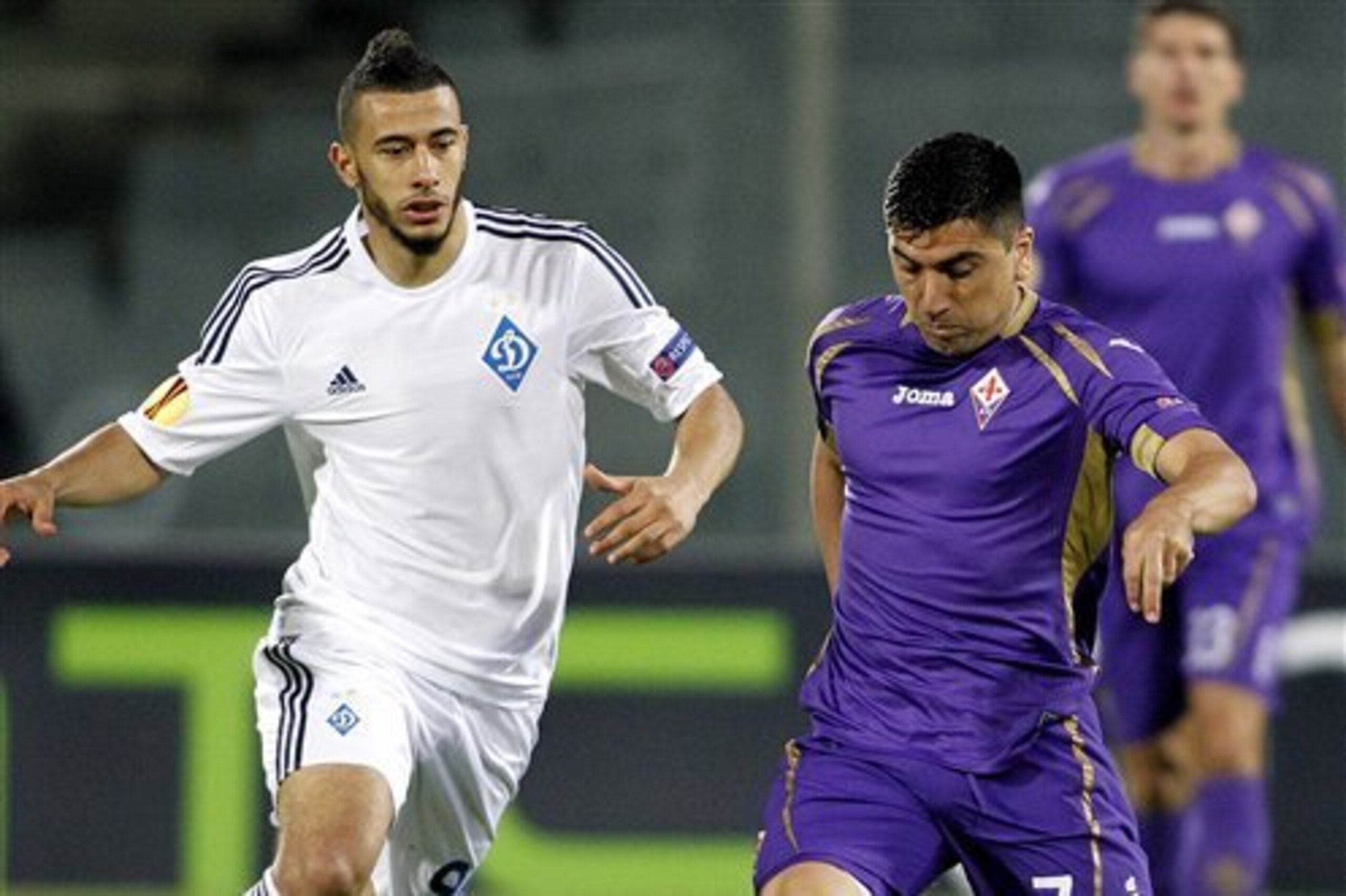
As midfielder Younes Belhanda explained to Canal Plus earlier that month (in French), the squad returned from their customary mid-season training camp in Marbella to meet some distressing scenes. His apartment was less than a kilometre from Maidan. At night, he could hear protest chants and—when it got bad—gunfire.
When European competition began again in February, Dynamo’s opponents Valencia were understandably uneasy about visiting the Ukrainian capital. According to PA Sport (via ESPN FC), Dynamo president Ihor Surkis called in a favour and switched the home first leg of the tie to the Cypriot city of Nicosia. Dynamo lost 2-0 en route to a last-32 exit from the Europa League, but in a way, this uncomfortable set-up was a small step towards working normality.
In those terms, it’s clear that some of Dynamo’s Ukrainian Premier League peers have had it a lot tougher than them. Clubs in the east of the country were particularly affected, and champions Shakhtar Donetsk were one of four clubs to leave their home cities and come to Kiev. Today, the capital often hosts three UPL games per weekend, with Olimpik Donetsk, for example, training and playing at Dynamo’s former home, the Valeriy Lobanovskiy Stadium.
Shakhtar are not one of the teams to play there, living and training in Kiev but playing their matches in Lviv, though they have explored the possibility of playing in Odessa instead. There is a sense (certainly within Shakhtar) that the troubles have handed Dynamo an advantage in recent times, with Mircea Lucescu’s team undermined by constant travelling and a lack of home support.
"In one day, we lost everything,” Shakhtar chief executive office Sergei Palkin told this correspondent in a film for the Guardian earlier this year, referring to the military action that saw the club forced to leave Donetsk. Though Dynamo’s experiences didn’t include the same geographical upheaval, they, too, have had to adjust to a rapidly morphing landscape in Ukrainian football.

Moreover, complete reconstruction was required on the pitch, too. Blokhin had left a bloated, disparate squad behind him which hadn’t seriously challenged for honours in some time. When Dynamo legend Sergiy Rebrov took over as caretaker boss in April 2014, he inherited a mess.
What Rebrov has done since is little short of extraordinary. He won the Ukrainian Cup a month after taking over and was appointed permanently. He then led Dynamo to the double on the back of a season in which they were undefeated in domestic competition. Dynamo have still only lost two domestic matches under Rebrov; this season’s Super Cup and a UPL game a few weeks back, both to Shakhtar.
At least as important as the zesty, bright football that his side practices is the fact that Rebrov was a well-travelled player, and he has a grasp of the bigger picture. He knows exactly what Dynamo putting their collective best foot forward in Europe means in terms of international projection.
“Any success for Dynamo is success for the whole of Ukraine,” he told me in an interview for ESPN FC in March. “I hope people from outside can see that life is continuing here."
Kiev is a city that understands better than most that football means something outside the white lines. The venue of the biggest single massacre of the Holocaust in Babi Yar, it was also where the famous "Death Match" took place in 1942, something investigated (and partly debunked) by Mark Pougatch for the BBC at Euro 2012.
So Dynamo hope to garner attention, as well as admiration, at Stamford Bridge this week, where their very presence is already a triumph of sorts.

.jpg?w=2560)


.jpg?w=2560 "Viral Rams Coach Vid 🖕")

.jpg?w=2560 "Injury-stricken Seahawks signing veteran RB")
