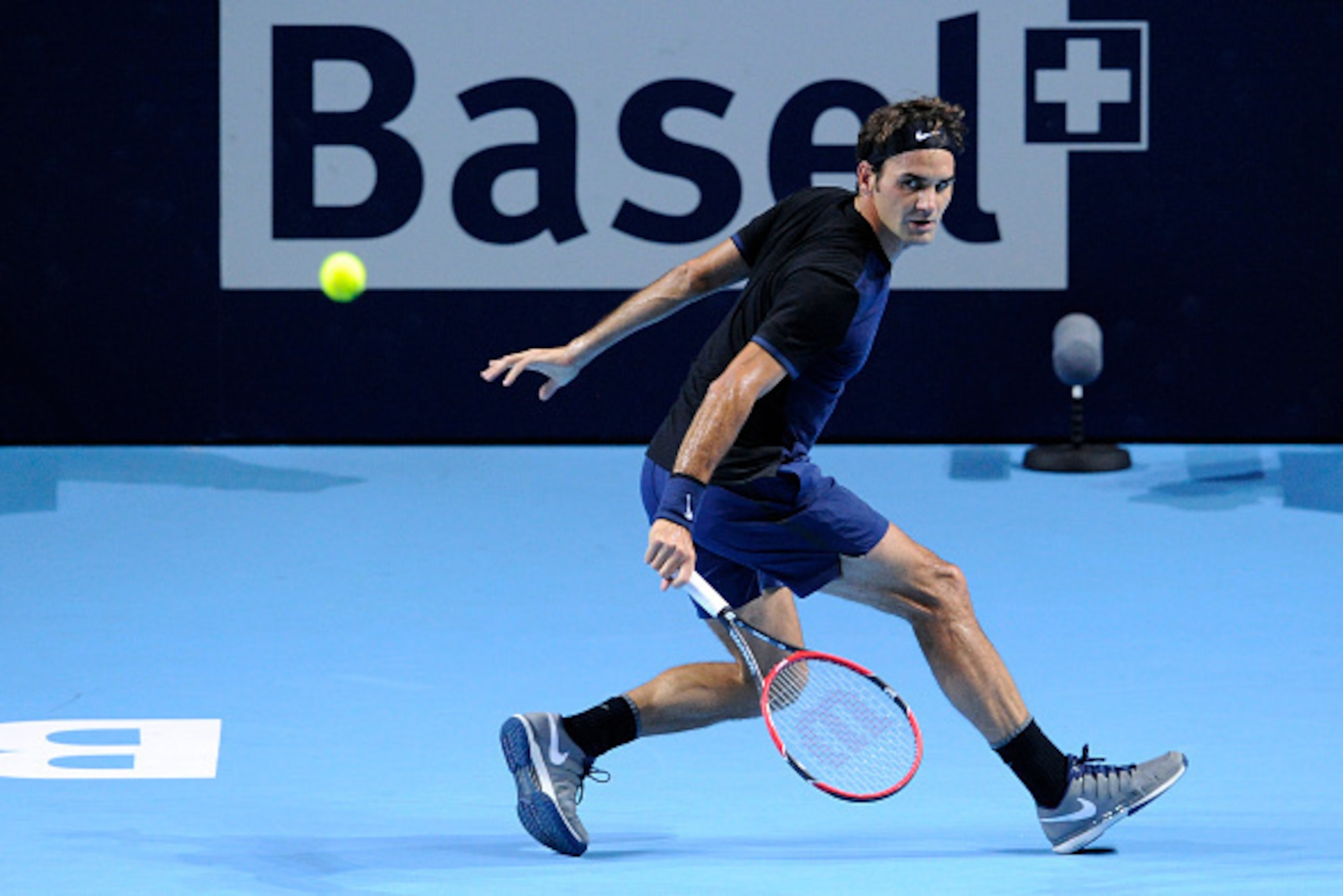
Roger Federer Looking for More Hometown Dominance at the Swiss Open
Someday, the Swiss Indoors Basel will have to name their tournament after hometown hero Roger Federer.
Had the Swiss Maestro never won a major or any other title outside of Basel, he can still boast of more dominance at this tournament than anyone else.
Nobody has dominated any tournament quite the way Federer has in his hometown. He has appeared in Basel’s final the past nine years, pulling in six titles. He also had two runner-up appearances from 2000-01 before he matured into a superstar.


.jpg?w=2560 "Colts Football")
Although he has accomplished more in terms of titles and importance at Wimbledon, Cincinnati, Halle and (perhaps) Dubai, Federer can add that seventh title at Basel by the weekend, which would be his fifth tournament with seven or more titles.
A 10th consecutive appearance in Basel’s final would also put him one up on Rafael Nadal’s Monte Carlo finals streak from 2005-13 (Nadal claimed more titles, however, winning eight straight until the 2013 loss to Novak Djokovic).
Is there more of a lock than Federer landing in the final? The last time Basel hosted a final without the 34-year-old was 2005 when tennis fans would not have been able to find highlight videos or matches of Federer on YouTube. It would only be weeks later that the mega video site would be officially launched to the public.
Then, the 2005 Swiss Indoors Basel had much thinner competition, featuring David Nalbandian, Guillermo Coria and champion Fernando Gonzalez. A decade later, the tournament has Federer, Nadal and Stan Wawrinka.
Quiet: Fast Courts King Still Dominant
Part of what has made the past decade in tennis history so fascinating is the different territories that the Big Three of the sport have carved up for their dominance.
There’s Nadal, the undisputed “king of clay,” with titles and records that will never be approached.
There’s “King Novak” Djokovic, who has dominated slow hard courts like nobody else. He could tack on another wing of trophies before he walks away.
And then there’s Federer, who started all of the 21st-century global conquests. Renowned as the biggest major winner of all time, the Swiss Maestro has clearly been the greatest fast-surfaces player of the Open era.
What’s extra impressive about his fast-surfaces dominance is that he has done this on hard courts, grass, indoors and outdoors. He’s won from winter, through summer and fall. His adaptability to all seasons and conditions have shown him to be the most versatile of legendary champions.
Indeed, Federer has been the master of finishing points quickly where that is the most rewarded objective on fast surfaces.
Consider the elements that make Federer so dominant well into the twilight of his career:
- Is there anyone who mixes up his serve more intelligently? It’s not quite the level of historical giant Pete Sampras in terms of raw serving, but Federer keeps his opponents off balance and defends his second serve better than anyone else, 57 percent points won, according to ATP World Tour.
- He backs up his game with aggressive net forays from serves to opportunistic moments in rallies. This done at a time when the classic serve-and-volley game is all but extinct and against some of the most powerful baseliners and technology the sport has ever seen.
- Forehand putaways are still lethal. At his peak, Federer’s forehand was liquid-metal smoothness, as if he alone was bequeathed with superpowers to hit winners from beyond the baseline. On fast courts, opponents who dared to make a mistake would helplessly watch the Swiss Maestro blow out a winner as easily as a birthday candle.
- Ah, the footwork, the unheralded and most important part of his offensive genius. Federer’s always been an underrated defender, able to poke back against big servers and turn the tide on baseline punishers.
- On fast surfaces, his backhand flick is an asset and rarely the maligned weakness that gets more than its fair share of attention during springtime on clay. In short, the Swiss Maestro is the near-perfect offensive machine on fast surfaces where all of his variety and strengths are played out how ever he needs to push the buttons.
Swiss Road 2015
"Roger Federer vs Mikhail Kukushkin Basel 2015 Highlights https://t.co/k5ayq1UQR9
— Sofia_RF (@Sofia__RF) October 27, 2015"
Federer made quick work of Mikhail Kukushkin, 6-1, 6-2. Shanghai aside, Federer has usually polished off fast victories against his early-round opponents this year, leaving plenty of energy for the later ties.
His second-round opponent Philipp Kohlschreiber can hardly be delighted with his 0-10 record against the Swiss. For that matter, Federer has taken 22 of their 24 career sets. Anything Kohlschreiber does is better performed by Federer. The German has no advantage or strategy to tip a Federer match in his favor.
His quarterfinals opponent could be David Goffin, whom Federer defeated in the finals last year. The Belgian is a nice player, but he lacks the indoors punch, serve and options that Federer has.
In the semifinals, there’s a good chance that Federer will face a big server like Kevin Anderson or John Isner. It’s never easy to endure the tension of holding serve against a “serveborg,” but Federer puts even more pressure on his one-dimensional opponents. Even superior big-serving tennis players like Andy Roddick can attest how difficult it was for them to hold against the Swiss Maestro.
Dare we even talk about a potential final against fellow Swiss Wawrinka or career rival Nadal? Let’s give it a few days.
.jpg?w=2560 "NFL Paris Football")

.jpg?w=2560 "Trevon Diggs Cut by Seahawks")