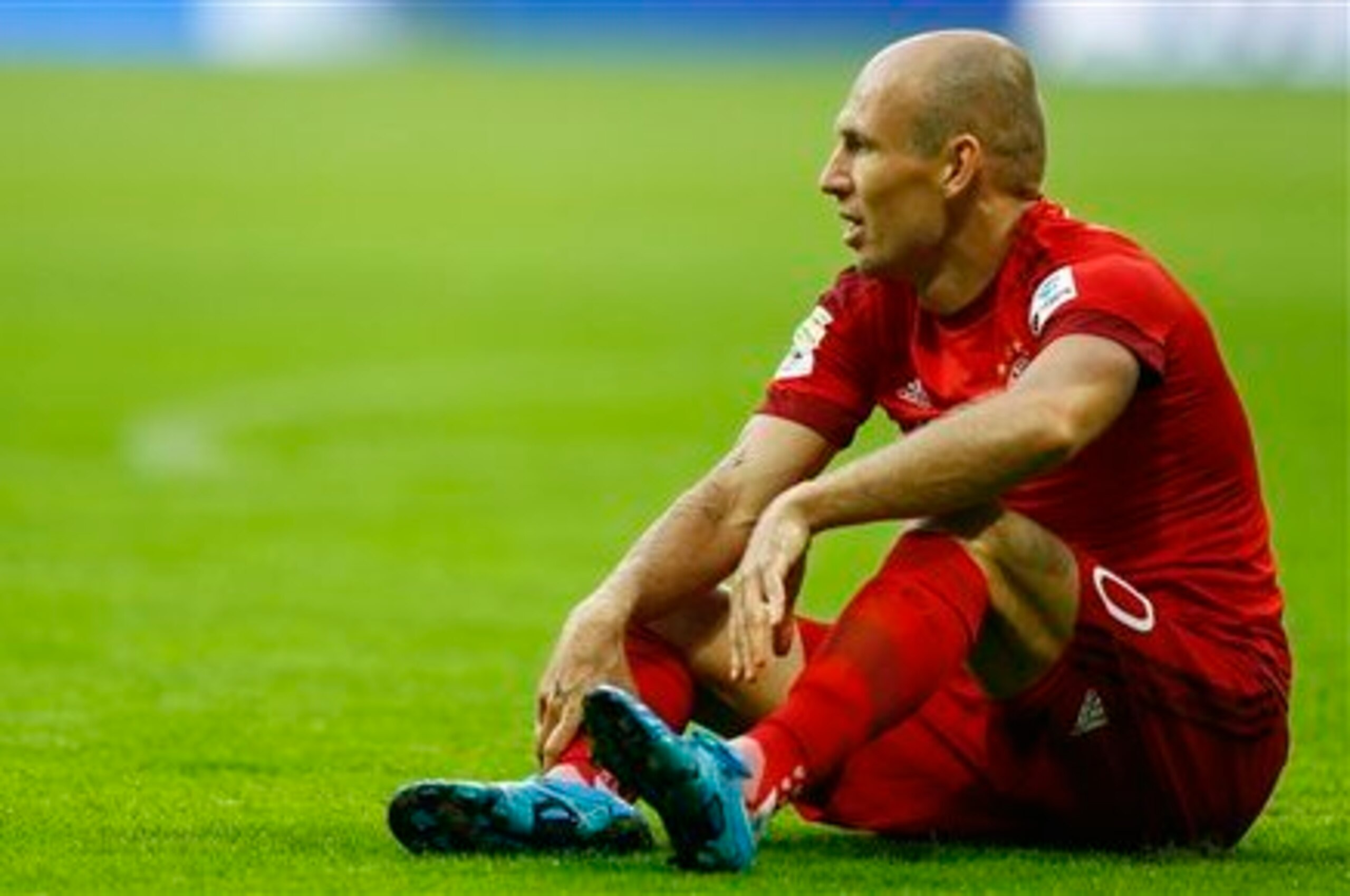
Why Arjen Robben Will Spend 2 More Seasons at Bayern Munich
When Arjen Robben leaves Bayern Munich, he will be remembered as a legend of the club. Signed at a time when the Bavarian giants were in transition, he almost single-handedly dragged the historic German team to the 2010 Champions League final in his first season.
And although he’s fallen short from time to time, Bayern have since succeeded and failed largely depending on his individual performances.
Robben is now approaching his comeback after an injury-enforced absence, and Bayern are sure to benefit from his return.


Yet, as the Dutchman’s 32nd birthday draws nearer, the questions of how long he’ll be reliable—and for how long Bayern will indeed need to rely on him—are becoming more and more of a pressing matter.
As recently as last season, Robben proved he still had plenty left in the tank. In 30 appearances in all competitions, he scored 19 goals and assisted nine more. He may well have been crowned top scorer in the Bundesliga if not for a season-ending injury that saw him miss the final eight matches of the campaign.
At the same time, age is a fickle thing in football, and Robben is approaching the time when most players start to lose their edge.
Neuromuscular velocity on average begins to decline around the age of 32, and with it, pace starts to wane. Robben will have to adapt his game to rely less on explosive bursts of speed.
In this regard, his previous injuries may be a blessing in disguise. In the past, he’s had to manage to perform without being at the physical peak of his game.
Take, for instance, his return after the 2010 World Cup, when he was at first significantly slower due to a hamstring injury that had kept him sidelined for the first half of the season. He’ll have a good idea of how to change his style as he grows older.
Even so, Robben's injury-prone nature will only be exacerbated by age. He never was an iron-man, and he may already have reached the point at which his body has become extra-susceptible to muscular and joint-related damage.
Per Transfermarkt, he missed 18 games last season and has already been out of action for eight in the current campaign.
At Bayern in their current state, an ultra-rich club where the standards are sky high, even legends can be replaced within a few months.
Consider Franck Ribery, a Ballon d'Or finalist some 21 months ago who has become a distant memory since Douglas Costa's emergence on the scene. The Frenchman is 32, and it's hard to see him becoming a key player when he eventually regains his fitness. Ribery's story will be a cautionary one for Robben.
Looking ahead, the Dutchman still has one year left on his contract after the current season, and it's hard to imagine him being sold.
The Netherlands international is too much of a club hero at this point to be sold, and the money Bayern could expect to recoup wouldn't be very much due to his age. He will, in all likelihood, stick around until his current contract expires in 2017, a few months after his 33rd birthday.
If he plays well this season, Robben will probably be offered another year's extension. And whether or not a full-time starter, he'll probably stick around until 2018.
Beyond that, however, the odds are against Robben remaining at the club. By 2018, he'll be in the twilight of his career, and hungry, young talents will be champing at the bit.
Kingsley Coman already looks a star in the making, and if Bayern exercise their right to sign him on a full transfer from Juventus, he'll be entering his prime as a 22-year-old in 2018.
By 2018, Bayern will in all likelihood have at least one or two more useful attacking players, either ones currently in their squad (Mario Gotze and Sinan Kurt, for example) or signings from other clubs.
As with Ribery, it's normal for Bayern to think about replacing superstars as they approach a time of natural decline, rather than waiting for them to overstay their welcome.
Robben said a year ago he could see himself staying in Munich for "a very long time" (via the Telegraph), suggesting he could end his career in Munich given that he'd already played in England and Spain.
The age of 34 is a good time to retire, and it's foreseeable that the Dutchman will have something to offer Bayern until then. Beyond that time, the club and the player will, in all likelihood, be ready to move on.

.jpg?w=2560 "Colts Football")
.jpg?w=2560 "NFL House in Paris Closes for Protests (AP)")

.jpg?w=2560 "Trevon Diggs Cut by Seahawks")