
2016 NFL Draft: Updated Prospect Radar Post-Week 3
A third of the way into the college football season, we generally have a feel for how this draft class is going to shake out.
We've seen some quality nonconference games in which prospects went head-to-head, and if a team hasn't started conference play just yet, it's at least finished going up against cupcake FCS squads instead taking on FBS conferences like the MAC or Sun Belt—which, believe it or not, are a big step ahead of the lower divisions athletically.
Injuries are starting to become apparent in the sport. Everyone is noticing how sloppy and broken the professional game is looking early on in the season, but a blind eye must be on college football, where the issue is really troubling. Two major prospects went down this week, potentially for the year.
Other than that, we're seeing two running backs put up consistent enough numbers to begin jumping them up the ranks, an offensive lineman who is going to shift in the NFL, a receiver who had a career day on a national stage, a defensive end who is leading an elite team with elite numbers and a top corner who is having a shaky start to conference play. There are ebbs and flows, but they are no longer on a game-to-game basis.
At this point, there isn't an Ezekiel Ansah, who blew up out of nowhere his senior year at BYU to land as the fifth overall pick in 2013.
It's rare to see top-100 picks come out of the blue, but we will go over the slight ups and downs that high-profile prospects are going through after a big slate of games this week.
Stock Up: Devontae Booker, RB, Utah
1 of 8
Looking back, Devontae Booker probably should have declared for the 2015 draft class. Rarely do running backs who are drafted early stay for their senior years, unless they improve greatly, like Carlos Hyde did at Ohio State, or if there's a change of circumstances, like Charles Sims' transfer to West Virginia from Houston.
Arguably the top two senior backs in the 2016 class went head-to-head on Saturday when Booker's Utah Utes faced Byron Marshall's Oregon Ducks. Here's the thing, though: Marshall now plays as a hybrid receiver, while Booker is a true running back.
Booker and Company shocked the world when they defeated the 11th-ranked Oregon Ducks, 62-20, which has since vaulted Utah into the top 10 in the AP poll. Also on their resume is a win over the Michigan Wolverines, who under new head coach Jim Harbaugh are now a top-25 squad, too.
Booker's 98-yard game doesn't look great on the surface, but we must remember that his 4.5 yards per carry average also came along while Travis Wilson, Utah's quarterback, was injured. Wilson was a game-time decision, meaning that Oregon was keying on the senior tailback often.
Had he gained two more yards, it would have been his third straight 100-yard rushing game. At this point, his 2015 total might eclipse his 1,512 yards and 10 touchdowns from last season.
Booker was a Power Five recruit coming out of high school but landed at American River College before signing with Utah. In his one year in Salt Lake City, he was named Pac-12 First-Team over Buck Allen, who was the conference's only drafted feature back in the 2015 draft class.
The arrow is trending up on Booker, who is running hard and separating himself from the pack.
Current Draft Projection: third round
Stock Down: Darius Hamilton, DT, Rutgers
2 of 8
The story of Darius Hamilton is an odd one. He's the son of former Giants great Keith Hamilton, who played 12 seasons for New York, making the Pro Bowl in 2000 as a defensive end. The younger Hamilton played at Don Bosco High, a football juggernaut in New Jersey.
By his senior year of high school, Hamilton was an All-American and had scholarship offers to Miami, Florida, Auburn, Georgia, LSU, Oklahoma, USC and many others. Still, he chose the local Rutgers over any other option.
At 6'4" and 265 pounds, Hamilton is small for a defensive tackle but was projected to play defensive end at the professional level, the same spot where his dad spent over a decade. Just before the 2015 season kicked off, Hamilton's NFL chances were verified as legitimate when the Senior Bowl, college football's top all-star game, named him as one of four Scarlet Knights on its watch list.
Hamilton missed the first two weeks of 2015 only to have to pull himself out for the season after the same game against Penn State that began his campaign. His year ended in September due to a knee injury, and since he didn't use a redshirt early on in his career at Rutgers, he has the option to use a late redshirt due to medical reasons, which means that he'd become a 2016 prospect.
Either way, the senior flashed with double-digit tackles for losses last season. He already has so much going against him, considering the positional change and size questions. If he wanted to go in the top 100 picks, he needed to have a big season.
At this point, he should head back for 2016. Right now, he's a high school stud who never really put it all together at the college level. Returning for one last year in scarlet and white will do him well, especially if he's able to move to defensive end.
Even if he has to make that move as a graduate transfer, eliminating question marks for NFL squads will do him good. Think about it this way: How high would Russell Wilson have been drafted if the shorter passer didn't choose to play behind a giant Wisconsin offensive line?
Graduate transfers are allowed the ability to start anew, showing scouts they can thrive in multiple systems. That's on the table for Hamilton as of now.
Current draft projection: undrafted
Stock Up: Josh Doctson, WR, TCU
3 of 8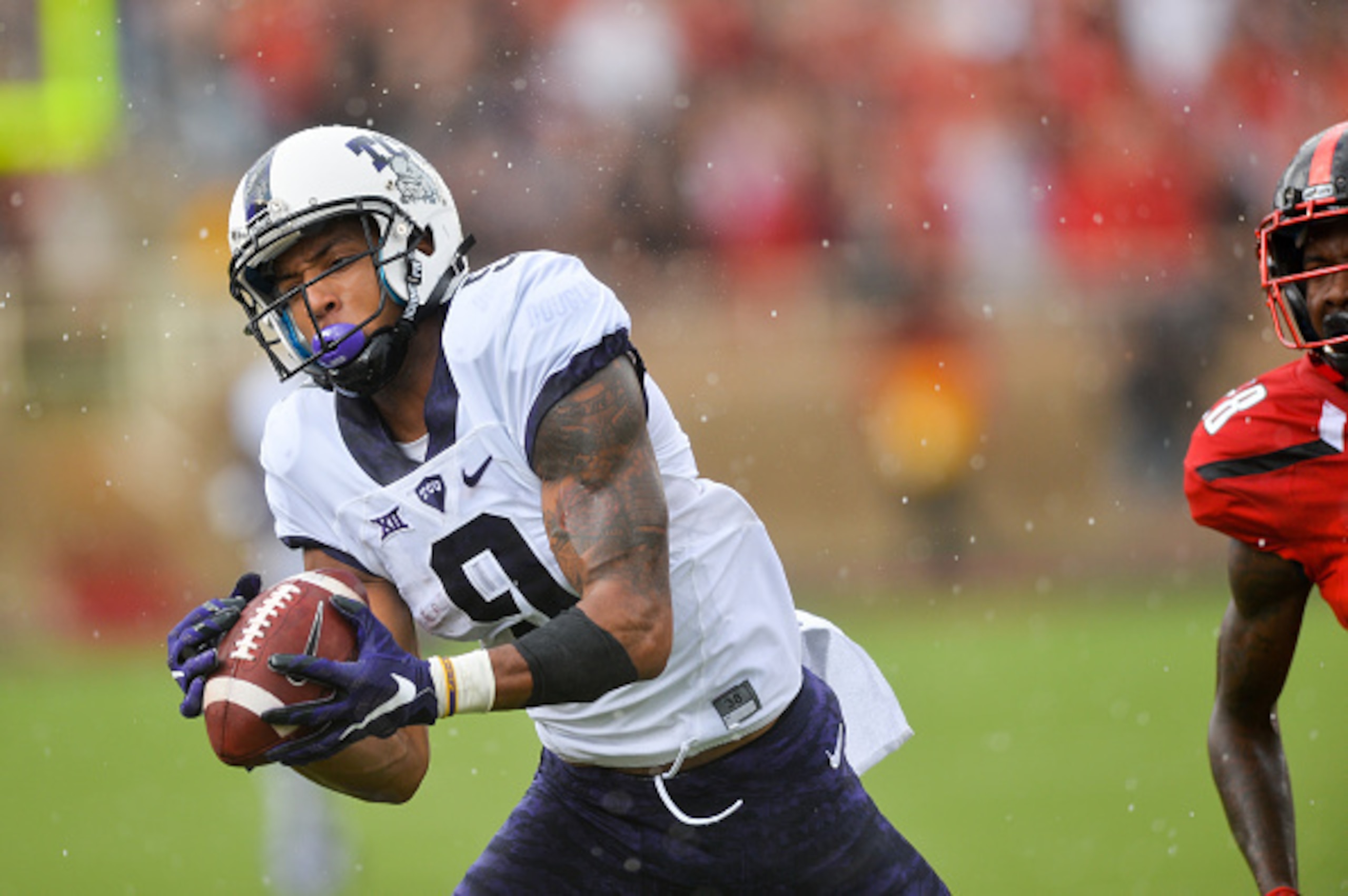
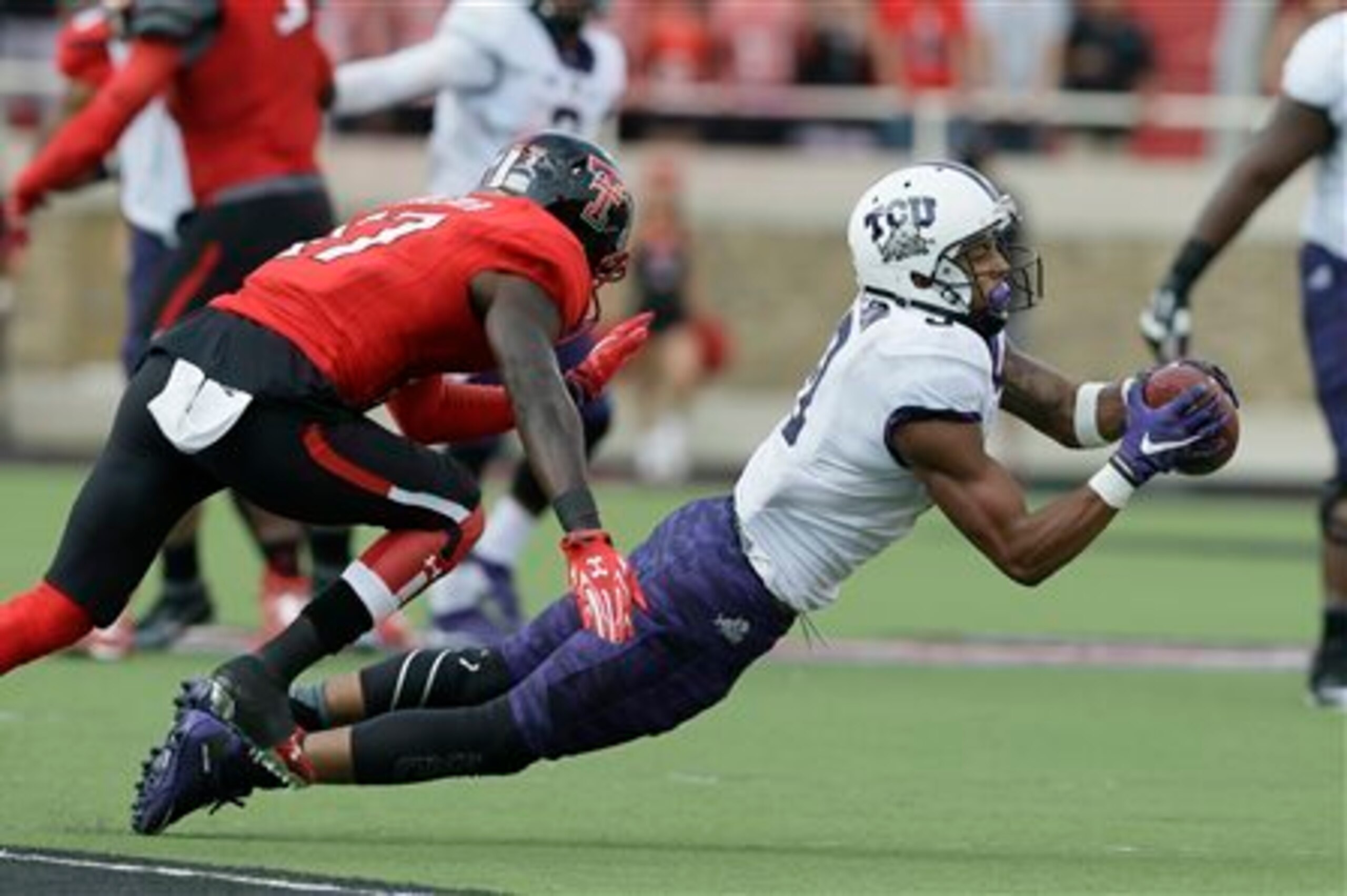
Josh Doctson started his college career as a receiver for the University of Wyoming, where he caught passes from Brett Smith for a year. At the end of his true freshman season, Doctson decided to go a different route, returning back to his native Metroplex area to play football for the TCU Horned Frogs.
After sitting out a transfer year, he started in 2013. His 440-yard redshirt sophomore season was nothing like his 1,018-yard junior year, which also featured 11 touchdowns. Still, he's progressively getting better, even as a fifth-year senior.
In last week's 55-52 shootout against Texas Tech, the Horned Frogs kept going back to Doctson, as he caught an astonishing 18 receptions for 267 yards and three touchdowns. In what may be his best game of his career, the lasting memory will be of him tipping a pass to running back Aaron Green in the back of the end zone, leading to the game-deciding touchdown.
Doctson is very strong at the point of attack and is a physical receiver. Has doesn't have poor speed, but if he ends up in the 4.5-second 40-yard dash range at the combine, it wouldn't be shocking. He's listed by the school at 6'3" and 193 pounds but plays like a mid-sized target; don't think he's some Calvin Johnson or Mike Evans type of stretch player.
Honestly, the best comparison for Doctson might be Keenan Allen, who is a trustworthy possession receiver for the San Diego Chargers. Prior to the combine, Allen was looked at as a first-round talent. He ran a slow 40-yard dash due to a lingering knee injury and failed a drug test due to "suspiciously high levels of water," according to ESPN's Adam Schefter.
He was still drafted 76th overall in 2013, and in Week 1, against a conservative Detroit Lions defense, the Chargers sent the ball his way 15 times. Doctson has the chance to be a top receiver in an offense which is based on efficiency and taking advantage of short zone coverages. If he continues to see success like Saturday's, he just might sneak into the first-round conversation, too.
Current draft projection: second round

Stock Up: De'Veon Smith, RB, Michigan
4 of 8
Jim Harbaugh is the most popular man in Ann Arbor right now. After being let go by the San Francisco 49ers, whom he took to a Super Bowl, he returned to his struggling alma mater in an attempt to rebuild a once-proud program.
As his first September as Michigan's head coach is nearing its end, the Wolverines are ranked in the top 25. They've beaten Oregon State, a Power Five squad, by four touchdowns and also turned down BYU, who played back-to-back-to-back close games against Nebraska, Boise State and UCLA, to the tune of a 31-0 victory this past week.
Their lone loss? Their opener against Utah, when they fell seven points short. On Saturday night, the Utes blew out Oregon, who went to the national championship game just last season, in a 62-20 game in Eugene.
There's an argument that Michigan is "back," but it has as much to do with their running back as it does with their new coach.
De'Veon Smith, a junior, started the season slowly with a 47-yard game against the Utes but has since found his groove. Against both Oregon State and BYU, he's cracked over 100 yards, scoring in both with yards-per-carry averages of 5.5 and 7.8, respectively.
He's thick but holds it well, standing at 5'11" and 228 pounds. Michigan runs a power-run scheme, which is perfect for Smith, who lowers his shoulder and follows his blockers.
On a 60-yard run, Smith demonstrated his best attribute: effort. On a 2nd-and-2 rush, he hit the designed gap, with plenty of bodies around him. Magically, he resurfaced outside of the pile then fought his way away from a tackle, eventually finding his resting point in the end zone.
Rarely do running backs with this type of talent stick around for their senior years, as they realize that their lifespans depend on how much wear they put on their bodies.
He's not too far from a poor man's Eddie Lacy at this point: a running back on the bigger side with balance and grit who lacks breakaway speed. Lacy fell into the second round due to a foot issue, so it's not out of line to project Smith landing in the same range.
Current draft projection: second round
Stock Down: Gunner Kiel, QB, Cincinnati
5 of 8
Gunner Kiel started his career in the spotlight but has slowly stepped away.
He was once considered a blue-chip recruit and was headed to Indiana out of high school, where his brother, Dusty, was also a quarterback. He then flipped his commitment to LSU, but then backed away from that decision to go to Notre Dame, where his uncle, Blair, had played his college ball.
After a year in South Bend, Kiel transferred to Cincinnati, the fourth program which had trusted his word. Prior to 2015, he looked to have potential. He's nothing special, but in a class desperate for average passers and considering the NFL's demand for the position, there was an outside chance that Kiel could have landed among the top 30 picks.
Throwing out the team's first performance against Alabama A&M, an FCS squad, Kiel has yet to look impressive in 2015.
He completed 57.7 percent of his passes against both Temple and Miami, throwing four interceptions against the Owls. Against Memphis in Week 4, he threw 11 passes for 63 yards and an interception before an injury to his neck removed him from the game. His replacement, freshman Hayden Moore, promptly entered the game and threw for an amazing 557 yards.
We wish Kiel the best, but this just isn't his season. Even after a full recovery from his neck issue, it's probably a wise decision for him to stay in school for another season. Currently, he's nothing more than a late-round flier as an NFL prospect.
Current draft projection: fifth round
Both: Vadal Alexander, IOL, LSU
6 of 8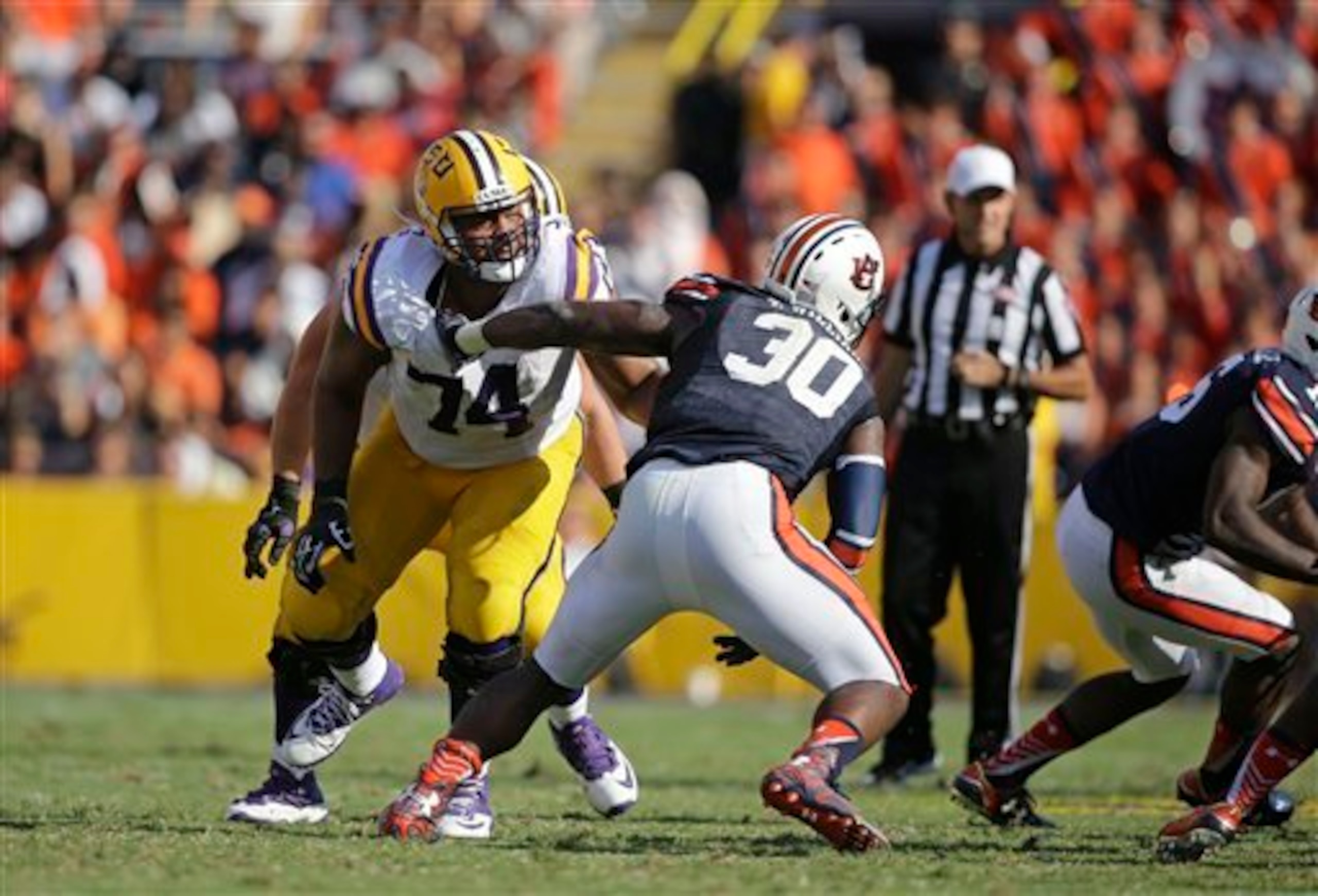
All college football season, you're going to hear about Leonard Fournette's accolades. The 21-year-old running back has been in the national media since he was in high school, and after back-to-back 200-yard games for the undefeated LSU Tigers, he's at the top of the Heisman race.
Equally as important to LSU's success is their top offensive lineman: Vadal Alexander. He's never going to show up in the stat book, but he's making great plays consistently. At 6'6" and 329 pounds, he's not really light on his feet, but he's a road-grade blocker, as apparent by Fournette's production.
As Rob Rang of CBS Sports pointed out, though, the right tackle is more than likely going to have to kick inside at the professional level. He's just not good enough in pass protection to trust on an island as a bookend. He allowed a sack against Syracuse where he let a man run right by him, not even attempting to make him run the arch. In the NFL, that's a sack every play.
He's tall for a guard prospect, but it's worked in the recent past. Kyle Long, for example, is 6'6" and entered the league as a guard until the Chicago Bears flipped him to tackle this season.
The hype on Alexander as the top guard prospect is rising, while his potential as a tackle is dying. If we're talking career earnings, his stock is pointing down, but with so many teams like the Philadelphia Eagles and Seattle Seahawks in dire need of interior offensive linemen, his draft stock is rising.
Current draft projection: first round
Stock Up: Shilique Calhoun, DE, Michigan State
7 of 8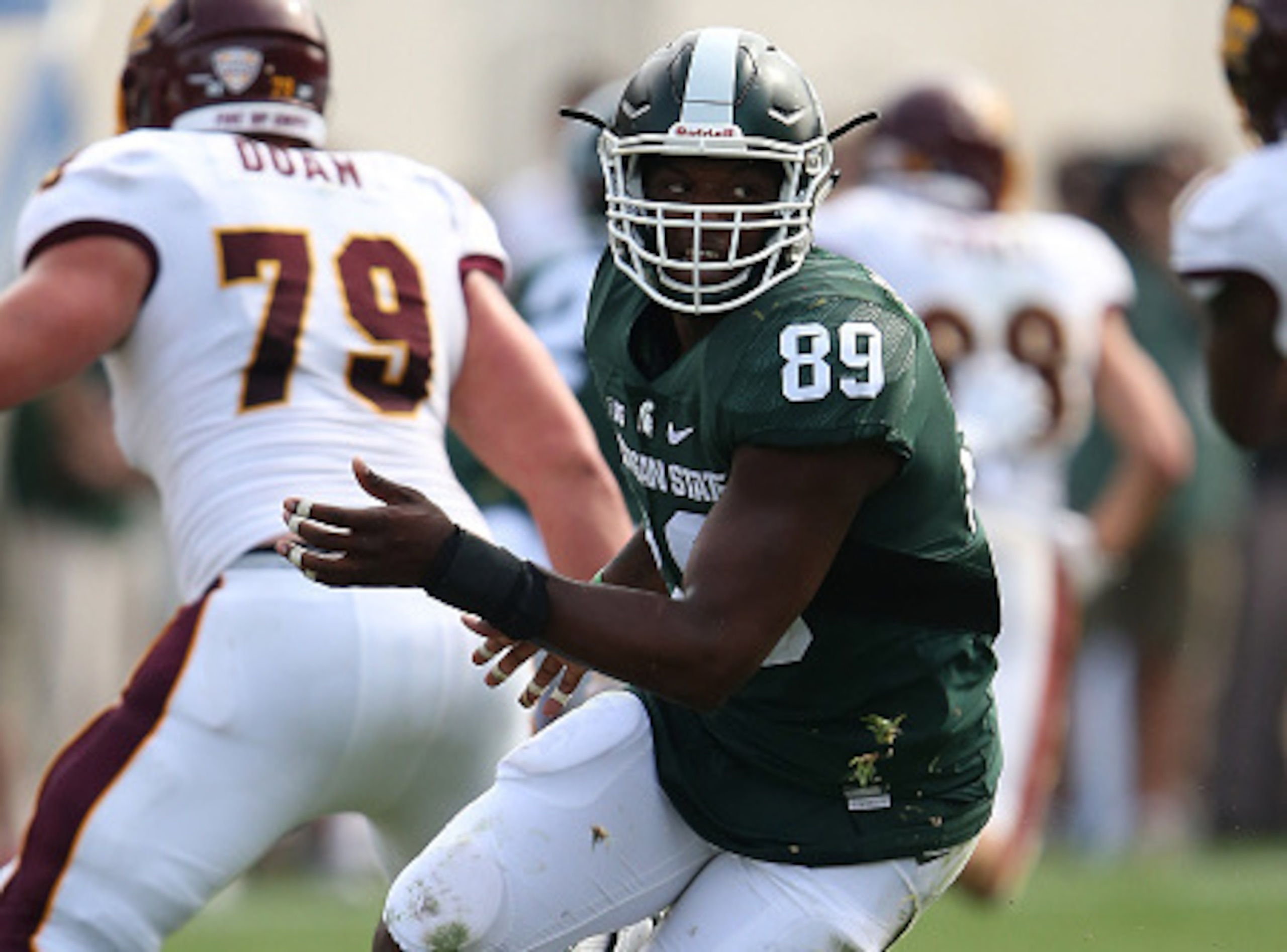
Shilique Calhoun's game was admittedly unimpressive heading into the season.
Michigan State plays a quarters-heavy defensive scheme in which it doesn't play a left and right defensive end in its base 4-3 sets, but instead assigns players to field and boundary positions. Calhoun is its field defensive end.
He's 6'5", so length is a plus for him, but at only 250 pounds, he's rail-thin considering what he could be based on his height. He's a decent run defender because of his technique, but even without that extra weight, he's not an overly explosive or agile pass-rusher. Despite that, he's posted 15.5 sacks and 26.5 tackles for losses between his sophomore and junior campaigns.
He hasn't stopped during his senior year, either. After single-sack games to start 2015 against Western Michigan and Oregon, with a quiet break against Air Force before Week 4, Calhoun came down with 2.5 sacks against Central Michigan this past weekend. On top of that, Calhoun also blocked a field goal to keep Michigan State ranked second in the nation with a win.
Calhoun's individual traits may not dazzle, but he's a high-motor guy who is the leader of one of the best teams in the country and has put up quality production for his third straight year. That's going to go far for some NFL franchise.
Now, is he going to be a Jarvis Jones, Aaron Maybin, Erasmus James or Jarvis Moss? That's the question.
Current draft projection: first round
Stock Down: Vernon Hargreaves III, CB, Florida
8 of 8
Against Tennessee in Week 4, Vernon Hargreaves missed plenty of tackles. The corner isn't known to be a strong run defender, but his tackle total of two could have been much higher, and his team didn't have to go down to the wire and survive with a missed field-goal attempt from the Volunteers in the final moments of the match.
Hargreaves is a good cover cornerback, but how much does that matter?
This may seem like a crazy question, but two draft classes ago, Jason Verrett was the best coverage corner in nation. This past class, it was Marcus Peters. Peters seems to have a step on Defensive Rookie of the Year honors after posting two interceptions in three games as a Kansas City Chief. Verrett has had a solid career when he's on the field, but injuries continue to hold him back.
What's the difference between the two? Two inches and physicality.
Defensive backs must now use their shoulders to blow up plays instead of their heads, due to changing rules in the NFL. The smaller the corner, the smaller and weaker the shock pad for tackles. There's no question as to why Verrett has shoulder issues and why they keep popping up.
Hargreaves is listed at 5'11", just an inch shorter than Verrett. As a whole, the NFL is getting longer on the boundary, as receivers are also looking more like basketball players each week. If you don't believe that, tune in to a Tennessee Titans game. Dorial Green-Beckham, their second-round pick, is almost used exclusively as a red-zone threat who takes advantage of his 6'6" length over shorter corners.
In this changing NFL, is Hargreaves talented enough in coverage to make up for the fact that he's going to be at an athletic disadvantage at the professional level against basically every target he's going to match up with outside? Between that question and his tendency to shy from tackles, it's hard to say 2015 has been good to him.
It's evident that the majority of NFL teams don't care about safety play, as maybe only offensive line play is worse in the league, but a forward-thinking squad might just invest in Hargreaves to play as a single-high coverage safety.
Typically, we see squads draft strong safety types in the first round for some reason, even though it never seems to work, but if you have a free safety who can allow your franchise to play with another safety in the box or play man coverage on most downs, he's one of the most impactful players on your team. Look at the Patriots with Devin McCourty and the Seahawks with Earl Thomas, who were both cornerbacks at one point in college.
Current draft projection: second round

.jpg?w=2560 "Rams Eagles Football")

.jpg?w=2560 "Grading WWE Raw 🔠")