Crazy Saturday at British Open Ends Where It Began, Dustin Johnson on Top
ST ANDREWS, Scotland — In the end, it finished just as it had begun, with Dustin Johnson leading by a single shot. Between the obscenely early start and the late evening conclusion, however, there were all sorts of excitement to be had—with no one enduring more of a roller-coaster ride than Johnson himself.
At 7 a.m. on Saturday morning, Johnson, The Open leader, returned to the 14th hole at the Old Course at St Andrews to resume his second round, looking to improve upon his 10-under par score and open up his advantage on the field.
Instead, he would be blown off course—literally and figuratively—almost immediately. When he tapped in for birdie at the 18th a full 12 hours later, merely being back to 10-under felt like real success.
.jpg?w=2560 "Texans Titans Football")
.jpg?w=2560)
.jpg?w=2560 "Cardinals Giants Football")
The American will head into Sunday’s third round with a one-shot lead over Englishman Danny Willett, buoyed after overcoming one of the more unusual days of his career to date, which started when his ball was blown off the green at the 14th.
“This morning when we started, it was almost impossible,” Johnson said later. “But [we] managed to hang in there. I came back strong and played one-under to the house. So it was a good way to finish the day.”
It had been an awful start. When Johnson opted to chip from the front of the 14th to start his day, he looked on in horror as his under-hit effort barely climbed the false front. As he lopped up in characteristically languid fashion to mark his ball, a gust of wind sent it rolling back down to the fairway, sparking playing partner Jordan Spieth to scramble across to mark his own ball.
“It was pretty funny,” Johnson said of the 21-year-old's panic. “I was laughing at him.”
Until he made bogey, that is.
Spieth was soon caught on camera moaning that play never should have been started in the morning, while other players were struggling even worse. Brooks Koepka flat-out refused to play as the wind-swept 11th green became impossible to putt on, creating a blockage in the middle of the course as players behind were forced to stop.
Then, when Louis Oosthuizen saw his short par putt at the 13th roll off past the cup of its own volition, organisers realised they had no choice but to stop play.
“Taking all that together, we decided to suspend,” Peter Dawson, the R&A’s chief executive, said later. “Clearly with the benefit of hindsight, it would have been better if play hadn’t started, but the decision was taken based on evidence at the time.”
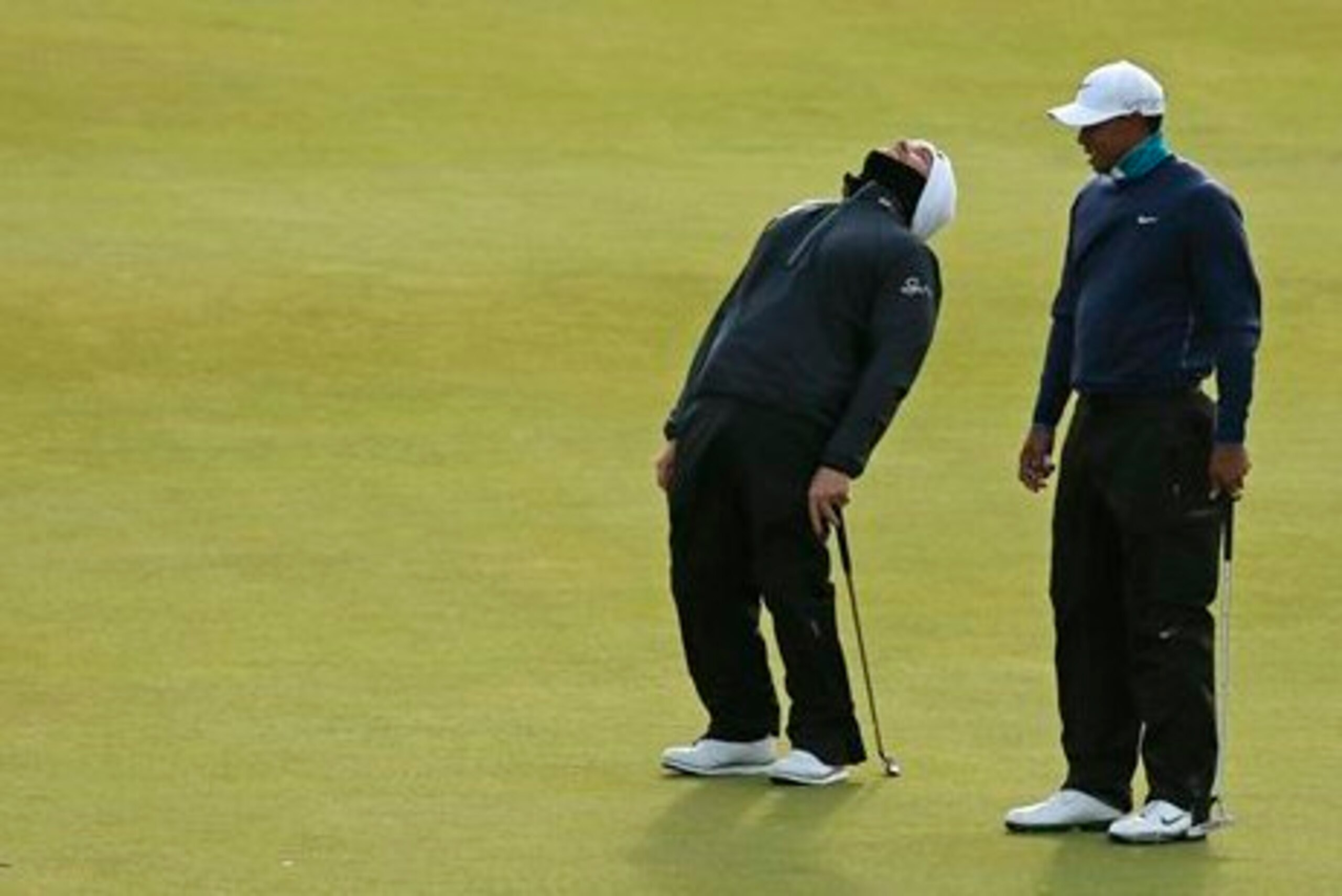
Organisers felt they had done their homework: They sent out groundstaff before play started to spend 30 minutes on the most exposed green on the course, the 11th, testing whether balls were oscillating on the green. At the time, they were not, giving the green light for play to begin. But by the time the players arrived, the wind was gusting six mph quicker (at 40 mph), enough to cause carnage.
“It just picked up a notch,” Oosthuizen agreed. Initially the suspension looked likely to be short, but it ended up being a 10-hour, 28-minute delay as conditions resolutely refused to improve sufficiently.
Players found different ways to occupy themselves during the delay. Ian Poulter gave Paul Lawrie a lesson in social media—“I picked up so many followers just after five minutes with him,” the Scot joked—while others, including Patrick Reed and Spieth, found a place to have a sleep.
Johnson followed suit, albeit while also finding time to fit in “a couple” of workouts at the gym. “Just to get the body back moving again,” he explained.
It was the spectators who really had to bear the brunt of the frustration, however, with the disappointment of missing out on some action at the Home of Golf assuaged to an extent by the fact that, unlike most other courses on The Open rota, there was at least a nearby town they could walk into.
The town was overrun with men (and women) in golf waterproofs. “All these people just walking around,” as one American exclaimed in amazement. “They’ve all got nothing to do!” Although, that was not strictly true of many of the locals in attendance: They went straight into the nearest drinking establishment.
St Andrews the town was simultaneously completely prepared and caught utterly unaware by the masses suddenly milling around. The many golf-oriented shops—"the best deals by par!"—suddenly had footfall they could only dream of, a blessing that came with its own curses. Demand for everything was huge, and by mid-afternoon, the one Subway store in town had already run out of bread.
The British Golf Museum, which gave free entry to those with a day ticket, saw large queues. Old Tom Morris’ grave, inside the ruins of St Andrews Cathedral, became another popular pilgrimage, with only the most patient of souls stalking out positions inside one of the grandstands on the back nine.

With most ticket-holders having missed the calamitous 30 minutes of action that occurred at the crack of dawn, the announcement that they would only be eligible for a 60 per cent refund was greeted with remarkable equanimity by all but some on social media. A further announcement, that tickets for Monday’s final round would only cost £10 ($16), perhaps improved some moods.
“You can make an argument many ways about this,” Dawson added. “I think our decision to open up the championship to a very low price on Monday is the right thing to do. Let’s hope we get lots of people taking advantage of that.”
At 6 p.m. local time, play finally resumed, with the second round concluding happily inside daylight hours. The tournament will now go to a normal schedule—“keeping with traditions,” as Dawson said—albeit 24 hours delayed. The players will go out on Sunday and Monday; only the second Monday finish in the tournament's 155-year history.
Johnson, thanks to some beautiful shots down the stretch—he gave himself a rare birdie chance at 17, and then drove the green at 18 for a long two-putt birdie—will be the last to go out, alongside Willett at 3 p.m. local time (10 a.m. ET).
The American’s issues at the business end of majors have been well-documented, but he has rarely had any problems in the third round. (Indeed, his final-round troubles have become so noticeable almost because he has become so adept at making his move a day earlier.) This is a course that clearly sets up well for him, something that will only prove even truer if the rain scheduled overnight softens the course further.
“If you’re driving it well and driving it long, this course is very much gettable,” as the departing Tiger Woods said. No one is driving it longer this week than Johnson.
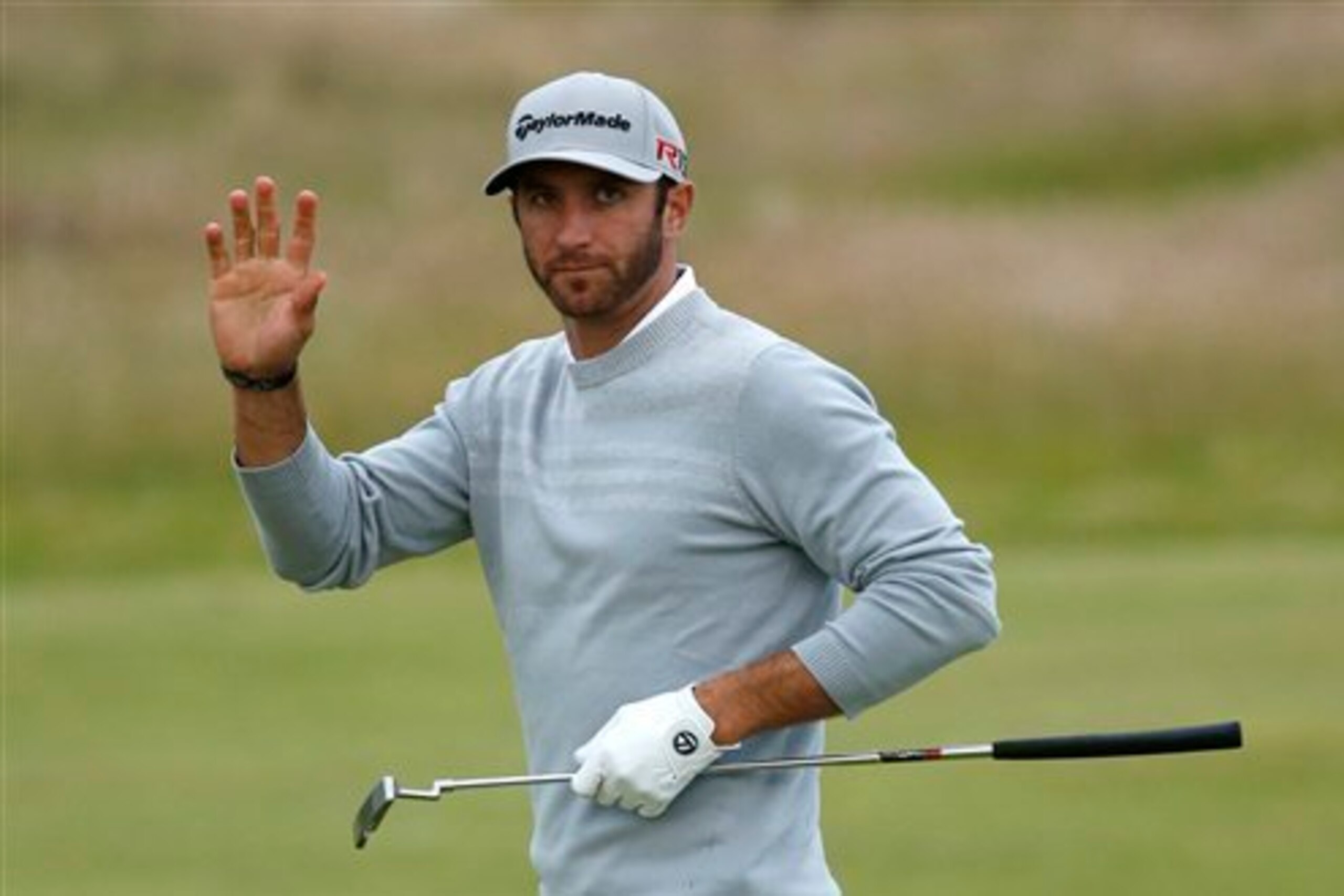
For his rivals, the preoccupation is to ensure the 31-year-old does not extend his lead over the course of Sunday. They know that will not be easy.
“I need a really solid round tomorrow, because Dustin is not letting up,” Spieth said. “He’s the only one I can speak of—he and Hideki [Matsuyama]—because I saw it firsthand. To fall from two back to five back isn’t exactly what I wanted.”
Johnson, in contrast, ended a roller-coaster day where he started—at the front. Which is exactly what he wanted.
All quotes obtained firsthand unless otherwise stated.
.jpg?w=2560 "Broncos Chargers Football")
.jpg?w=2560 "MHJ Bought Own Jugs Machine")