

Dez Bryant, Demaryius Thomas Reset NFL WR Market for Years to Come
Welcome to Football Econ 101. Today, we're talking about the free market.
A player hitting the open market usually means a huge payday. With revenues always increasing and the salary cap going up, the bar is reset again and again as top players sign new contracts. For the rest of the NFL, each position's top contract serves as a benchmark to approach, or template to build on, until it's topped.
In 2012, the wide receiver bar was set by Calvin Johnson's seven-year, $113.5 million contract. The deal's $16.2 million average annual value, with a whopping $53.3 million of it guaranteed, blew out the curve for wide receivers.
.jpg?w=2560 "Texans Titans Football")
.jpg?w=2560 "Broncos Chargers Football")
.jpg?w=2560)
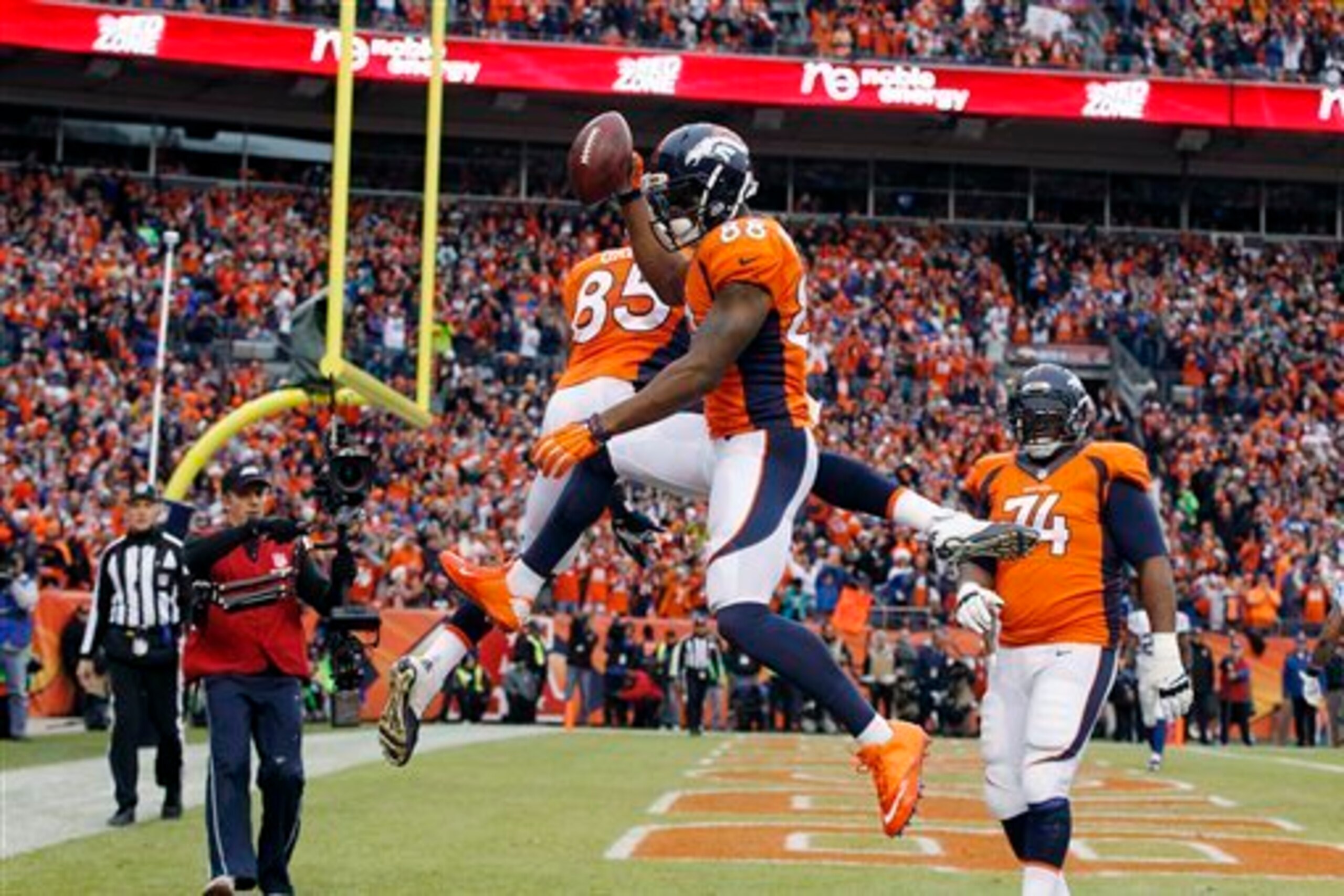
Dez Bryant and Demaryius Thomas, two consistently elite receivers who each outproduced Johnson by a large margin in 2014, just signed stunningly similar contracts. At five years, $70 million, with around $45 million guaranteed, both deals fall significantly short of Johnson's in terms of length, average annual value and guarantees.
This isn't how it's supposed to work. Similarly productive players at the same position taking significantly lesser deals two years later? When the salary cap is roughly $20 million higher than it was in 2012?
What gives?
Here's where market forces prove tricky. Price is a function of supply and demand—and the way the game has changed in recent years has affected both.
In 2013, I wrote about the NFL entering a "golden age of wide receivers," in which more teams have better wideouts than ever in history. I took a set of 2012 receivers with a qualifying number of snaps and checked the distribution of their Pro Football Focus Approximate Value—a one-number stat that contextualizes a player's overall production within his team.
Working backward in 10-year chunks, I tracked the number of receivers who contributed anything at all, who achieved the 2014 average production level and who reached one, two and three standard deviations above that mean. Dividing those numbers by the number of teams in the league lets us see how rare each level of production is.
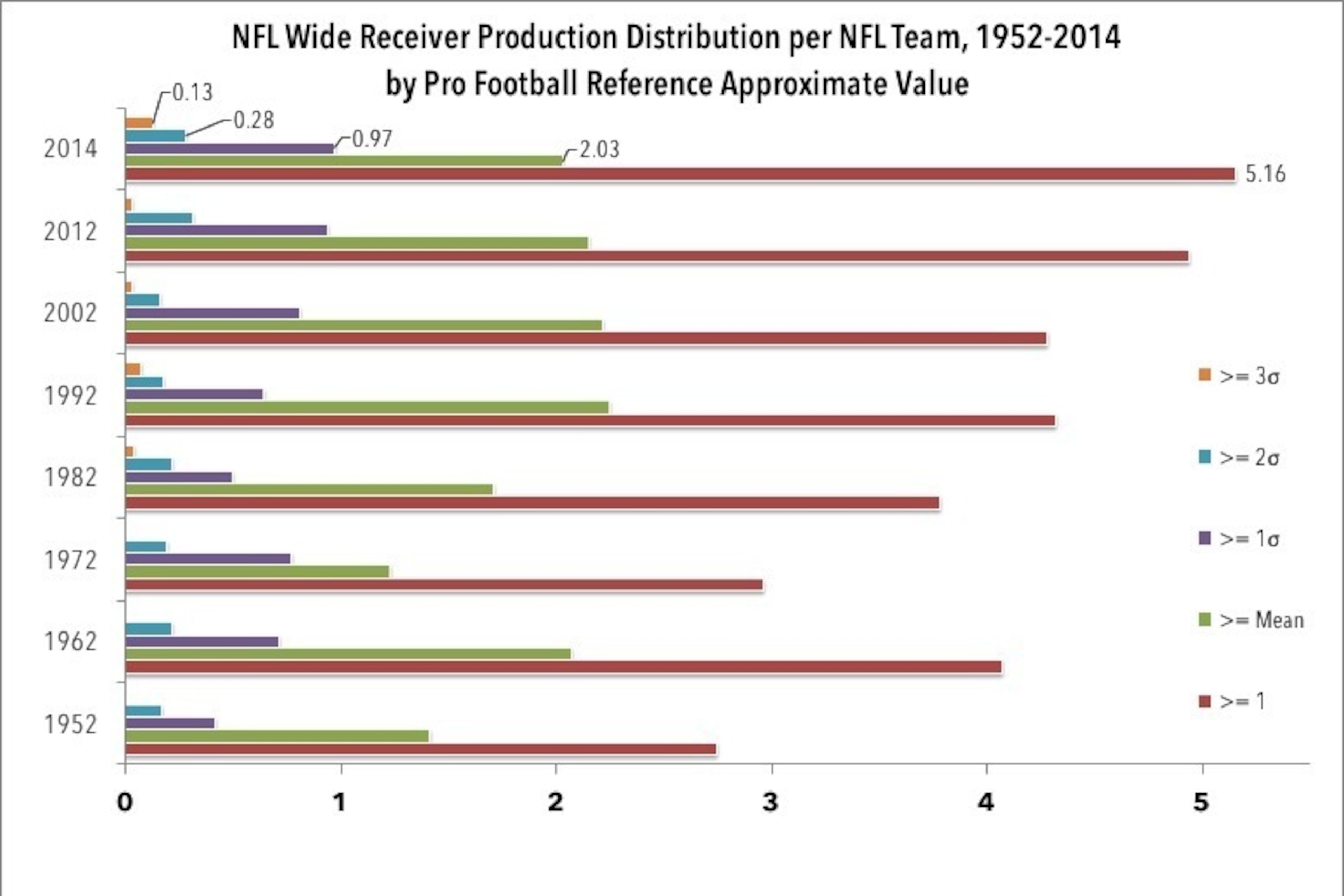
In 1952, for example, the average NFL team had 2.75 receivers who contributed anything at all, less than 1.5 who contributed at an average level and less than 0.5 who produced at one standard deviation above the mean.
Put in plain language, most teams had one starting-caliber wide receiver, and fewer than half of teams had a good one.
Zip ahead to 2014. Now, the average NFL team has about five receivers who contribute at all, two who play like starters and one that's a standard deviation above average. About a third of teams boast a receiver who's two standard deviations above average.
However, since 2012, there's been an explosion in truly elite receivers. Four receivers recorded AVs of 15 or better in 2014, three standard deviations above the 2012 average. Three more receivers finished with an AV of 14, just one below the cutoff.
Thomas and Bryant, along with Jordy Nelson, Antonio Brown, Randall Cobb, Julio Jones and Emmanuel Sanders, made up a group that included more receivers with an AV of at least 14 than in any other season since the 2002 realignment. There hasn't been more than five wideouts that productive in any given year since 2009.
What's really impressive is the pool of top wideouts who flirt with elite status: 20 different receivers have posted AVs of 12 or better since Johnson signed that contract; almost any of them could do so again this year.
So not only are as many or more receivers contributing, starting and playing well for each team than at any point in history, there's a glut of outstanding, top-level wideouts. What's more, the draft pipeline is fattening:
| 5 | 7 | 9 | 6 | 12 | 8 |
Since Johnson's deal set the old bar, 25 different first-, second- or third-year players have put up a season of eight AV or more, and six have joined the two-standard-deviations-above club.
With more teams taking more wideouts earlier, and each crop seemingly richer than the last, does it make any sense to blow out the curve on one of more than a dozen veterans all capable of putting up elite numbers?
As Jones, A.J. Green and Alshon Jeffery seek their next deal in 2016, they aren't going to try to top Johnson's contract. Not only would they have to put up a Megatron-style assault on the NFL record book to make a serious case for that kind of money, NFL teams will simply be able to point to the presence of the other talented players coming free.
Johnson's contract was the result of a generational talent seeking a big raise from a massive rookie deal, the sort that was eliminated with the 2011 CBA. Today's affordable rookie contracts and wealth of brilliant young receivers will make that kind of money impossible to command.
The contracts Bryant and Thomas just received are the ones Green, Jeffery, Jones and other top receivers will be asking their agents to try to replicate next spring—and, most likely, for several springs to come.
.jpg?w=2560 "Cardinals Giants Football")

.jpg?w=2560 "MHJ Bought Own Jugs Machine")