

If you think the state of play in Major League Baseball is solid now, just wait until everyone is tapping their heads in 2026.
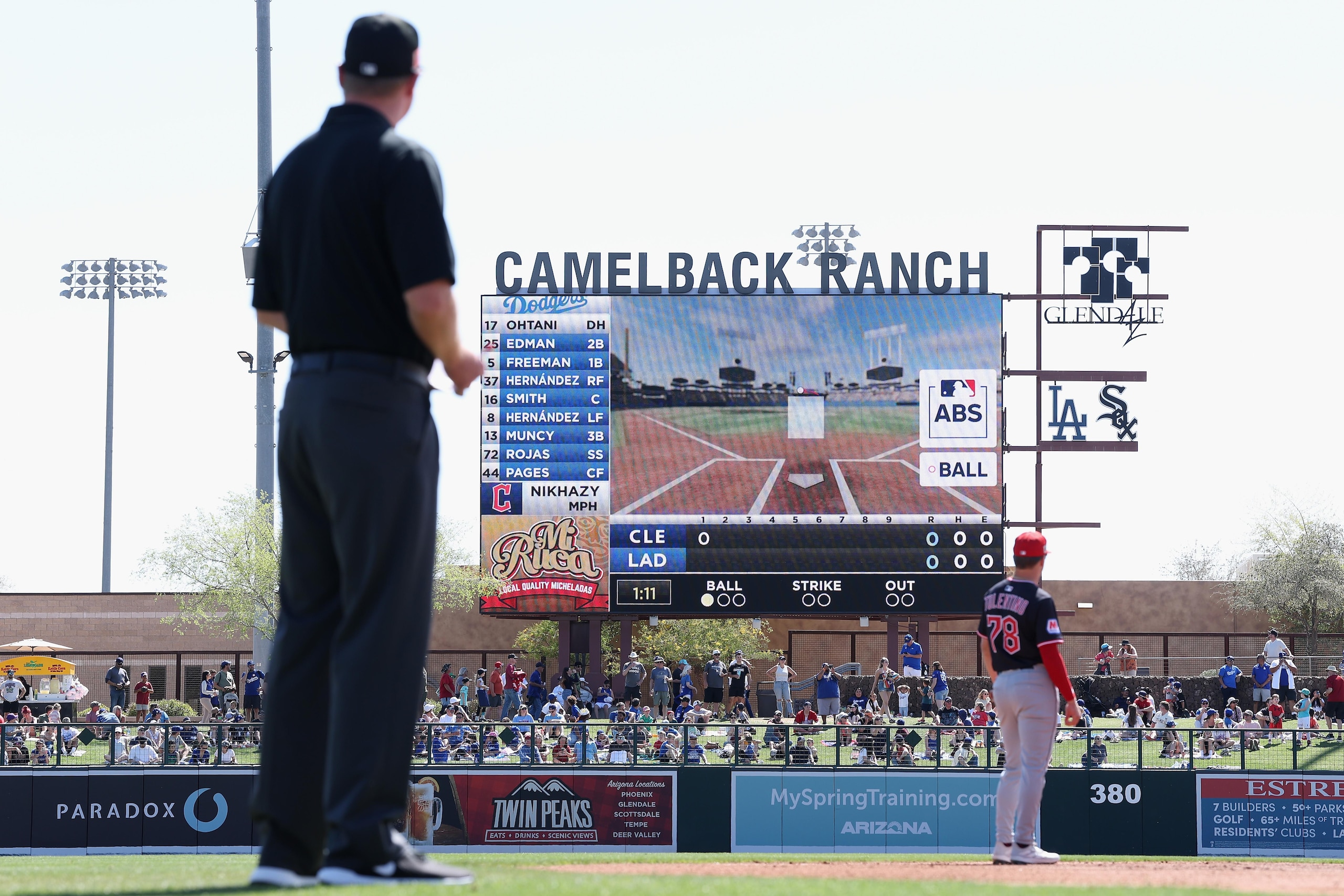
This isn't yet the official signal for "That call was garbage and I demand justice!" but it almost certainly will be next year. As reported by Evan Drellich of The Athletic, MLB commissioner Rob Manfred plans to propose to the league's competition committee that the Automated Ball-Strike System be implemented for next season.
Now, a proposal is not technically a decree. But it might as well be, as Drellich noted the league has enough votes in said committee to push through the proposal even if there is opposition to it.
TOP NEWS
Live World Series Game 2 Highlights 🎬

MLB Commissioner Defends Salary Cap
Miz Trades Cards With Kid 🥹
In other words: Robot umps are coming soon to a major league park near you.
A More Perfect Strike Zone Is Exactly What MLB Needs
Though not everyone is going to agree, it doesn't feel like a hot take to say the time is right for the strike zone to go electric.
Even in theory, the challenge system—in which each team begins the game with two challenges and retains successful challenges—is a perfect compromise between no automation and 100-percent automation. And by now, the league has enough evidence to know the ABS right wrongs more often than not.
In the minor leagues in 2023, 51 percent of challenged calls were overturned. Even better results came out of the first trial run of the ABS in spring training, with 52.2 percent of challenges proving successful.
Assuming the success rate on challenges stays above 50 percent when the ABS hits the big time in 2026, the effect will be ball and strike calls edging that much closer to perfection.
As it is, it's astonishing how close human umpires have gotten to that point all by themselves. Both miscalled balls and miscalled strikes are a lot less frequent now than they were at the dawn of the pitch tracking era in 2008, with this year's correct call rate of 88.2 percent marking a new all-time high.
Still, there's obviously some daylight between there and 100 percent. The ABS can do nothing but help with that, even if it is likely to fall well short of getting the league to a completely clean sheet for missed calls.
Beyond that, the ABS should act as a sort of buffer for when human umpires suddenly alter how they're calling the zone. You wouldn't think this would be something to worry about in a macro sense, but it clearly is now after the zone got smaller as a result of MLB changing its grading system for umpires over the winter.
Not that we're complaining, mind you.
The smaller zone has helped provide MLB with a gameplay boost, most notably in the sense that strikeouts are down and balls in play are up. Combined with an increase in stolen bases and a steady flow of home runs, the sheer amount of action in games this year is akin to a dream come true.
The ABS Will Also Make Baseball a Lot More Interesting
If there is a potential downside of the ABS finally coming to the big leagues, it's that we figure to see fewer players and coaches getting their money's worth in arguments with umpires.
Ejections have unsurprisingly gotten less common in the decade-plus since MLB expanded the use of replay in 2014. So much so, in fact, that ejections related to balls and strikes might as well be the only game left in town.
Granted, such ejections probably won't go away forever when the ABS comes online. But they do figure to become fewer and further between, which leaves us no choice but to recommend bookmarking this clip of Kyle Schwarber berating Ángel Hernández for the odd occasion when you might need a fix:
And yet, don't take this as a lamentation that the ABS is going to suck all the drama out of games. It'll still be there, just with theatrics and obscenities being replaced by thundering heartbeats.
The stakes are going to be high whenever a batter, pitcher or catcher taps his head to call for a challenge. When he does that, he's insisting he's right while simultaneously opening himself up to being wrong in front of tens of thousands of people. A stressful prospect under any circumstances, but especially so if, say, the bases were loaded with two outs in the ninth inning.
Indeed, the underrated genius of MLB's ABS protocols is in how they differ from video reviews. Whereas a manager can take his cue from someone looking at a monitor somewhere in the bowels of the stadium, they'll have to sit out ball and strike challenges and let their players trust their guts on the spot.
This, too, has revolutionary potential. Some players are going to be better than others at using the ABS, which will open the door to a whole new discussion about value.
For hitters and pitchers, whatever value is gained or lost from the ABS figures to be minimal. A given hitter typically only sees about 16 pitches per game, while even the most prolific pitchers cap out at around 100. Both parties are only going to make so many challenges throughout the course of the season.
But catchers? Different story.
As an example, Seattle Mariners backstop Cal Raleigh has already caught over 5,000 more pitches than the leading pitcher (Garrett Crochet) has thrown in 2025. That would be equating to a metric you-know-what of challenge opportunities if the ABS was in place, and we know from spring training that he's going to have a knack for getting his right.
He surely won't be the only one with such a knack, which points to still more revolutionary potential: There is sure to be a science to what gets challenged and when.
Players with proven track records of success figure to get carte blanche, while those with spottier records figure to only get the green light in certain situations. The ABS will thus introduce a whole new element of strategy that simply wasn't there before, and one powerful enough to potentially be measured in wins and losses.
Check Swings Will be the Last Frontier for Reviews
It's hard to come up with an exact figure for how long the ABS has felt inevitable, but "since 2023" is as good an answer as any.
More so than when the league expanded replay in 2014, that was the year that any and all innovations seemed not only possible but also welcome in MLB. The introduction of the pitch clock and bigger bases along with limitations on shifts and pick-offs represented a historic roll of the dice, and it's been a winner. There are still purist holdouts, but the general public has voiced its approval in the form of attendance and viewership increases.
"The product we're putting on the field is better than it was five years ago," Manfred said this week, via Eric Fisher of Front Office Sports.
As the ABS figures to make things even better in 2026, the only question then is what could be next. And we kinda-sorta already have an answer.
In May, the league revealed it would begin experimenting with using bat tracking technology to police check swings in the minor leagues. It is yet another challenge system, and the key stipulation is simple: If the head of the bat moves ahead of the knob by more than 45 degrees, it's a swing.
This is intuitive, and certainly more clearly defined than the rules for what constitutes a swing as per the rule book. All they say is that a swing is any pitch that is "struck at by the batter." It's no wonder actual human-called check swing rulings tend to be all over the place.
It'll likely be years before the check swing challenge system is in place in the majors. For reference, even if the ABS comes to MLB in 2026, that will be four years after it got its first close-up in the Arizona Fall League in 2022.
All the same, it feels like forever ago that Major League Baseball had a reputation for being overly attached to its history and traditions. For all his faults as a commissioner, this is where you genuinely have to hand it to Manfred. He has not only been willing to embrace change, but also to ultimately find the right ways to pursue it.
The sport is already better for it, so it's genuinely exciting to think it can still get better.
Stats courtesy of Baseball Reference, FanGraphs and Baseball Savant.

.png?w=2560)


.png?w=2560 "Week 8 Winners & Losers 📊")


.jpg?w=2560 "Malik Beasley Negotiating Plea Deal (AP)")