
The Predictable and Hidden Consequences of MLB's New ABS Challenge Rule
Major League Baseball's next revolutionary rule change is coming, and it will show what happens when an imaginary box becomes real.
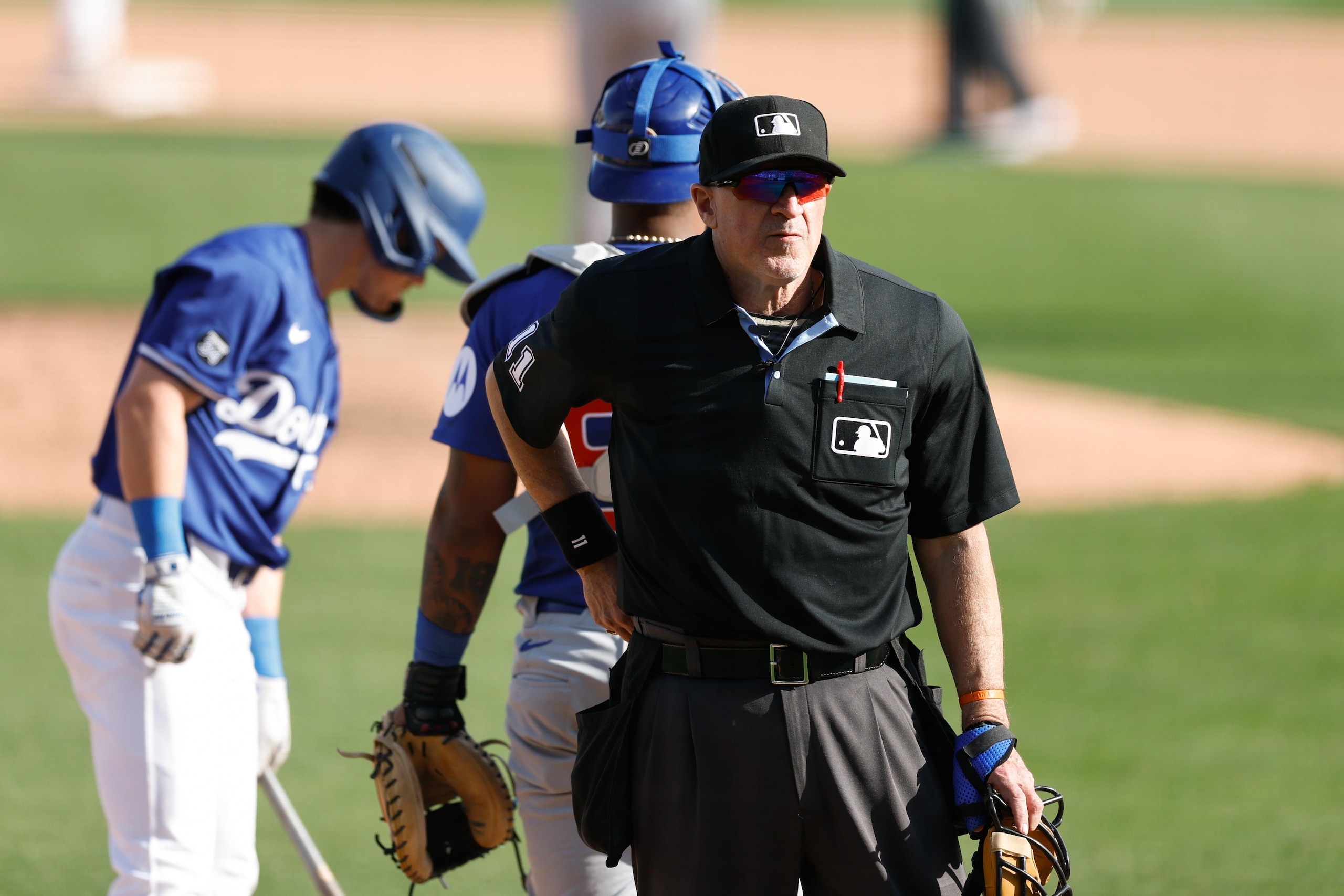
Two years after MLB went gloves off on tradition by introducing larger bases, regulations on shifts and [audible gasp!] a pitch timer, now it's umpires who are on notice.
Following exhaustive testing in the minors, the long-heralded "robot umps" are getting their major league close-up during spring training. To this end, the first thing to understand is that "robot umps" is, unfortunately, not the technical term.
TOP NEWS

Ranking Top 25 Trade Chips For Offseason 🔢

MLB Playoffs Winners and Losers ⚾
Brewers Beat Dodgers in Game 1
It is actually called the Automated Ball-Strike System, or ABS for short.
It will be used for about 60 percent of all spring training games. Rather than on all ball-strike calls, it will only weigh in whenever a batter, catcher or pitcher challenges the home-plate umpire's call. Teams start each game with two challenges apiece, with unsuccessful challenges resulting in a loss of the challenge.
Allow San Diego Padres catcher Martín Maldonado to demonstrate how it works:
The protocol of the ABS is fairly straightforward, as is its likely impact in the short term once MLB starts using it in games that count, which could be as soon as 2026.
As for the long-term impact, well, who knows?
Here's What to Know About How the ABS Works
Though some maniacal purists have chosen the sanctity of baseball's "human element" as a hill to die on, some might say the ABS is long overdue.
Alternatively, what if it's arriving right on time?
The human element of calling balls and strikes has improved quite a bit since the pitch-tracking era began in 2008. That year, 11.4 percent of takes outside the zone were called strikes. Similarly, 25.2 percent of takes inside the zone were called balls.
In 2024, those rates were 5.9 percent and 10.9 percent, respectively.
Even still, absolute perfection seems just out of reach for flesh-and-blood arbiters of balls and strikes. Therefore, there is the question of why MLB is not moving forward with an ABS that calls all of the balls and strikes.
The answer is that the league tried that in its minor league testing, and nobody liked it.
"[They] felt like it just was too big a change for baseball," Morgan Sword, MLB's executive vice president of baseball operations, told Becky Sullivan of NPR, "that was unnecessary, [that] it was an overreach of technology that we didn't need in the game."
Whatever it is, the ABS is not a rush job. It runs on the same Hawk-Eye tech that has been the backbone of Statcast since 2019, and all that testing in the minors allowed the league to fine-tune what, exactly, the strike zone is for each hitter.
The Short-Term Impact Is Predictable
Whether it's in 2026 or 2027, there will be a couple of bankable outcomes when the ABS is ready for primetime.
For one, MLB's minor league experimentation suggests fans can expect an average of about four challenges per game. Each will add about 17 seconds of game time, which would be an outrage if the average time of game wasn't down close to 30 minutes relative to the last pre-timer season in 2022.
Otherwise, it's a safe guess that some players will hate it, and not just in the abstract, a la Toronto Blue Jays hurler Max Scherzer.
This means you, Patrick Bailey. The San Francisco Giants catcher is the master at getting strikes outside the zone, fooling umpires an MLB-high 8.3 percent of the time over the last three seasons.
This likewise equals bad news for Giants ace Logan Webb, who is among the main pitching offenders for the crime of having a bigger-than-expected strike zone.
Ask any New York Yankees fan, however, and they might insist it'll all be worth it if Aaron Judge is less frequently shafted on low strikes.
The 6'7" Judge is the poster boy for the potential benefits of the ABS, and it's easy to assume that it will similarly favor other super-sized hitters.
You'd be surprised, though. Among hitters who consistently have bad strike calls go against them are Mookie Betts, who's 5'9", and Seiya Suzuki, who's 5'11". Just as Judge is often bitten by the low strike, these guys feel the sting of the high strike.
There are also pitchers and catchers on the opposite end of the spectrum from Bailey and Webb. Framber Valdez, for example, has had too many strikes erroneously called balls. And in Elias Díaz and Luis Campusano, the Padres have two catchers with an inordinate number of calls in the zone that go against them.
Regardless of specifically who benefits, the ABS should push MLB toward a more just version of the game. There was a 51 percent success rate on challenges in the minors last year. If that rate holds once the ABS comes to the majors, we're talking about hundreds of bad calls getting erased in any given season.
The Long-Term Impact Is Murkier
Still, one wonders what kind of unintended consequences are out there.
According to Sullivan's article, defenses had a better challenge success rate (54 percent) than offenses (48 percent) in minor league games. This adds context to a June 2024 report from J.J. Cooper of Baseball America, which showed that minor league games with the challenge system had a lower walk rate and a higher strike rate.
Another advantage for pitchers? That's just what MLB needs, he said sarcastically.
After initially spiking with help from the new rules in 2023, the league's batting average (.248 to .243) and scoring (4.6 R/G to 4.4 R/G) went back down in 2024. There's your reminder that hitting is really hard, particularly in an era wherein every pitcher throws 95 mph with some kind of lab-grown mutant secondary pitch.
More so than anything related to the sanctity of the human element, the threat of the ABS further reducing offense is the best argument against it. And while it isn't quite a solution in search of a problem, the numbers referenced above don't paint a picture of a league in the middle of a bad call crisis.
One thing the ABS would certainly do, however, is introduce a whole new element of something that games could frankly use more of these days: strategy.
One can imagine a team only ever using its challenges on the defensive side, and let's credit Jomboy for raising an interesting point in one of his breakdown videos: If a catcher or pitcher knows that an umpire is really good at making certain calls, maybe they don't risk challenging him in those areas.
Another potential benefit? Drama.
This includes the high variety, as Sullivan's article further notes that challenges in minor league games were more common in such situations as 3-2 counts and in the ninth inning. In these, the ABS stands to be another thing that will get fans' adrenaline pumping.
There would also be ample potential for light comedy, particularly in a genre I refer to as "come-ump-ance."
Everyone loves when an umpire gets comeuppance for a bad call, after all, and the ABS has already demonstrated it's good for that, if nothing else.
To be sure, the unknowns that would come with full implementation of the ABS are numerous.
We do not know to what extent framing will be devalued as a catching skill. We do not know if pitchers would be more or less prone to nibbling at the edges of the zone. We do not know if batters will become more or less aggressive.
Most ominously, we do not know how teams might try to game the system by giving real-time directions on which calls to challenge. This is technically impermissible under the current rules. But where there's a will, there's a banging scheme.
Yet, as potential unintended consequences go, none of these sounds like a sports killer. And since MLB doesn't necessarily need the ABS to present an entertaining, well-liked product—seen those attendance numbers lately?—who says its eventual implementation would need to be forever?
In any case, the fact is the ABS wouldn't be this close to show time if it wasn't promising. It is best to think of it as the technological equivalent of a top prospect.
Maybe it'll end up breaking our hearts. But right now, the hype is real.
Stats courtesy of Baseball Reference, FanGraphs and Baseball Savant.

.jpg?w=2560)
.jpg?w=2560 "AD Trolls Bears WR on IG 😂")
.jpg?w=2560 "Viral Dan Campbell Presser 💙")
.jpg?w=2560 "Report: Steelers WR to Miss 'Weeks'")
.jpg?w=2560 "Cam Ward Says He's Not A Loser")
.jpg?w=2560 "Buzz: MHJ Hired Agents for Trade")
.jpg?w=2560 "Chargers Fall to 0-5 🤢")