
Ranking the 5 Greatest Drivers on the Monaco Street Circuit
Formula One stars are born and raised on the streets of Monaco.
For all the history and heritage of other classic venues such as Spa-Francorchamps, Suzuka, Silverstone and Monza, the Monaco Grand Prix is the one they all want to win.
And it is usually the best drivers who do so.
The Monte Carlo circuit, ever-present on the grand prix schedule since the 1950s, continues to offer the most profound test of a driver's repertoire.
Merely driving quickly will not suffice in Monaco, where fitness, anticipation, precision, bravery, car control, concentration and finding the balance between aggression and caution all count toward the final result.
The twisty nature of those sacred streets requires drivers to quickly establish a rhythm and stick to it throughout the weekend.
And in the latter stages of the 78-lap race—when the arms begin to weaken, the vision starts to blur and the crash barriers smother the track surface more noticeably than ever before—it is those who can maintain both their focus and flow who are rewarded with a trip to the makeshift podium in the royal box.
As the 2015 event approaches, here are five drivers who mastered Monaco better than anyone, from seven-time world champion Michael Schumacher to three-time title winner Ayrton Senna.
Honourable Mentions
1 of 6Stirling Moss told the Telegraph's Tom Cary how he once wooed a "piece of crumpet" as he raced in the Monaco Grand Prix, but those antics clearly didn't distract him from driving.
Moss, so often regarded as the greatest driver never to win the Formula One title, won three Monte Carlo events in total, becoming the first British driver to triumph at the principality in 1956.
Moss' great competitor, Juan Manuel Fangio, was the first to win a World Championship race at Monaco in 1950 behind the wheel of an Alfa Romeo and followed that up with another pole-to-flag win for Maserati seven years later.
In more recent times, the Monaco Grand Prix always tended to bring out the best in Mark Webber, who won with ease in 2010 before withstanding constant pressure from no fewer than five drivers in 2012.
Fernando Alonso and Nico Rosberg are the only multiple winners on the current grid and, according to BBC F1, the latter can enter Monaco folklore this weekend with a third straight victory from pole position.
5. Jackie Stewart
2 of 6Wins: Three
Podiums: Four
Pole Positions: Four
Like many, Jackie Stewart confirmed his status as a future world champion at Monaco, qualifying and finishing third in just his second Formula One race in 1965.
The Scot claimed his second career win at the principality the following year, finishing over 40 seconds ahead of Ferrari's Lorenzo Bandini.
What should have opened the floodgates for further success, however, instead signalled a change of fortune, and Stewart failed to even finish the race in his next four Monaco appearances.
A differential problem on his BRM saw Stewart retire from the lead in 1967, and he didn't participate in the '68 event after breaking his wrist in a Formula Two crash, according to ESPN F1.
Mechanical issues once again meant he failed to capitalise on pole position in 1969, his maiden title-wining campaign, and 1970.
With every DNF, it seemed as though Stewart's chances of entering Monte Carlo folklore was slipping away, but his record was salvaged somewhat with two victories in three seasons at the end of his career.
The Scot dominated the 1971 race, securing pole and the fastest lap, and almost repeated the trick in '73, with Emerson Fittipaldi claiming the fastest lap instead.
Stewart certainly knew his way around Monaco—see his insightful, eloquent explanation of the unique challenges of the circuit—but rotten luck prevented him from having an even better record.
4. Alain Prost
3 of 6Wins: Four
Podiums: Six
Pole positions: Four
Alain Prost failed to score a single point in his first three visits to Monaco, retiring from the 1980 and '81 events, although his fortunes soon turned for the better as he exerted control on the event at the wheel of the McLaren MP4/2.
Prost set pole position for the 1983 race but was punted down to third as reigning world champion Keke Rosberg took the spoils.
His first win at the principality was arguably his most famous and definitely his most controversial, with Prost gesticulating in a successful bid to have the 1984 race stopped due to heavy rain at a time when Toleman's Ayrton Senna and Tyrrell's Stefan Bellof were closing in on the lead.
There could be few arguments about his victory in 1985, however, as Prost triumphed after a battle with Michele Alboreto, who recovered from a slide on oil to retake the lead only to suffer a puncture at Sainte Devote, the scene of the early collision between Nelson Piquet and Riccardo Patrese.
A third consecutive win in 1986, when he set pole and the fastest lap en route to victory, cemented his status as a Monaco great, but perhaps he saved his best until last.
Having been outclassed by McLaren team-mate Senna across the entire '88 weekend, Prost significantly picked up his pace just as the Brazilian, under the impression the race was won just 12 laps from the finish, began to ease his own.
Panicked by the Frenchman's speed, Senna duly raised his own but got it disastrously wrong, crashing at Portier and handing Prost the victory.
Prost could have, and should have, sealed win No. 5 in his final season in the sport, but a schoolboy error—a jump-start from pole position—earned him a penalty, from which he could only salvage fourth.

3. Graham Hill
4 of 6Wins: Five
Podiums: Seven
Pole positions: Two
The original Mr Monaco, Graham Hill was a dominant force at the principality in the mid-to-late 1960s, reaching the podium in every race at the circuit between 1963 and '69.
Hill took a shine to Monaco from the moment he made his grand prix debut for Lotus in 1958, leading for a short period before retiring 31 laps from the chequered flag, but he had to wait until '63 for his maiden victory at the track.
He lapped the entire field en route to victory in the 1964 event and, according to GrandPrixHistory.org, referred to his win the following year as "one of the best races I have ever run or ever won."
Having established a strong lead from pole position, Hill had to take to the escape road to avoid hitting the slow Brabham of Bob Anderson at the chicane, forcing him to jump out of his BRM, push it back toward the track and climb back in before continuing.
The time it took him to do that meant he had dropped to fifth, over 30 seconds behind the leaders, when he resumed, but a heroic recovery saw him ultimately claim victory by more than a minute.
A pole-to-flag victory in '68 was followed by his final F1 win the following year, with the injuries sustained in a crash at Watkins Glen at the end of 1979 leaving the British driver unable to reach those heights again.
Fittingly, his career came full circle at the 1975 Monaco GP when, at the age of 46, Hill failed to qualify for a race he'd once made his own, retiring from driving there and then.
2. Michael Schumacher
5 of 6Wins: Five
Podiums: Seven
Pole positions: Three
Despite his considerable success at the principality, it would not be entirely unfair to suggest that Michael Schumacher actually underachieved at Monaco.
That just underlines how supreme the seven-time world champion was at F1's most famous race.
Four of his five victories (1994, 1995, 1997, 1999) were claimed prior to his five-year spell of dominance with Ferrari, when he failed to truly cash in on his performance advantage for a variety of reasons.
Schumacher was on course for a comfortable win in 2000 when a cracked exhaust forced him to retire, while his chances of victory in 2002 were hindered when, as he told GPUpdate.net at the time, he could only qualify third at a place where a front-row start is often crucial.
The German could only manage fifth on the grid in '03 and missed out on a potential victory in 2004 due to a bizarre collision with Juan Pablo Montoya behind the safety car, which left Schumacher taking his frustration out on his crash helmet.
He might have challenged Fernando Alonso for the win in 2006, but he was infamously relegated to the rear of the field for deliberately blocking the track in the dying seconds of qualifying as he tried to maintain provisional pole.
Despite all those misses, a true measure of Schumacher's expertise came in 2012 when, aged 43 and very much past his peak, he set pole position on the most driver-dependent track of them all.
A penalty carried over from the previous race meant he didn't take his place at the front of the grid, but it remains one of the most impressive achievements of this decade and proved just how good Michael was around Monaco.
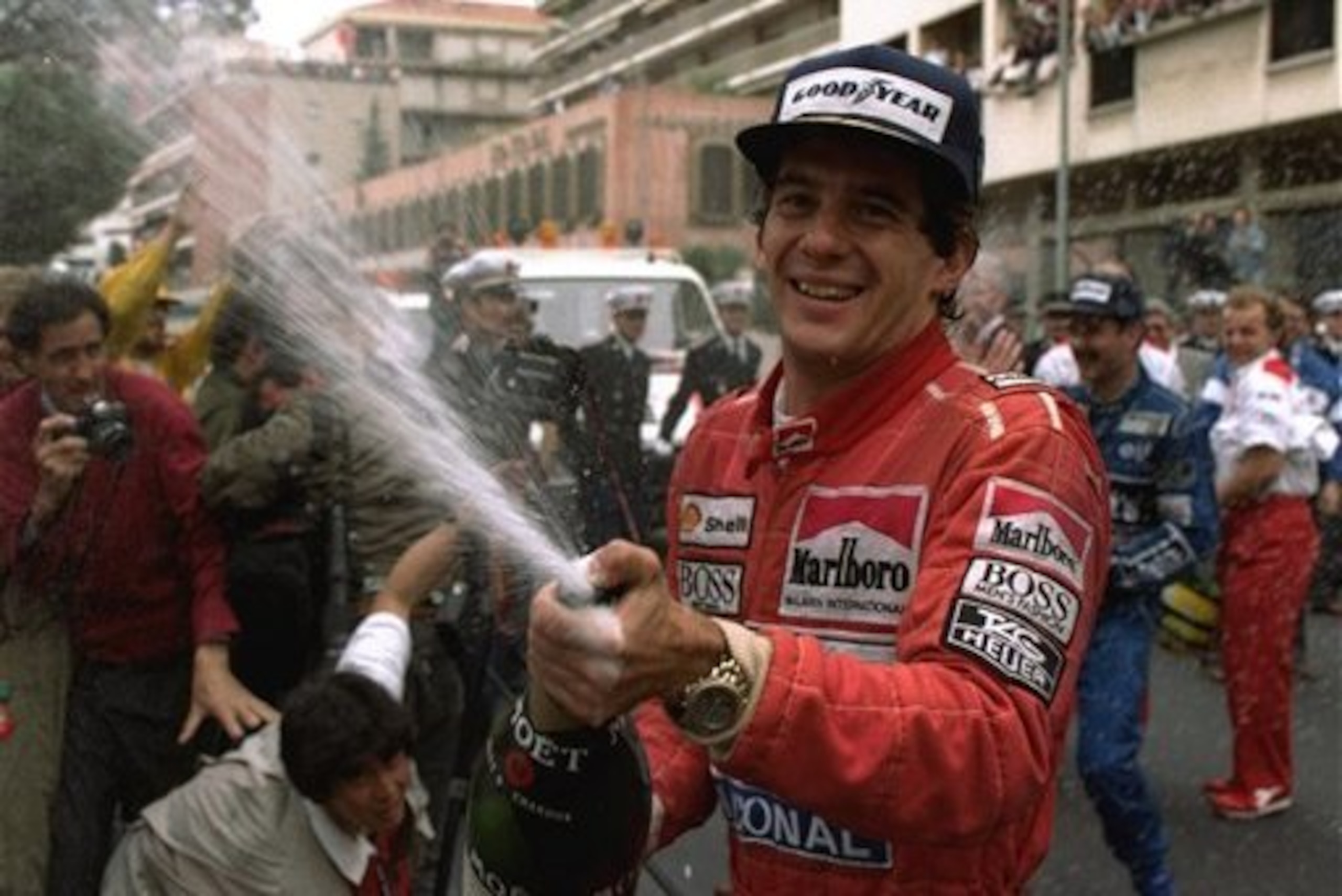
1. Ayrton Senna
6 of 6Wins: Six
Podiums: Eight
Pole positions: Five
Like Graham Hill, Ayrton Senna's career was defined by the Monaco Grand Prix.
The Brazilian developed an intimate relationship with the principality over the 1980s and early '90s, and the track rewarded his pursuit of perfection with six victories in 10 appearances. He might have even more wins, too, but for misfortune and the odd questionable decision.
Driving the uncompetitive Toleman car in just his sixth grand prix weekend in 1984, he was rapidly closing in on leader Alain Prost when the race was suspended due to torrential rain, forcing Senna to settle for second on an afternoon the F1 fraternity really came to recognise his potential.
Senna set pole position for Lotus in the '85 event before an engine problem prevented him from converting it into victory, but luck favoured the Brazilian in 1987, when he inherited the win from Williams' Nigel Mansell.
With a first Monaco win finally in the bag, and a McLaren contract in his pocket, Senna was elevated to a whole new level of performance at the principality from 1988, when he became one with the circuit and set the greatest lap in F1 history to claim pole ahead of new team-mate Prost by almost 1.5 seconds.
His crash out of the lead just 24 hours later was among the most deflating moments of his entire career, yet it played a crucial role in the Senna story and was undoubtedly the reason why he was never beaten on those streets again, winning the next five Monaco GPs.
The pick of those came in 1992, when after assuming the lead in the latter stages following Mansell's unscheduled pit stop, Senna refused to give it back as his McLaren-Honda became a cork, containing the blistering pace of the British driver's Williams-Renault F14B.
Senna will remain the undisputed master of Monaco.
All results and statistics used in this article, unless stated, have been taken from Wikipedia.


.jpg?w=2560 "🚨 Giants to Start McCarthy")