Ifo Ekpre-Olomu and the Tricky Business of Predraft Insurance Policies
About six months ago, Ifo Ekpre-Olomu was considered to be a lock as an early-round pick in the NFL draft. In October, ESPN's Mel Kiper Jr. ranked the Oregon cornerback as the best prospect in the league at that position. In November, Andy Staples of Sports Illustrated pegged Ekpre-Olomu as the ninth-best player in the entire draft.
But then Ekpre-Olomu blew out his knee in December, leaving no time for him to rehab ahead of the draft and causing his stock as a prospect to drop significantly.
How significantly? Only a few months after analysts such as SI's Chris Burke and CBS Sports' Dane Brugler predicted he'd be drafted in Round 1, Ekpre-Olomu was forced to wait nearly seven full rounds before the Cleveland Browns called his name with the 241st selection in a 256-pick draft.
The potentially great news for Ekpre-Olomu is that he and several of his top-flight Oregon teammates possessed loss-of-value insurance in case of injury or illness. As a result, it's been widely reported that the 21-year-old is in store for a $3 million payday, which would in theory cover some of the wages he'll lose as a result of his draft weekend cliff dive.
But since a loss-of-value claim has never been successfully collected from an insurance company by an NFL prospect, nothing's set in stone. Ekpre-Olomu's case does appear to be clear-cut, and a representative from International Specialty Insurance, the coverholder for Lloyd's of London which handles Ekpre-Olomu's coverage, told Bleacher Report this week that he expects the corner to become the first player to collect. But until the paperwork is filed and accepted, there will be questions.
In the meantime, let's break down what exactly loss-of-value insurance is, who can get it and what it takes for policies and claims to be processed.
What you need to know about predraft loss-of-value insurance policies...
They're not for everyone

I mean that literally.
"My understanding," Noel Paul, an insurance recovery lawyer at Reed Smith LLP, told Bleacher Report, "is it's only available if you're projected as a pick in the top three rounds of the NFL draft."
Ron Boynar, who works with Cleveland-based insurance brokerage firm Oswald, which has issued coverage to players in all of the major professional sports, says that the scope is even narrower in his neck of the woods. They only insure football players they believe will be picked in Round 1.
"It's a sexy product," said Boynar. "But I think the thing to keep in mind is it's not for everybody. Loss-of-value is really for the elite athletes."
Loss-of-value insurance policies can't be purchased on their own. Instead, they're riders on permanent total disability (PTD) policies, which are practically ubiquitous at elite levels of college sports. The NCAA has used its Exceptional Student-Athlete Disability Insurance Program to finance PTDs for players for 25 years.
But only in the last decade has the commercial insurance market begun to offer student-athletes alternatives. With that, the loss-of-value rider has emerged for those perceived to be blue-chip prospects.
Chris Larcheveque, a sports and entertainment partner at International Specialty Insurance (ISI), which holds Ekpre-Olomu's policy, says his company represented 19 first-round picks this year, all of whom utilized the loss-of-value rider in addition to their regular PTD coverage.
Up until recently, loss-of-value insurance was primarily issued to professional athletes who sought a safety net in case they suffered major injuries before arbitration or free agency, and that's still a popular product at both Oswald and ISI. The retail insurance market entered the college game late, but it is making up for lost time.
Larcheveque estimates that about 35 percent of the players his company insures get loss-of-value protection. Top athletes only, but they're already starting to write 2016 draft prospects now. That means that between now and next spring, he and his peers and counterparts will be shooting at a moving target.
"The top kid today may not be a top kid in November," said Larcheveque, "so while we try to target writing the top two rounds—basically 60 to 70 kids—you could have 130 kids that over time fit into those two rounds."
From a business standpoint, companies like ISI want to lock in as many premiums as possible while weighing that with the risk of too many payouts. As with always in insurance, it's about the transfer of risk.
That's why they do their homework in a major way.
"A lot of the other firms basically just go on an Internet website and look up the kid and then they do it," said Larcheveque. But his company watches film, subscribes to two non-public draft reports and has a scout on retainer.
"So we're not just going on and looking at Todd McShay's draft report."
They're increasingly being covered by the schools
In the past—even the very recent past—standard protocol here was for a player and his representatives (typically his agent and/or his financial adviser) to work with a retail insurance agent in order to initiate a PTD policy with a loss-of-value rider that was agreeable to all involved parties. And then they'd take that to a large firm, like Lloyd's, or a syndicate of a large firm, like ISI, where the policy would be issued and the premiums would be collected.
That is still generally how things work, except that athletic compliance officers at the schools these athletes attend have begun to play a fairly large role.
See, Ekpre-Olomu didn't pay his own premiums, nor did any of his four teammates—including No. 2 overall pick Marcus Mariota—who entered the draft with similar policies. Those guys didn't have to take out loans or mortgages either, because Oregon picked up the tab.
In fact, that's become a common practice at Division I programs across the country as more schools take advantage of their ability to dip into the NCAA Student Assistance Fund in order to cover those expenses.
According to NCAA spokesperson Meghan Durham, that fund made $76.5 million available in the 2013-14 fiscal year in order to "help Division I student-athletes with essential needs that arise during their time in college."
Premiums for disability policies, including loss-of-value insurance, are included on that list.
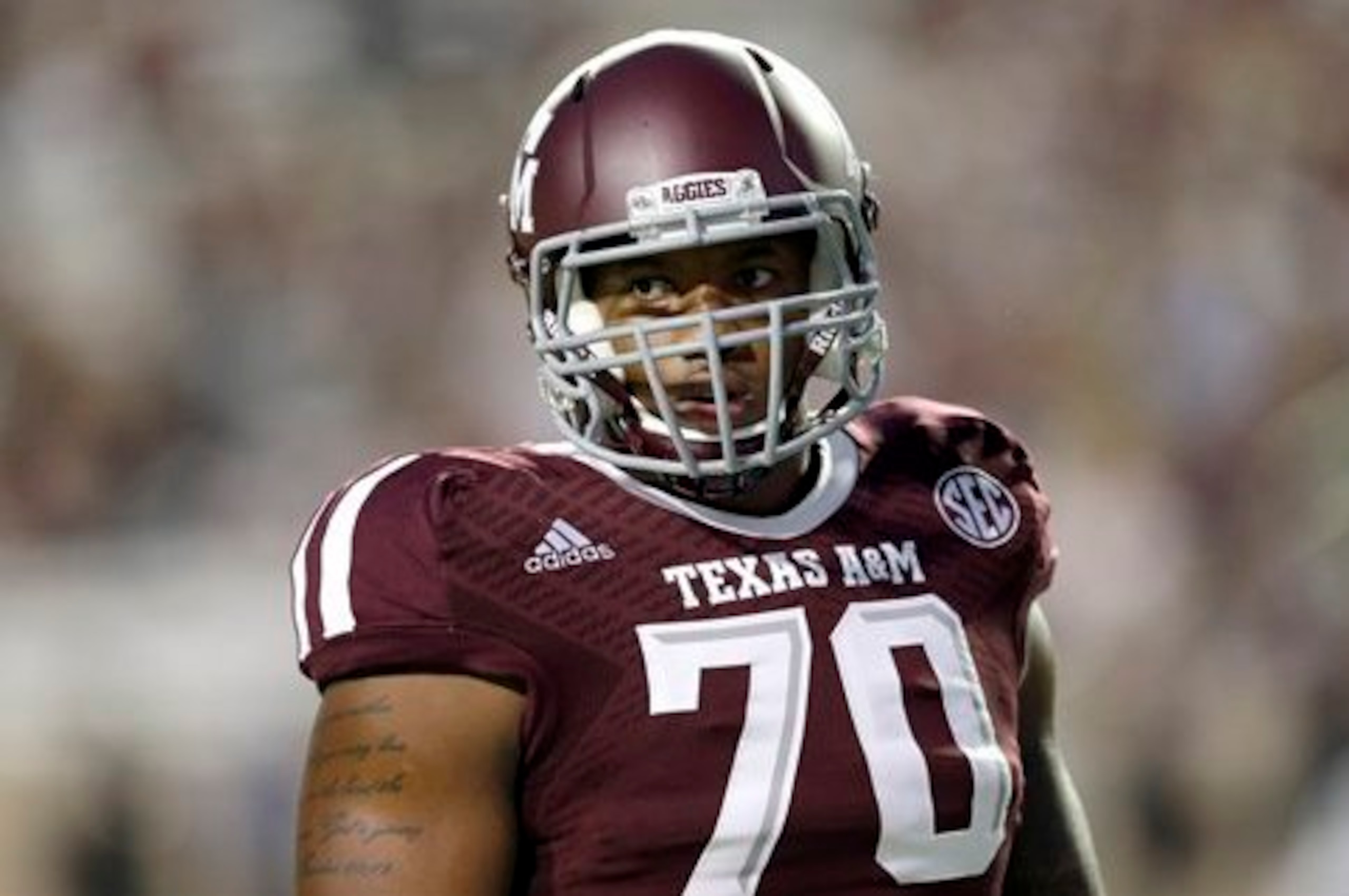
So schools are now driving the process, or at least playing a much more significant role than in the past. They always had the option to use the Student Assistance Fund in order to pay insurance premiums on behalf of their players, but that didn't become a household practice until Texas A&M lured star offensive tackle Cedric Ogbuehi back for his senior year in 2014 by using the fund to pay his PTD and loss-of-value premiums.
Sounds like a win-win, but Larcheveque believes there are potential issues at play.
"Because the schools are paying, there are a lot of compliance officers who are picking the insurance and educating the kid," said Larcheveque. "Which is fine; they certainly do a great job, but they're not licensed insurance agents."
Larcheveque is concerned that some compliance officers might not be equipped to coach student-athletes through the process, and he also fears that school reps could choose an insurance option merely because it's cheap or because the agent pitching it has a connection to the program.
Would alumni get preferential treatment regardless of their qualifications?
"You could call a big school and just say, 'Hey, I can do your insurance cheap.' And the school is now paying and they might want the cheapest option," said Larcheveque. "Somebody comes to me and says, 'Can you do it for X price?' I look at it and say, 'That's 15 percent loss for me.' Some new people are going to look at the same thing and say, 'I've never had this type of premium before,' and take it on. That, to me, threatens the viability of the product. Because if it gets too cheap and you do get claims, you'll have folks who won't want to write it anymore."
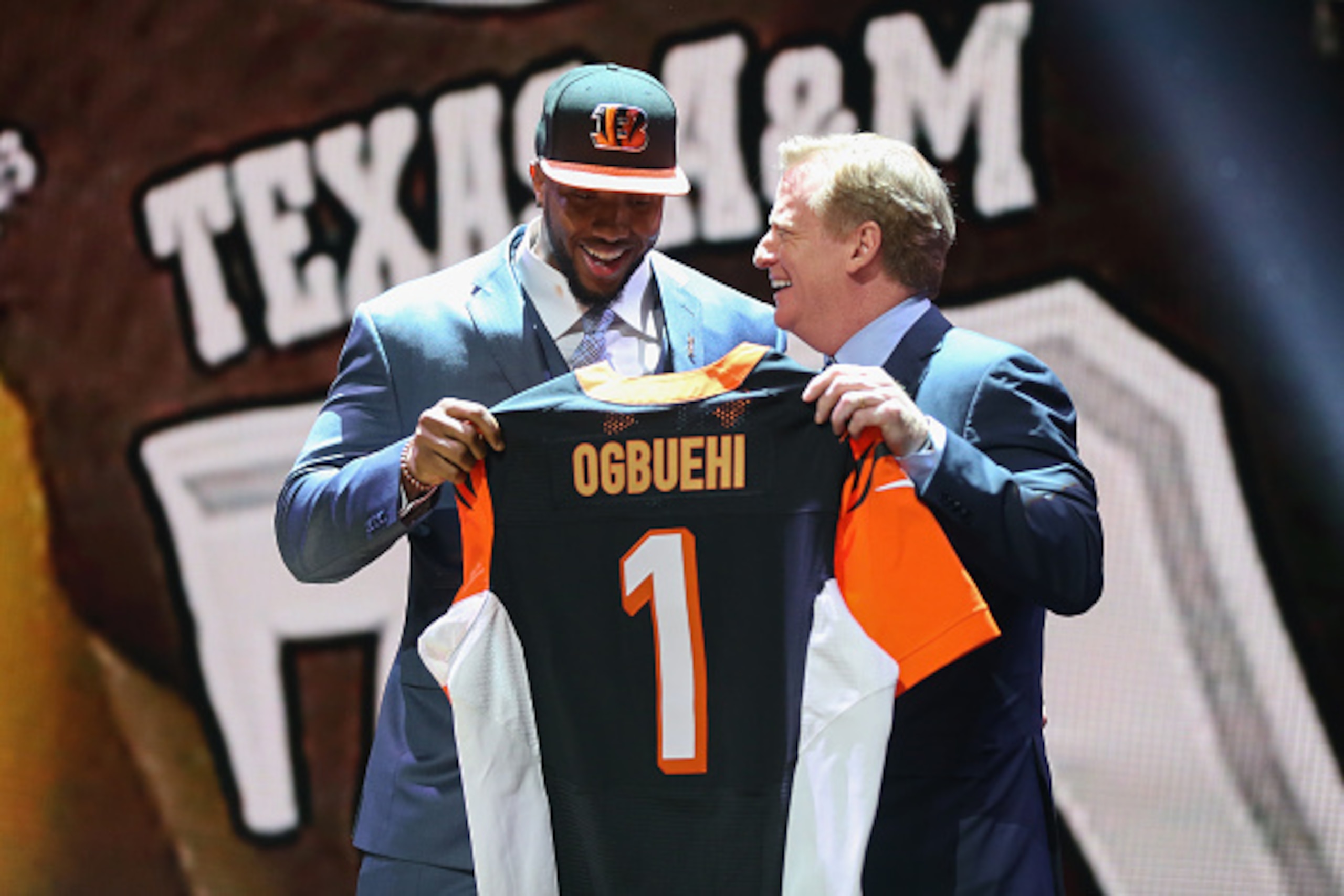
Brad Barnes does appear to be well-equipped to lead prospects through this nuanced process. Barnes, the assistant director of athletic compliance at Texas A&M, helped that program pursue insurance for Ogbuehi. And he admits it's become a free-for-all as insurance agents try to land huge premiums for a product that to this point hasn't resulted in a single successful claim.
"Now you're seeing people propose these for freshmen," said Barnes, who says he received 63 policy proposals for Texas A&M players this past year, including several for guys who didn't even play football. "It's something that makes you ask questions."
And so he did.
Barnes said he would call companies back in order to inquire about their basis for ranking these players. Eventually, he concluded that there's a huge range of insurers circling Division I programs, spanning from those who are established and very conservative to those who are extremely liberal.
It's fair to wonder if there are compliance officers who aren't as thorough as Barnes.
"This model has been great for the players," said Larcheveque, "but it might be detrimental long term."
Larcheveque says that in a perfect world schools would pay but players and their families would seek out coverage independently. He notes that it's too early to get a feel for whether the current system favors the players or the insurance companies, but the market requires both sides to be thorough and disciplined. Right now, there's a risk of things getting out of control.
From an actuarial standpoint, Larcheveque says that insurance companies aim for one loss for every 150-200 players who are insured. Thus far, there have been no losses. And that's bad for everybody.
"It's like a casino," said Larcheveque. "Vegas is clearly built on losers. Those are big, expensive buildings; they aren't handing out money. But if nobody ever wins, nobody would ever come back. You need to show that you can pay to play, but at times it will benefit you.
"You don't pay something like this and your books look a lot more profitable, but people won't come back and buy it anymore because they won't believe in it."
They keep kids in school
It has to be pointed out that Ogbuehi has admitted he probably wouldn't have risked staying in school if not for the loss-of-value insurance Texas A&M purchased for him by using funds from the NCAA. And in that respect, loss-of-value insurance has to be considered a potentially strong retention tool.
"What we're seeing is schools are using this product as more of a way to keep that elite player for an extra year," said Boynar. "They're suggesting to the player that you can use an extra year to build your draft stock and come out with more money, and we'll cover you with that insurance policy in case something bad happens."
That's good for the NCAA, the schools and their graduation rates, and players who value their degrees but fear missing out on an NFL payday.
And yes, athletes have always possessed the ability to buy insurance with their own dime, but these policies with loss-of-value riders can run upward of $150,000. And until very recently, prospects couldn't borrow against their future earnings potential to purchase loss-of-value insurance. That changed in January, when the autonomy schools in Division I voted to allow college athletes to do exactly that, and the belief is that will only encourage more prospects to stick around for their senior year.
They rarely pay out
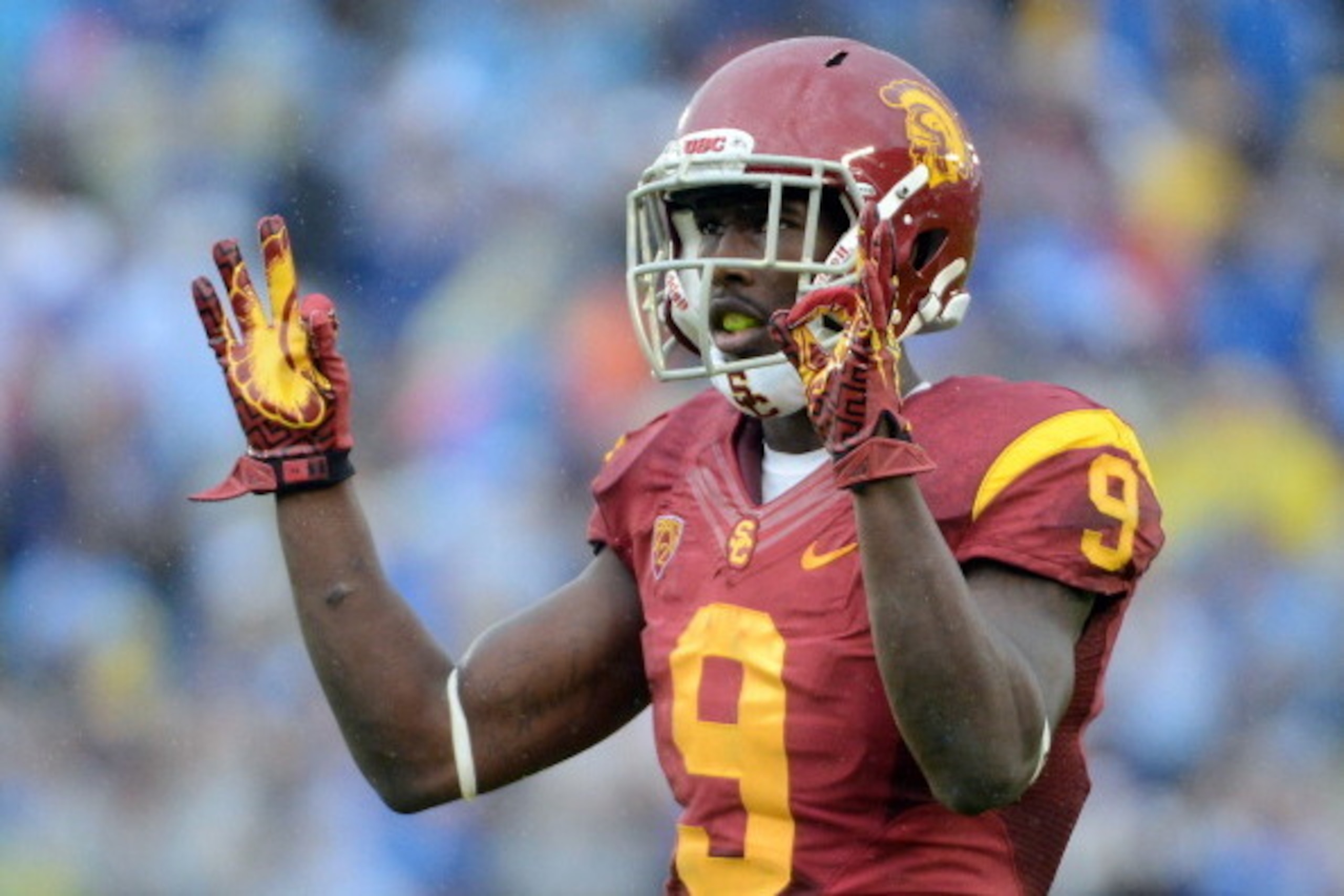
In fact, Larcheveque isn't sure anyone has filed for collection except Marqise Lee and Morgan Breslin, both of whom are suing Lloyd's after having their claims denied last year. Both former USC stars suffered injuries as seniors and fell in the 2014 draft, but their insurer isn't caving in either case.
Lee's lawsuit states that Lloyd's claims he failed to disclose certain health information when applying for his policy, while according to Paul, Breslin's suit states that the firm argued he didn't disclose a preexisting injury in his application.
Paul considers those types of denials to be based on technicalities, which could be a bad omen for the industry.
"If insurance companies continue to deny these claims on technical grounds," said Paul, "then the whole industry of trying to insure college athletes so that they can stay in college for another year or so is just going to disappear."
Ekpre-Olomu could change that, which is why Larcheveque doesn't sound as though he's troubled by the prospect of having to see his people take a loss in this particular case.
"That's going to happen," he said of the Ekpre-Olomu fall. "And it might happen every other year. And that's how the product is done, is to pay every two years. It just hasn't paid yet in four, but then we might get three this year. We don't always know. Ifo might not be the only one."
They're complicated

Arguably deliberately so, which is why Larcheveque wants to ensure that the policies in question are being pored over by experienced professionals. Otherwise, the market could be overrun by agents who might look to prey on student-athletes who will never have any hope of collecting claims.
"They're going to take a very close look at [Ekpre-Olomu's] claim," said Paul. "They're going to see if there's any kind of medical condition that he didn't report when he applied for the insurance. They're going to take a close look to see if his draft stock could have fallen for any other reason. So it's not at all a foregone conclusion he's going to get paid."
Boynar points out that there are also a lot of misconceptions regarding both PTD and loss-of-value policies, starting with the notion that players are supposed to be paid the difference between what they're making and what they were supposed to make. Even if a player signs for $5 million and would have made $25 million in his originally projected draft slot, there's often a cap of no more than $10 million on potential payouts.
Insurance companies also utilize market research in order to establish thresholds related to a player's projected earnings. Usually, those thresholds come to about 55 percent of those projections, which means that $25 million number will actually come in at about $13.75 million.
"People have to make sure that they're not being sold a $20 million product when the maximum payout is only $5 million," said Boynar, who added that players also have to be aware of where the triggers for a claim lie.
And as Barnes notes, it goes deeper.
"When you go through and buy these things, you have to disclose everything about yourself, in terms of injuries, illnesses, discomfort—discomfort!—you're a football player and you're having to disclose discomfort," said Barnes. "In all those disclosures, there's certain things that the insurance company might write out of your policy."
You also see language in these policies that concerns Barnes. The phrase "sole and direct cause," for example, can be tricky because it's very hard for a player to prove that an injury was the sole and direct reason for his entire draft fall. There are negative reports on every prospect, and those can be used against him when he tries to file a claim.
"The insurance company could argue that your injury or illness wasn't the sole and direct cause of your loss," said Barnes. "They could argue that market forces were also in play, that there was an overabundance of supply, and that played a factor in your dropping, and therefore you have no claim."
Oh, and don't forget about the potential for clawbacks.
"Let's say that you outplay your contract and you renegotiate and ultimately you sign a big contract after Year 3," said Barnes. "The insurance company might look at you at the expiration of that four-year term and say, 'He made that $5.5 million back; give us our money back.'"
It's all daunting enough for Barnes to conclude that he wouldn't use his own money to purchase such expensive and tough-to-collect insurance.
"I wouldn't advise against purchasing them or for purchasing them," said Barnes. "I'd say that the institution and the athlete need to be aware of all the facts about these policies and really understand how unlikely it is to get paid through these policies.
"No disrespect to insurance companies, but they're not in the business of paying out claims. They're in the business of taking out policies and doing something else with that money. That's not a slight, that's the nature of insurance."
Ekpre-Olomu: Watershed development?
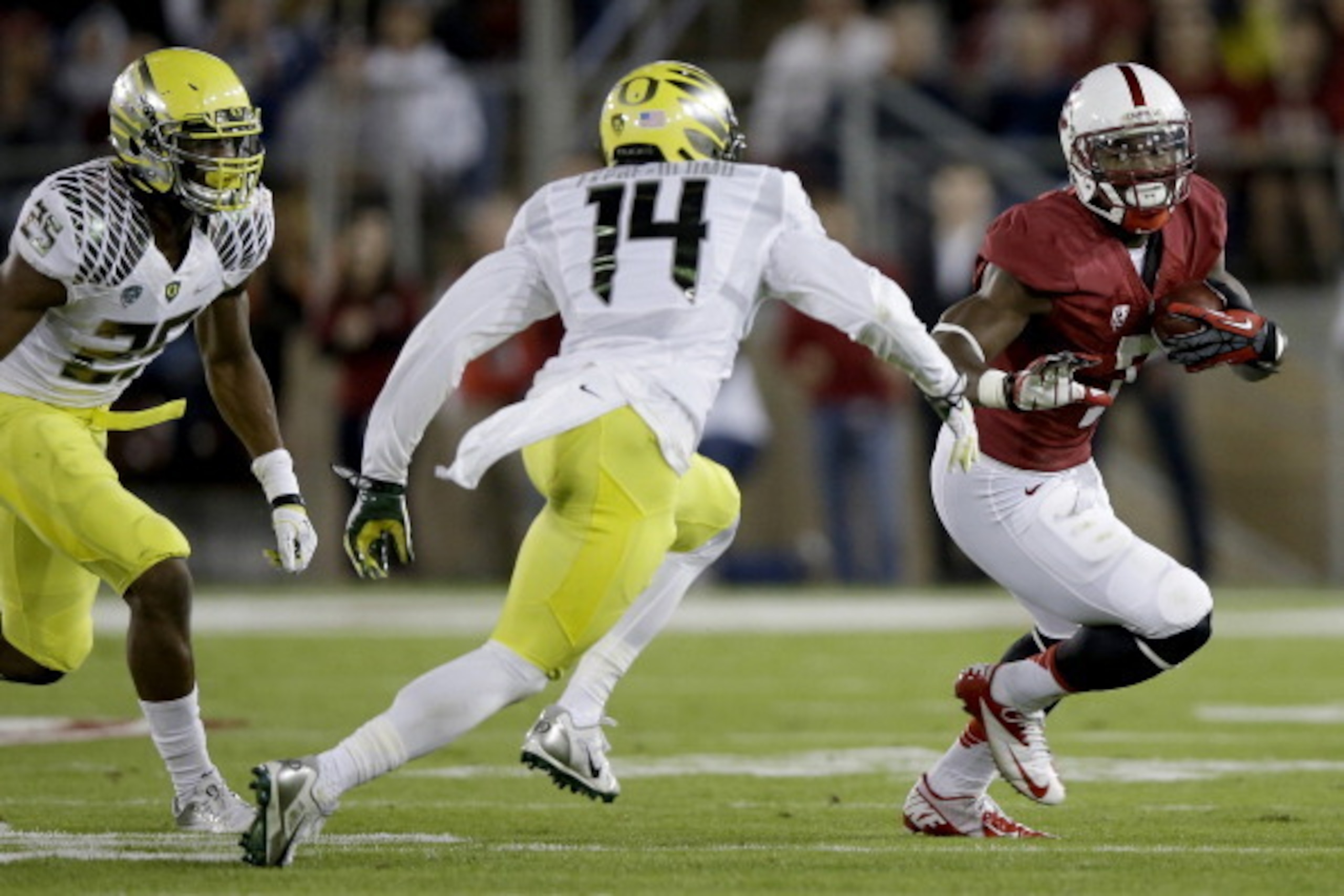
Ekpre-Olomu can't file a claim to ISI until he signs his rookie contract with the Browns, but Larcheveque fully expects that to happen.
And if everything is in order, he also expects his company to sign off on the first-ever payment to a loss-of-value insurance claimant in NFL draft history.
"Assuming that he's told the truth on the application, the injury certainly seems on the surface to have materially affected his stock loss for the draft," said Larcheveque. "And we think that a knee injury that had to be surgically repaired probably impacts some of what he can do for the future, so assuming that's all accurate and was represented truthfully and they get the forms back to us in time and it substantiates everything we believe, I have to think that this is going to be the first claim ever paid."
If or when that happens, it'll bring some much-needed balance to a young, specialized insurance field. And if that balance can be maintained and the policies can be cultivated in order to benefit both players and insurers, everyone—including schools, programs and even NFL teams that could wind up with more thoroughly groomed prospects—will be better off.
Brad Gagnon has covered the NFL for Bleacher Report since 2012.

.jpg?w=2560 "Saints Falcons Football")