

2016 NFL Draft Prospects Overshadowed Yet More Prepared Than Touted Teammates

The "Fail for Cardale" campaigns have already started for teams trapped in the endless search for a franchise quarterback.
I'm looking at you, Cleveland.
Sure, Ohio State's Cardale Jones has all the physical tools NFL teams drool over as a potential franchise quarterback. He's 6'5" and 250 pounds with the ability to escape the pocket and even run over a defender if needed. Oh, he also has a cannon strapped to his right shoulder.
.jpg?w=2560 "Rams Raiders Football")

.jpg?w=2560 "Steelers Saints Football")
"You know he's the biggest arm in college football," Ohio State special teams coordinator and cornerbacks coach Kerry Coombs told reporters during spring practice, per Sporting News' Bill Bender. "He threw a field go route, (in practice), I don't know, 35 yards on a rope. There aren't very many guys who can do that.
"He can do that without a big windup. He has a great skill set."
Those tools helped Jones complete a magical run through the Big Ten Championship Game and College Football Playoff on his way to a national championship. In only three starts as a member of the Buckeyes on the biggest of stages, Jones completed 61.3 percent of his passes for 742 yards, five touchdowns and two interceptions.
But it's far too early in the process to anoint Jones as anything other than a talented prospect with plenty of upside. He's not guaranteed to be the No. 1 overall pick, despite his strong finish to last season.
Here's the dirty little secret about Jones: He's not currently the best quarterback on Ohio State's roster.
The following prospects are as good or better than their more highly touted teammates:
J.T. Barrett
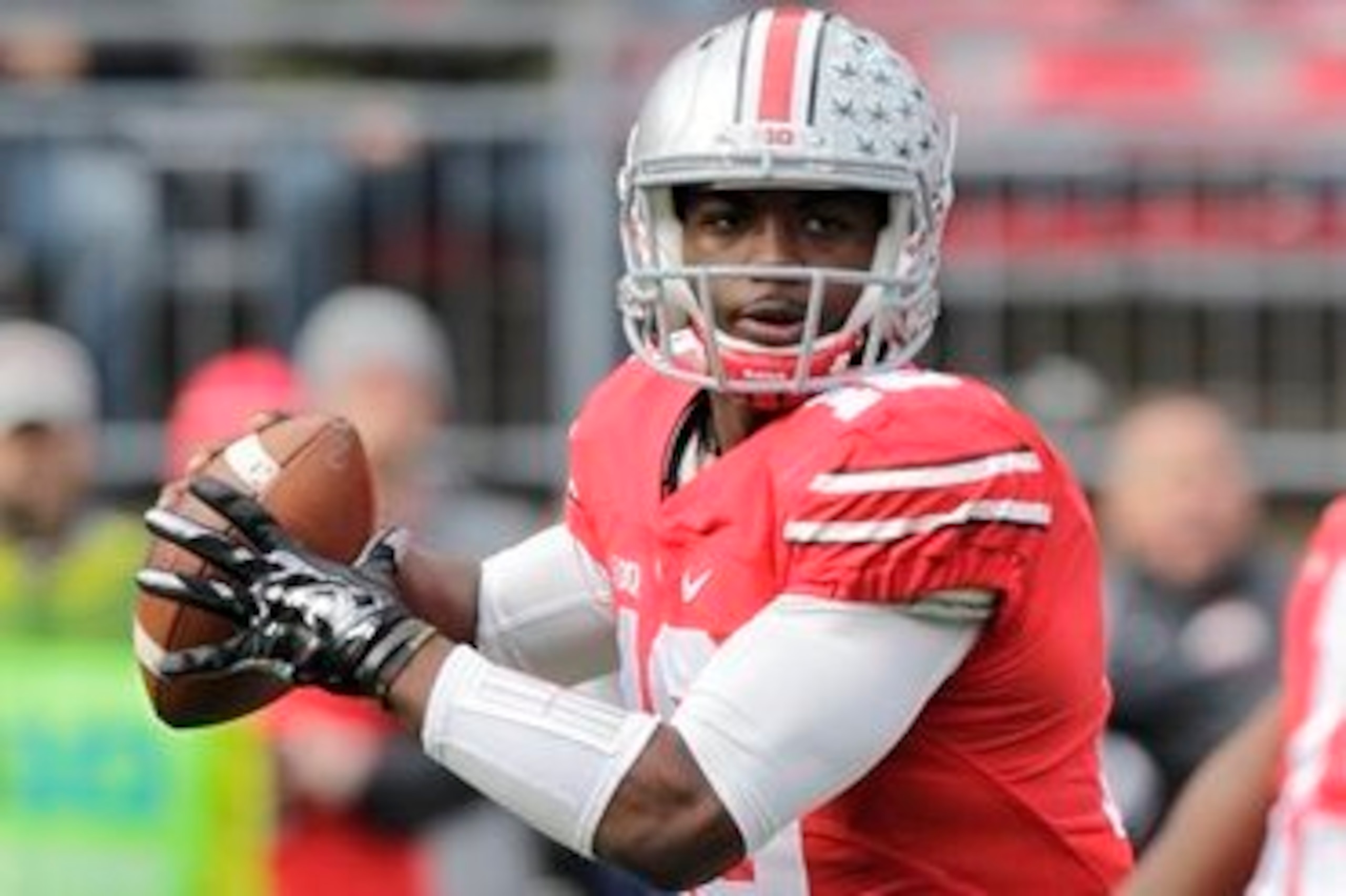
Quarterback play requires nuance and an understanding beyond the reliance on raw physical tools. Barrett already showed he's a far more advanced passer in Ohio State's system than Jones.
Prior to either being forced into the starting role, the duo battled to become Ohio State's No. 2 quarterback behind the two-time Big Ten Offensive Player of the Year, Braxton Miller.
Miller re-injured his throwing shoulder during fall practice after it required surgery earlier in the year. Barrett, who already surpassed Jones on the depth chart at that point, was then handed the reins of the Buckeyes offense.
Barrett lacked Miller's raw athleticism and Jones' overall arm strength, but the team saw something more in him, which allowed the Texas native to enter the season as the starter.
Former Ohio State offensive coordinator Tom Herman described what the staff saw in Barrett at the time (via John Taylor of College Football Talk) instead of leaning toward Jones, who actually played during the 2013 campaign as Miller's backup:
"[He's] extremely cerebral. Very magnetic leader. I think the kids kind of gravitate towards him.
We've got to work on strengthening his arm. He's a distant third in terms of Braxton and Cardale in terms of just rearing back and trying to throw it through a wall. But he makes up for it in his anticipation and his accuracy and all that. You don't have to have a howitzer to be successful in college football. I'm very pleased with his continuing growth.
"
What's the most overrated aspect of quarterback play? Arm strength. It can be a blessing if a prospect has it and knows how to properly harness the ability, but it's not a necessity.
In the first 11 games prior to Barrett's ankle injury, the sophomore signal-caller completed 64.7 percent of his passes for 314.3 total yards per game. Those numbers dipped to 61.3 percent and 277.3 total yards per game in the final three contests with Jones behind center.
The fluctuation was due, in part, to the stiff competition the Buckeyes faced during their national championship run. While Barrett posted big numbers against teams like the Cincinnati Bearcats, Rutgers Scarlet Knights and Minnesota Gophers, Jones faced the Wisconsin Badgers, Alabama Crimson Tide and Oregon Ducks in pressure-packed situations.
But this argument extends beyond simple statistics.
Prior to Barrett ever starting a game, his former offensive coordinator hit on two key aspects of the quarterback's approach that translate well to the next level: intelligence and leadership.
A quarterback doesn't need to be 6'5" and 250 pounds, with a howitzer for an arm, to succeed in the NFL. Barrett is still 6'2" and 225 pounds—the same dimensions as NFL MVP Aaron Rodgers—with an effortless and compact throwing motion.
It's easy to see him survey the field during games. Even as a first-time starter, Barrett regularly checked to his second or third options. He quickly progressed through his reads. When those options weren't open, he then decided to break the pocket, because he's also a very good athlete. Barrett ran for 938 yards in 11.5 games.
However, he combines an understanding of the offense, which is perfectly suited to his overall talent, with nice touch and and ball placement.
"I was blessed with Coach Herman and Coach [Urban] Meyer to design ways for me to best fit this offense," Barrett told theozone.net's Tony Gerdeman. "I really appreciated it, but I think also that there are a lot of things that I could have done better. I think that's something that I really appreciated, but there are a lot of things that I could have done better. I think I can play a lot better."
Jones, on the other hand, lacks variance in his velocity, and his ball placement can be erratic. The team also tailored the offense to the big quarterback's strengths once he was in the lineup, but it was very limited.
He didn't work the middle of the field nearly as much as Barrett and, instead, opened up the field with his ability to push the ball vertically. It certainly worked, but Jones has yet to show he can handle the entire offense.
Whereas the coaching staff foresaw Barrett as a magnetic personality, Jones knows his attitude on and off the field can improve, and he specifically identified it as an area where he wants to be better.
"Carrying this leadership over to the weight room, and the summer conditioning, things like that,” Jones told Bender when asked what he can improve upon this year. "So the guys I’ll be going with can see that they can trust and believe in me, and they know I got their back."
Intangibles are as important to playing the quarterback position as a prospect's physical traits.
Jones would never have even seen the field had Barrett not suffered a fractured ankle against the Michigan Wolverines during the last regular-season game of the year.
It's one thing to be overlooked due to a previous injury when the backup excels at a high level, but it's an entirely different thing to have your contributions trivialized due to the tantalizing talents of an unproven commodity.
Andrew Billings
Arguably, the most physically gifted prospect in college football resides in Waco, Texas.
Baylor Bears defensive end Shawn Oakman became a household name during the coin toss prior to this year's Cotton Bowl. NFL.com's Gil Brandt provided a glimpse at the imposing figure:
The 6'9", 280-pound defensive end, who originally transferred from the Penn State Nittany Lions, finished his junior season with 11 sacks and 19.5 tackles for loss.
Oakman decided to remain in school for one more year with the intention of being one of the premier talents in the 2016 NFL draft.
"I could be No. 1 [overall]," the defensive end said in a media session before this year's bowl game, per MLive.com's Mike Griffith.
Yet for all the bluster, there may not have been a more overrated prospect for this year's class.
Oakman disappears during games, despite his impressive frame and overall production. There are points when he doesn't provide much of an impact. He doesn't fire off the ball. He's not the most flexible defensive end off the edge. And his pad level is inconsistent due to his height.
Even the defensive end acknowledged his "body of work wasn't good enough" during the previously mentioned media session, and it was the primary reason behind his return for his senior campaign.
But Oakman isn't the only physical freak on the Bears' defensive line. One of the strongest men in college football plays nose tackle for Baylor.
Billings is an absolute load in the middle of the Bears defense.
"For me, I look at it as Shawn's intimidating before the play and after the play," Billings told USA Today's Paul Myerberg. "It takes me a play for them to know who I am."
Prior to joining Art Briles' squad, Billings broke a Texas prep state record that stood for 22 years with a 2,010-pound all-around effort in squat (805 pounds), bench (500 pounds) and dead lift (705 pounds).
Some might know the previous record-holder. He's often referred to as "The World's Strongest Man," Mark Henry.
The 6'2", 300-pound defensive tackle isn't simply strong; he's nimble too. Baylor's official website claims Billings runs a sub-5.0-second 40-yard dash. It's not simply lip service either.
ESPN.com's Max Olson provided an example of the nose tackle tracking down Kansas running back Corey Avery:
Billings' strength actually proved to be beneficial as he developed as an all-around player.
"I didn't have that much technique, but being stronger helped me stay where I was supposed to be—even if I might stand high as a kite," Billings told Olson in a November interview.
"I'm still not playing up to my potential, but I'm gradually getting up there."
Billings proved to be a handful all season for opposing offenses even without reaching his full potential. The defensive tackle can easily hold his ground against double-teams. He's quick off the snap, and he can even be disruptive (11.5 tackles for loss last season). However, the powerhouse defender isn't going to get many sacks, but he can certainly collapse the pocket.
In reality, a presence like Billings in the middle of a defense helps make the team's edge-rushers, like Oakman, even better.
It's nice to look good when playing the game, but it's even better when a team owns the big uglies up front to set the tone and consistently win in the trenches.
Jarran Reed
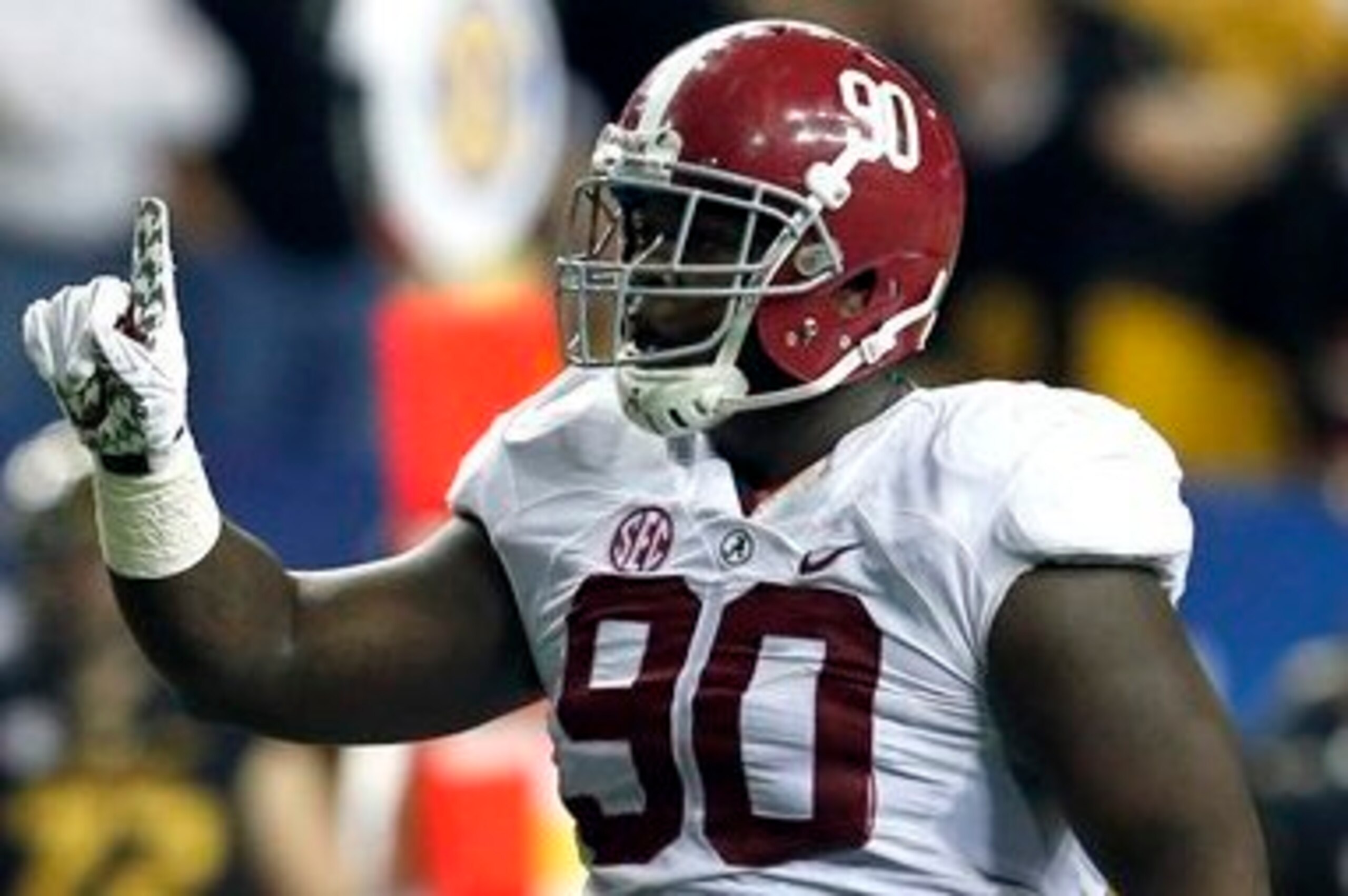
Per usual, this year's Alabama roster is loaded. After all, head coach Nick Saban and Co. put together three straight No. 1 overall recruiting classes, according to ESPN's Recruiting Nation.
Reed wasn't one of the the team's top recruits among the 2014 class, though. The defensive lineman was considered a 3-star talent by ESPN and Rivals.com.
It's easy to get lost in the mix with all the talent Alabama recruits each and every year. Running back Derrick Henry, linebacker Reggie Ragland and nose tackle A'Shawn Robinson headline this year's team, but Reed may have been the most dominant player on the defensive side of the football last season.
The defensive end developed rapidly during his first season with the Crimson Tide. After transferring from East Mississippi Community College, Reed didn't enter the 2014 campaign as a starter. He also didn't remain a backup for long. By the second game of the season, Reed was inserted into the starting lineup and never relinquished the role.
What makes Reed such an intriguing prospect is twofold.
At 6'4" and nearly 315 pounds, he is nearly immovable at the point of attack. As a result, Reed was arguably the nation's most dominant run defender last season. The North Carolina native led the way as Alabama finished fourth overall against the run.
Statistics simply can't tell the entire story of how stout the defensive end really is. Reed finished his first season in Tuscaloosa with 54 total tackles, 6.5 tackles for loss and only one sack. Those numbers aren't going to get casual observers excited.
So much that is accomplished in regard to line play is overlooked, yet it's vital to the unit's success. Reed's ability to get extension, maintain leverage, stay square and display the type of functional strength to not be driven off the ball while maintaining his gap integrity isn't sexy. But all of those things are crucial to successful run defense.
Once Reed arrives at the ball, opponents don't forget the type of impact he really makes, according to Ragland (via the Anniston Star's Marq Burnett):
Also, Alabama employs multiple defensive fronts. Reed is a versatile prospect who starts at defensive end in the team's 3-4 base scheme. He also moves to nose tackle to spell Robinson at times and plays both 3-technique and 1-technique when the team decides to use a four-man front.
Reed's size, versatility and strength at the point of attack make him a monster of a prospect.
But he's also the type of player teams want in the locker room, even after being arrested for a DUI in July. Teams will certainly do their homework on the incident, but Reed's teammates can't speak highly enough of the run-stuffer.
"Jarran Reed has a very explosive personality, and I mean that in a positive way," Alabama defensive end Jonathan Allen told AL.com's Drew Champlin. "He's always on the upbeat. He's always bringing guys who are down, up. He's a great, positive guy to have in the locker room."
Prospects—even good ones—can get lost in the mix when they excel in areas that don't reflect directly on the stat sheet. The ability to stop the run at a high level is still a valuable commodity. Not every prospect needs to get after the quarterback to warrant first-round consideration.
Others, meanwhile, need to show their ability to create pressure opposite a teammate with more upside.
Jordan Jenkins
The Georgia Bulldogs own the top pair of edge-rushers available for the 2016 NFL draft.
Jenkins and Leonard Floyd are both considered early-round talents. Floyd is generally viewed as the better overall prospect due to his length and raw athleticism. The junior led the team with 12.5 sacks over the past two seasons.
Floyd, though, remains flawed as a top prospect due to an overall lack of bulk. The same can be said of Jenkins, according to Bleacher Report's Justis Mosqueda:
The difference being Jenkins is 22 pounds heavier than Floyd. The senior stands 6'3", and he's officially listed at 253 pounds on Georgia's official website.
Plus, it's particularly difficult for a 231-pound linebacker like Floyd to add bulk when he's recovering from shoulder surgery. The junior suffered from a sore shoulder late in the season that eventually required surgery, which prevented him from playing in the Belk Bowl against the Louisville Cardinals.
Despite the previously mentioned concern regarding Jenkins' game, the upperclassman is far more stout at the point of attack by comparison, which was evident by the way Georgia defensive coordinator Jeremy Pruitt decided to use him last season.
Jenkins is another versatile product with the ability to play in multiple fronts. After viewing one of the outside linebacker's games, NFL.com's Ben Fennell detailed the different ways he was utilized:
The linebacker can also drop in space if need be.
Floyd, on the other hand, can be engulfed at the point of attack by much bigger offensive linemen. If he doesn't beat them clean off the line, he struggles to disengage from blocks and can easily be driven wide by better pass-blocking offensive tackles.
Also, consistent pressure can be just as important to a defense as sacking the quarterback. Floyd may have led the team in sacks each of the last two seasons, but he didn't lead the team in overall pressure.
Jenkins accumulated an impressive and team-leading 47 quarterback hits over the last two seasons to go along with his 10 sacks. He relies on a quick first step, long arms to ward off blockers and enough flexibility to turn the edge and bore down on quarterbacks.
Over half of the NFL's teams now employ a 3-4 base defense. Each team is constantly searching for hybrid edge-rushers who show enough versatility in their game to translate into their system. Jenkins is one of those prospects, and he's more physically capable of making the leap when compared to his bookend.
Scheme fits are key to the success of any prospect.
Trae Elston

As this year's NFL draft approached, Alabama's Landon Collins was considered the consensus No. 1 safety prospect. But as the first round came and went, Collins remained available.
The New York Giants eventually traded up to select the Alabama product with the first pick in the second round. It was too late by that point. Collins wasn't even the first safety off the board.
Arizona State's Damarious Randall was selected by the Green Bay Packers with the 30th overall pick in the first round, and a lesson was learned.
In today's NFL, box safeties aren't nearly as valuable as those who can erase mistakes as true single-high free safeties. After all, it's a passing league, and the ability to play from sideline to sideline is far more important than being an aggressive run-stopper.
This specific example can be juxtaposed to the Ole Miss Rebels secondary.
Tony Conner is generally viewed as the No. 1 safety prospect entering the season. He's an intimidating 6'0", 217-pound defensive back who finished second on the team with 69 total tackles and even tied for first with nine tackles for loss.
However, Conner spent most of his time at or near the line of scrimmage. His primary coverage responsibilities were lining up against slot receivers. Collins was used in a similar fashion during his sophomore campaign, too.
Conner may be listed as a safety, but he essentially serves as a strong-side linebacker for the Rebels. When viewing Ole Miss games, Elston could be frequently found over the top of Conner in zone coverage. Below is an example of the two in coverage from Ole Miss' contest against their hated rival, the Mississippi State Bulldogs:
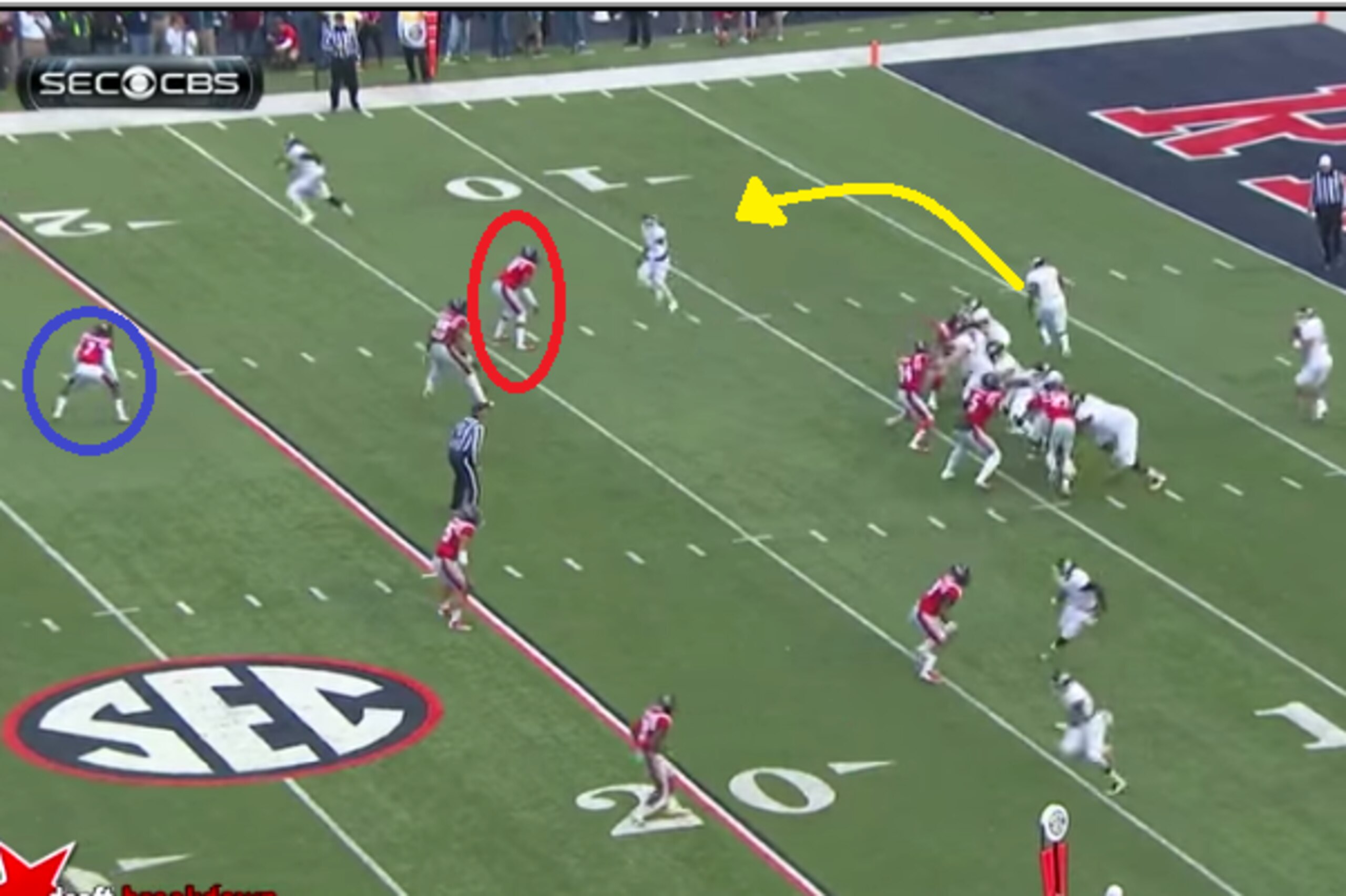
Conner (in red) lined up over the slot receiver originally, but he remains flat-footed in his coverage. His job was to re-route the No. 2 receiver (inside receiver to the left side) and buzz to the flat. Elston (in blue) lined up behind Conner, and he's responsible for the No. 2 receiver going vertical.
The deep safety already opened his hips in anticipation of covering the deep threat, while Conner is simply reading what's in front of him.
During the "Egg Bowl," Conner spent as much time lined up at the line of scrimmage as he did dropping into coverage. But Ole Miss head coach Hugh Freeze isn't going to change Conner's role and ask him to cover more. It's not beneficial for his team to do so with such an effective player.
Elston, meanwhile, will receive more responsibilities this season as the Rebels' last line of defense. He'll officially switch to free safety this season, according to the Jackson Clarion-Ledger's Hugh Kellenberger:
The former ESPN 4-star recruit from Oxford, Alabama, is more comfortable working in space. The ability to cover and make plays against the pass are crucial to a defense's success.
Every team is looking for the next Earl Thomas to prowl the deep part of the field. Thomas is a rare talent, but he's currently considered the prototype in today's game. The overall value of a playmaking safety with speed, athleticism, range and ball skills can't be understated.
Elston will be in position this season as part of the nation's most talented defense to truly establish himself as a difference-maker and an ideal fit for the NFL.
Plenty to Prove

So much will change regarding next year's draft class between now and next April.
For example, Nebraska defensive end Randy Gregory was considered one of the favorites to become the No. 1 overall pick a year ago. His story has been well-documented, but fate wasn't on his side.
In fact, 22 of the first-round picks I projected in last year's way-too-early 2015 mock draft weren't selected in the first round for numerous reasons.
While the aforementioned players are currently considered second-tier citizens on their respective teams, each of them has the talent to become the more highly regarded prospects for those same programs.
Fall camp, a long season, the awards circuit and the predraft process will all come before the status of any of these prospects can be determined.
The evaluation process is long and even tedious at times, but it's worthwhile to find the best players available. And those players aren't always the biggest names on the roster.
Brent Sobleski covers the NFL draft for Bleacher Report. Follow him on Twitter @brentsobleski.
.jpg?w=2560 "Cowboys Packers Football")




.jpg?w=2560 "🚨 Week 8 AP Top 25 Poll")