

Statistical Comparisons for the Top 5 Prospects of the 2015 NBA Draft
Projecting the future of NBA draft prospects is a murky business.
Anyone who says they have it figured out is probably selling something. Even 30 seconds spent perusing the history of the draft will show that every team, even the ones with the most resources and investment in getting things right, still have spotty track records.
Facing such a complicated challenge, it's often nice to rely on comparisons as a tool for sifting through some of the noise. While simple subjective comparisons can often be misleading—Adam Morrison is the next Larry Bird because he's tall, white and can shoot—rigorous statistical ones can help create a frame of reference for using other tools like scouting and statistical projections.



At Nylon Calculus, Layne Vashro has built a tool that lets you find statistical comparisons for draft prospects from any year. You can choose your own variables and weights from an array of stats and find the closest statistical comparisons. The tool also returns a value measure—essentially a statistical version of the standard "poor man's _____" or "rich man's _____" comparisons.
With the draft lottery on Tuesday, May 19, here are the closest comparisons for the top five prospects in this year's draft.
Karl-Anthony Towns, Center, University of Kentucky
| Player | Season | Similarity | Value | Pts/40 | Reb/40 | Ast/40 | Stl/40 | Blk/40 | TS% |
|---|---|---|---|---|---|---|---|---|---|
| Karl-Anthony Towns | 2015 | - | - | 19.5 | 12.7 | 2.1 | 0.9 | 4.3 | 62.7% |
| Tim Duncan | 1995 | 0.38 | -1.80 | 18.4 | 13.7 | 2.3 | 0.4 | 4.6 | 62.8% |
| Greg Oden | 2007 | 0.41 | 0.73 | 21.7 | 13.2 | 0.9 | 0.8 | 4.5 | 62.6% |
| Tim Duncan | 1996 | 0.44 | 0.58 | 20.6 | 13.3 | 3.1 | 0.7 | 4.0 | 59.5% |
| Greg Ostertag | 1992 | 0.47 | 4.52 | 19.8 | 14.4 | 0.6 | 0.9 | 4.4 | 56.9% |
| Robin Lopez | 2008 | 0.49 | 4.81 | 16.6 | 9.2 | 1.0 | 0.8 | 3.8 | 56.5% |
This is an impressive group of comparisons for Towns with an obvious trend toward stalwart defensive centers. All of the similarity numbers are fairly small, meaning we're looking at a very close grouping (the smaller the number, the closer the similarity). The value measurement rates Towns' season as being considerably better than Duncan in 1996 and Oden in 2007, and dramatically better than the Ostertag or Lopez seasons.
For any team looking to draft Towns, this would have to be encouraging information.
It's interesting that we see Duncan's sophomore and junior seasons here but not his senior season. Duncan scored a lot more that year and blocked fewer shots—22.8 and 3.6 per 40 minutes, respectively—which is probably why it doesn't show up. This could highlight Towns' relative lack of polish as well.
If there is one caveat to be drawn in this comparisons, it's that while their minute-adjusted statistics are fairly similar, Towns played far fewer minutes than any of these other players. He averaged just 21.1 minutes per game for the University of Kentucky this year. Greg Oden played just over 28 minutes a game in 2007, and Duncan played over 36 minutes a game in both of the seasons here.
Given these comparisons, it seems like the Minnesota Timberwolves might be an ideal landing spot for Towns. The rest of that roster is trending toward speed and athleticism. Towns could be a great fit, growing into a rangy rim protector and pick-and-roll threat.
Jahlil Okafor, Center, Duke University

| Player | Season | Similarity | Value | Pts/40 | Reb/40 | Ast/40 | Stl/40 | Blk/40 | TS% |
|---|---|---|---|---|---|---|---|---|---|
| Jahlil Okafor | 2015 | - | - | 23.0 | 11.3 | 1.7 | 1.0 | 1.9 | 64.1% |
| Bryant Reeves | 1993 | 0.38 | 2.11 | 24.0 | 12.3 | 1.5 | 0.6 | 1.6 | 63.7% |
| Chris Webber | 1993 | 0.43 | -3.57 | 24.1 | 12.7 | 3.1 | 1.7 | 3.2 | 63.8% |
| Zach Randolph | 2001 | 0.45 | 2.18 | 21.8 | 13.5 | 2.1 | 1.5 | 1.3 | 60.4% |
| Andrew Bogut | 2005 | 0.45 | -1.84 | 23.4 | 14.0 | 2.7 | 1.1 | 2.1 | 64.8% |
| Clifford Rozier | 1994 | 0.46 | 2.99 | 22.3 | 13.7 | 1.9 | 1.1 | 2.8 | 60.8% |
With Okafor, we again see a grouping of very similar players, only much more uneven in quality. By the numbers, Okafor had a much better season than those of Reeves, Randolph or Rozier. However, he was not nearly as good as Bogut or Webber.
The most interesting thing here is when these comparable seasons occurred. Bogut's is the most recent, and that was a decade ago. Reeves', Rozier's and Webber's seasons all occurred more than two decades ago. The bulk of Okafor's value is wrapped up in his ability to score in the low post—a trait that has become rarer and rarer in today's NBA.
Okafor's other numbers are not as impressive in these comparisons. He's not the same quality shot-blocker or rebounder that Towns appears to be and not the passer that his comparables, Bogut or Webber, were. Any concerns about Okafor as a one-dimensional, low-post scorer would seem to be reinforced by these comparisons.
Looking at teams likely to draft at the top of the lottery, the New York Knicks seem like an obvious match for Okafor. Their commitment to the triangle offense without an actual post-scoring threat was a disaster last season. His inside scoring could be just the thing for the Knicks to start building around.
D'Angelo Russell, Shooting Guard, Ohio State University

| Player | Season | Similarity | Value | Pts/40 | Reb/40 | Ast/40 | Stl/40 | Blk/40 | TS% |
|---|---|---|---|---|---|---|---|---|---|
| D'Angelo Russell | 2015 | - | - | 22.7 | 6.7 | 5.9 | 1.9 | 0.4 | 57.3% |
| Brandon Knight | 2011 | 0.43 | 4.05 | 19.3 | 4.5 | 4.7 | 0.7 | 0.2 | 55.3% |
| Ben Gordon | 2002 | 0.44 | 4.07 | 20.2 | 4.4 | 5.0 | 1.6 | 0.2 | 57.6% |
| Delonte West | 2003 | 0.45 | 4.11 | 22.9 | 5.8 | 4.2 | 2.1 | 0.3 | 58.6% |
| Ben Gordon | 2003 | 0.45 | 4.08 | 23.4 | 5.0 | 5.7 | 1.4 | 0.2 | 57.6% |
| Khalid El-Amin | 1998 | 0.46 | 3.30 | 20.0 | 3.9 | 6.5 | 2.1 | 0.1 | 52.6% |
This comparison group provides a nice stylistic framework for thinking about Russell as an NBA player. The players here spent time at both guard spots in college but revealed themselves to be primarily shooting guards once they moved into the NBA. El-Amin is the exception, both in that regard and in that he didn't actually have an NBA career.
The really striking thing about these comparisons is that Russell's freshman season was dramatically better than any of the seasons here. Thus, we're left with a picture of a player perhaps much better than his stylistic peers and with a well-defined niche that fits with the modern style of NBA basketball.
The Philadelphia 76ers will likely be picking in the perfect range to snap up Russell. Their roster is unformed, but most of their talent is in the frontcourt. Russell's dynamism, versatility and perimeter scoring could be a great complement to what they (theoretically) have up front with Nerlens Noel, Joel Embiid and Dario Saric.
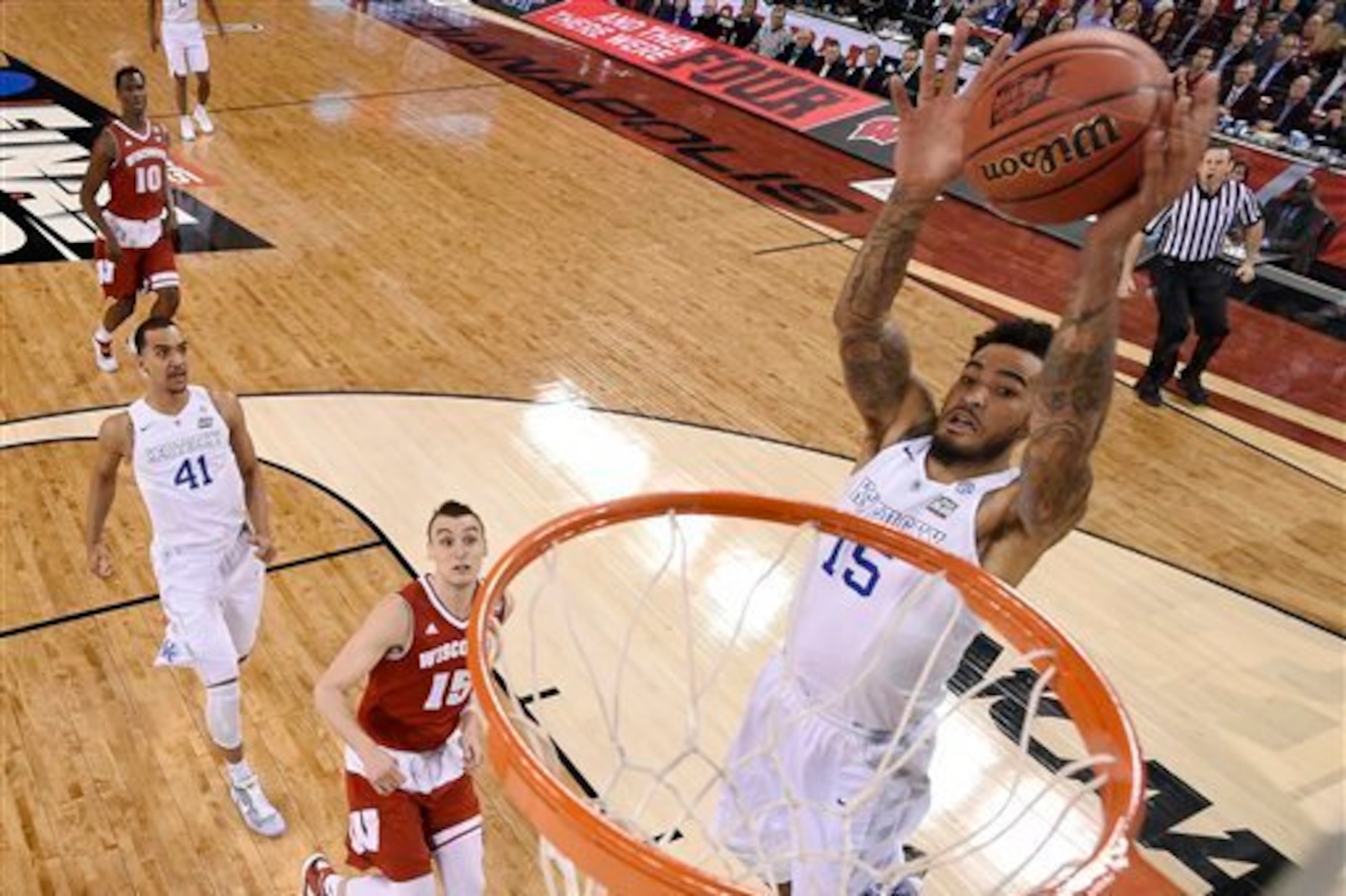
Willie Trill Cauley-Stein, Center, University of Kentucky
| Player | Season | Similarity | Value | Pts/40 | Reb/40 | Ast/40 | Stl/40 | Blk/40 | TS% |
|---|---|---|---|---|---|---|---|---|---|
| Willie Cauley-Stein | 2015 | - | - | 13.8 | 9.9 | 1.5 | 1.9 | 2.6 | 58.8% |
| Josh Boone | 2006 | 0.39 | 1.78 | 15.2 | 10.3 | 1.0 | 0.6 | 3.0 | 56.6% |
| Cherokee Parks | 1994 | 0.40 | 0.78 | 18.9 | 10.9 | 1.2 | 1.4 | 2.9 | 58.6% |
| John Thomas | 1997 | 0.41 | 1.62 | 15.2 | 10.6 | 1.9 | 1.4 | 1.2 | 58.2% |
| Mikki Moore | 1997 | 0.43 | 1.38 | 15.2 | 9.7 | 1.7 | 1.4 | 3.5 | 61.7% |
| P.J. Brown | 1991 | 0.44 | 0.77 | 19.0 | 12.9 | 2.5 | 1.6 | 3.3 | 57.6% |
Of these top prospects, Cauley-Stein's comparisons are the only ones that really dampen enthusiasm. Although statistically he rates out as more productive than all five of his comparisons, there is not really any lottery-level talent in this group.
All five comparisons turned into rotation players in the NBA, but none even sniffed becoming stars. P.J. Brown was probably the closest as a key defensive cog on several good Miami Heat teams and the 2008 champion Celtics.
Cauley-Stein presents as an athletic, defensive center but doesn't necessarily have the statistics to be accurately compared to the most effective prospects of that stripe. Here, the numbers make him look more like a serviceable backup than the lottery pick he's likely to be.
Assuming he develops closer to his ceiling, Cauley-Stein might make a lot of sense for the Sacramento Kings or Orlando Magic. Both could use a lift for their interior defense, and he has both the size and athleticism to play next to DeMarcus Cousins or Nikola Vucevic.
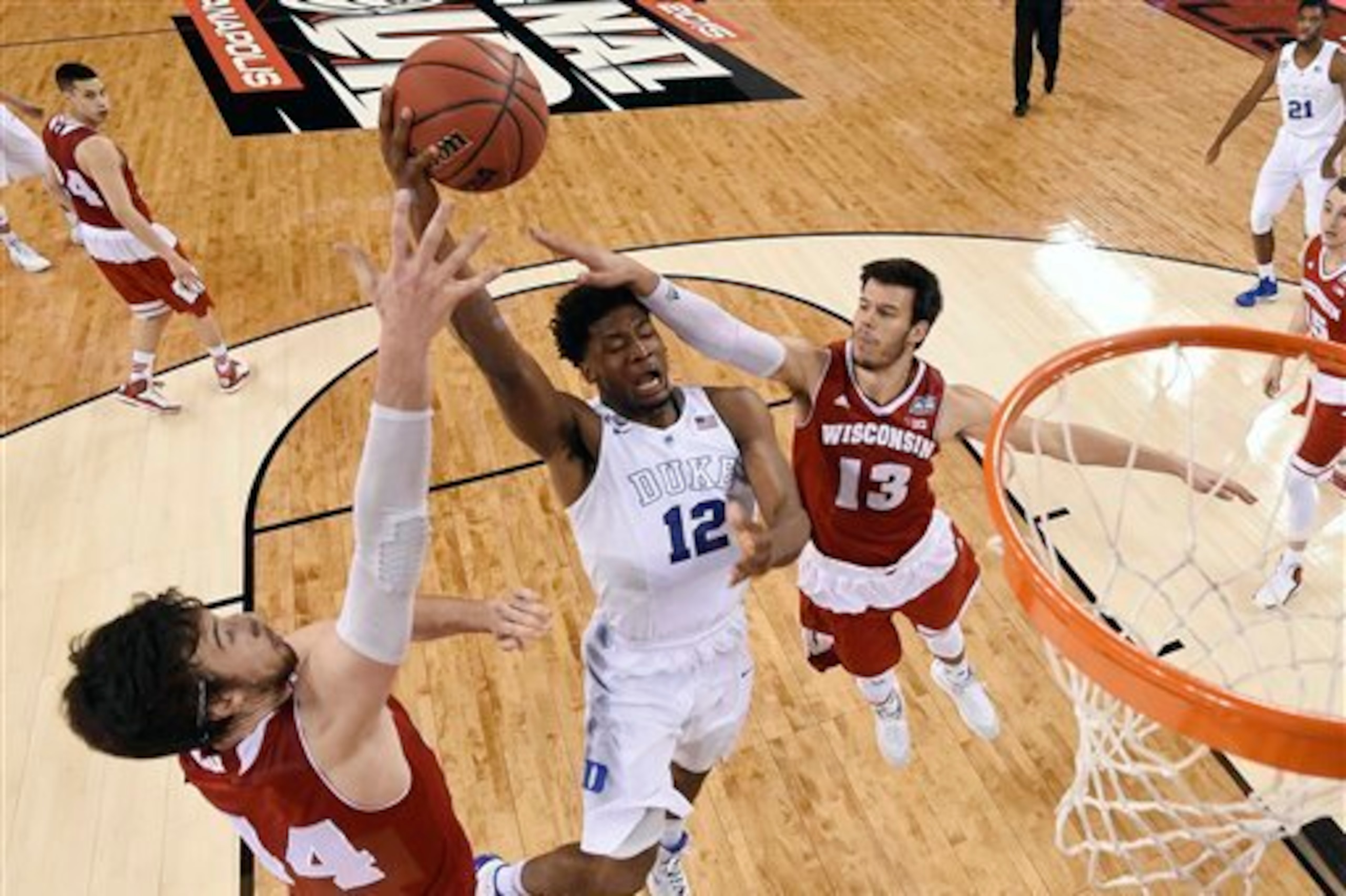
Justise Winslow, Small Forward, Duke University
| Player | Season | Similarity | Value | Pts/40 | Reb/40 | Ast/40 | Stl/40 | Blk/40 | TS% |
|---|---|---|---|---|---|---|---|---|---|
| Justise Winslow | 2015 | - | - | 17.3 | 8.9 | 2.9 | 1.8 | 1.2 | 57.2% |
| Branden Dawson | 2012 | 0.35 | 2.56 | 16.2 | 8.7 | 1.8 | 1.8 | 1.6 | 58.4% |
| Bradley Beal | 2012 | 0.39 | 1.48 | 17.2 | 7.9 | 2.6 | 1.6 | 1.0 | 57.5% |
| Paul Pierce | 1996 | 0.42 | 2.00 | 18.7 | 8.4 | 2.8 | 2.0 | 1.3 | 49.7% |
| Jamal Mashburn | 1992 | 0.43 | 1.60 | 26.1 | 9.6 | 1.8 | 2.2 | 0.8 | 64.7% |
| Chuck Hayes | 2003 | 0.44 | 2.63 | 12.4 | 9.8 | 3.4 | 1.7 | 1.4 | 56.5% |
This is a really impressive group to be compared to, especially since Winslow's season rates out as more valuable than any of the others. In this group, you can really see some physical similarities reflected in the numbers. Winslow—as with Pierce, Mashburn and Beal—combines some perimeter skills with size and strength that can often be overwhelming for defenders.
One point of emphasis these comparisons underline is Winslow's outside shooting. Beal was a tremendous natural shooter, which allowed him to contribute almost immediately in the NBA. Both Pierce and Mashburn became knockdown shooters in the NBA whose careers took off when they did. Hayes never developed an outside shot and has toiled away as a defensive stopper.
Winslow shot 41.8 percent on three-pointers this season, on 2.8 attempts per game. That's not a tremendous number of attempts and gives a sample of only 110 three-point shots on which to evaluate him as a shooter. If a team thinks he can continue to shoot that well on a higher number of attempts, he'll be a much more intriguing prospect.
Looking at the lottery landscape, there are several teams who could use Winslow effectively. The 76ers and and Denver Nuggets make a lot of sense. If he fell far enough, the Detroit Pistons could definitely make use of him as a slashing complement to Andre Drummond and Reggie Jackson.
Conclusion
In the end, these statistical comparisons are not any more definitive than anything else in the scouting toolbox. However, they can provide a much more rigorous starting point for analysis and projections than simple comparisons based on who a player looks like physically.
We can see how a player's statistical contributions manifest stylistically by the players they are similar to. We can also compare the relative quality of players within each style group.
There are no sure things in life, and certainly not in the NBA draft. But numbers like these can help us cut through some of our subjective biases and apply the best tools available in a more effective way.

.jpg?w=2560 "Raiders Could Start Mendoza")

.jpg?w=2560 "Rodgers Iced Out on Plane 💎")
.jpg?w=2560 "🚨 Week 8 AP Top 25 Poll")
.jpg?w=2560 "Fantasy Waiver Wire Stars 🤩")
.jpg?w=2560 "Packers Safety Slams Refs 🤬")
