

How Aging Quarterbacks Could Prompt Shift Toward Ground Game in the NFL
You can hardly go a day without hearing or reading that the NFL is a “passing league.” There’s also scant statistical evidence to suggest that statement is wrong—at least not right now.
It may always be true going forward, but we still may have unknowingly reached the point of diminishing returns on the passing game over the last couple of years. That means we are due for a correction, and it makes sense that defenses are finally adjusting to the new-rules environment.
Yet defensive adjustment is not the only reason we could see a shift back toward the ground game. The NFL is constantly tweaking the rules or officiating to make sure offense can stay a step ahead.
.jpg?w=2560 "Rams Raiders Football")

.jpg?w=2560 "Steelers Saints Football")
What we are really seeing is the effects of age on the so-called “elite” quarterbacks.
Peyton Manning, Tom Brady, Drew Brees and Philip Rivers are just a few examples of quarterbacks who are past their primes now. If history is our guide then their drop in production will be swift when it does happen. Their respective teams are already planning a shift to the ground game in 2015 so they can be ahead of the curve.
What you may not have realized was that the NFL attempted fewer passes as a whole last year than in 2013. This is notable because it was the first year-over-year decline in the last five years.
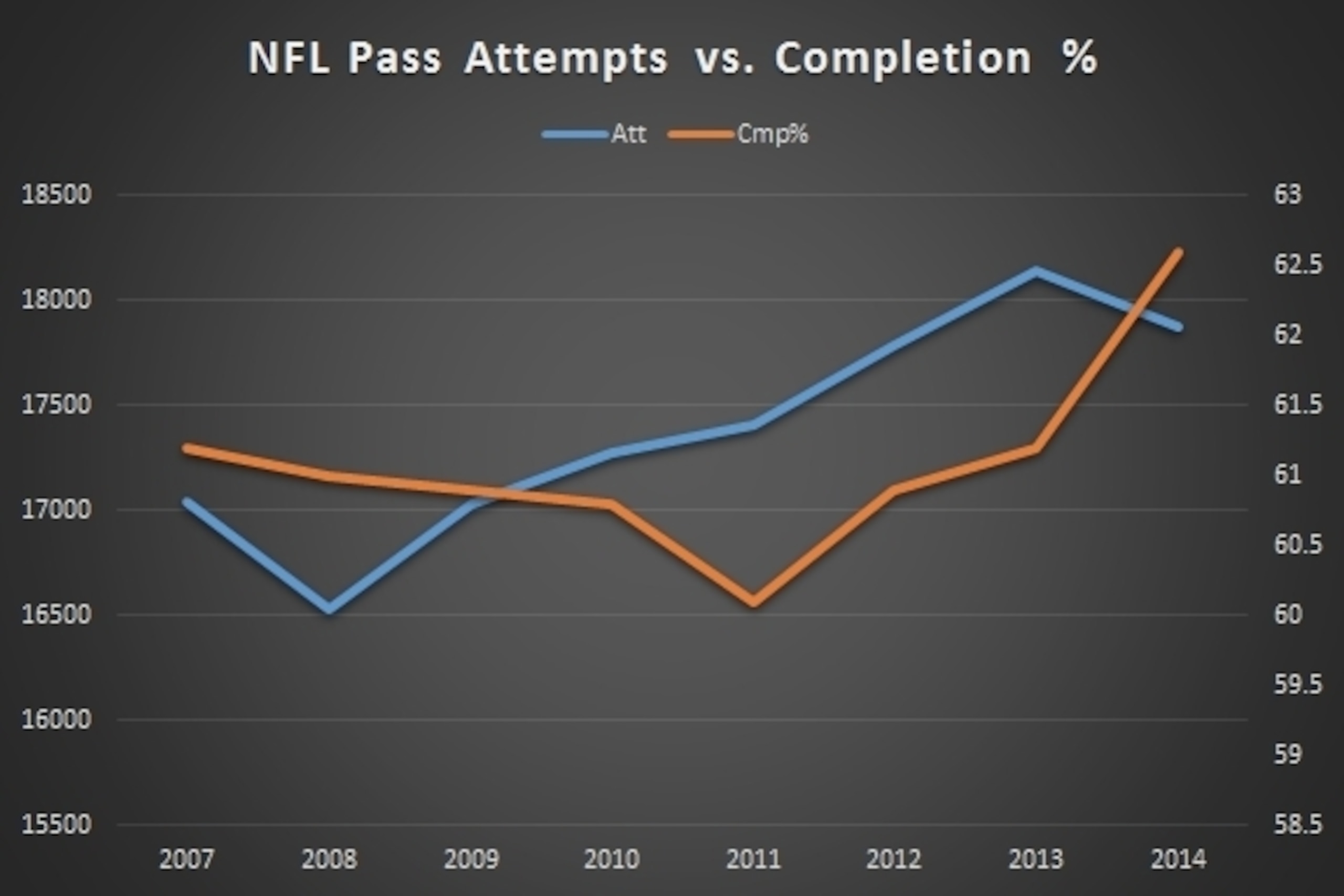
Brady’s attempts went down from 628 in 2013 to 582 in 2014, and he got more efficient as well. The New England Patriots also had fewer rushing attempts. Both the increase in passing efficiency and trend toward fewer pass attempts mimicked the NFL trend last year.
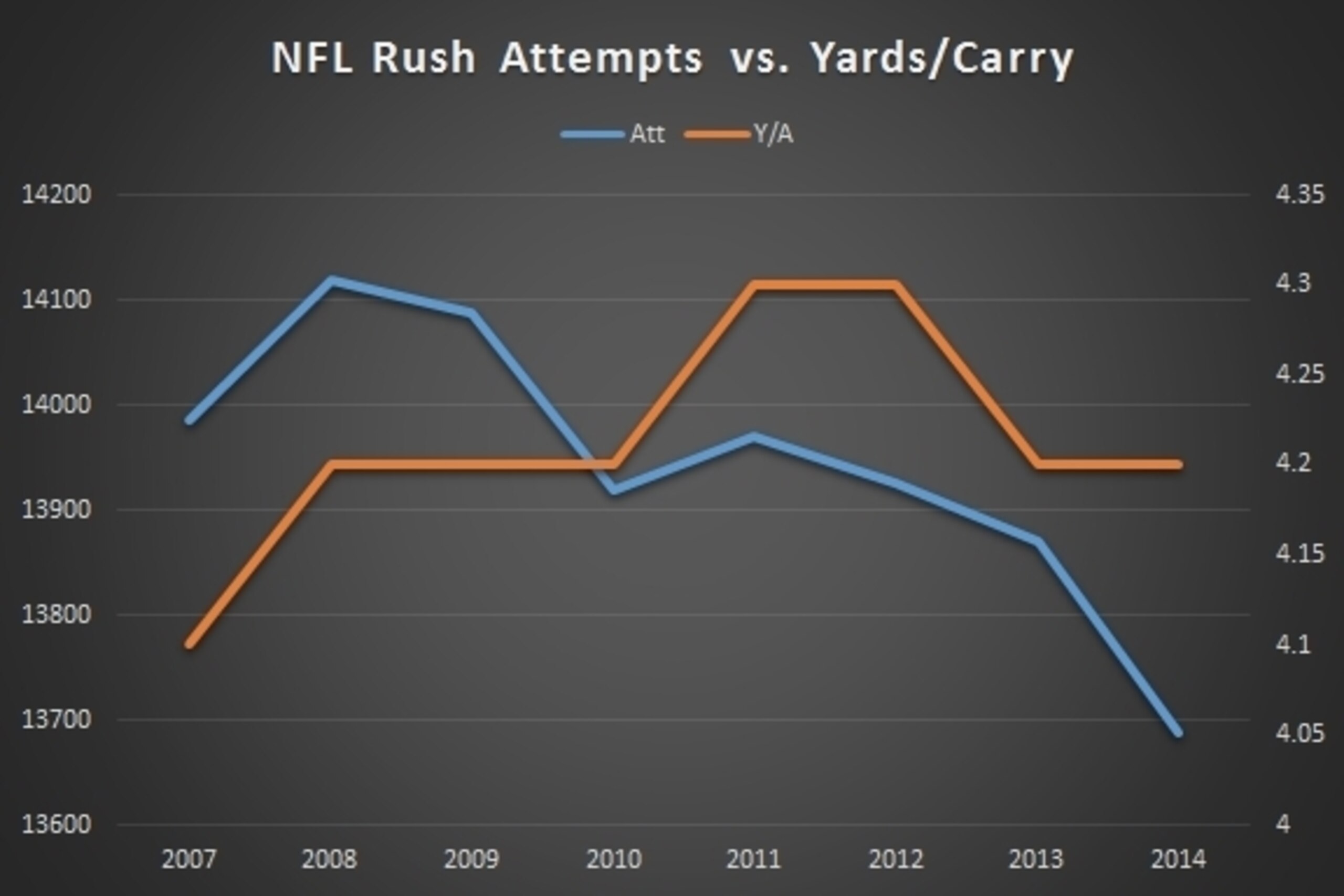
Last season, the NFL saw its biggest decline in the total number of rush attempts in the last seven years. The last time we saw a large dip in rush attempts was in 2010, and the NFL had a year-over-year increase in 2011.
This time, we might see an even larger correction due to so many teams' recommitting to the ground game. Another maxim that we hear is that the NFL is a copycat league, which is another reason we could see a shift back the running game.
The 2014 Dallas Cowboys were a great example of how a running game can help a quarterback. The perennially underrated Tony Romo had his best year as a pro in 2014 but attempted 100 fewer passes than he did in 2013.
Overall, the Cowboys bucked the NFL trend of going away from the running game and actually attempted 172 more runs in 2014 than they did in 2013. They were only marginally more effective on a per-carry basis, going from averaging 4.5 yards per carry to 4.6 yards, so it’s not as if the running game actually improved rapidly.
| 2013 | 535 | 63.9% | 6.54 |
| 2014 | 435 | 69.9% | 8.11 |
| Career | 548 | 65.2% | 7.08 |
| 2013 | 336 | 1504 | 4.5 |
| 2014 | 508 | 2354 | 4.6 |
What made the Cowboys as good as they were had a lot to do with improving the offensive line over the last few years, which is why they were willing to let running back DeMarco Murray leave in free agency. Perhaps the Cowboys realized how hard good pass-protectors are to find, but how readily available good run-blockers are at the college level due to the nature of most college offenses.
The Denver Broncos are going to shift heavily to the running game to protect the aging Manning. New head coach Gary Kubiak is installing his version of the zone-blocking scheme, and general manager John Elway has spent the offseason remaking the offensive line for that purpose.
Unlike Brady and Romo, Manning threw fewer passes in 2014 and was less effective than he was in 2013. He was still great, but he was certainly in need of more help from the running game to stay healthy and effective for 16 regular-season games and the playoffs.
Brees and Rivers attempted more passes in 2014 than in 2013 but were less effective overall. That’s the opposite of the NFL as a whole last year. Both the New Orleans Saints and San Diego Chargers also missed the playoffs and are committed to running the ball more in 2015.
In the case of Rivers, we’ve seen how good he can be when he has a decent ground game. Rivers completed a ridiculous 69.5 percent of his passes in 2013, when the Chargers ran the ball 486 times. That was the fifth-most rushing attempts in the entire league.
| 2013 | 544 | 69.5% | 7.79 |
| 2014 | 570 | 66.5% | 6.45 |
| Career | 516 | 64.7% | 6.95 |
| 2013 | 486 | 1965 | 4.0 |
| 2014 | 398 | 1367 | 3.4 |
In 2014, the Chargers earned 0.6 yards fewer per carry on the ground and had to lean more on Rivers. They ended up attempting just 398 runs, and Rivers’ efficiency suffered to the point that nearly all his numbers declined to his career averages or worse.
The Chargers brought in left guard Orlando Franklin in free agency to pave the way for the ground game. Last season, Franklin was the Broncos’ best run-blocker, per Pro Football Focus, and graded out as the 13th-best guard in the league in that department.
Franklin will replace Chad Rinehart, who graded out as one of the five worst run-blocking guards in the league last year. Rinehart ranked 74th out of 78 guards in run blocking and didn’t do much better against the pass.
Then the Chargers traded up in the first round to get running back Melvin Gordon. This is notable because Gordon was the second running back to go off the board in the first round. Before Todd Gurley and Gordon, a running back hadn’t been drafting in the first round since 2012.
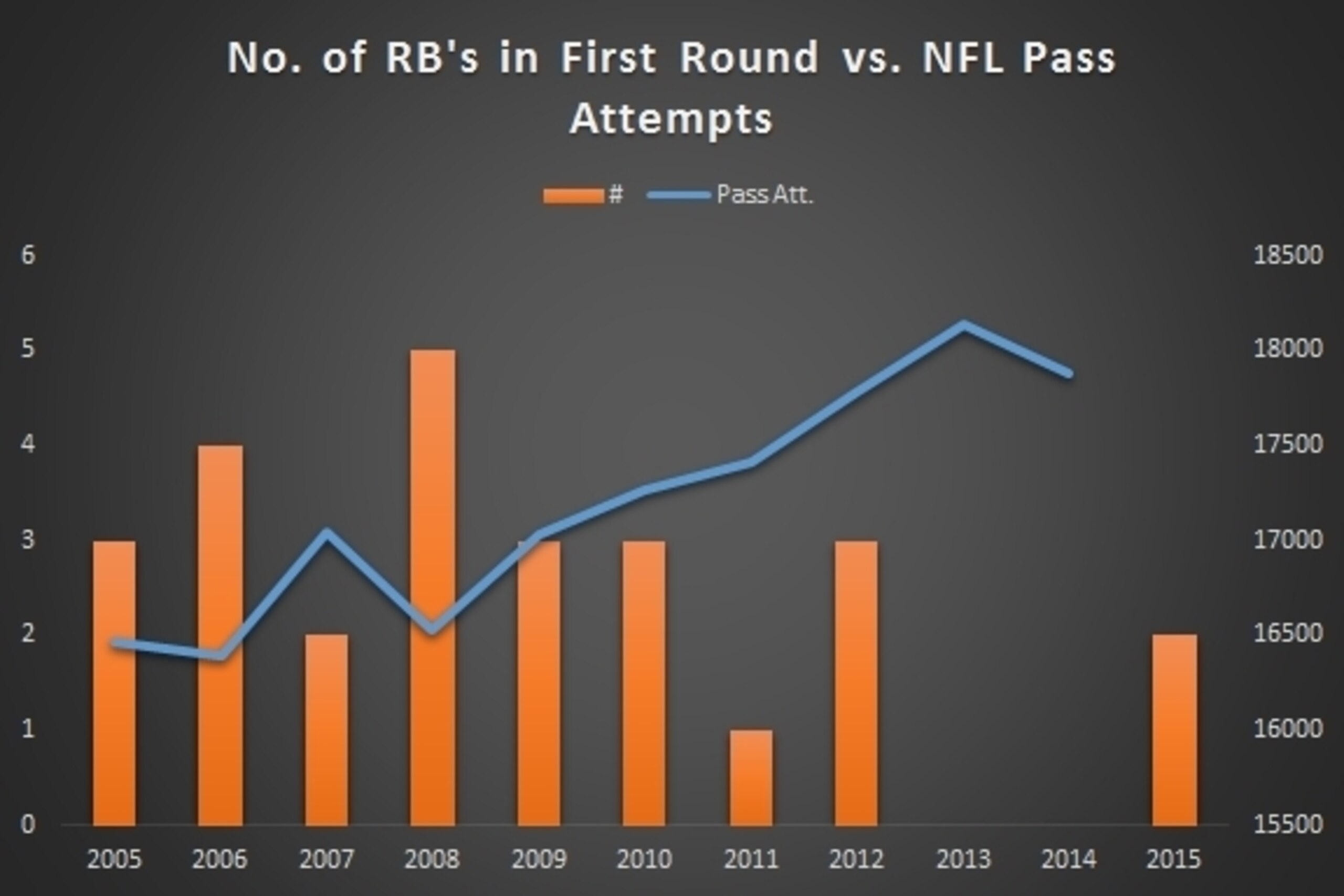
The running backs drafted in the first round recently weren’t even game-changers. The few who were good players weren’t for very long and many have changed teams by now.
Before 2012, we usually saw three or so running backs drafting in the first round per year, so we seem to be headed back in that direction as a league, with two going in the first round and T.J. Yeldon going just a few picks into the second round.
The Saints were a little different. They ran the ball a little more in 2014 but were also much more effective than they were in 2013. With Brees declining the way he did in 2014, much like Rivers, the coaching may have realized they made a mistake in their heavy reliance on the passing game.
Gone are tight end Jimmy Graham, wide receiver Kenny Stills and offensive guard Ben Grubbs, who was a much better pass-protector than run-blocker last season. In are running back C.J. Spiller to go with running back Mark Ingram and center Max Unger, who was one of the top four run-blocking centers in 2014 and came over in the Graham trade from the Seahawks.
The Saints also used one of their two first-round draft picks on offensive tackle Andrus Peat.
We have several different veteran quarterbacks in different situations that are all suggesting the same remedy, which is to run the ball. Obviously, there is a certain level of effectiveness required to make that possible, but all these teams are trying.
The Arizona Cardinals and New York Giants are also trying to beef up their running games with veteran quarerbacks under center. The Pittsburgh Steelers are another team ahead of the curve, as they had the No. 1 offense last season thanks in part to running back Le'Veon Bell.
The good news is that teams are getting more and more effective running the ball as the passing game has taken over the league. Smaller linebackers and more defenses using nickel packages on defense around 70 percent of the time have helped offenses get more from less on the ground.
If there were more elite quarterbacks coming into the league, it’s possible these shifts could be offset. Take the Indianapolis Colts, who drafted wide receiver Phillip Dorsett to give quarterback Andrew Luck yet another weapon in the passing game.
Time will tell if that was a good decision or if the Colts are committing resources to an area where there is minimally more gain possible. It makes sense to bet on Luck, but few other teams have a quarterback like him in terms of ability and age.
The Seattle Seahawks have been a run-heavy team over the past several years despite having Russell Wilson under center, who is arguably one of those quarterbacks. They’ve ranked second in rush attempts in each of the last two years and have been to two Super Bowls.
Last year, they were also the most effective team on the ground, but they did move Unger in order to get Graham. They could be shifting ever so slightly toward the pass, but there just aren’t enough great quarterbacks in the league for every team to justify throwing the ball 40 times per game.
Despite the league’s trend toward the passing game, it looks like we may have reached the point of diminishing returns, even for the elite quarterbacks in this league. Even if you have an elite quarterback, it appears the smart play is to have a good ground game. For this reason, expect a slightly more run-centric NFL in 2015—even if it remains a quarterback-driven league as a whole.
Unless otherwise noted, all statistics via Pro-Football-Reference.com and Pro Football Focus.
.jpg?w=2560 "Cowboys Packers Football")
.jpg?w=2560 "Dolphins Jets Football")



.jpg?w=2560 "🚨 Week 8 AP Top 25 Poll")
