

For some NBA prospects who've entered the draft, the next seven weeks can make or break their outlook.
The predraft period consists of team workouts, the NBA combine (May 12-17) and interviews.
It's the first time many of the general managers will get a chance to meet each prospect and study each one's game, body and character up close.
There are a handful of prospects who must use the predraft period to answer questions that have been raised throughout the season. Failing to do so could be costly financially, especially for those fighting for guaranteed first-round dollars.
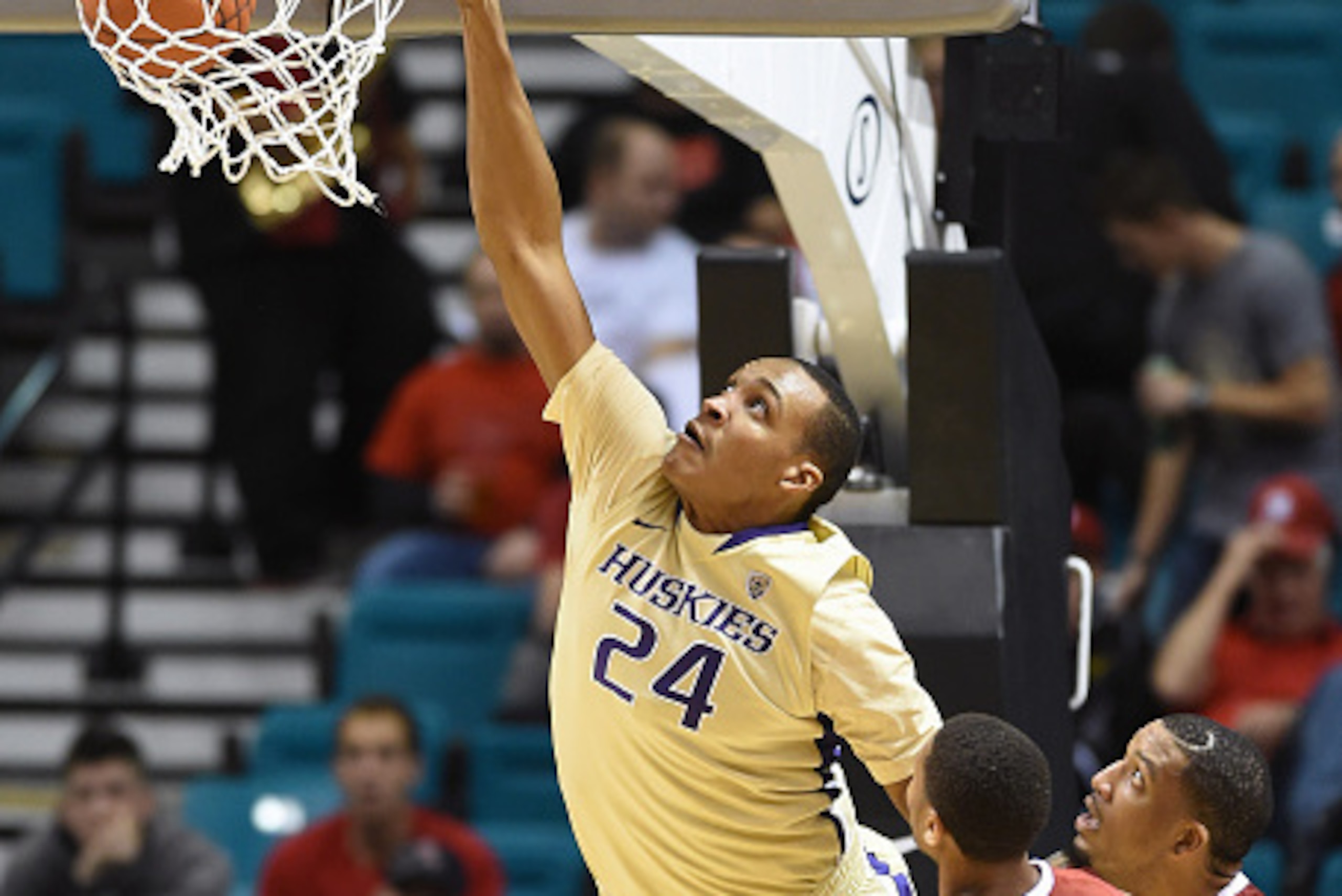
Robert Upshaw, Washington (Dismissed), 7'0", C, 1994
1 of 8
The size of Robert Upshaw's first NBA contract will likely be determined by interviews. Somehow, he'll have to explain getting dismissed from two schools in three years.
Upshaw got the boot from Washington in January after Fresno State let him go back in 2013. According to ESPN's Jeff Goodman, Upshaw "failed multiple drug tests while at both schools."
Fortunately for Upshaw, there is too much value tied to his physical profile and defensive upside.
According to NBA.com's Scott Howard-Cooper, one executive told him "It's possible" in reference to Upshaw going in the first round. "He's one of the most talented big guys I saw this year."
At 7'0", 250 pounds, Upshaw looks the part of an NBA center. He was also leading the country in shot blocking before his season prematurely ended.
With Upshaw, the Huskies were 14-5. Without him, they were 2-10.
The rim protection he potentially offers is worthy of first-round consideration. But Upshaw won't get it unless he convinces NBA decision-makers he's mentally up to the task.
Cliff Alexander, Kansas, 6'8", PF, Freshman
2 of 8
Nobody should be looking forward to the predraft process more than Cliff Alexander. He averaged just 3.7 points over his final nine games before missing every one in March with eligibility issues.
With a lack of ball skills and size for a player who operates strictly inside the paint, the 6'8", 240-pound Alexander didn't show enough to earn any first-round security.
Now, he has to capitalize at the NBA combine and workouts, where he'll have the chance to revitalize his stock by selling teams on his explosive athleticism.
Once a prospect some projected as a potential top-five pick, Alexander could be in danger of falling into this year's second round.
Justin Anderson, Virginia, 6'6", SF, Junior
3 of 8
The next seven weeks will be huge for Justin Anderson, whose track record isn't all that convincing.
Anderson emerged as a three-and-D prospect after making 39 of his first 70 three-point attempts as a junior. However, he'd miss 18 of his next 25 before breaking his finger. Upon returning, Anderson would go on to make just one of his final nine three-point attempts.
Coming into the season, he'd shot just 29.4 percent from three as a sophomore and 30.3 percent as a freshman.
To buy into Anderson as a first-round prospect, you'd essentially have to buy into one 16-game shooting streak over a three-year career.
Shooting lights out at the combine and workouts would certainly give his first-round chances a boost. But failing to look like the sniper he appeared to be early in the season could lead to a slide down the board. Without the ability to create or score, he just doesn't have much margin for error as a shooter.



Terry Rozier, Louisville, 6'1", PG/SG, Sophomore
4 of 8
Terry Rozier should be fighting for a spot into the back end of June's first round.
In two years, Rozier did little to sway scouts on his ability to play point and run an offense. He finished his sophomore season with a shaky 3-2 assist-to-turnover ratio, having spent lots of time at the 2 alongside ball-handlers Chris Jones and Quentin Snider.
However, at 6'1", Rozier doesn't exactly have the size or shooting stroke (30.6 percent from three) to play off the ball as a pro.
During the predraft period, he'll need to sell teams on the idea his jumper will improve and that his lackluster playmaking at Louisville was a result of the role coach Rick Pitino gave him.
"All I have to do is worry about being more of a point guard, being more of a leader," Rozier told The Courier-Journal's Jeff Greer.
He certainly has the athletic ability to turn some heads in workouts.
The NBA combine will ultimately be a big opportunity for Rozier, assuming he participates in five-on-five competition.
J.P. Tokoto, North Carolina, 6'5", SG, Junior
5 of 8
J.P. Tokoto left school early despite still having work to do building his NBA case. And unless he uses this predraft process to answer some questions raised over the year, June 25 could be a long night.
Though superathletic and unique based on his passing instincts (4.3 assists per game) and defense, Tokoto's struggles as a scorer and shooter are impossible to ignore. You just don't see many guards who can't create or consistently make open shots.
Tokoto averaged fewer than 10 points a game for the third straight season. Over his past two, he's hit just 20 total three-pointers, and he's never shot above 61.5 percent from the line since arriving at North Carolina.
At the very least, he'll need to convince scouts and decision-makers his jumper is capable of improving. Otherwise, I'm not sure he offers enough to draw any interest.
Aaron Harrison, Kentucky, 6'6", SG, Sophomore
6 of 8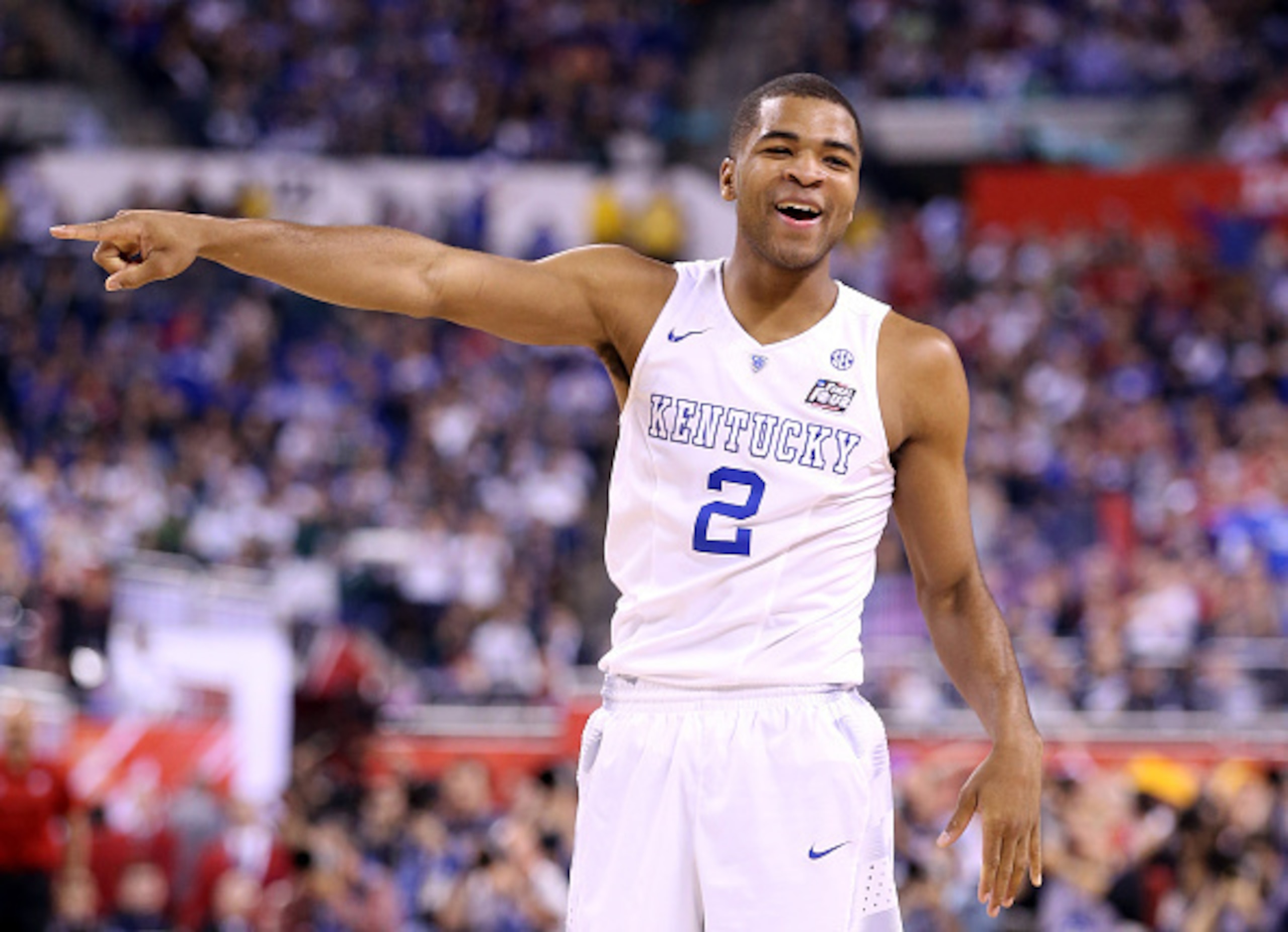
If Aaron Harrison wants to hear his name called on draft night, he'll need a strong predraft period.
He hasn't been particularly convincing through two years at Kentucky. Despite establishing himself as a perimeter scorer, Harrison has struggled mightily with shooting inconsistency.
He hit just 31.6 percent of his threes this past year after shooting an average 35.6 percent as a freshman. This wouldn't be as big of a deal if Harrison had standout athleticism or explosiveness to work with. But he doesn't get to the rim much (2.6 free-throw attempts per game) or threaten defenses off the dribble. And he isn't a playmaker (11.1 percent assist percentage, per Sports-Reference.com).
Without much offensive creativity to his game, the only realistic path to the NBA for Harrison is as a shot-making specialist. If he isn't able to convince teams he can be that accurate over the next two years, they won't have a reason to draft him.
Jarell Martin, LSU, 6'10", PF, Sophomore
7 of 8
Jarell Martin has a number of attractive qualities from an NBA standpoint, particularly his explosive athleticism and face-up ball skills.
But there is a slight discrepancy with regard to his measurements—something that will likely be settled at the NBA combine.
LSU lists Martin at 6'10"—a solid size for a power forward. However, Martin measured 6'7 ½" this past summer at the LeBron James Nike Skills Academy.
The 2 ½-inch difference is pretty significant—especially when you consider Martin's below-average 6'10" wingspan and 26.9 percent three-ball.
He's not quite sharp enough on the perimeter to play small forward. Measuring in around or below 6'8" sure wouldn't be a good look for Martin, who'll be fighting to secure a spot somewhere in the late first round.
Dakari Johnson, Kentucky, 7'0", C, Sophomore
8 of 8
Dakari Johnson made a questionable call by entering the draft and giving up two years of eligibility.
He's nowhere near ready to contribute to an NBA team, having played fewer than 17 minutes a game in each of his two seasons at Kentucky. For his sake, it would be nice to earn over a million dollars a year while developing in the NBA D-League.
But at this point, the first round is no sure thing for Johnson, who averaged 6.4 points, 4.6 rebounds and 0.9 blocks on 50.6 percent shooting. Johnson has strong size and mobility, but he isn't overly athletic, advanced in the post or soft with his touch.
To trigger a first-round bite, he'll need to stand out among the bigs and sell his physical tools and presence. Falling into the second round would delay and probably even hurt Johnson's chances of earning decent NBA money.

.jpg?w=2560 "Raiders Could Start Mendoza")

.jpg?w=2560 "Rodgers Iced Out on Plane 💎")
.jpg?w=2560 "Packers Safety Slams Refs 🤬")
.jpg?w=2560 "🚨 Week 8 AP Top 25 Poll")