Does Yoan Moncada's Story Signal a New Type of Cuban Defection?
December of 1997, Orlando "El Duque" Hernandez found himself stranded on a nameless rock in the middle of the sea. Fourteen years later, Yasiel Puig found himself in an anonymous hotel room, staring at a gun held by an alleged member of Los Zetas, a notorious Mexican drug cartel.
And then there's Cuba's latest great athletic export: Yoan Moncada, a 19-year old uber-prospect who suddenly appeared in Guatemala, without a harrowing defector tale and seemingly with Cuban officials' blessing, even though he had yet to swing a bat in any league outside of Cuba. The Boston Red Sox won a bidding war, lavishing the shortstop with a $31.5 million signing bonus.
TOP NEWS

FAs Who Need Team Change 👀
Should Yankees Target Jacob Young? 🤔
.jpg?w=2560)
Ranking Tarik Skubal's Top Landing Spots 🛬
For the past two decades, Cuban ballplayers have found various illegal and illicit means to arrive at the pristine, shining diamonds of America's major league cities. It took 10 years for the first 30 Cuban ballplayers to leave Cuba. Now there are roughly another 75 Cuban players searching for contracts, according to MLB.com's Jesse Sanchez, all of whom presumably not only defected but, like El Duque, Puig and many others, were smuggled out of Cuba.
What started as a trickle is becoming a strong current of Cuban talent flowing along a pipeline that started with Rene Arocha's defection in 1991. The stream of Cuban talent would be unremarkable except for the international set of circumstances in which Cuban ballplayers operate in order to pursue their craft outside of Cuba.
The mystery and romanticism surrounding them is part American dream and part Pirates of the Caribbean.
Moncada warranted such lavish attention, given his skills and rapid ascent through the ranks of Cuban baseball. A swift switch-hitter with power from both sides of the plate, he was Cuba's best teenage ballplayer, a once-in-a-generation talent.
The world became aware of Moncada when he starred for Cuba's national team at the U16 IBAF 2011 World Baseball Championships in Lagos de Moreno, Mexico, as the only Cuban named to the tournament’s All-Star team. Born in the Las Quinientas neighborhood of Abreus in the province of Cienfuegos, he led Cuba's U16 national league in batting average (.500), OBP (.643), slugging (.918), home runs (8) and walks (37) while going 15-for-15 in stolen bases as a 15-year-old.
At 16, he repeated this type of play in the U18 league, leading the league in offensive categories by hitting .434/.543/.648 in 152 plate appearances with a league-best 20 steals in 24 tries. He more than held his own as a 17-year-old rookie for Cienfuegos (.283/.414/.348 in 172 plate appearances with 13 stolen bases in 18 attempts) in Cuba's Serie Nacional.
So how did Moncada manage to make such a routine exit from Cuba despite falling under MLB's recent, somewhat draconian rules for signing international free agents?

His exodus hints that change is imminent in Cuban baseball. Moncada's departure may have occurred through Cuban resignation, indifference or ignorance of his intentions. One prominent Cuban sports broadcaster, speaking without official clearance, explained, "Of course they didn't know Moncada was going. But even if they did, they couldn't really stop him. Only delay. He was gone. Just a question of when."
The loosening of regulations allowing Cuban citizens to travel more freely is a significant recent change. Cubans have had the right to leave Cuba without obtaining the government's permission since January 2013. No longer required to obtain an exit visa to legally leave the country, Cubans can obtain a passport (provided they can afford the processing fee), as long as they can get the destination country's required visa.
There are, of course, still some limitations. For instance, Cuba, like many impoverished countries, faces a brain drain. Consequently, many high-skilled professionals—doctors, scientists, members of the military, engineers and other valued professionals—currently face restrictions on their ability to travel. Cuba's international athletes, including members of its national baseball squad, fall under these restrictions, and Moncada certainly would have been included on any immigration list of elite athletes.
Yet Moncada apparently left the country with the full knowledge of immigration officials. However, it is not so apparent he did so with the knowledge of the Cuban Baseball Federation, the national governing body of baseball responsible for all aspects of the sport in Cuba. Most Cuban ballplayers do not simply apply for a passport and leave—for two reasons.
The first is that as long as they remain members of the national team, they will not be issued personal passports. When the national team travels, every player's documents are held by a team manager rather than in the athlete's personal possession. When in Cuba, his name will be on a list prohibiting his departure, and his passport will be held by the Federation.
The second is that it takes money to be able to book a flight off the island, money that is usually beyond the means of most players. Players' salaries, while low, are not as woeful as commonly reported, especially for medal-winning national team members, but are insufficient to readily cover international airfare.
Moncada apparently solved these issues. He dealt with the former by convincing authorities that his heart was no longer in baseball and resigning not just from the national side but from his position on his Cuban team, Cienfuegos. By not playing in 2013-2014, he gave the impression that he could be done with baseball.
This is not that unusual. Many of Cuba's elite athletes take a year or more away from their sport to focus on their university educations during the early portion of their athletic careers as part of their plans for their post-athletics lives.
"I went to Nicaragua. I went as a baseball coach and worked with youth programs," said Carlos Tabares, former star of the Cuban national baseball team, who missed a season early in his career. "Lots of us do this. It was part of my education. They are part of the exchanges all over the world."
Another possibility is that Moncado married a foreigner. If Moncada went that route, Cuban authorities must have recognized his marriage as legitimate rather than as "a marriage of convenience"—a common emigration ploy.
Jorge Luis Toca, the first baseman for Villa Clara in the 1990s, pursued the same strategy, marrying a Japanese woman he met while at an international tournament in Japan in 1996. Cuban authorities refused to recognize the marriage's legitimacy, and he had to resort to being smuggled out of Cuba and into the Bahamas. Once she got word that he was being held in the Carmichael Road Detention Center, his wife traveled to Nassau with proof of his Japanese spouse visa to procure his release.
After further bureaucratic delays in Japan, Toca eventually signed with the Mets and soon after divorced his Japanese wife.
However Moncada resolved the two major obstacles faced by many Cubans wishing to depart the country, it still remains unclear where and how he traveled. All we know at the moment is that Yoan Moncada apparently left Cuba in June 2014 and that he was in Guatemala toward the end of 2014.
For at least four months, Moncada virtually disappeared. According to some reports, Moncada was in Argentina prior to his arrival in Guatemala; another mentions Ecuador. Both Argentina and Ecuador have good diplomatic relations with Cuba, and it's relatively easy for a Cuban national to obtain a carta de invitacion (letter of invitation), which is basically a visa that states that a Cuban's host will cover his expenses while in that country.
To travel to either country, Moncada could have been part of an educational exchange and, once there, slipped away to Guatemala as long as someone was bankrolling his travels. It is also plausible that permission was granted to visit Argentina if he married a foreigner. A third possibility is that Moncada traveled directly to Guatemala, where again a carta de invitacion would be relatively easy to obtain.
There is one other possibility: Cuban Baseball Federation officials knowingly let Moncada go with an undisclosed agreement that some of his contract would be sent back to the Federation. While completely illegal under U.S. law, the Cuban company Cubadeportes S.A. has been exporting Cuba's athletic talent since its inception in the early 1990s. It is a significant means by which Cuba funds its highly regarded sports programs, including baseball.
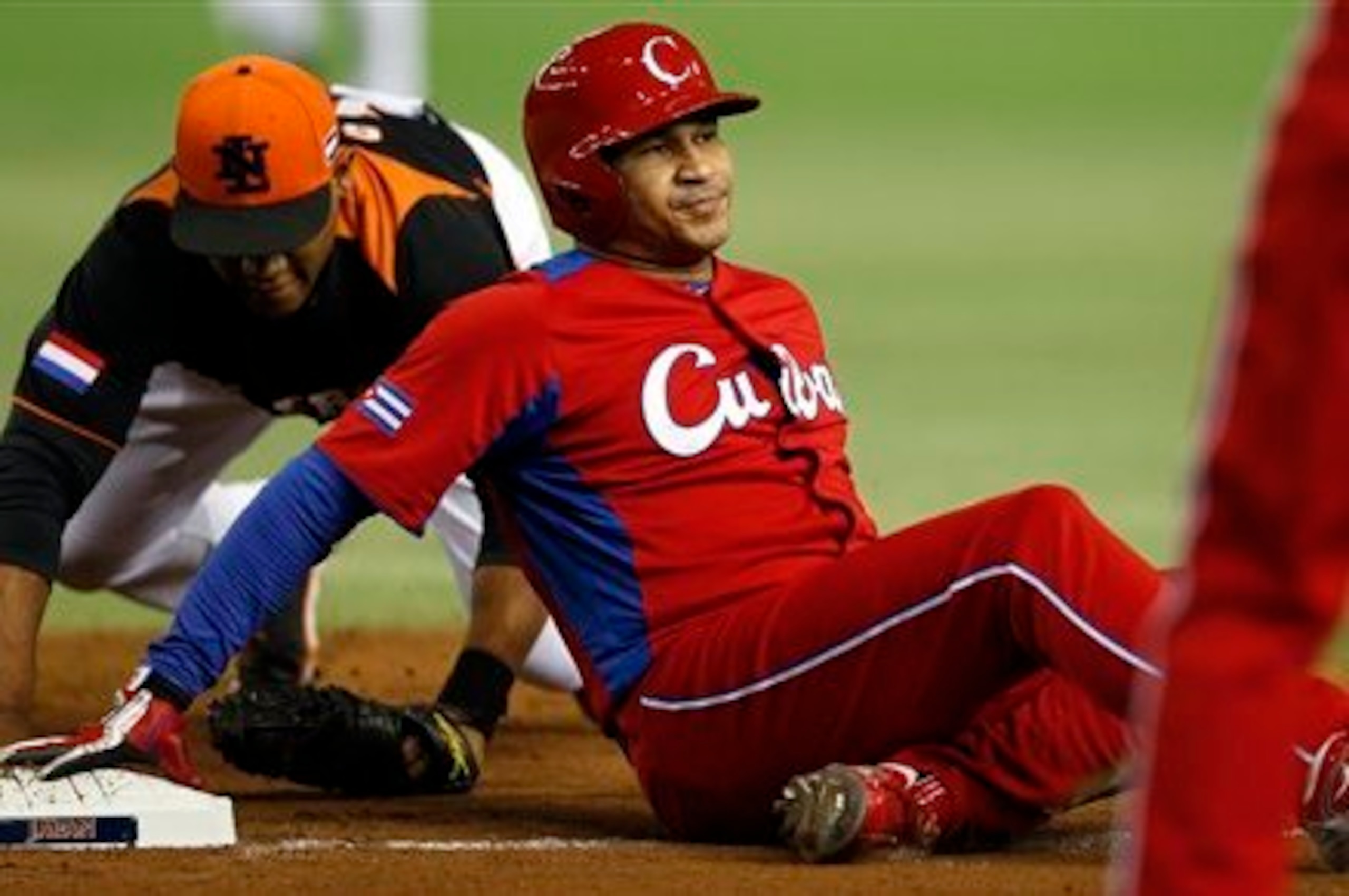
Cuban ballplayers have played and do play overseas in Japan, Taiwan and Mexico. Five players—Yulieski Gourriel, Frederich Cepeda, Lourdes Gourriel Jr., Alfredo Despaigne and Hector Manuel Mendoza—are contracted with Japanese clubs for 2015 and will head for Japan once the Cuban season finishes later this month.
As Benito Camacho, now retired dignitary of the Cuban Baseball Federation, explained, "We spend all our resources developing these athletes. Therefore, it is only logical to expect that we should receive some form of payment when they compete overseas. Why should the athlete be the only one to benefit when they would not have those skills without all our training and knowledge?"
Authorities now attempt to provide sufficient overseas opportunities to help develop athletes' careers (and earn higher salaries) so that they remain loyal to the country that nurtured them. That foreign contracts for Cuban athletes have shifted is indicative of this sea change. Now, a reported 10 to 30 percent goes to the Cuban Baseball Federation, instead of the 80 percent we saw back in the 1990s.
Since Cuban athletes can now earn and keep thousands, if not millions, it would appear that the major obstacle for future Cuban ballplayers is not the Cuban Federation but Major League Baseball and the U.S. government.
Let's make one thing clear: Yoan Moncada did not defect. He is still a citizen of Cuba. This is the major difference. Yes, he established residency in Guatemala and likely travels to the U.S. on a Guatemalan passport. But he has his Cuban one as well, since that was the document he used to leave Cuba and to arrive in Guatemala.
Whether he left with the authorities' knowledge is up for continued debate until we are told otherwise. However, he certainly took an unusual path to obtain his contract. The usual routes pursued over the past two decades take Cubans elsewhere, usually to the Dominican Republic or Mexico. Those athletes who left Cuba clandestinely, smuggled or not, and established residency elsewhere do not have Moncada's advantage regarding his ability to return home.
Players like Jose Abreu, Adrian Nieto and the recently signed Hector Olivera, having traversed the treacherous waters between Cuba and Haiti and then crossed the porous border between Haiti and the Dominican Republic, cannot go back to Cuba—yet. Moncada's experience suggests that circumstances in Cuba may be changing.
Whether or not the smuggling of Cubans out of the country is affected by Yoan Moncada's experience, his arrival signifies a potentially new departure in the business of signing Cuban players.
Dr. Thomas F. Carter is the author of two books: The Quality of Home Runs (published by Duke University Press) and In Foreign Fields: The Politics and Experiences of Transnational Sport Migration (published by Pluto Press).

.jpg?w=2560 "Travis Hunter Makes Rare History")
.jpg?w=2560 "NFL Addresses Paris Concerns")
.png?w=2560 "B/R CFB Top 25 After Week 7 🔢")
.jpg?w=2560 "Ref Slips on Wet Turf in London 🎥")

.jpg?w=2560 "Texans Beat Jags in London")