Questions Mounting for Rafael Nadal Heading into Clay-Court Season
Rafael Nadal has reigned over men's tennis every spring for the last decade.
The King of Clay dominates his surface like no other player in ATP history. And this year, the switch to dirt can't come soon enough for the Spaniard. After several months of disappointing results on grass and hard courts, Nadal looks increasingly vulnerable.
That's a word which hasn't been used to describe him in a very long time—if ever.
.jpg?w=2560 "Cardinals Giants Football")
He hasn't entered a clay-court season with this many doubts about his form since 2005, when he was still a relatively unknown 18-year-old.
So how did Nadal reach this crossroads? It started last January.
Nadal kicked off the 2014 season with a bang, winning a season-opening title in Doha. At the Australian Open, his torrid streak continued as he beat Kei Nishikori, Grigor Dimitrov and Roger Federer on his way to the final. But that's where the first cracks in the Spaniard's armor began to show.
Against first-time Grand Slam finalist Stan Wawrinka, Nadal looked out of sorts at the start of the match. Wawrinka used some overwhelming power to fluster him and took the first set 6-3. After being broken early in the second set, Nadal's back seized up.
At times, Nadal could barely strike the ball. But he soldiered on. Yet despite his heroic efforts, Nadal couldn't hold off Wawrinka and lost the match in four agonizing sets.

A golden opportunity to collect another major slipped away for Nadal because of his increasingly fragile body. And it was an injury he'd never fully recover from until having a stem-cell treatment at the end of the year.
His pains continued at Indian Wells last spring when Alexandr Dolgopolov shocked him in the third round. At his next tournament in Miami, Nadal raced to the final but was soundly rocked by Novak Djokovic in a straight-sets blowout.
During the 2014 clay-court season, those same uncharacteristic losses surfaced again.
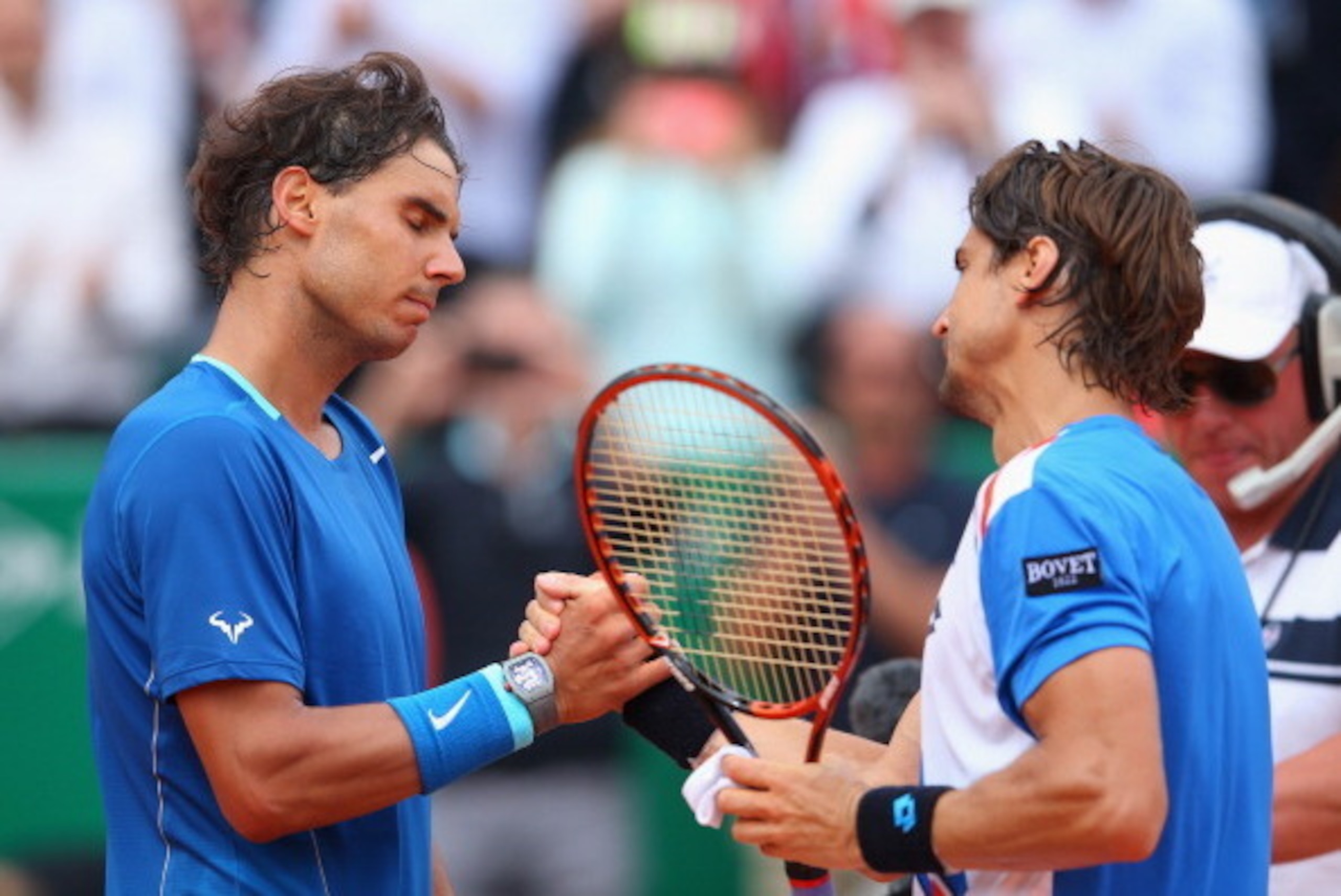
After winning a title on the dirt in Rio earlier in the year, Nadal probably thought clay would be his refuge. Not so fast. He suffered back-to-back quarterfinals losses in Monte Carlo and Barcelona last April to David Ferrer and Nicolas Almagro, respectively.
Not only was he losing on his beloved clay more frequently, he was losing to his own countrymen.
At his next tournament in Madrid, Nadal started to make strides and wound up in the final. He quickly found himself outplayed by Nishikori, who captured the first set 6-2 and went up an early break in the second.
Ironically, Nishikori's hip gave out and he eventually retired in the third set. Nadal would leave the event with the trophy but few answers.
In Rome, Nadal again stood across the net from Djokovic in a final. And again he lost to the Serbian, this time in three sets. As he readied himself for the French Open, Nadal had three recent clay losses to ponder.
Like he so often does in Paris, Nadal summoned his best form just in time. He lost only one set on his way to the championship round, surging past Ferrer and Andy Murray in the process. In yet another matchup with Djokovic, Nadal turned the tables and won in four topsy-turvy sets for his ninth Roland Garros crown.
And that's when the magic ended.
Nadal had to be supremely pleased to play his best tennis when it mattered most, especially after earlier losses on clay. But when he transitioned to grass, that form didn't carry over.
In Halle, Nadal lost his first match 4-6, 1-6 to unheralded Dustin Brown of Jamaica. No big deal he likely thought. At Wimbledon, however, the struggles continued when he lost the first set in each of the first three rounds. He was able to pull himself out of each hole, but in the fourth round against Australian teenager Nick Kyrgios, the luck ran out in another shocking defeat.

After his third straight early exit from the All England Club, Nadal looked forward to a strong run in the summer U.S. Open Series. His body had other plans.
While training before Toronto, Nadal injured his wrist and had to withdraw from the event. He'd eventually also pull the plug on Cincinnati and the U.S. Open, relinquishing the 4,000 rankings points he won at the three events in 2013.
As his ranking suffered, Nadal prepared himself for the fall. He finally reappeared at the end of September in Beijing, but the rusty Spaniard lost in the quarterfinals to journeyman Martin Klizan.
An early defeat in his first tournament back after inactivity wasn't a surprise. But another ailment was a stunner, and Nadal announced he had contracted appendicitis. He decided to play Shanghai, yet he lost his opening match to Feliciano Lopez.
He tried to fight through the pain in Basel until 18-year-old Borna Coric handed him another upset loss. Then, Nadal chose to end his season and have surgery.
If not for his championship at Roland Garros, 2014 would have been almost a lost season for Nadal. With a horde of surprising losses and physical ailments, he set his sights on a resurgent 2015 campaign.
The early returns this year have been just as troubling.
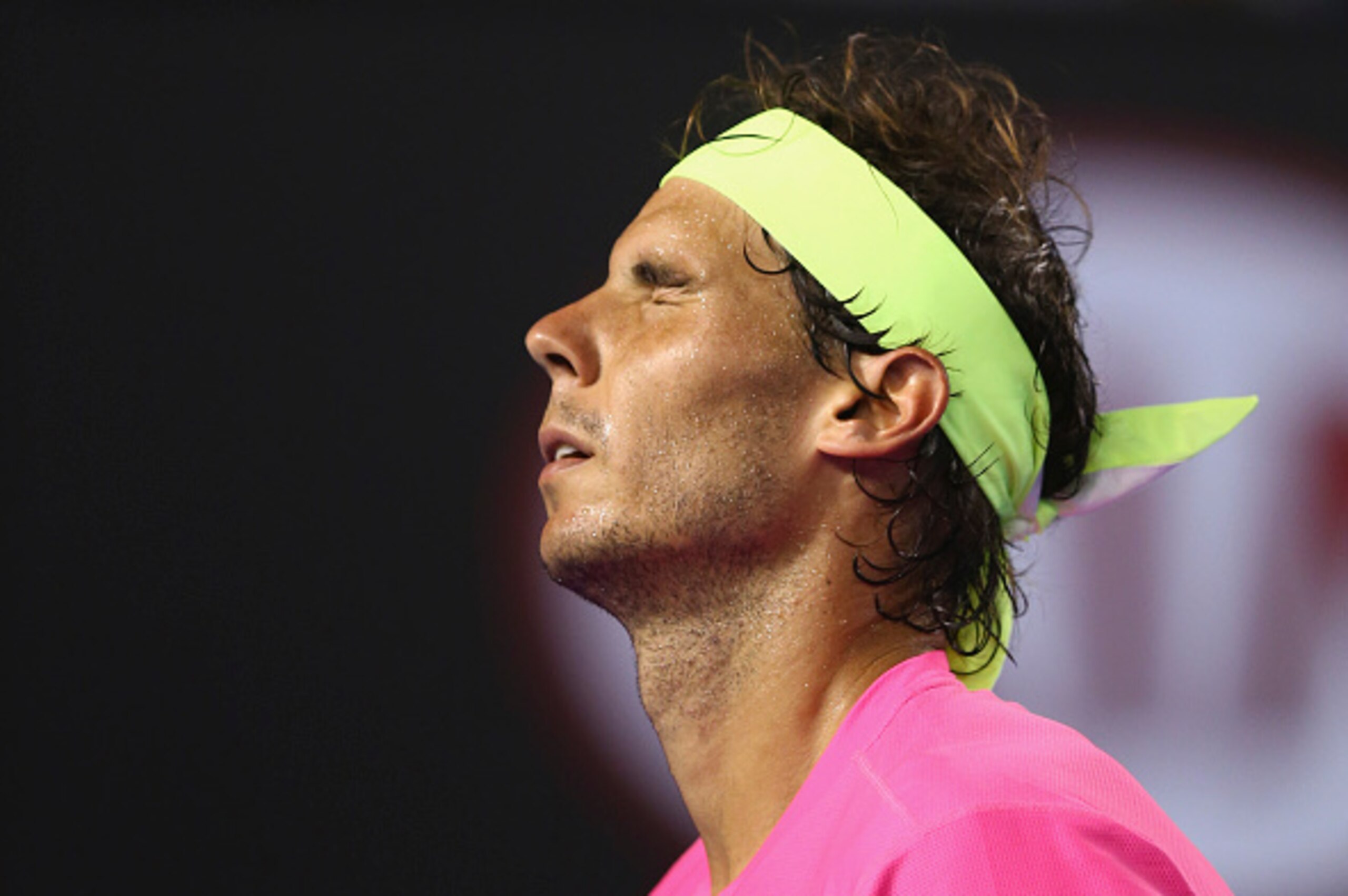
In Doha, Nadal's title defense came to a swift end with a loss to Michael Berrer in his first match. He'd enter the Australian Open with little match preparation, and it showed during a second-round tussle with Tim Smyczek.
A brittle-looking Nadal needed five sets to outlast his challenger in a 6-2, 3-6, 6-7(2) 6-3, 7-5 epic. That result raised more questions about his form, and they intensified after a straight-sets thrashing to Tomas Berdych in the quarterfinals.
His rough start to 2015 continued on the dirt in Rio, where he lost in the semifinals to Fabio Fognini. That defeat ended his remarkable 52-0 streak in clay semifinals.
Though he rebounded at the end of February by winning a small tournament in Buenos Aires, he still didn't look like the Nadal of old on the court.
At Indian Wells, Nadal worked his way into the quarterfinals, but his momentum ran out against Milos Raonic in a tough 6-4, 6-7 (10) 5-7 loss. During their duel, Nadal squandered match points and lost to the Canadian for the first time, winning only 19 percent of his first-serve returns in the process.
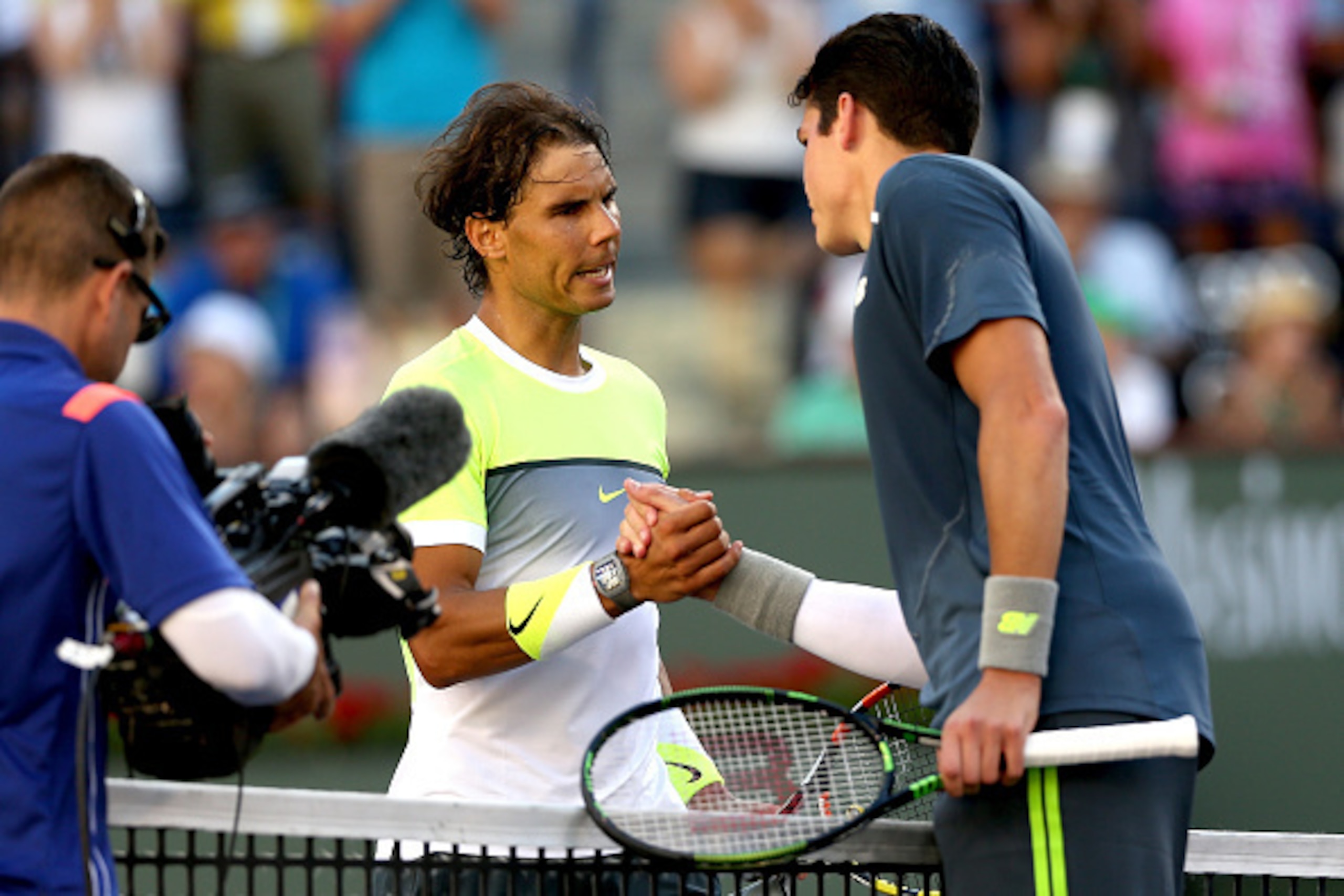
If that loss didn't raise eyebrows, the next one did. In Miami, Nadal dropped his third-round match to Fernando Verdasco 4-6, 6-3, 6-3, his earliest exit from the tournament since 2006.
The slump had intensified.
Most players would be ecstatic to start a season 15-5 like Nadal has in 2015. But the Spaniard holds himself to a higher standard, and that record is troubling for him. What's even more alarming is the fact Nadal hasn't beaten a top-10 opponent since June 9, 2014, when he took out Djokovic at the French Open.
As FiveThirtyEight.com's Carl Bialik pointed out, Nadal hasn't been able to find great success away from clay since that run at Roland Garros:
"Rafael Nadal has failed to reach the semifinals of his last 9 events off clay, a slump going back 12 months. http://t.co/4yMVzeuGmO
— Carl Bialik (@CarlBialik) March 30, 2015"
Where do the problems lie for Nadal? Because of recent physical limitations, it's clear Nadal isn't hitting the ball as well as he has in the past. Sure, he can still impart vicious topspin on his shots, but they lack depth and consistency. Nadal is now struggling to win important points as easily as he once did.
Movement doesn't seem to be a huge issue for him, and he still hovers behind the baseline like a hawk scanning for its next meal. Perhaps the main reason for his woes is more psychological.
After all that time away from the court last year and his body continually breaking down, it had to be tough for Nadal to remain optimistic. When he returned to the court this year and the results didn't come as naturally as they had before, it had to put more doubts in his mind.
Even when Nadal lost seven straight finals to Djokovic during 2011 and 2012, he was still playing good tennis and knew the tide would turn eventually through hard work and tactical adjustments.
This time, however, he's finding it more difficult to build momentum. And his recent defeats are starting to wear on him.
The Telegraph's Simon Briggs quoted Nadal saying his self-belief is currently in a state of crisis:
"I am feeling more tired than usual ... Feeling that I don’t have this self-confidence that I am going to hit the ball where I want to hit the ball, to go for the ball knowing that my position will be the right one ...
All these are small things that are difficult to explain. One of the tougher things has been fixed, that is the game, in my opinion. Now I need to fix again the nerves, the self-control on court. That’s another issue.
"
One of Nadal's most admirable qualities is his honesty. He's never shied away from handing out self-assessments to the media, but his latest analysis isn't easy to brush off. It's rare for an athlete of Nadal's caliber to admit a lack of confidence. If he can't find some fast, he risks falling further behind his rivals.
After his loss in Miami, Nadal is set to drop to the No. 5 ranking. With 3,870 points on the line from now until mid-June, he has plenty to defend. He'll just hope his pre-French Open run last year was an outlier. History suggests so.
As he searches for solutions to end his drought, Nadal can take comfort in the fact some of his favorite tournaments are around the corner.
In Monte Carlo, he's an eight-time champion (2005-2012), a feat the Spaniard has matched in Barcelona (2005-2009, 2011-2013). On the red dirt of Madrid, Nadal has won four titles (2008, 2010, 2013-2014), and he's added seven more (2005-2007, 2009-2010, 2012-2013) on the notoriously slow courts in Rome.
The opportunity to play on European clay will come as much-needed relief for Nadal in light of his recent struggles. With four tournaments left for him before the French Open, he still has time to work out the kinks in his game and build back his mental fortitude. He'll need to enter Roland Garros ready with Djokovic hungrier than ever for an elusive first title at the tournament.
But write off the soon-to-be 29-year-old at your own peril.
Nadal is famous for his unwavering self-belief and unshakeable determination. The Spaniard is one of the the sport's all-time great champions and rightfully so based on his past experience of overcoming hardships. Still, he's never had to deal with this level of uncertainty before in his career.
How he responds this spring will not only shape his 2015 season, but it could also impact his legacy and quest to pass Federer as tennis' most decorated champion.
All statistics courtesy of ATPWorldTour.com unless otherwise noted.
Joe Kennard is a Featured Columnist for Bleacher Report.

.jpg?w=2560 "Jets Dolphins Football")
.jpg?w=2560 "Ward Nearly Walks Out of Presser ▶️")
.jpg?w=2560 "NFL investigating 2 referees for separate viral exchanges")