
2015 NFL Draft: Late-Round Prospects Who Can Contribute as Rookies
First-round picks get all the hype, but in the NFL, championship teams are built by late-round picks who can come in and play. You don’t have to be a genius to know that Amari Cooper can be a great NFL wide receiver. However, the geniuses in the league are the front-office personnel and scouts who identify those guys who are flying under the radar.
In the age of technology and the Internet, it is still baffling how so many great players slip through the cracks. Teams that can identify the late-round guys really illustrate the power of being able to find great fits for a specific scheme and integrate athletes into them.
Let’s take a look at a late-round player at each position who just needs the right team. If they land with the right franchise, any number of these players could contribute as rookies in a big way.
Quarterback
1 of 12Bryan Bennett, QB SE Louisiana
If you are counting on a sleeper quarterback from this group to step up and start as a rookie, you’d better hope your team drafted either Jameis Winston or Marcus Mariota. Yes, this group is something less than inspiring.
However, if your team is looking for a fascinating quarterback prospect late in the draft, it could do worse than Southeastern Louisiana quarterback Bryan Bennett. Of course, drafting Bennett would be done so with a purpose.
He started his college career at the University of Oregon, but once he recognized that he would spend his career behind Mariota, he chose to transfer to Southeastern Louisiana. This is significant for a couple of reasons.
First, Bennett is an Oregon-style quarterback. And it is clear that the NFL is trying to incorporate more and more of the zone read into the offense. This is a great sign for a player like Bennett with the athleticism to excel in that system.
Second, and perhaps more important for Bennett’s NFL future, is that during his time at Southeastern Louisiana he expanded his game beyond just the zone read. Was he terribly successful? Not if you only scout the box score. However, when you go to the film, you see that he had to take an inordinate amount of deep shots in the passing game.
So much of the statistics we see in college football are a product of these novel offenses that minimize risk and maximize simple, short throws. Bennett didn’t get that, and his 49 percent completion percentage raises red flags.
However, if a team out there wants a change-of-pace player or perhaps wants to try to incorporate more zone read into the offense, then Bennett makes a fascinating prospect. Obviously, this might not manifest itself in his rookie year, but for this exercise, that’s a trick. Even the quarterbacks at the top could struggle this year.
However, a team could do much worse than to draft Bennett and tuck him away. Given time, his potential is completely unknown but looks to be quite untapped.
Running Back
2 of 12Josh Robinson, RB Mississippi State
It’s just not enough anymore for a running back to be able to run the football. Look at Chicago Bears running back Matt Forte, who caught 102 balls in 2014, or Pittsburgh Steelers running back Le’Veon Bell, who racked up 854 yards receiving.
Every team would love to have a Bell or Forte on the roster who never has to come off the field. For the rest of the league, a committee of running backs, one of which is a specialist on passing downs, is required.
Because of this, Mississippi State Josh Robinson could find himself in great demand. While he isn’t an elite runner, he is polished as a route-runner and shows soft hands. Robinson is also a good pass-blocker, which again creates a niche for him in the league.
As a runner, he is good at a lot of things but not great at any of them. He has nice patience and vision and runs low with impressive power. Teams must account for his ability to get to top speed quickly, even if he lacks elite long speed. Overall, Robinson is a fascinating prospect on the third day of the draft as a complement to a feature back who doesn’t impact the game as a receiver.
Wide Receiver
3 of 12Tyrell Williams, WR Western Oregon
The 2015 wide receiver class is shaping up to be as deep as any in recent memory, including 2014. Because of this, players will slide by due to no fault of their own. There are also guys who will slide because they are small-school prospects who get glossed over compared to the big-program players.
One of those players in that category is Western Oregon’s Tyrell Williams. If we’re going down the NFL wide receiver checklist, he checks off plenty of boxes. At 6’3” and 204 pounds, he certainly looks the part. His 4.42 40-yard dash time at his pro day (Oregon State) checks off the box for NFL-caliber speed.
So, what is missing? A high level of production against top competition. Williams has rock-solid film. He's fluid in his routes and is able to use his length of dominate defenders.
Unfortunately, Williams will slide because for all his gifts, his film doesn’t show him beating any future NFL cornerbacks. Nevertheless, some team will take a shot on his measurables and could find a starting wide receiver late in the draft.
.jpg?w=2560 "Chiefs Giants Football")
.jpg?w=2560 "Steelers Buccaneers Football")
.jpg?w=2560 "Steelers Saints Football")
Tight End
4 of 12C.J. Uzomah, TE Auburn
Sleeper picks and late-round stars don’t always have to come from small programs or be hidden. When it comes to Auburn tight end C.J. Uzomah, you have a player who was on one of the highest-profile teams in the country. So, why is he on this list?
For the most part, it is because Uzomah is an unknown. That Auburn offense almost never uses the tight end, and so the film on him is quite negligible. Nevertheless, when you dig a little, you see some amazing athletic potential. Every team wants a 6’5”, 262-pound tight end who can punish as a run-blocker and has soft hands.
This tight end class is bad. An athlete like Uzomah could be pushed up to the end of the second day if there is a run on the position. However, it is more likely that a team will view him as a steal in the fifth or sixth round. There’s no doubt Uzomah’s ceiling is high, because when he was involved in the passing game, he delivered.
Offensive Line
5 of 12
Doniel Gambrell, OL Notre Dame College (Ohio)
Can a Notre Dame offensive lineman be a third-day star? If he is an offensive lineman from Notre Dame College (Ohio), then the answer is yes. That’s the case with offensive lineman Doniel Gambrell.
Every franchise is looking for that next great unknown offensive lineman. You can pore over the rosters across the league and see these lesser-known guys who got on the right team, found the right position and made a name on the offensive line.
Gambrell is an impressive-looking football player. At 6’5” and 306 pounds with nice length, he looks the part of an NFL lineman. Granted, he looks more like a guard than the tackle he played in college, but it’s not unusual for a guy to kick inside.
What makes him a great prospect for a rookie impact? The kid wants it. I say kid, when he will turn 25 at the start of the season. No, Gambrell is a grown man. He is also married and has three children, which further adds to his motivation to succeed.
In terms of his game, Gambrell is agile and powerful and plays with intelligence. Down the road he does look like an NFL right tackle, but as a rookie, don’t be shocked if he gets key snaps as a guard as an injury replacement.
Defensive End
6 of 12
Martin Ifedi, DE Memphis
Whether or not you think Memphis defensive end Martin Ifedi can be an impact rookie really depends on two factors. First, you have to assume that the switch will come on for Ifedi when he gets to the NFL, and he'll play with the power he flashed in college on every play.
Second, and perhaps more importantly, a team is going to have to wonder what Ifedi’s physical limits are at the next level. Right now, he is 6’3" and around 275 pounds. If a 4-3 team wants to draft him, this is nearly ideal. He could maybe even lose eight to 10 pounds and improve his first step.
However, with his length, beefing him up to 285 pounds or so could reap some benefits. This would allow him to play in a 3-4 as a 5-technique end or as a strong-side end in a hybrid 4-3 front. This group of defensive ends isn’t great, so if the league lets Ifedi slide, some team is going to get a real steal.
Defensive Tackle
7 of 12
Ellis McCarthy, DT UCLA
All anyone wants to talk about when it comes to defensive tackles are how they can rush the passer. Every team wants that guy who can collapse the pocket and wreak havoc on passing downs. This automatically devalues massive tackles who are more about stuffing the run.
This is why UCLA defensive tackle Ellis McCarthy will slide, yet it's also the main reason he can get on the field early. McCarthy is massive (6’5”, 338 lbs) and powerful. There are a couple of ways to look at McCarthy’s time at UCLA. You could view his game as subpar for a rotational player and question his work ethic and stamina.
Guess what? The kid is huge. There are very few guys the size of McCarthy who can stay on the field for the entire game. No, McCarthy is going to give some team an excellent nose tackle, and he should be a rotational player as a rookie.
Think about how Pittsburgh Steelers defensive tackle Daniel McCullers went late in the draft and finally found his way into more and more snaps as he got up to speed. Look for something similar from McCarthy.
Outside Linebacker
8 of 12
Kwon Alexander, LB LSU
From a philosophical standpoint, you can approach drafting a linebacker late in the draft a couple of different ways. You can draft a guy with impressive athleticism and hope to coach him up. Or, you can select that lesser-known guy from a big program who warrants a closer look.
No matter which of these approaches you choose, LSU linebacker Kwon Alexander fits the bill. He went to the NFL combine and ran an elite 4.55 40-yard dash that supported his film. However, for all of his athletic ability, Alexander was never as productive as you might expect.
His lateral agility really pops when you watch him play, though. At 227 pounds, he is a little undersized and has to work hard to slip blocks. Nevertheless, he has a much better all-around game than his draft stock indicates. LSU asked Alexander to blitz, rush off the edge and even drop into coverage. At the next level, in a 3-4, he could be a terror on the inside.
The key to Alexander’s success early is to find his spot on special teams where he will be able to dominate. Then, he needs to learn the scheme and work his way into a linebacker rotation. Alexander also has the skills to play the "Will" backer in a 4-3, if he can improve play recognition. Giving up big plays was his chief weakness last season. Gap integrity will be a focus for his coaches.
Inside Linebacker
9 of 12
Bryce Hager, ILB Baylor
Baylor inside linebacker Bryce Hager, like Alexander, wowed with his athleticism at the combine and sent teams back to see what all the fuss was about.
No team is going to spend an early pick on Hager, because he is not physical enough at the point of attack, but that doesn’t mean he can’t have a rookie impact. Whether it is on special teams or as a two-down inside linebacker in a 3-4, Hager’s explosion and closing speed will be coveted.
You can see his past experience as a running back when he is breaking a play down and then flying to the football. Hager really does make plays seem easy at times. You don't record 114 tackles by accident, especially in a Big 12 Conference that forces defenses to respect the big play.
Cornerback
10 of 12
Ladarius Gunter, CB Miami
There is no explanation as to why Miami cornerback Ladarius Gunter can’t be a starting cornerback in the NFL. Unfortunately, he is going to slide because his strength is playing zone coverage. With so many teams emphasizing man coverage, Gunter isn’t going to be on their radar.
However, at 6'1" and 202 pounds, he has the look of a nice single-high free safety. He has the ability to glide to the football with minimal effort and boasts impressive ball skills. Gunter amps up his aggression closer to the end zone and could slide into a nickel cornerback role, where his lack of deep speed isn’t a concern.
How late will Gunter be drafted? Don’t be shocked if he lasts until the fifth round. There are enough teams that run predominantly zone that he’ll get reps as a rookie. Whether it is at cornerback or safety is the only question left.
Safety
11 of 12
Erick Dargan, S Oregon
Not getting an invitation to the combine can hurt the draft stock of any player. Oregon safety Erick Dargan got no favors by being snubbed from the event. Even though he was one of the most productive defensive backs in the country in 2014, concerns about his size (5'11", 212 lbs) and speed are still keeping him out of serious conversation as a top safety.
But does it matter? Just put on the film. Dargan has a powerful, compact frame and plays much faster than any timed speed. He is a strong tackler who is fearless. You cannot undersell the fact that in a league that wants elite athletes at safety, Dargan is a bit of a throwback. Teams want an enforcer in the middle of the field, and he is absolutely that kind of presence.
It doesn’t hurt that Dargan also has impressive ball skills and can flip the field in a single play. Some team is going to see how Oregon put Dargan on an island in press-man coverage and wonder if he could transition to a slot cornerback in the NFL. Either way, he is just too skilled to keep off the field.
Special Teams
12 of 12
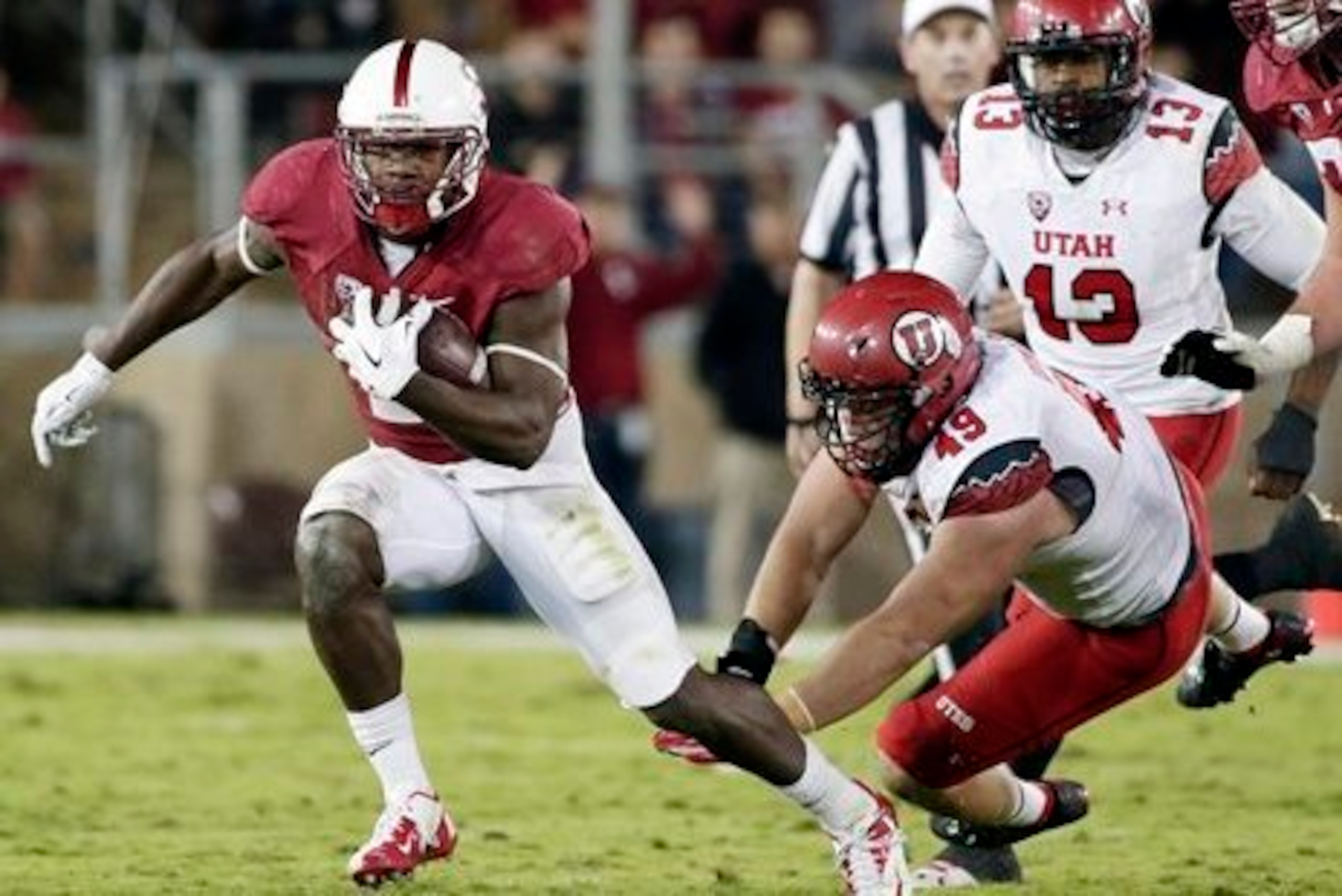
Ty Montgomery, WR Stanford
Going into the 2014 season, hopes were high for Stanford wide receiver Ty Montgomery. Unfortunately, inconsistent play and a struggling Stanford passing offense pushed him way down in the draft. Add in some less-than-spectacular triangle numbers, and Montgomery’s future is questionable.
But do not fret. He is the type of player who just needs the boost of being an NFL player to showcase his skills. Montgomery is going to be a big-time player in the NFL but perhaps not in a traditional wide receiver role.
Look for him to be an elite kick returner from Day 1. His ability to see the field and find creases makes him devastating in the open field. In addition, don’t be shocked if he takes snaps out of the backfield on jet sweeps and end-arounds. All he needs is the football in the open field, and he can break off big runs.
He plays like a running back, so why not treat him like one? Montgomery even has experience as a Wildcat quarterback, so on the right team he could see snaps in this role as well.
All player and combine data courtesy of NFL.com.
.jpg?w=2560 "Titans Colts Football")
.jpg?w=2560 "Eagles Jaguars Football")
.jpg?w=2560 "🚨 Week 8 AP Top 25 Poll")

.jpg?w=2560 "Updates from EVERY Game")