

Fantasy Baseball Sleepers 2015: Breakout Candidates at Every Position
Sleeper remains a confounding term to define for fantasy baseball preparation.
Sleepers come in all different shapes and sizes. Former top prospects often deliver a year or two later than expected. Past stars rebound, ignored players emerge from nowhere and popular selections take the next step from good to great.
Is Nolan Arenado a sleeper? Depends on whom you ask. The Colorado Rockies third baseman falls under the breakout category, but he will also cost a fifth- or sixth-round pick in most mixed leagues.
If he hits .300 with 25 homers with Coors Field's help, he'll outperform his draft position's expected value. Yet if he was included here, several drafters clamoring for hidden gems would justifiably yell, "He's not a sleeper!"
Maybe that introduction was just a sneaky way of discussing Arenado without stamping him as an official sleeper at third base. It's also a warning that these picks are not for intense gamers searching for a late-round steal or $1 buy in auction formats.
These guys will be highly desired, but they still look poised to derive great value from reasonable asking prices. Treat these breakout sleepers as swing-for-the-fence upside picks.
C: Travis d'Arnaud, New York Mets
1 of 10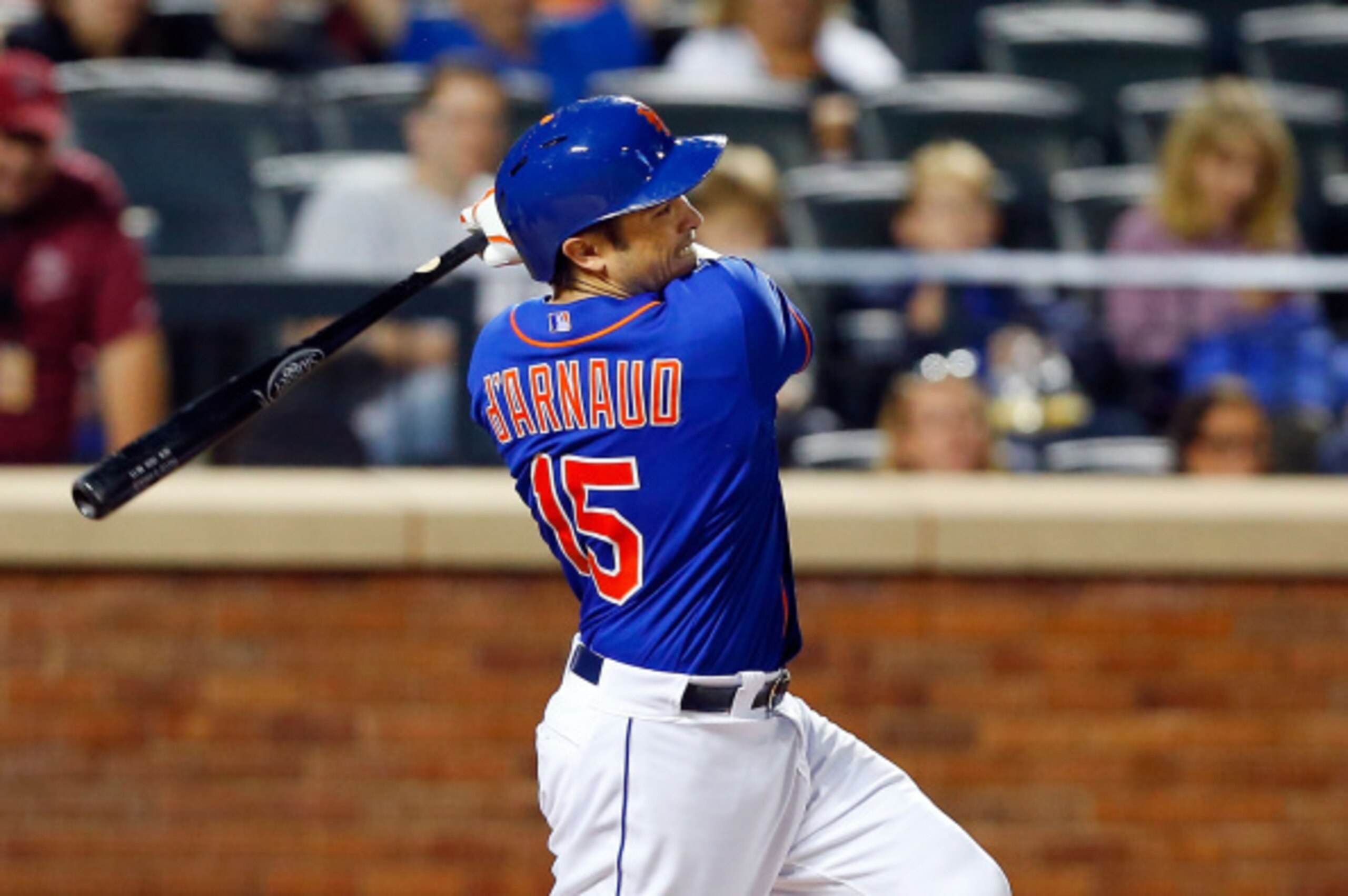
It's surprising that Travis d'Arnaud hasn't received more love this spring. The former top prospect turned the corner after a midseason demotion, and he's one of few high-upside catchers worth chasing after the established names get taken much earlier.
Answering the New york Mets' wake-up call, the 26-year-old hit .265/.313/.474 with seven home runs after the All-Star break. A more aggressive batter emerged, slashing his strikeout percentage to 12.3 percent while upping his line-drive rate to 21.1 percent.
Dissecting half splits is dangerous, but in this case, it proves useful for someone who logged just 112 plate appearances before the 2014 campaign. It's reasonable to credit d'Arnaud with making tangible improvements rather than enjoying luck-fueled success in a small sample size.
OK, so he's not hitting .300, and 20 home runs is an optimistic projection. But if the alternatives are Russell Martin or Wilson Ramos, drafters punting at catcher might as well roll the dice on d'Arnaud.
1B: Chris Davis, Baltimore Orioles
2 of 10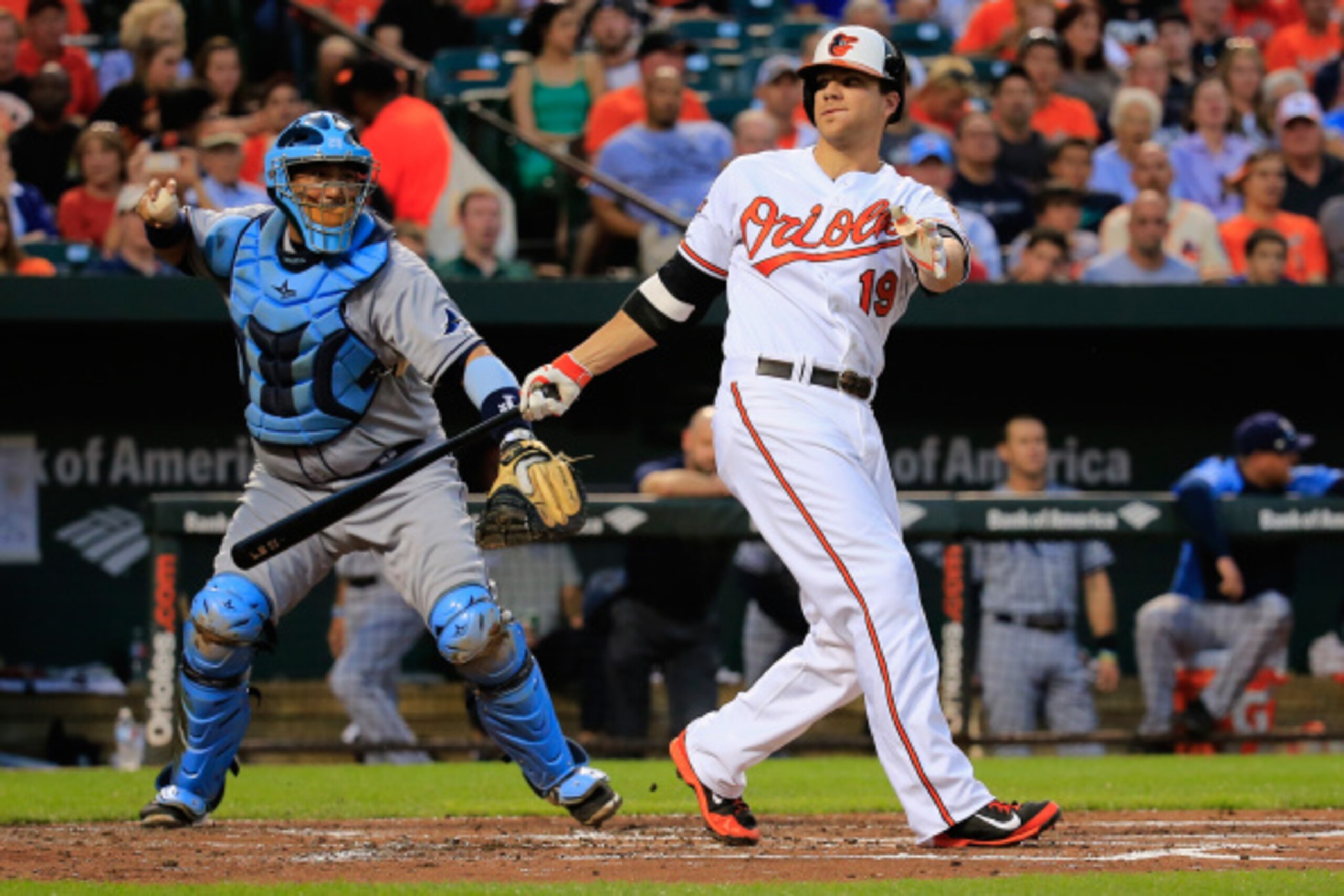
That's right, the guy who hit 53 home runs in 2013 is ready to break out.
This may seem obvious, and no other sleeper listed carries a top-100 average draft position (ADP). But it was either Chris Davis or tout Eric Hosmer or Brandon Belt for the third straight year.
File Davis under the bounce-back section, as hitting .196 doesn't do wonders for a batter's draft stock. An easy first-rounder last spring, his ADP is now 82.3, falling as low as 97 in Yahoo leagues.
And yes, that's pretty darn high for someone who careened below the Mendoza Line with a 33.0 strikeout percentage last year. Along with his wide-ranging swing, extreme defensive shifts caused severe regression for the lefty pull hitter.
According to Fangraphs' Mike Podhorzer, opponents employed shifts on 83 percent of Davis' plate appearances last year:
"Perhaps with two years of data in their back pockets, teams learned precisely where to station their fielders, as Davis’ BABIP into the shift plunged to just .230. His BABIP without the shift remained well above average, but it didn’t matter since he rarely faced a straight up defense. Since his overall batted ball distribution remained excellent, as he continued to hit lots of line drives and avoid the pop-up, the shift was his worst enemy.
"
Remember that before expecting Davis to repeat 2013's .286 average. Podhorzer, however, also showed Davis netted a .302 batting average on balls in play (BABIP) while getting shifted over half the time (51.7 percent) during his breakout year. Expecting a rise closer to his career .253 norm is feasible.
In a full season, Davis will likely hit between .240-.250 with 35 homers and a hefty chunk of RBI. Only 11 sluggers crushed 30 or more long balls last year, so a poor average is worth the sacrifice.
2B: Marcus Semien, Oakland Athletics
3 of 10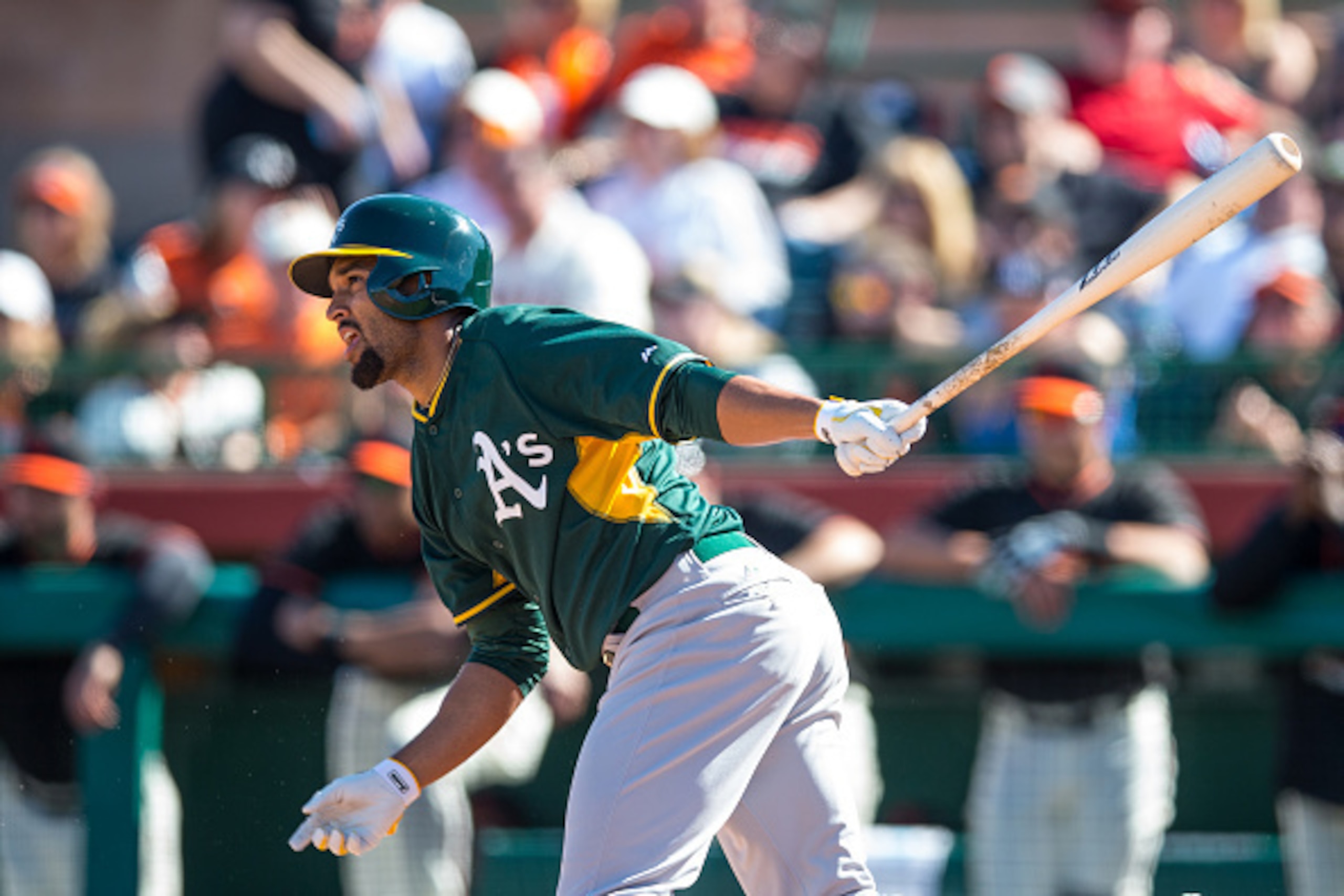
Before starting, let's answer the inevitable question that will flood the comments section. Yes, Marcus Semien is slated to start at shortstop for the Oakland Athletics. He must, however, compile a certain amount of games—depending on the league's rules—first before earning eligibility there.
For now, Semien can be inserted at second base and third base. Keep this in mind, as he'll be available to use at three infield slots in May, making him a tremendous assets for deep-league owners.
Like Davis, Semien's high strikeout rate (27.5 percent) makes him a potential average liability. That's a common trend, as drafters are advised to target power and speed over the more fungible batting average. In this case, he can offer double-digit homers and steals for Oakland.
In 2013, he procured 21 home runs and 26 steals through the farm. Last year, the middle infielder registered 15 homers and seven steals before adding six blasts and three bases through 64 games with the Chicago White Sox.
He has also brandished excellent plate discipline, sporting a 14.5 walk percentage during 2014's Triple-A stint. ZiPS projects Semien to tally 16 homers, 12 steals, 71 RBI and 80 runs. He's also forecast to hit .237, but nobody should care if they land those numbers to close a draft.


3B: Manny Machado, Baltimore Orioles
4 of 10
Another post-hype pick, Manny Machado transferred doubles into home runs during an injury-shortened season.
During a strong 2013 that did more for Baltimore than rotisserie managers, Machado offered 51 doubles but just 14 homers. Last year, he delivered a dozen dingers in half a season. Remember, he's still 22 years old.
The main concern is health, as Machado underwent his second knee surgery last season. The early signs are positive, with him declaring his knee is "brand new" to The Baltimore Sun's Peter Schmuck.
"I've been ready since August, since I had surgery,'" Machado said. "I'm not wasting no time. I'm here to work and I've been doing what I need to do to get ready for the season and come out strong. I missed a lot of time and I feel healthy and I'm out there doing what I can."
This is not the type of player typically endorsed. He doesn't walk, improving his percentage to a still mediocre 5.6. A 20-homer season is in play, but he won't provide elite power.
While Machado feels boring, he's a projected superstar who is still younger than Kris Bryant. His composite ADP of 123, below Josh Harrison and Matt Carpenter, is tame given the upside.
SS: Xander Bogaerts, Boston Red Sox
5 of 10
Another high-profile prospect who has yet to honor extraordinary expectations, Xander Bogaerts can press the reset button during his second full season.
For a youngster who typically possesses a keen batting eye, it was unnerving to witness his walk rate wither away to 6.6 percent. Yet he made more contact and swung at fewer pitches than during 2013's miniature MLB debut, and like Machado, he's also a 22-year-old learning the ropes.
Despite his underwhelming .240/.297/.362 slash line, there's hope for a post-hype rebound. Along with his sterling minor league track record, Bogaerts hit .266/.333/.391 with seven homers and an 8.0 walk percentage when he started at shortstop.
The Boston Red Sox tested the natural shortstop at third base, where he hit .182 with a 3.3 walk percentage. Perhaps the change forced the rookie to focus added attention to defense, making him uneasy inside the batter's box.
His No. 177 ADP is currently below Javier Baez, who would whiff at a giant pinata without wearing a blindfold. Even if he doesn't leap to stardom, Bogaerts should meet owners halfway by hitting between .260-.270 with 15-20 homers inside a potent Red Sox lineup.
OF: Leonys Martin, Texas Rangers
6 of 10
Texas Rangers manager Jeff Bannister made music to fantasy gamers' ears when he declared his intention to insert Leonys Martin into a leadoff role.
“There is a consistency to having Leonys at the top of the lineup on a daily basis,” Banister told The Dallas Morning News' Gerry Fraley. “My mindset, the coaching staff’s mindset, is let’s give this kid every opportunity to have all those at-bats.”
While Martin won't unlock magical abilities higher in the batting order, he will unearth several more plate appearances, which will provide him more running and scoring opportunities.
In 79 games slotted seventh or eighth in Texas' lineup last season, Martin amassed 293 plate appearances, 15 steals and 35 runs. Through 40 games and 164 plate appearances setting the table, he swiped a dozen bags and accumulated 22 runs.
Despite a poor .314 on-base percentage, Elvis Andrus scored 72 runs atop a decrepit Rangers offense last year. In 2013, he totaled 91 runs with a .328 on-base percentage. If Martin reaches base at a .325 clip again, he will score 80-90 runs with roughly 35 steals and some scattered power.
OF: Adam Eaton, Chicago White Sox
7 of 10
Is this the third straight year Adam Eaton enters a season with sleeper eligibility? Yes. Will this time be different? I don't know. Maybe.
As he proved last year, the skills are there. Through 123 games, the outfielder hit .300/.362/.401 with 76 runs and 15 stolen bases. After praying for better production last spring, his owners now simply need him to play 150 games.
Even if the average falls along with his .359 BABIP, his plate discipline will keep him on base more than the typical bargain-bin speedster. Now that the Chicago White Sox bolstered their offense with Melky Cabrera and Adam LaRoche, Eaton could cross home plate 100 times as the leadoff man.
Although 20 steals is a safe projection over a full year, he swiped 46 bags in 2012. If given the green light, he's capable of taking 25-30 bags. He also hit five homers during 380 MLB plate appearances over 2012 and 2013, so don't assume the 5'8" hustler is a lost cause in the power department.
OF: Steven Souza, Tampa Bay Rays
8 of 10
If there's one significant theme to take home, early-career shortcomings aren't the end of the world for highly regarded position players. Mike Trout hit .220/.281/.390 during his first 40 games.
OK, pulling out the Trout card before discussing Steven Souza was ill-conceived. Souza's .131/.231/.391 line during 26 MLB plate appearances last season is far worse, and the 25-year-old is not a future MVP.
The new Tampa Bays Rays acquisition is, however, a 20/20 candidate based on his minor league results.
Last year, Souza scorched Triple-A pitching, hitting .350/.432/.590 with 18 homers and 26 steals during 96 games. The year before, he feasted for 15 long balls and 20 steals in 77 games.
Don't read much into 2014's brief MLB audition. The sample is way too small, and his .071 BAIP reflects the wild variance of such a short stint. He won't help in terms of batting average, but he'll hold his own as an everyday player.
SP: Drew Hutchison, Toronto Blue Jays
9 of 10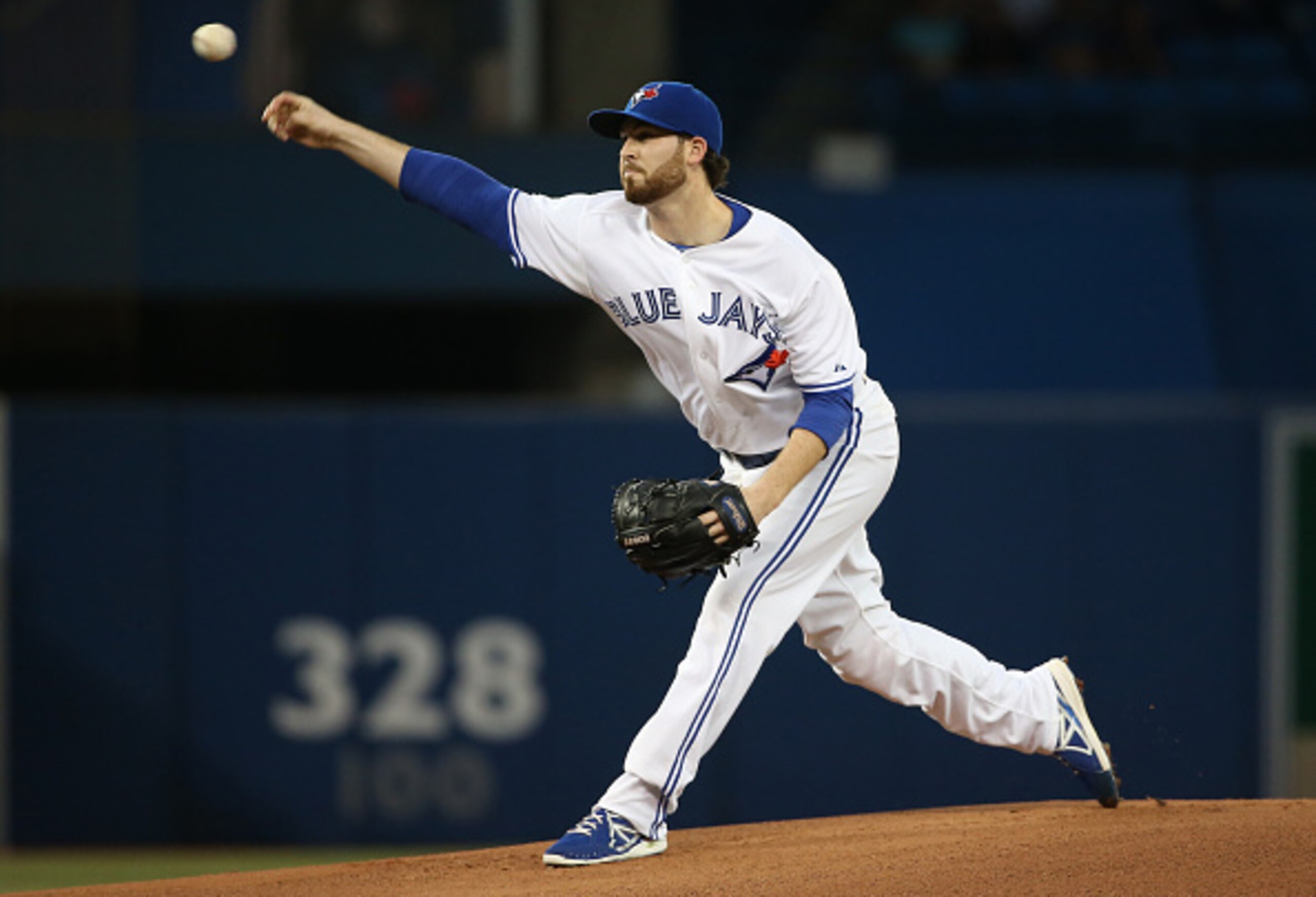
Marcus Stroman would have made a terrific breakout candidate before tearing his ACL. With him out for the season, let's slide over to Toronto Blue Jays teammate Drew Hutchison.
During his first full season as a starter, the righty posted a 4.48 ERA and 1.26 WHIP, relegating him to late-round fodder in standard mixed leagues. Rather than writing the 24-year-old off, take a flier on a big strikeout arm.
Hutchison fell a hair shy of generating a punchout per inning, tallying 184 through 184.2 frames. His talent is backed by a 10.8 swinging-strike percentage, the 14th-best mark among qualified starters. Opponents also chased pitches outside the strike zone on 34.5 percent of his offerings.
No skill correlates to pitching success more than strikeouts. As long as he's not Ubaldo Jimenez- or Tim Lincecum-level wild—which Hutchison isn't with a solid 2.92 walks per nine innings—anyone capable of collecting 200 strikeouts deserves a speculative selection.
If his ERA matches last year's 3.59 skill interactive ERA (SIERA), he'll have no problem finishing as a top-50 fantasy starter.
RP: Ken Giles, Philadelphia Phillies
10 of 10
Let's be clear: Ken Giles broke out last year. It won't be easy topping last year's 1.18 ERA, 0.79 WHIP and 31.9 strikeout-minus-walks (K-BB) percentage. Those are Craig Kimbrel numbers, but Giles didn't accomplish them with saves attached.
As of now, that won't change. Jonathan Papelbon remains the Philadelphia Phillies closer, and that won't change as long as he's around. Yet with trade rumors spiraling all winter, it makes all the sense in the world for the bottom-feeders to deal an expensive relief pitcher, even if it's proved to be difficult, as Fox Sports' Ken Rosenthal illustrates.
If Papelbon goes, Giles immediately becomes an elite fantasy weapon. The earlier Kimbrel comparison was not hyperbole. Actually, the top-tier closer wasn't as good, posting a lower K-BB percentage (28.3). Only Aroldis Chapman and Wade Davis generated better fielding-independent-pitching (FIP) numbers than Giles.
Rather than taking a low-end closer in a volatile situation (i.e., Joe Nathan, Neftali Feliz, Santiago Casilla, LaTroy Hawkins), gamble on Giles late in your draft. If Papelbon stays put, his understudy remains a magnificent source of strikeouts and ratios.
If the Phillies clear the way for Giles, congratulations on stealing a top-10 closer.
Notes: All advanced statistics are courtesy of FanGraphs. ADP info obtained from FantasyPros.
Need any fantasy baseball advice before draft day? Send questions my way on Twitter.

.jpg?w=2560 "Mahomes Told Teammate to Leave Meeting")


.jpg?w=2560 "🚨 Week 8 AP Top 25 Poll")

.jpg?w=2560 "Updates from EVERY NFL Game 🏈")
.jpg?w=2560 "Baker Gets Glove From Rays 🧤")