
Manchester United vs. Tottenham: Winners and Losers from Premier League
Tottenham Hotspur's worst performance in months coincided with Manchester United's best on Sunday.
Goals from Marouane Fellaini, Michael Carrick and Wayne Rooney duly followed in a comfortable 3-0 win for Louis van Gaal's side—a result which has strengthened the latter's hopes of a Premier League top-four finish and has severely hurt those of the north London club.
Read on for the winners and losers from this one-sided affair.
Winner: David de Gea
1 of 5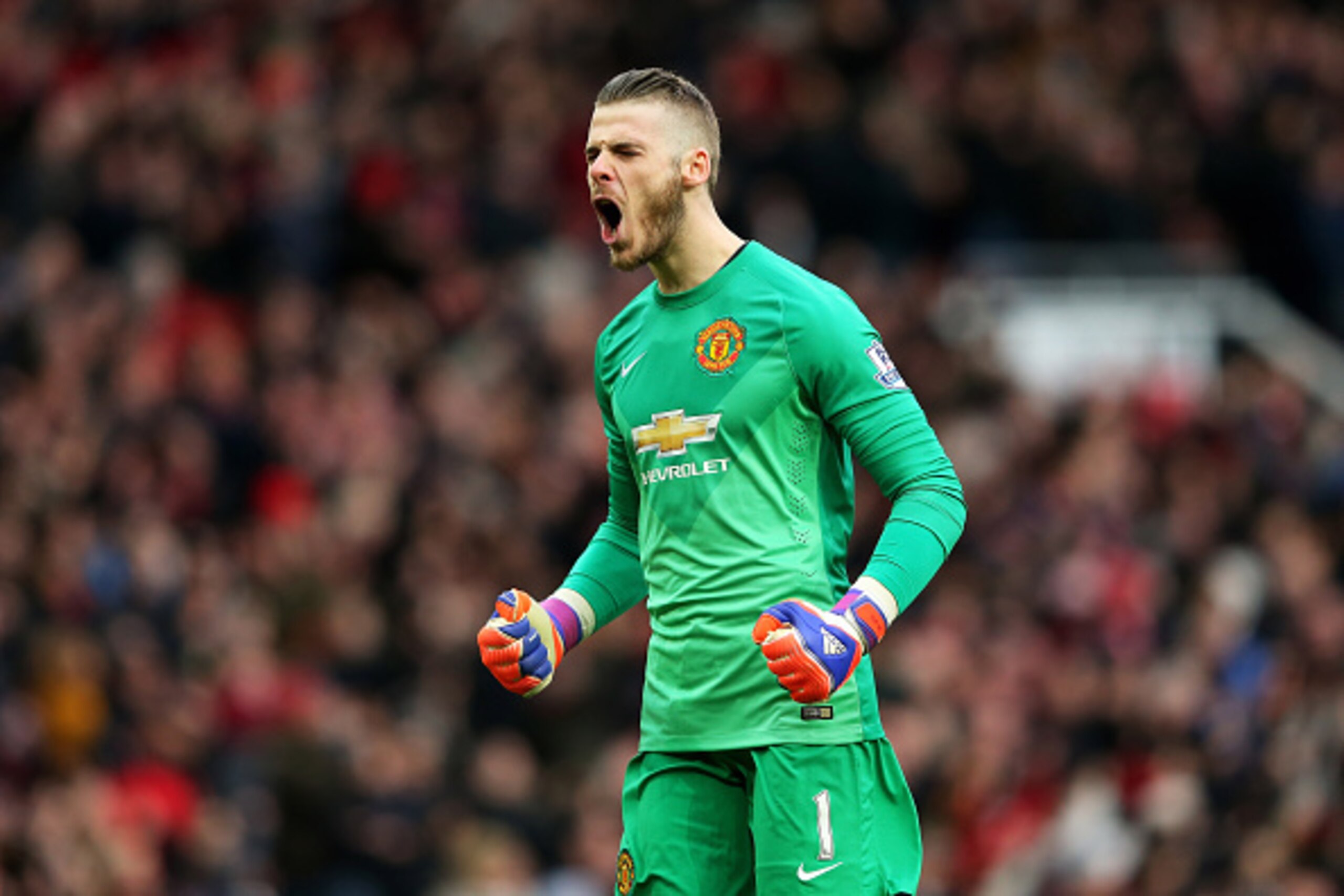
David de Gea has not had many days as quiet as this in 2014-15. Manchester United's dominance and Tottenham's ineptitude meant the goalkeeper was allowed to watch on untroubled for large periods.
Of the two saves De Gea did make, one of them ensured United did not suffer a potentially costly early blow.
Chased down by Harry Kane, Phil Jones sent a heavy back pass to his goalkeeper from around 30 yards out. Played dangerously to the left of the centrally positioned Spaniard, De Gea reacted well to keep it out.
After Monday's FA Cup exit to Arsenal, conceding an early goal as needlessly as that might have set both the Champions League-chasing team and the Old Trafford faithful on edge.
Instead, they remained level and soon took hold of the game. The majority of headlines will go elsewhere, but the reliable presence of De Gea was once again crucial for Manchester United.
Loser: Pochettino's Away-Day Plan Against the Premier League's Best
2 of 5
In his examination of Tottenham's poor performance at Manchester United, manager Mauricio Pochettino might draw a correlation with Spurs' loss to Liverpool last month.
On both occasions, the Argentine fielded his team in his predominant 4-2-3-1 formation. Ryan Mason and Nabil Bentaleb were in central midfield proper. Further forward there were variations, but the attack at Old Trafford again essentially hinged on Christian Eriksen and Harry Kane.
Spurs' attack played vigorously and confidently at Anfield. Though not flawless, they fought back to level twice after the home side scored.
That element was absent in Manchester. Subsequently, even more so than against Liverpool, their naivety and over-adventurousness became exposed.
Pochettino cannot account for his midfielders again passing so poorly or the whole team ball-watching with little regard for nearby opponents. Nor would he have expected his team to be so overwhelmed by United's left-sided players or the individual quality of Fellaini and Rooney.
However, after away losses to Manchester City, Chelsea, Liverpool and Man United, the Spurs boss must now realise the relentless, aggressive style which has worked so well at home and against weaker opposition is not always suitable.
Sometimes replacing one of his more attacking players with a defensive midfielder like Benjamin Stambouli (or even the recently absent Etienne Capoue)—perhaps as part of a three-man midfield—is not being negative; it is just sensible.
The one time Spurs played in a more measured fashion against a top-four rival away, September's north London derby, they almost won and earned a solid point.
Pochettino's side have moved on, since their adoption of those protective measures made sense for a side struggling at that point. But a little more rigidity in their game plan when invading the territory of their toughest opponents would not go amiss.
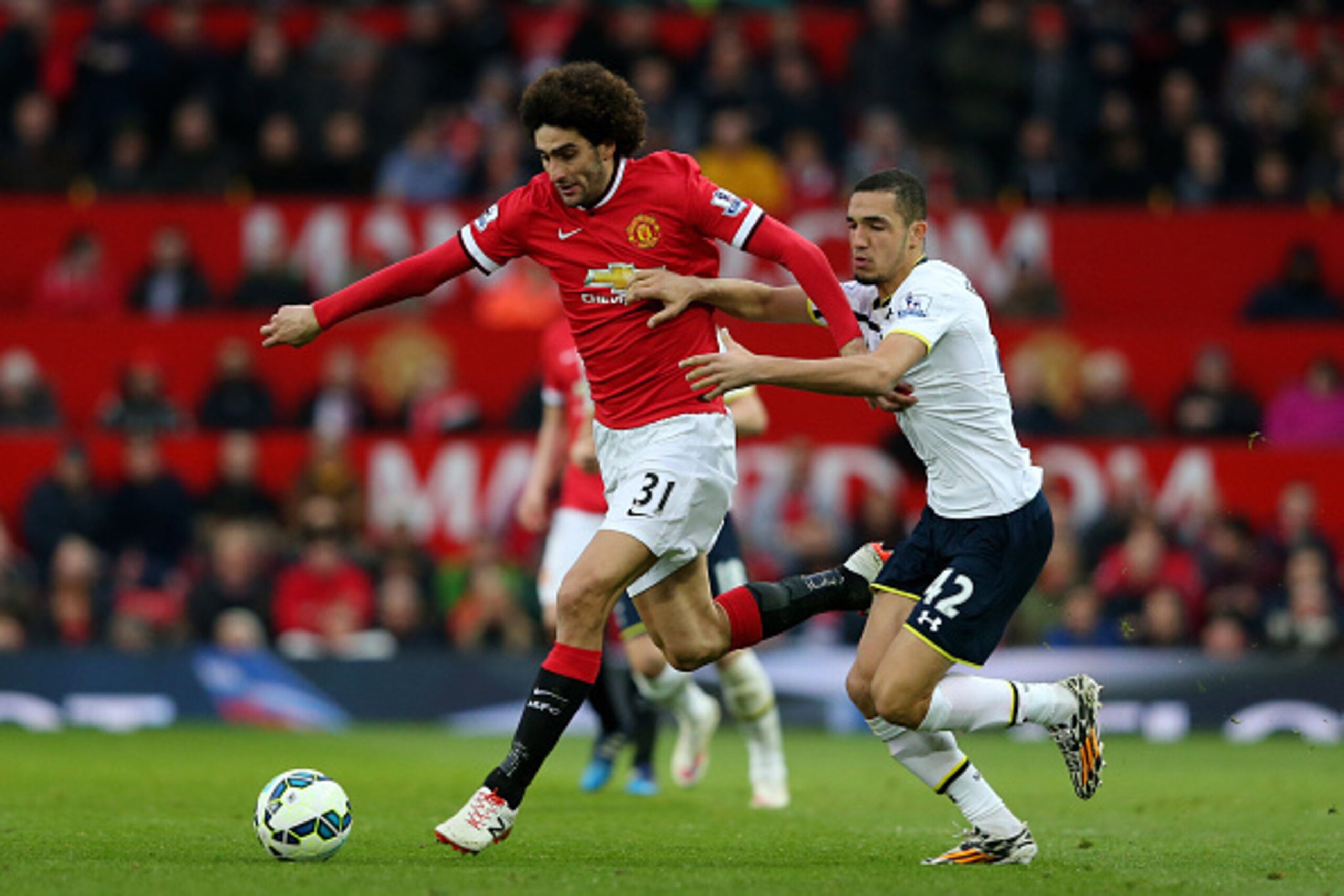
Winner: Marouane Fellaini
3 of 5
Fellaini has been used as Van Gaal's go-to battering ram on days when his team have not been able to get through to goal with more subtle, eye-pleasing methods. (Take last month's 1-1 draw with West Ham United, for instance.)
Against Tottenham, Fellaini served a reminder that his physical, aggressive style needs not only be used in direct-to-penalty-box attacks.
Floating in the space between Spurs' right-sided defensive pair, Kyle Walker and Eric Dier, and off of the nearest central midfielder (often Mason early on), the Belgian was the conduit through which Man United's excellent work down the left pivoted.
The most notable example came when, as Mason went to close down Carrick, Fellaini ran behind into the vacated space. Slotted through by his midfield team-mate, he proceeded to fire smartly past Hugo Lloris into the bottom corner and put his side one-nil up.
Fellaini won 58 percent of his aerial duels, per Squawka, but his most telling statistic was his 79 percent completed passes. Both left-back Daley Blind and winger Ashley Young frequently benefited from his precise, often quick linkup play which helped them pull Spurs apart so mercilessly.
For good measure, the 6'4" attacking midfielder did also make the initial header which led to Carrick doubling United's lead.
Nice as it was to make use of his floor work, it would be a waste not to make at least some use of the Belgium international's height at set plays.


Loser: Tottenham's Young Talent
4 of 5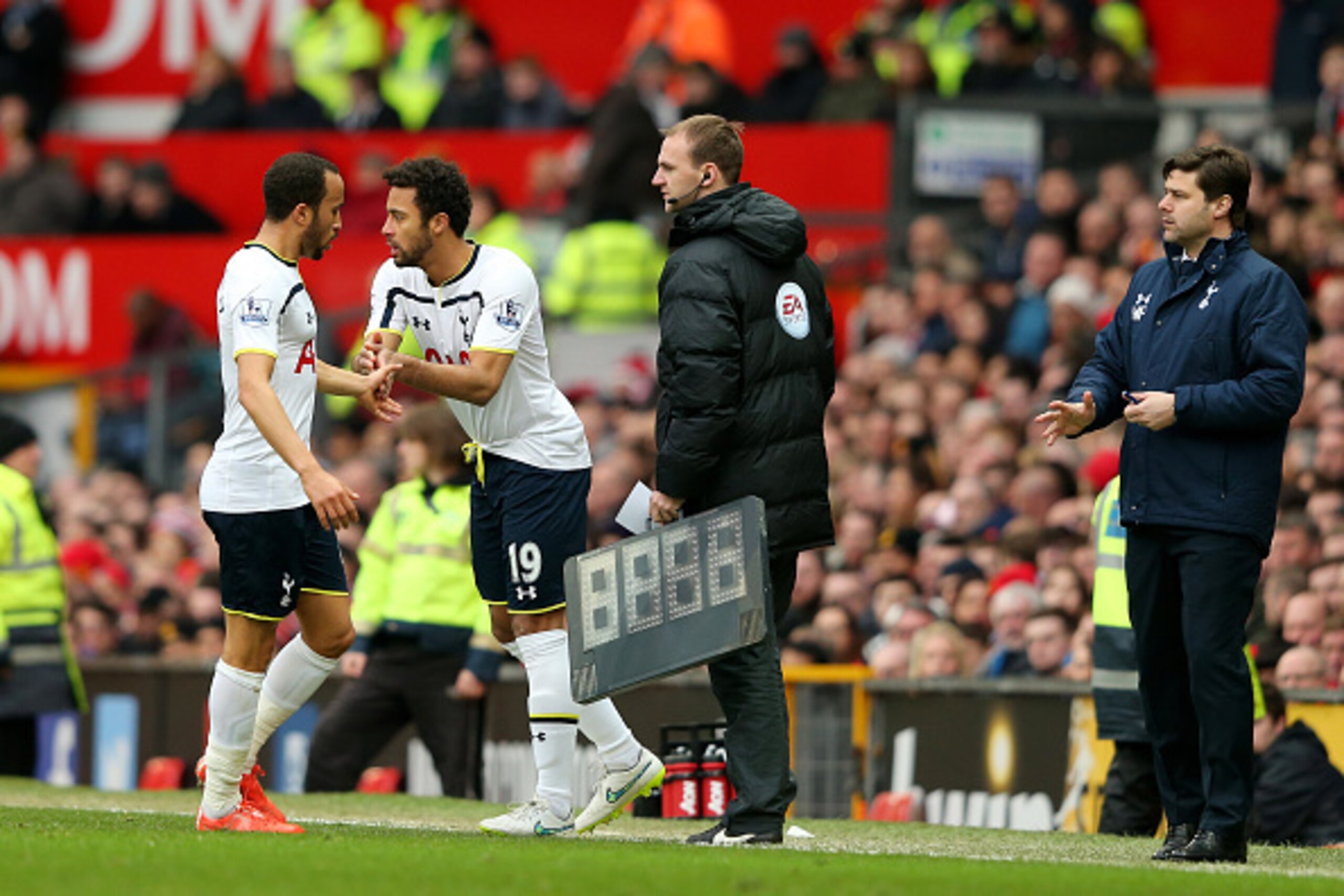
Andros Townsend suffered the ignominy of being substituted in the first half after Tottenham went two goals down. He had been unable to check the forward runs of Blind or offer anything in response going forward.
The England winger was far from the only one culpable in the north Londoners' dreadful first half and altogether insipid performance. Indeed, in the face of the Red Devils' finding their, well, inner devil, none of Tottenham's youthful side were able to resist their methods of persuasion.
Mason and Bentaleb were overwhelmed by Man United's aggressive tactics. The latter was so shook by their approach that he made the unforced, blind pass which allowed Rooney to charge through and net the afternoon's third goal.
Centre-back Eric Dier was on the receiving end of that runaway train. He feebly attempted to get in Rooney's way before thinking better of it. Attacked regularly from United's left, too, he should be grateful it did not get worse for him.
Further forward, neither Eriksen nor Kane was able to create anything of note in the first half. The latter has arguably not been defended so closely and vigorously all season.
These young players have enjoyed fine campaigns overall. But on this occasion, they were made to look like boys compared to the men of Manchester United.
Winner: Van Gaal's Patience Game
5 of 5
"It was a very enjoyable game to play in," Blind said after the match. "We were really aggressive for the full 90 minutes."
Blind is right to label Manchester United's performance as aggressive. They hounded Tottenham relentlessly when Spurs dared to cross into their half. Just about each time United won the ball in the opening 45 minutes, they turned it into an attack which threatened to cause their visitors harm.
Yet while Man United took the game to Spurs, their combativeness was founded on a virtue which has not proved so palatable for Old Trafford's paying masses recently.
Patience.
Earlier this month, Van Gaal pleaded for the fans to understand why he wanted his team to bide their time during matches—even when it has not resulted in particularly entertaining football.
"Sometimes the solution is to play back and sometimes there might be another solution the player has not seen," Van Gaal said, via The Telegraph's Chris Bascombe.
"What I think is we can improve our unnecessary ball losses," the Dutchman added. "When we stop losing the ball unnecessarily, then we will make a big step."
Man United's ball retention was far more satisfactory Sunday. While their tempo from there was often high, it was built on their exhibition of patience in the right moments.
Carrick, Jones, Ander Herrera and Chris Smalling did not force the ball forward. They moved it until the runs of Blind, Juan Mata and others allowed them to direct it more positively.
It also helped United's attacking talent were so impressively on song to make the most of it.
.jpg?w=2560 "Chiefs Giants Football")
.jpg?w=2560 "5 Teams Eyeing Jonathan Taylor")

.jpg?w=2560 "Baker Gets Glove From Rays 🧤")
.jpg?w=2560 "NFL investigating Eagles")
.jpg?w=2560 "🚨 Week 8 AP Top 25 Poll")
.jpg?w=2560 "Steelers Roll Saints in Paris")
.jpg?w=2560 "Jonathan Taylor Landing Spots 📍")