

Referees Remain a Controversial Topic, but More Technology Is Not the Answer
The pressure on the man in the middle has never been greater, as players, managers and fans—even some of the referees themselves—call for the introduction of more technology to the game.
Never have the performances of the officials been scrutinised more, with an entire film set of cameras recording every single incident from every conceivable angle before placing it under a microscope for frame-by-frame analysis to either exonerate or lambast a decision that had to be made in the blinking of an eye.
So what about increasing the part technology plays in football when it comes to adjudication? To be, or not to be, that really is the question. Unfortunately, the answer is not simple. I’ve just come back from a discussion forum, "You Are the Ref," with West Ham United manager Sam Allardyce and former top grade refs Keith Hackett and Mark Halsey, where the general consensus of opinion was that it would be a good thing.
TOP NEWS

Final Men's Ballon d'Or Rankings 📊

Highlights and Viral Moments 🍿

J-Dub Suffers Gruesome Injury
But would it, I wonder, give more or less authority to referees? And if you are going to introduce more technology, then you have to ask yourself: how much more?
The problem is, when you decide to opt for a technology escape clause, you’re basically saying that better refs are not the solution simply because their mistakes can be overturned. That effectively would take authority away from the officials.
Also, how far down the road do we go with this? Tennis allows a maximum of three incorrect challenges to line calls per set, but an unlimited amount of challenges if they are always correct. Do we impose a limit on the challenges that can be made? Three challenges, indeed; why not ten?
And for what should technology reviews be introduced? Simulation (diving), offsides, over the top tackles, or do we just stick with goal-line technology?

Technology can be implemented from the moment the referee blows his whistle to start proceedings. Two players go crashing into a tackle, and as the ball flies out of play two separate voices yell out, “My ball.” Let’s not mince our words here; someone’s lying. Should we let technology decide?
What’s also forgotten is decision-making on the football field is very often a matter of interpretation. You can write the rules down in every one of the estimated 5,000 to 7,000 languages of the world, but just how those rules will be applied is another matter altogether. A raised foot in La Liga that would almost certainly result in a free-kick and maybe even a yellow card could well be seen as a fair challenge in the Premier League.
We also need to remember that even with the benefit of technology there is no guarantee that the players, managers and fans will be as one with whatever decision is taken. By now, we must have all seen Ashley Barnes' challenge on Nemanja Matic at least 100 times, and yet we still can't agree as to the intentions behind it. The unfortunate referee Martin Atkinson saw it just the once, in real time and at normal speed.
The truth is, what is really needed is better coaching for officials to keep apace with the modern game, higher levels of fitness and improved recruitment of referees to the top levels.
Retired referee Mark Halsey used to train with Bolton Wanderers and is one of the few former top-flight officials that played football to quite a high non-league standard. If more officials did likewise, it would help them to understand players better and also give them a better grasp of the new trends in football. The governing bodies of our game introduce things like "Respect" campaigns, oblivious to the fact that football is no more or less than a mirror of a society, where respect for authority and a sense of fair play are currencies that are constantly being devalued—not just in football, but in life itself.
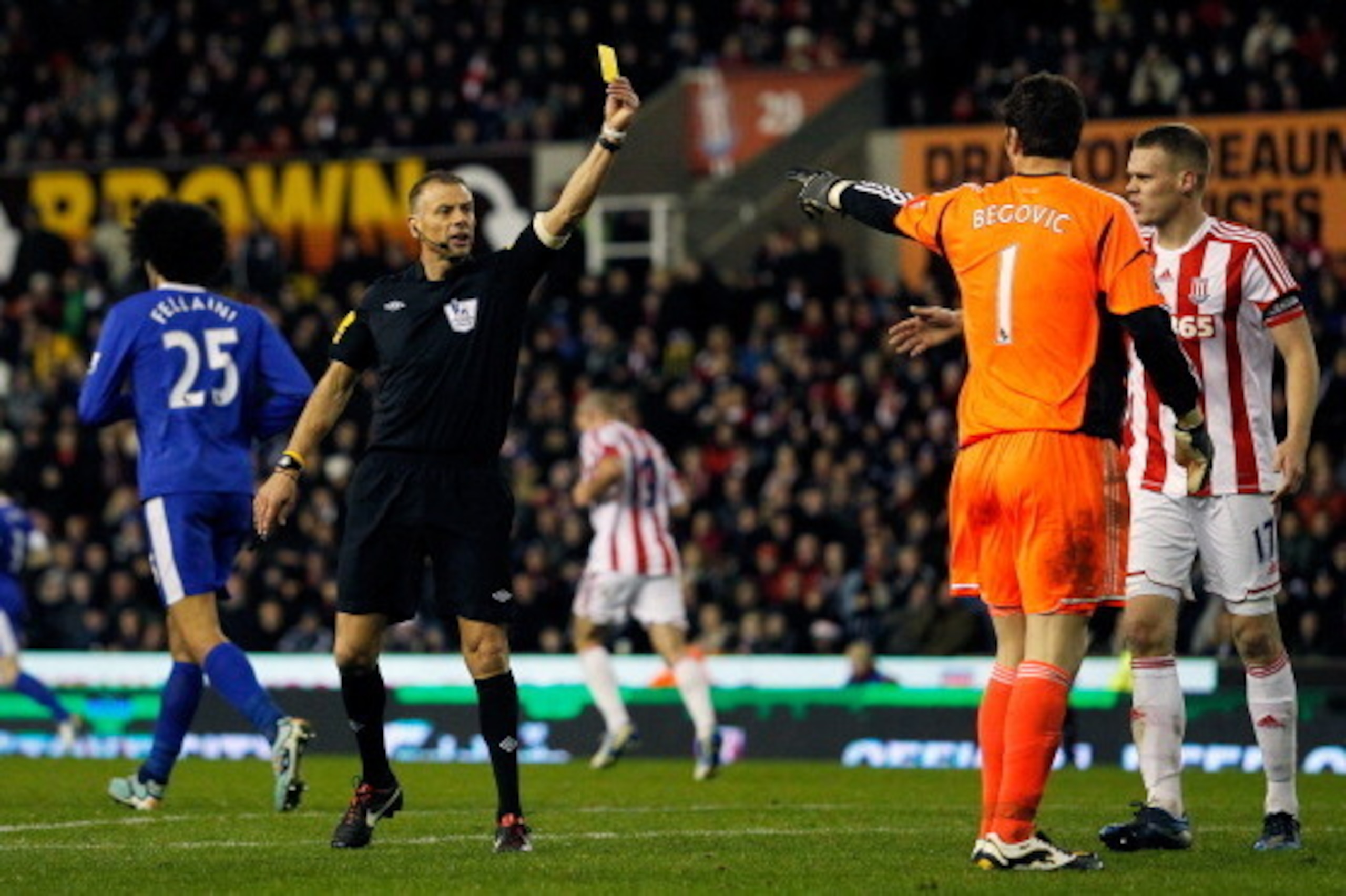
With increased pressure, as the spectre of relegation, hopes of promotion or dreams of European football loom large, these campaigns, projects, anthems, fine words and speeches, these best laid plans of mice and men soon wither on the vine. And technology will do nothing to alter that.
Advocates of technology should always bear one thing in mind. Referees, like players, are human. Are they unduly influenced and biased towards home sides that have a vociferous following? Of course they are, and if they weren’t they wouldn’t be human.
A 2008 report in Germany entitled "The Influence of Social Forces: Evidence from the Behaviour of Football Referees" by Thomas Dohmen, following an analysis of 12 years stats from the Bundesliga between 1992-2004, concluded that while all referees would look to be impartial and are fundamentally decent, they are most certainly influenced by the crowd at a match even as far as the awarding of penalties, length of added on time and crucial decision-making was concerned.
Similarly, in England, a study showed that referees frequently made different decisions when adjudicating with or without crowd noise to a variation of approximately 15 percent. Technology will not stop that, and the reality is, in football, as in most things in life, the devil is always in the detail. The little niggly foul, the contentious yellow card decisions; these sort of things will only be improved by better refereeing, not increased technology.

But that isn’t to say that refereeing in England is bad. Keith Hackett, the former head of referees who was on the panel with me, has gone on record as saying that referee-wise this is “the worst that we have seen” in the Premier League on his blog You Are The Ref. I beg to differ.
How does that get calculated anyway? Across the nations, different cultures make for different refereeing styles. The English will say that there are too many yellow cards in La Liga, while the Spanish might accuse the English referees of allowing to much physicality in the game. What is certain is there is an element of standardisation achieved when top referees ply their trade in European matches.
If I had a concern about Spanish referees, it would be they are sometimes too eager to put themselves in the spotlight rather than concentrate on doing their jobs like their English counterparts. What I can tell you, categorically, is English referees are held in very high esteem in Spain simply on the basis of that old maxim that the best referee is the one you don’t notice.
For me, the standard of refereeing in England is as good as it has ever been, but that’s a long way from saying that it couldn’t be better.
.jpg?w=2560 "Rams Raiders Football")



.jpg?w=2560 "Rodgers Iced Out on Plane 💎")
.jpg?w=2560 "🚨 Week 8 AP Top 25 Poll")
