

Rob Manfred Should Think Radically to Leave His Mark on MLB
Rob Manfred is wielding a wide-open mind, his biggest asset and most important weapon as he slips into the chair once warmed by Bud Selig.
Manfred officially became Major League Baseball’s 10th commissioner on Jan. 25. It is a seat he adopts knowing his tenure could be the most influential ever in growing the sport for the masses and not just for its current aging demographic.
This commissioner so understands the need for change that it seems he is open to just about any suggestion. He proved as much by suggesting to ESPN he could consider a ban on defensive shifts, and while that rule change would be like replacing the faucet handles when the pipes are clogged, it shows Manfred’s willingness to be a radical. Meanwhile, his taste for quickening the pace of play proves his willingness to immediately fix a lingering problem.
TOP NEWS
Brewers Closer Blasts Tropicana Field Roof

Latest MLB Trade Rumors 👂

Best Fits for Cubs' Star FAs 🧩
MLB needs a leader like that, one willing to think the unthinkable to make the game better in the long term and assure he leaves his legacy gleaming.
"Rob is always focused on solutions. Rob is a really solution-oriented guy,” Los Angeles Dodgers President Stan Kasten, who has worked in baseball nearly 30 years, told ESPN,com’s Jayson Stark. “And at the end of the day, his ability to put the game on a path to seek solutions is going to help a lot when the debate gets heated and unhappiness crops up.”
For as much griping as there was about Bud Selig’s reign, and there was plenty that was warranted, the man made the sport’s top league better.
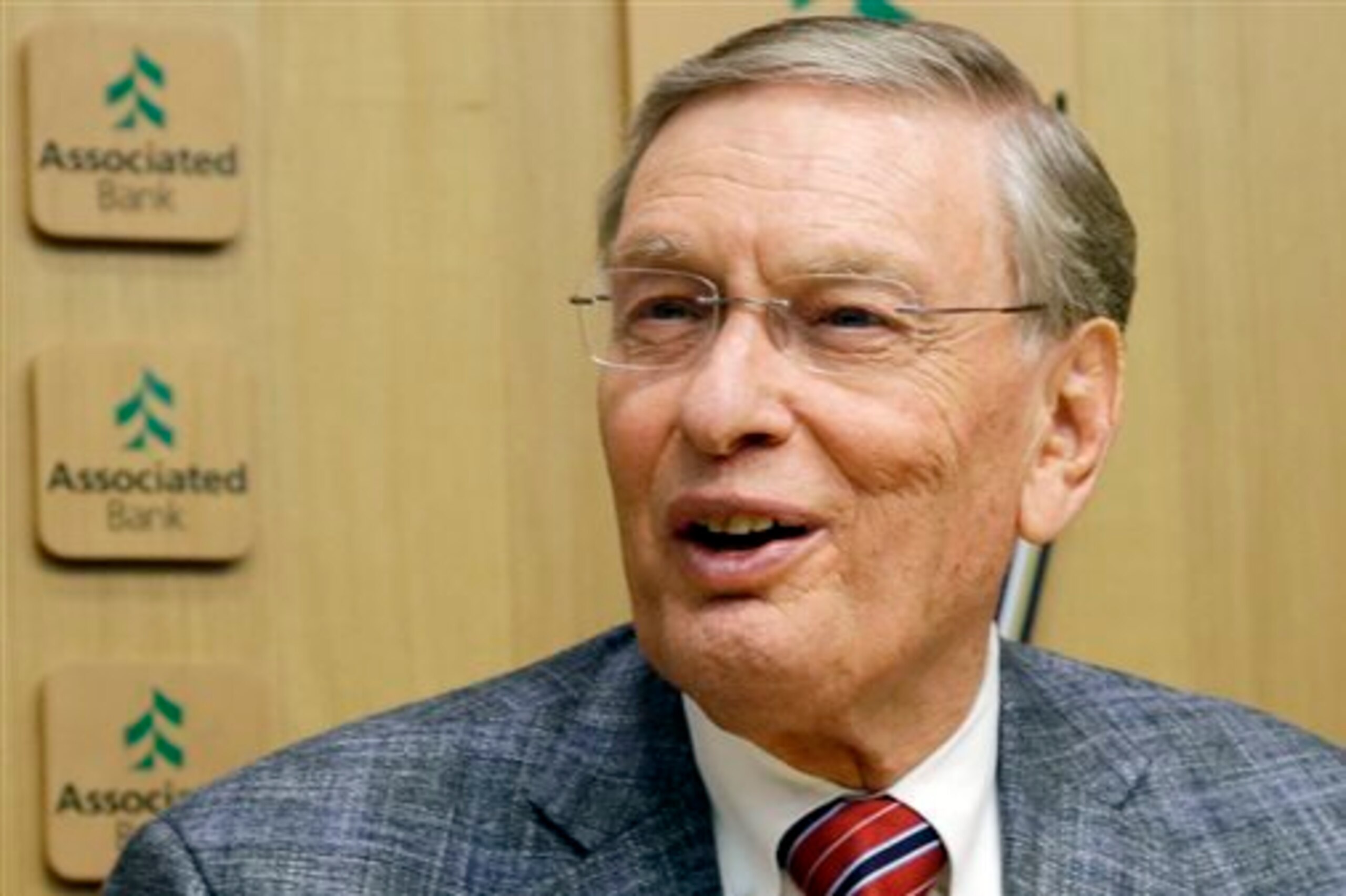
At the front of his train of changes was implanting first one, then a second wild-card team for each league’s playoffs. Under Selig, MLB also adopted the toughest drug-testing procedures in North American sports at the time, albeit a process so slow to be implemented that it hurt the game’s credibility and integrity only about a decade after the league had a damaging labor stoppage.
Instant replay was also introduced under Selig. While this was another slow process—it seems the only thing he managed to do quickly was making the All-Star Game “count,” one of his biggest faux pas—it was for the betterment of the game and signaled a new willingness to adapt the on-field product to available technology.
Now, it is time for Manfred to put his fingerprint on the game, and the start of this could fall in line with his mission to improve the game’s offensive output. Teams averaged 4.07 runs per game in 2014, the lowest mark since 1981. Here are two ways to start down the path to changing this pattern.
Eliminate the sacrifice bunt and intentional walk
Rational people understand there is a time when sac bunts actually are a reasonable strategy, but far more than not, giving up the out rather than letting a hitter swing is detrimental to an offense. Pitchers realize this, and many of them welcome the sacrifice bunt. That should be enough to tell people they do not help offense.
Unlike the sacrifice bunts, intentional walks usually seem to serve their purpose. Why is that bad? Because like sac bunts, intentional walks usually stifle offense, as proven through a study of nearly 3,000 plate appearances after intentional walks conducted by Fangraphs.

There could be fine subjective lines here. A player can argue he bunted for a hit, or a pitcher can argue he was not trying to walk a hitter. But the solution is simple: Give umpires the same kind of discretion they have when determining if a pitcher threw at a hitter intentionally. An umpire can issue a warning or penalize the offending team if he deems the violation egregious enough or if it is repeated.
Being that many fans already despise sacrifice bunts and intentional walks, and that they don’t help offense, a road Manfred clearly wants to go down, he ought to make the drastic change here. Outlaw both strategies and never look back.
Next, shorten spring training
This part of the baseball year is pretty much for pitchers to get their arms in shape for the grind of a season. For hitters, it is about tracking pitches, finding their timing and finding ways to pass the rest of it.
Spring training typically starts around Valentine’s Day and ends at the end of March or in early April. At a time when fitness and preparation were secondary to rest and recuperation for an entire winter, the length of spring training was understandable and necessary.
This is a different era. Players typically stay in shape the entire year and are ready for the regular season well before spring training ends.
"Everything about MLB is too long right now. Do we really need a month of spring-training games just to get ready for 6 more months of games?
— Eric SanInocencio (@EricSan) March 25, 2014"
Once this happens, Manfred can go about tackling the virtually impossible task of shortening the regular season, even if only by a week. While Selig consistently reminded us just how much he is an employee of ownership, Manfred will face significant challenges in even getting this kind of idea out of the basement.
But if the game wants its audience to skew younger, this will eventually become an inevitable innovation. Cutting down spring training would be a good precursor.
As for remedying a long-standing problem, force a 25-man September roster on every team.
Once rosters expand at the end of the minor league season, teams are allowed to carry as many as 40 players, and use them all. This seems ridiculous in baseball’s most important regular-season month. It creates competitive imbalance and lengthens games.
It is also an incredibly easy fix that already has support on the field and in the front offices. Allow teams to call up as many as 15 players, as is the current limit, but force them to declare 25 eligible players before each game.
“You play 80 percent of your season with even rosters,” Milwaukee Brewers GM Doug Melvin rightfully griped to MLB.com’s Mark Bowman in 2009, “and then all of a sudden, you throw that out. It's like playing three-on-six in basketball or 11-on-18 in football. I don't know of any sport in the world that does it like ours, with this kind of imbalance of rosters. I'd like to find out if there's any other sport that does that at the most important time of the year.”
Finally, Manfred must remedy the ugly situations in Oakland and Tampa Bay.
Manfred said last month he is hopeful the A’s can get a new ballpark deal done in Oakland “in the relatively short-term.” For Manfred’s sake, it has to be done quickly, or he risks being seen as little more than a dancing politician on this subject, as Selig was even after he put together his joke of a panel known as the “Blue Ribbon Committee,” which accomplished nothing in more than five years of existence.
If Manfred personally gets involved in the Oakland situation, he will be viewed as proactive in resolving such problems, unlike his predecessor.

Like Selig, though, Manfred acknowledges the need for a new stadium in Tampa Bay and told Mark Tompkin of the Tampa Bay Times that he is willing to travel to Tampa and get involved on the local level if it helps get a stadium deal done. That is progress.
However, Manfred also said there is no timetable for something like this to be completed and that he would like it to happen sooner rather than later, according to Tompkin. That sounds scarily like something Selig would say.
If Manfred publicly stated that it was of his highest priorities to get deals in Oakland and Tampa done, and actually pushed for them to happen in his first five years, it would be a massive bright spot for his legacy. Failure in this area would be crippling to organizations that have built themselves into model franchises but are unable to sustain success because of marketplace and/or the lack of a practical stadium.
If Manfred can’t make progress in California or Florida, there is always Montreal.
Anthony Witrado covers Major League Baseball for Bleacher Report. He spent he previous three seasons as the national baseball columnist at Sporting News and four years before that as the Brewers beat writer for the Milwaukee Journal Sentinel. Follow Anthony on Twitter @awitrado and talk baseball here.


.jpg?w=2560 "Raiders Could Start Mendoza")



.jpg?w=2560 "Rodgers Iced Out on Plane 💎")
.jpg?w=2560 "🚨 Week 8 AP Top 25 Poll")
