

Film Room Takeaways from the 2014-2015 NFL Season
With the New England Patriots’ win over the Seattle Seahawks in Super Bowl XLIX wrapping up the 2014-2015 season, let’s go back inside the film room to break down some of the schemes, trends and players that shaped the year.
After going back through cut-ups from the season, here are 10 things that stood out in my film study.
1. Rob Gronkowski Is the NFL’s Top Matchup Weapon
TOP NEWS

New NFL Power Rankings 📊
The Robinsons POUND the Rock 🪨
Takeaways from Falcons' dominant MNF win
Early in the season, I thought Gronkowski was laboring a bit on tape when studying his movement coming off the knee injury. But after the Patriots’ Week 4 loss to the Kansas City Chiefs on Monday Night Football, Gronkowski began to take over the league once again.
Think middle-of-the-field throws here (dig, seam) and the 7 (corner) route in the red zone with Gronkowski using his size/frame to create leverage to the football. And when the Patriots removed Gronkowski from the formation (backside of a 3x1 alignment; “Dakota”), both safeties and linebackers knew the slant (or fade) was coming—but they still couldn’t stop it.

I always focus on technique from a defensive perspective at the safety position. Play with the proper leverage, use your feet, drive to the upfield shoulder, etc. However, that doesn’t guarantee success versus Gronkowski. He is too strong, too physical at the point of attack versus press-man, and he will initiate contact up the field to generate separation at the break point.
A nightmare matchup for any defensive player (or game plan) in the NFL, Gronkowski set the bar for the tight end position in 2014. This guy is a beast.
2. Zero-Pressure Is on the Rise
I saw more zero-pressure on tape this season than I can remember as defenses sent six- and seven-man blitz schemes at opposing offenses with no help in the middle of the field.
A common blitz scheme out in Arizona under Todd Bowles, the Cardinals would send pressure in any down-and-distance situation with the defensive backs playing blitz-man technique from an off position.
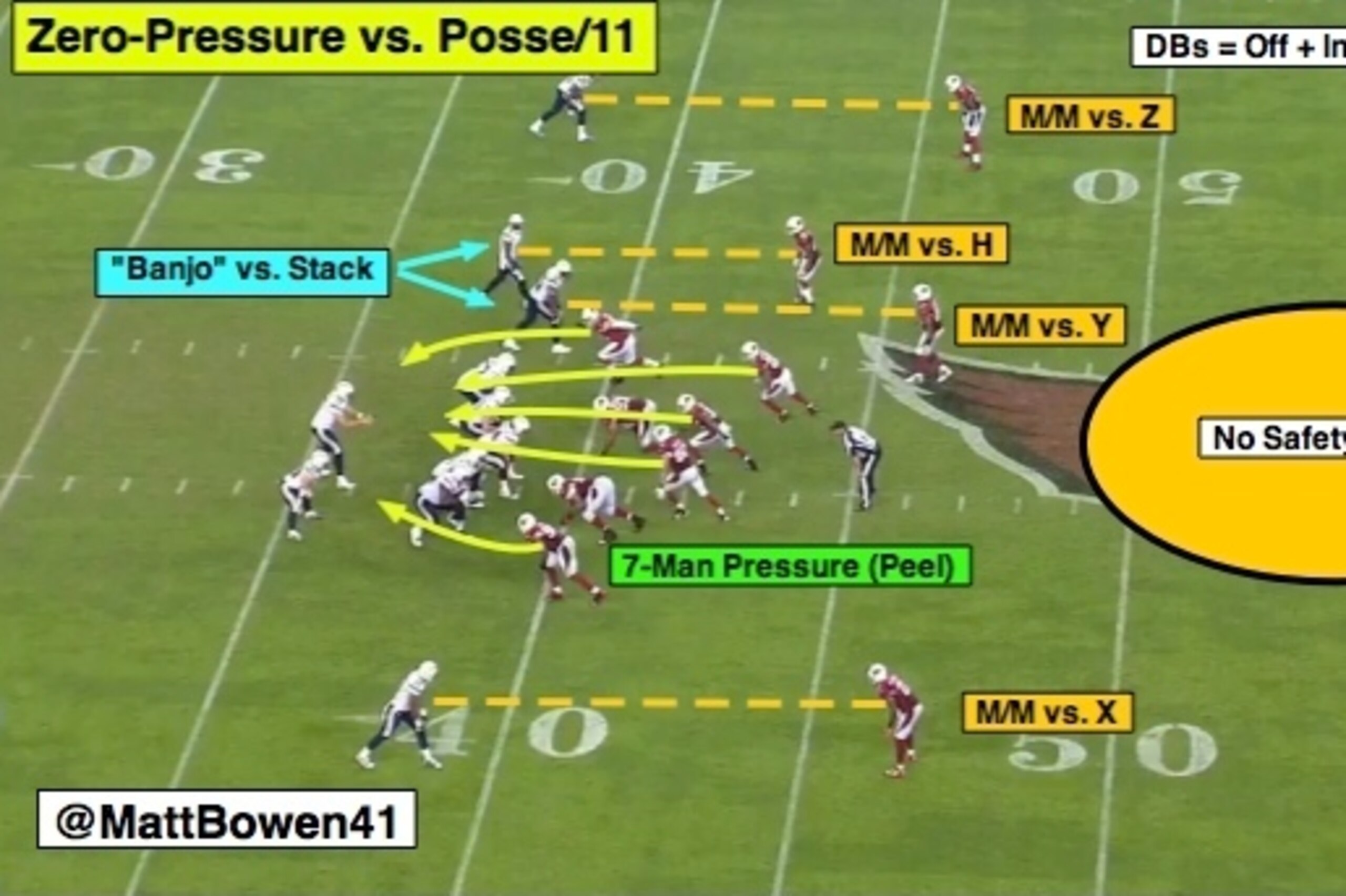
Why play off-man here? Because it allows the defensive backs to align with an inside shade, use the sideline as their help and flat-foot read (no backpedal) versus the release off the wide receiver.
If the offense throws a “hot” read (slant, hitch, smoke, etc.), the defensive backs simply drive downhill and make the tackle as the quarterback is forced to get rid of the ball quickly with pressure in his face.
Can zero-pressure get a defense in trouble? Of course. Think about a slant that beats the secondary (with no inside help) or a missed tackle on a hitch route. That’s six points. However, I love seeing more aggressive blitz schemes from NFL defenses. Go get the quarterback and force him to throw hot. That’s how you dictate the flow of the game.
3. J.J. Watt Puts on a Clinic
Turn on any Houston Texans game from this past season and just let film roll for a couple of series with a focus on Watt. This is clinic stuff. Look at the technique, speed, power and effort that allowed Watt to consistently produce in both base and sub-package fronts.

I really hope young defensive linemen will use the offseason to study Watt, because it’s much more than just talent with the NFL’s Defensive Player of the Year. Watt is a technician, and you can see that with his hands and the countermoves at the point of attack. This is when Watt sets up offensive linemen and converts power into speed to get home to the quarterback.
Given his versatility to bump down inside—plus his rare athleticism—Watt flashes every time I turn on the tape of the Texans defense. A true defensive playmaker who works extremely hard at his craft. I love watching this guy compete.
4. Rookie Wide Receivers Make an Immediate Impact
Rookie wide receivers are supposed to struggle a bit as they make the transition to the pro game. Think about press-man, route running and the ability to separate versus NFL veterans in the secondary. That’s not easy for rooks, and it usually takes a lot of reps before these young receivers truly start to develop.
However, this rookie class was loaded with ridiculous talent.
Odell Beckham, Jr., Mike Evans, Sammy Watkins, Kelvin Benjamin, Jordan Matthews, John Brown, Jarvis Landry, etc. These rookies produced on the NFL stage and made a smooth transition to the NFL game straight from college. This class has everything: speed, size and natural playmaking ability after the catch. And we will always remember Beckham’s one-handed grab versus the Dallas Cowboys. Unreal.

Looking ahead to 2015, I’m excited to see this group after it gets a true offseason to train like pros. No more combine prep or 40-yard-dash times. It’s all football now. And they might come back even better. That’s trouble for NFL secondaries.
5. Zone Blocking Continues to Produce
I’m a power football guy when it comes to the run game in the NFL. The Power O, Counter OF, Lead and Wham. There's nothing better. However, I have to admit that I’m starting to buy into the zone schemes after reviewing the tape from this season.
DeMarco Murray, Marshawn Lynch, Arian Foster, Eddie Lacy, LeSean McCoy. The list goes on for backs who produce numbers off the zone schemes (inside zone, split zone, stretch) by pressing the ball to the edge of the formation or showing the patience to find cutback lanes.

With the offensive line taking a “zone step” (step playside; chip to second-level), these NFL running backs can use their vision and acceleration to find daylight before pushing the ball up the field versus defenses that overpursue to the ball. Plus, the gaps move—making it tougher on safeties to fill downhill to the ball.
The same blocking scheme we see with the read-option, the zone concepts allow offensive lines to block any defensive front (3-4, 4-3, hybrid, nickel) while catering to backs who are one-cut runners with the speed to advance the ball through the second level.
6. Red Zone Cover 2 Is in Trouble
Every NFL defense plays some Cover 2, but is the two-deep shell becoming a defensive scheme that NFL quarterbacks can light up inside of the 20-yard line? I ask this because there are obvious matchups to attack and holes in the zone that can be created based on the route concept.
Check out this example from the Philadelphia Eagles-Washington Redskins matchup with Chip Kelly’s offense occupying the deep-half safeties and sending speed up the seam (Jordan Matthews) versus the “Mike” ‘backer. That’s six.

This is just one example, but it shows us how offenses can use personnel and alignment to get a one-on-one in the seam. Plus, think about all the combination routes that can exploit Cover 2 with the ball in the deep red zone (plus 10-yard line).
Too often, defenses play their corners in a “soft squat” technique (no jam, sink). That’s a free release to get up the field and widen the deep-half safety. If Cover 2 is going to work in the red zone, it’s time for cornerbacks to jam outside and be much more physical to take some stress off the safeties. That will allow the deep-half players to overlap the seam and provide some help for the Mike ‘backer.
Yes, I still believe in the defense, but the tape is telling me that it is a better idea to lean more on man-coverage and Cover 4 (Quarters) in the red zone.
7. Le’Veon Bell’s Versatility
The footwork, vision and acceleration. That’s what I see with Bell when I turn on the tape from this season. A complete player at the position, Bell has some sweet change-of-direction ability in the hole and the burst to get the ball vertically up the field.
Plus, he can be used as a matchup weapon out of the backfield on a basic option route when he draws a linebacker or a safety in coverage. That’s a “two-way-go” for Bell in the open field (inside or outside break) where the running back can play off the defender’s leverage. And he can separate quickly at the break.

I know Murray ran for 1,800-plus yards in that Cowboys offense this season, but don’t forget about Bell. He deserves to be mentioned in the discussion with the top players at the position this season. And he also has the tape (and the numbers) to back it up.
8. The “Sting” Route Is Back
When a safety opens his hips in the deep half versus the sting route, it is time to strike up the band and play the fight song. Lights out. That’s a touchdown with receivers such as Dez Bryant, Jordy Nelson, Calvin Johnson or Beckham pressing down the field.
In this diagram, I drew up the sting route out of a 2x2 formation versus a standard Cover 2 shell with the Z receiver using a “dino” stem (work to corner, break back to post). Inside release, work up the field, show the “dino” stem and take this route over the top.
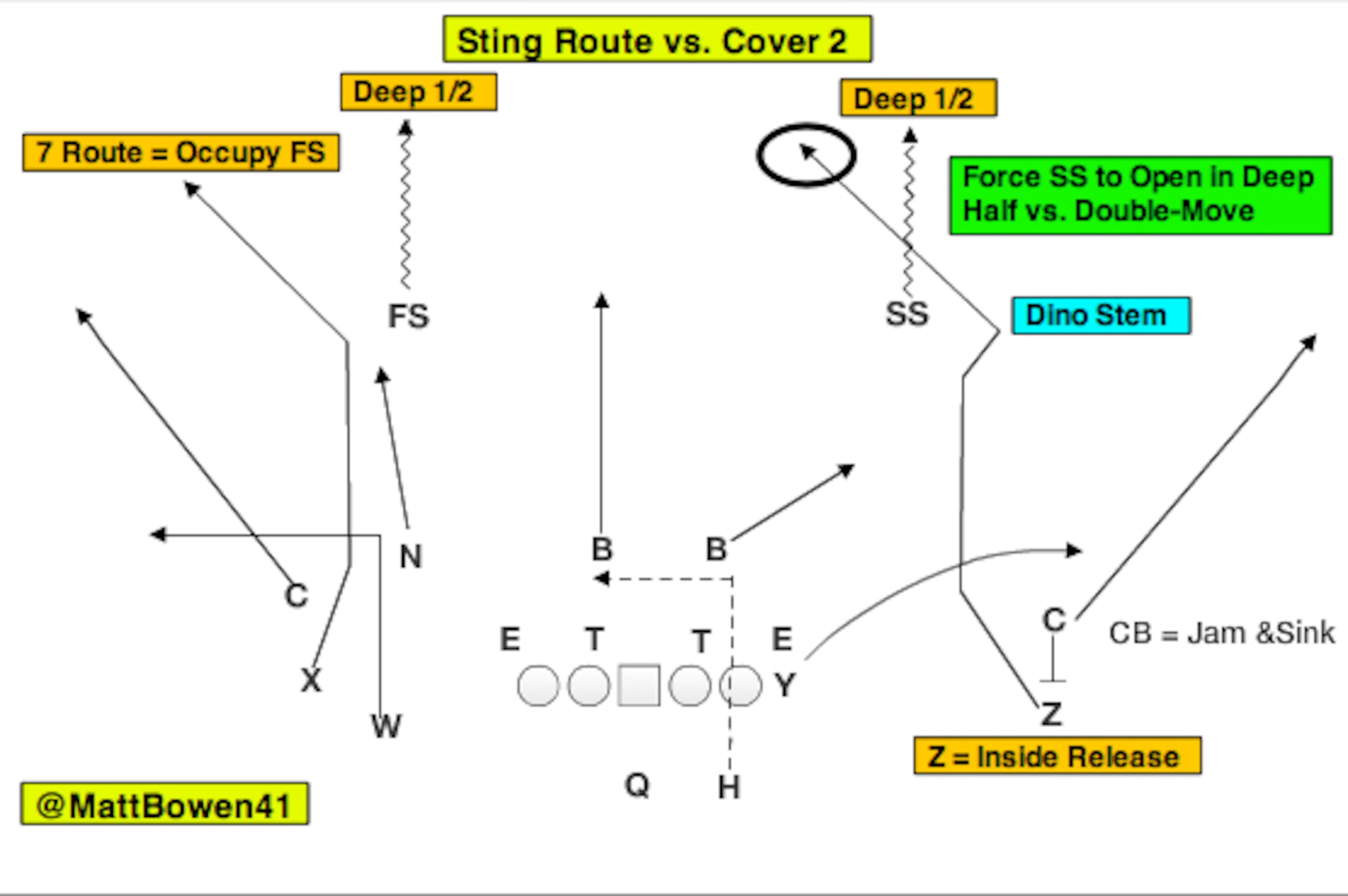
How do you defend it? Stay square in the deep half through the double-move and play with enough depth to drive to the hip of the wide receiver. However, it’s never that easy when Nelson is running at top speed and Aaron Rodgers is throwing the ball.
Check out Nelson running the sting route versus Minnesota Vikings safety Harrison Smith from earlier in the season.

With Smith opening his hips (playing for the corner route), Nelson can break back inside to beat the top of the Vikings defense for a score. Technique, technique, technique. You've got to have it versus the sting route in the deep half. A concept that showed up on tape a lot this season.
9. “Trap” Coverages Lead to More Creativity on Defense
One way to disguise pressure and set the bait for the offense is to show two-deep in the secondary while running a “trap” scheme. In this coverage, the cornerbacks sink with No. 1 (count outside-in) and read inside. If No. 2 breaks on the out, the corner jumps it and drops the outside receiver to the safety over the top.
Here’s an example from Gregg Williams’ defense in St. Louis as the Rams rush five with the two linebackers playing the inside vertical hook (match to No. 2 vertical).
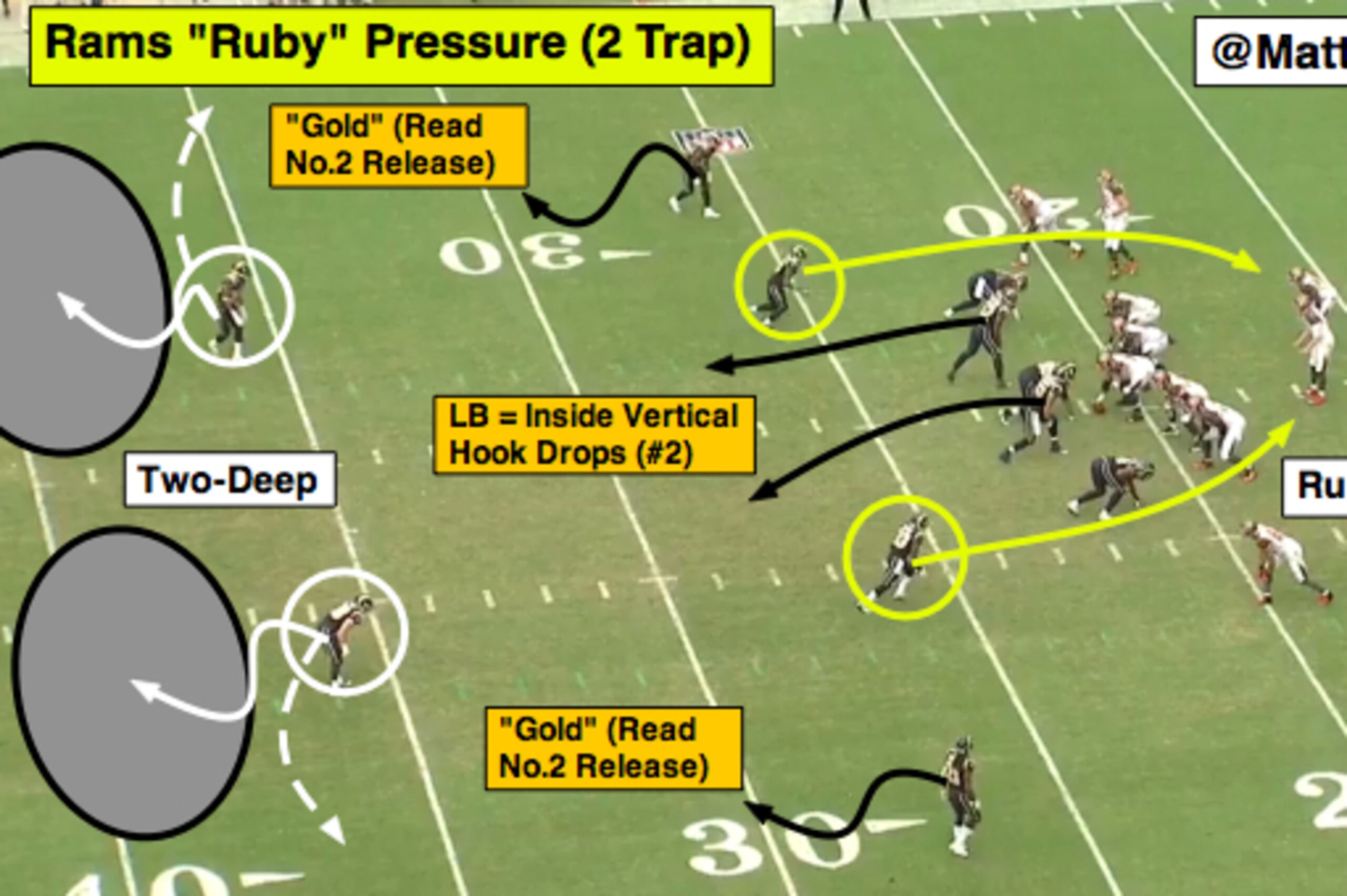
This allows the linebackers to run with the release of No. 2 while the corners lie in the weeds and wait for an outside break. Plus, they have the protection of the safeties over the top.
Along with defenses playing more combo-man looks (bracket coverages), the trap schemes continue to show up on tape because they create opportunities for the secondary to go steal one. If the quarterback reads Cover 2 or throws the flat versus pressure, the cornerback is in a position to go make a play.
10. Malcolm Butler’s Super Bowl Interception
I have to finish with Butler’s game-winning interception from Super Bowl XLIX, because the Patriots played this route perfectly versus a stack alignment.
With the Seahawks running a pick play (seam/slant), Brandon Browner stones Jermaine Kearse on the release (this is a touchdown without the jam). That allows Butler to get his eyes inside, play with a flat-foot read and create the ideal angle to cut off the slant to Ricardo Lockette.
Take a look as Butler beats Lockett to the spot to make this play versus quarterback Russell Wilson.

It’s a beautiful thing when eye discipline, footwork and the angle to the ball all come together. There are no false steps from Butler, he doesn’t give ground, and he utilizes his formation recognition (stack alignment) to get a jump on this throw. Believe it and go make the play. This is teaching tape stuff.
Not bad for an undrafted rookie on the NFL’s biggest stage.
Seven-year NFL veteran Matt Bowen is an NFL National Lead Writer for Bleacher Report.

.jpg?w=2560 "Rams Eagles Football")
.jpg?w=2560 "Grading WWE Raw 🔠")


.jpg?w=2560 "Injury-stricken Seahawks signing veteran RB")
