

What Do Scouts Want to See at Senior Bowl Practices?
Here at the Reese's Senior Bowl in Mobile, Alabama, many of the top college prospects from across the country will participate in a weeklong event that includes full-padded practices, team interviews, media sessions and positional meetings with coaches. The week concludes with the Senior Bowl game, which takes place Saturday, January 24 at 3 p.m. CT at Ladd-Peebles Stadium.
For fans of the Senior Bowl, the game itself might offer up the most tantalizing entree of the week, but for the scouts, general managers, coaches and NFL executives in attendance, the game is more like dessert.
Most of the vital elements to this event, in terms of prospect evaluation, will take place between Tuesday and Thursday.
.jpg?w=2560 "Seahawks Chiefs Football")


If this is true, then what exactly do scouts want to see during that time?
The Meat Market
First off, the week kicks off with a massive weigh-in session Tuesday that is reluctantly referred to as the meat market. This is essentially the first chance scouts and GMs get to see these athletes without their pads on. In fact, they don't have anything on except a tight pair of compression shorts—hence the term "meat market."
During this event, critical measurables like the prospect's height, weight and hand size are established and announced on stage for everyone to write down. In addition, scouts are taking vital notes about the prospect's build, shape, frame, potential room for growth and all of those details.
This part of the process can provide clues about whether a player is in good shape, if he has good genetics, can add more weight, can shed weight and so on.
Scouts will even take notes about things like tattoos and body piercings, as well as details like whether the prospect has all of his fingers and toes, whether he's flat-footed and things of that nature.
Some of the notes you might expect to see from a scout are:
- Pigeon-toed
- Bow-legged
- Duck-footed
- Thick ankles
- Narrow frame
- Flat or bubble butt
- Short torso
- Streamlined
- Barrel chest
- Maxed out
Interviews
After practices throughout the week, there will be no shortage of player interviews. This is essentially conducted on a team-by-team basis and generally flows like a job interview. During this time, scouts will be doing their best to gain a deeper understanding of who that player is and what makes him tick.
If a team places a high emphasis on locker-room chemistry, it will likely spend a lot of time trying to get a better feel for the prospect's overall character. In other cases, his football knowledge in terms of X's and O's is put to the test to see if his football IQ is up to par.

It's worth noting that when I was a part of this process as a player, there were no known regulations in terms of the questions or format for these interviews. That's still true, which essentially means teams have the freedom to ask anything they want during that time. The only restrictions I know about are the amount of time they get with each player.
One player who will be heavily scrutinized during interviews is USC cornerback Josh Shaw after a highly publicized lie in August.
Meetings
During meetings, the coaches will install their offensive and defensive systems in the most basic, vanilla forms possible. The goal here is not to overwhelm the players with too much information, but to provide them with a simple game plan that will allow them to just go out there and be football players.
With that said, you better believe the NFL coaching staffs conducting these meetings are paying close attention to the way these players absorb information and what types of study habits they exude.
Some coaches might get discouraged if they see a player not taking notes or appearing disinterested for much of the time. This might sound crazy given the stakes involved this week, but trust me when I tell you disinterested or exhausted players are more of the rule rather than the exception here.
Turning our attention to the practice field, it's better to approach this by position groups because every position will have its own unique set of elements scouts want to focus on.
Quarterbacks

There's always interest in a quarterback's ability to demonstrate arm strength and accuracy, both from the pocket and on the run. This along with more subtle (though no less important) aspects of the position can be spotlighted during the Senior Bowl.
With spread offenses so prevalent in college football these days, scouts are chomping at the bit to see which quarterbacks can operate from under the center. Though it may seem trivial to some, gauging how well a QB can function with his back to the defense and resetting his eyes in play action will be a key focal point among scouts.
The other aspect of the QB evaluation that the coaching staffs will be able to assess more than any scout out there is their ability to verbalize plays in the huddle while demonstrating confidence, leadership and command over the offense. These elements would have been particularly interesting to observe in Oregon's Marcus Mariota.
Mariota is known to be reserved and soft-spoken, which could be an area of concern for NFL GMs.
According to Conor Orr of NFL.com, Tennessee Titans head coach Ken Whisenhunt spoke to Mariota before the Senior Bowl to explain the benefits of participating. Apparently his advice fell on deaf ears.
Running Backs
We've seen these guys carry the ball and impress with their legs throughout the college season, but now it's time to see what weaknesses (if any) they're covering up with scheme adjustments. Scouts will be paying extra close attention to this group when it comes to pass protection. One of the benefits of Senior Bowl week is there are plenty of drills that allow evaluators to isolate various skill sets of the prospects.
In the NFL, if a running back can't catch or hold his own as a blocker, he most likely will never become a starting running back because he would be a liability in the passing game. After all, this is a passing league, and the value of a running back is strongly dependent upon his ability to add value to that aspect of the game.
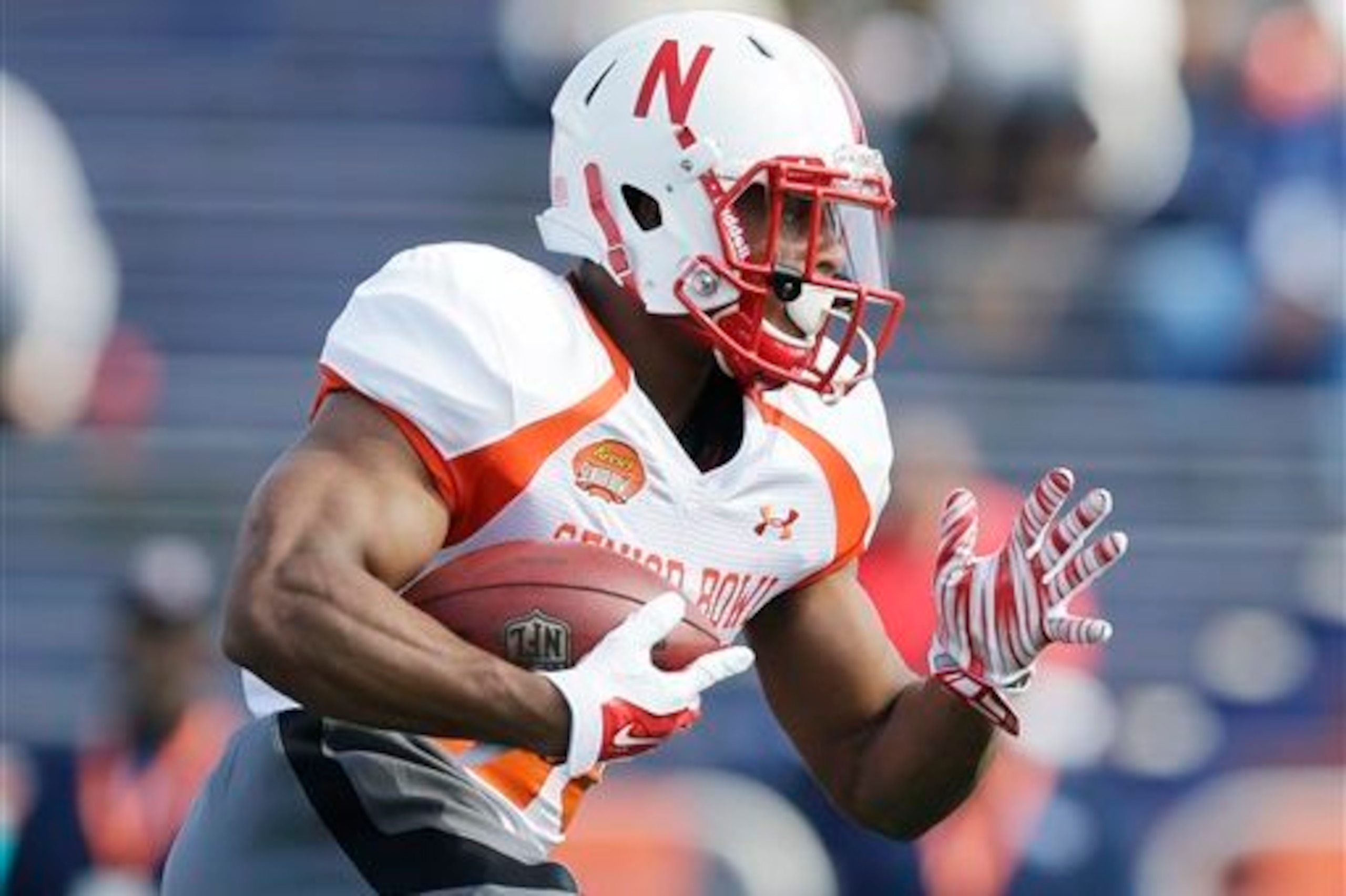
If a back shows inconsistency with his hands and running routes, it's not the end of the world, but he must be able to make up for that deficiency in other areas. The same goes for a back that may be lacking as a blocker.
The most intriguing back here at the Senior Bowl who needs to show at least one of these elements is Nebraska's Ameer Abdullah. Abdullah is a highly talented, undersized prospect who measured in at just 5'8" and 198 pounds.
Receivers/Tight Ends
This week is a great opportunity for scouts to keep a close eye on the nuanced elements of the receiver position. Although reliable hands are always going to be key for receivers, one-on-one drills against elite talent going 100 percent will help evaluators figure out who can excel as a route-runner and who struggles coming out of his breaks.
Another key area of focus for the receivers will be their physicality and quickness when trying to beat press coverage. This element of physicality bleeds into the receiver's ability to catch contested balls at their highest point. This will be critical for some of these players coming out of creative offenses who haven't shown much press coverage in their college tape.
For tight ends, they must demonstrate a degree of strength and toughness in the running game in addition to the things already mentioned. A tight end who shows an egregious lack of ability as a blocker will likely be devalued at the next level unless he is an elite receiving weapon.
Nine-on-seven drills are run-focused segments that offer the tight ends a great chance to showcase that "move the pile" quality many teams covet. During this drill, effort is sure to be valued over technique at this point, the idea being that one of those qualities is clearly more coachable than the other.
Offensive Linemen
This is a key position group for talent evaluators during the Senior Bowl. One of the best events to watch is the big boys on the line during one-on-one pass-rush drills. What's more fun to watch than colossal clumps of mass trying to move each other with elements of speed and deception?
The week of activities will provide scouts a great chance to see how well these linemen move in space. In addition, some of the strongest and quickest pass-rushers in college will test the skills of the men paid to protect the most important position in football.
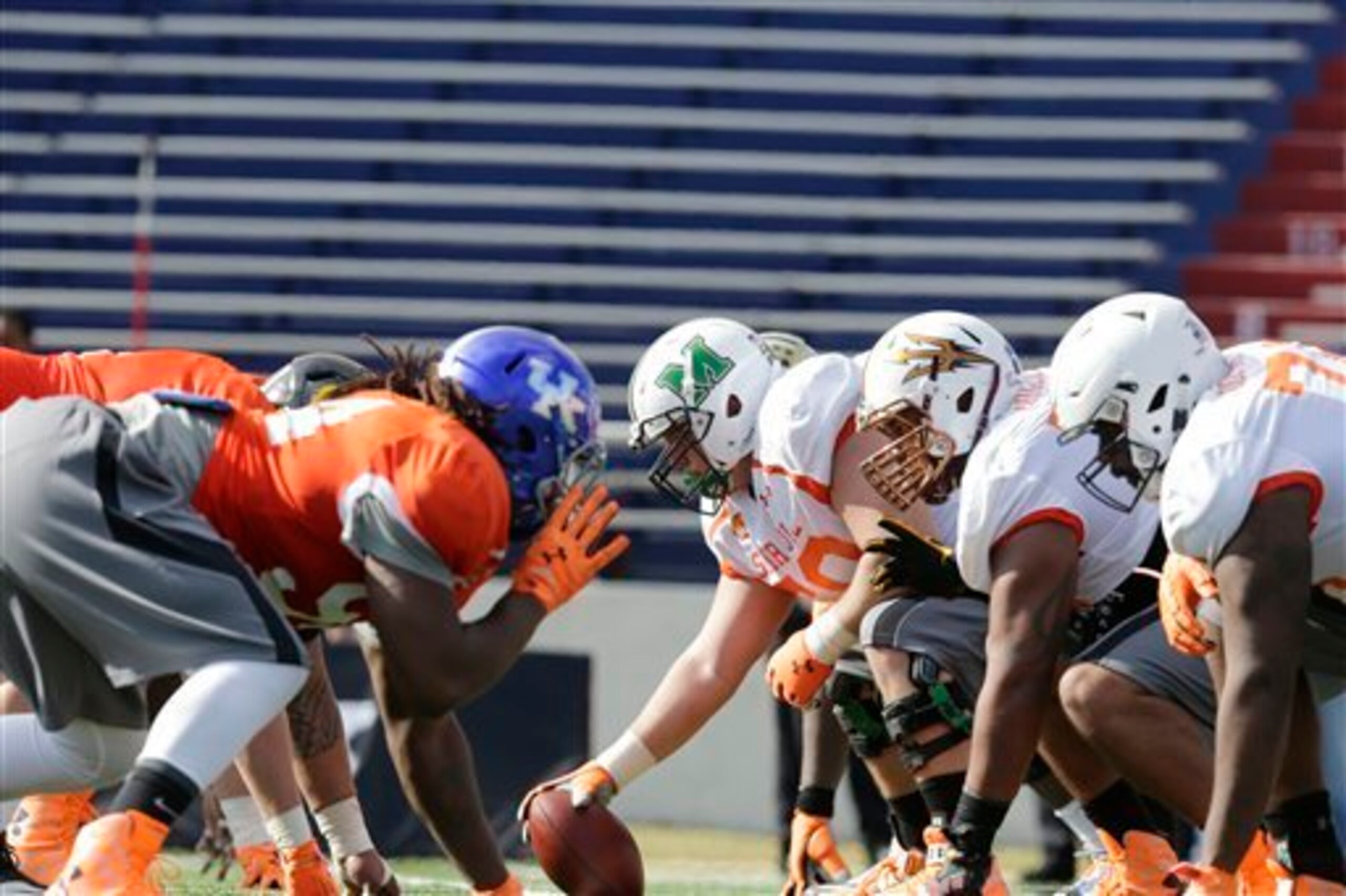
Team drills during the week are less important for the evaluation of linemen because the details of their hands and feet tend to get lost in the pile. In isolated drills, there is more emphasis on a prospect's movement in space and his ability to get his hands inside his opponent's chest.
A robotic or stiff athlete cannot hide this weakness against the competition at the Senior Bowl.
It also gives evaluators a chance to see how these blockers handle the different styles of rushers. Some guys may thrive against bigger, stronger rushers but can struggle when forced to move laterally or change directions quickly. If any such weaknesses exist for these prospects, you better believe they will be identified during this rigorous week of practice.
Scouts also can determine which players have solid anchors and which ones struggle against power.
Throughout the week, a critical aspect that will factor into every drill with linemen is their toughness and tenacity. These character traits are vital for a prospect to thrive in the trenches at the next level.
Defensive Linemen
Defensive linemen won’t have their heads spinning with plays and terminology during the Senior Bowl. This position is more of a "turn it loose and go get 'em" type of deal. For the guys on the edge, scouts can see up close whether a rusher has the speed, hip-flexion and agility to turn the corner on the blocker.
During pass-rush drills, scouts pay close attention to a prospect's get-off and hand technique.
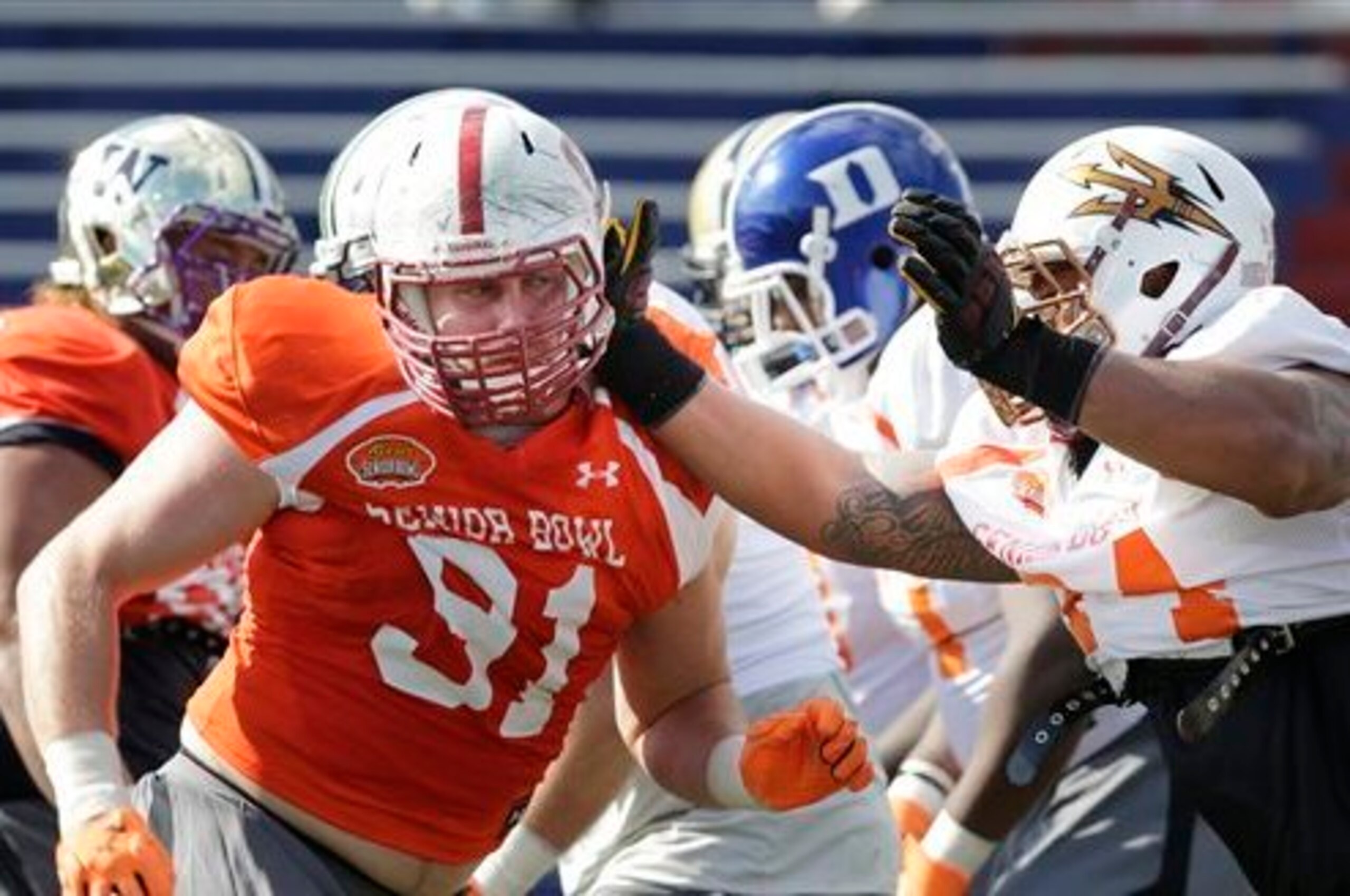
On the interior, anchoring and strength take center stage. It's important for a defensive tackle to be able to get a guy on his heels and drive him into the quarterback's lap. This ability can be demonstrated during pass-rush drills as well. If an interior lineman can flash the quickness to beat blockers with elusiveness, he will add a great deal of value to his game and likely become one of the highest draft picks of his class.
Like with offensive linemen, a tenacious mentality is an absolute prerequisite to surviving in the trenches during a 16-game NFL season. This is where those thick lower bodies come into play.
Competing in the trenches also requires something scouts call heavy hands. In other words, they want to see how much of a pop or shock comes when a lineman delivers a punch.
Linebackers
Because there is very little tackling going on during the week of practice, most of the run drills will be about fitting up and reading their keys. In all honesty, this element of the game can be better analyzed watching game film.
What scouts really want to see out of the linebackers down in Mobile is how they move in space, transition from run to pass or, perhaps most importantly, how well they can match up with elite prospects in coverage.
As mentioned earlier, the NFL is a passing league, and most defenses will use their nickel packages at a higher rate than their base packages throughout the season. This amplifies the importance of finding that every-down linebacker who can be an asset on passing downs when he isn't blitzing the quarterback.
Most of the time, linebackers will be asked to cover tight ends and running backs in one-on-one drills. These routes tend to be a lot more physical than those run by the receivers on the outside, which is an important area of interest for scouts.
Whenever possible, scouts will also play close attention to how a linebacker handles blockers at the point of attack. Does he shed the block quickly, or is he knocked back or swallowed up by the bigger lineman?
Cornerbacks/Safeties
For the athletes who make up the back end of the defense, speed, agility and quick feet are critical. There are not a whole lot of surprises here in terms of what a scout is looking for, but like most positions, the one-on-one drills offer the richest platform to scout a player's ability.
At the Senior Bowl, cornerbacks and safeties are paired with a variety of receiver types, forcing the defenders to adjust to a wide range of athletes. Scouts will always pay extra close attention to a cornerback's hips and feet. They want to see fluid transitions from their backpedaling to sprinting, as well as their ability to change directions.
Press-man skills will be challenged to exhaustion all week because it pretty much activates every element of the position. Toughness, strength and hand technique, as well as the ability to turn and run with the receiver, will all be on display this week.
Lower on the scale of importance, the safety or CB will have multiple opportunities throughout the week to showcase his ball skills.
Some universal elements to be mindful of on the practice field all week—scouts ultimately will be stepping back and trying to look at these prospects from a big-picture perspective. When doing this, a natural question arises that will eventually be answered by each personnel member: Does this guy belong here, or is the competition overwhelming for him?
If this stage is too much for a prospect, there is little chance the kid will ever succeed at the NFL level.
To read about some of Day 1's standouts according to Bleacher Report's Matt Bowen, click here.
Ryan Riddle is a former NFL player who writes for Bleacher Report.
.jpg?w=2560 "Raiders Saints Football")



