
Greatest Match of All Time: Objective Approach, Subjective Topic
What is the 2009 [Place great match here]’s Place in History?
We seem to always have these discussions. See Trey Bradley’s analysis following the 2009 Wimbledon final, in which B/R's top tennis analysts were invited to weigh in on the match’s "greatness".
Opinions and lists were provided by all, in this round-table discussion, but the discussion was qualitative (subjective) and biased toward those matches that have occurred in the recent past (begging a question—can one ever tack on the qualifier "of all time" to any appellation of greatness?)
Film clip (3m): From Henry V—the part where the Duke hold up a case of tennis balls and says ‘Tennis balls, my liege.’ The relevant part of the speech happens at (about) the 1:30 mark, but the whole clip is well worth it, particularly the lead in.
TOP NEWS
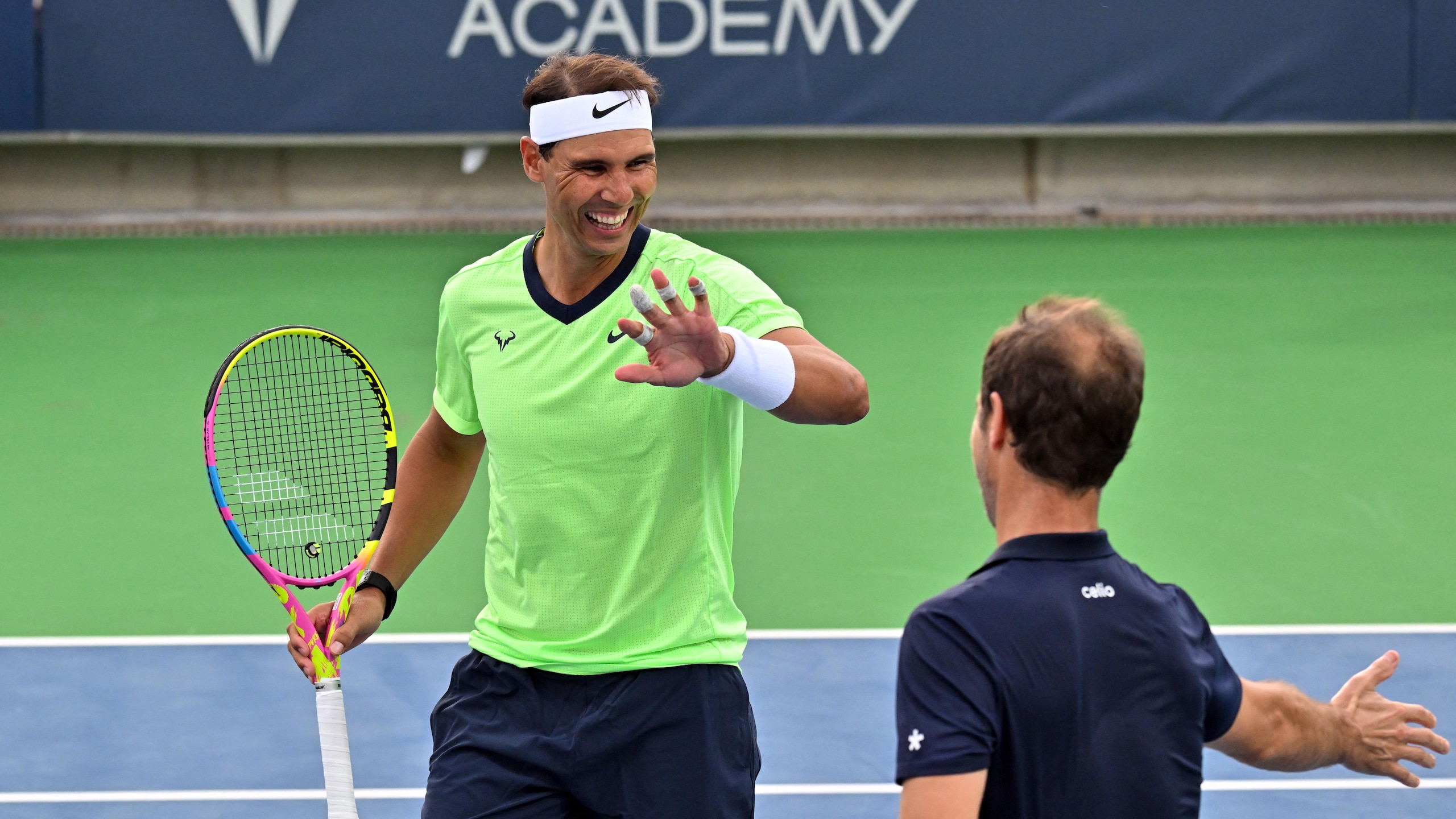
Rafa Playing Exhibition 🎾
.jpg?w=2560 "Seahawks Chiefs Football")
Chiefs, Steelers Eye WR Trades

J-Dub, Wallace May Miss Entire Season
FRENCH AMBASSADOR: ...He therefore sends you, (holding up a box),
This tun of treasure; and,
Desires you let those dukedoms that you claim
Hear no more of you. This the Dauphin speaks.
KING HENRY V: What...treasure, uncle?
EXETER (opening the box): Tennis-balls, my liege.
Can we really compare matches? How do historical matches, that fare well in our memory banks over the midst of time, really compare with that great match we saw yesterday?
I was shocked to discover recently that fellow writer Clarabella felt that the Madrid SF involving Nadal and Djokovic “was less gripping than the Rome semi between Novak and Roger, which swung from one to the other, with the weather throwing its bit into the equation.” How can she think that way?
Likewise I wrote an article and listed the scores of what I considered to be the best Nadal/Djokovic match-ups and was shocked to discover that the one I liked the best didn’t have the closest score, did not appear to be the hardest fought, nor was they the longest on record. Could I possibly be biased?
(For comparison, the list of scores for those matches are provided at the bottom or this article. The list was thrown up for a poll, and the most recent match was selected by a landslide, though one commenter remarked that the landslide for the most recent match might not have accounted for a match that received his personal vote for the best.)
How can we decide that we are talking about the same thing, much less take our biases and favoritism out of it and decide which is greatest? For one thing, we must get into the nitty-gritty of just what it is that causes a match achieve a consensus of "greatness."
A Sampling of Tennis Sensibilities:
Player X gets too long and drawn out in close matches for my liking, so I am usually inclined to the faster paced matches (loved the 2009 Wimbledon final for that reason—so much tennis for your money!).
I favor artistry over brawn, so give me Haas, Nalbandian, Djokovic, Mauresmo over Nadal, Murray, del Potro, Sharapova any day of the week...
Film clip (1m 30s): The opening of The Good, the Bad, and The Ugly, where ‘Ugly’ is rendered ‘Il Bruto’ in the original Italian.
To make it go faster, you could start about 60s in. Note that Rafael Nadal has been called 'The Ogre' in France!
For another fan, gripping tennis is: hard and smart hitting, lengthy rallies, improbable shots, variety, and unpredictability until the last shot. (Note: the 2009 Wimbledon final was unpredictable until the last point, but most agreed it did not have the same quality as the 2008 or 2007 Wimbledon final).
For another, memorable matches bring fiery personalities together, and contrasting styles of play.
Film clip (4m): More scenes from The Good, the Bad, and The Ugly: Tuco is cussing out Blondie: “Tuco: You’re the son of a thousand fathers, all bastards like you!”
The relevant part of the clip is the speech at the beginning up to the 1:00 mark.
For others, low numbers of unforced errors (UFEs) is an important criteria for "greatness"—yet in such a category, almost any Pete Sampras match is ruled out because Pistol Pete made a lot of double faults on his way to serving greatness.
For others, tennis speaks, and great tennis transcends nascent ideas of winning and losing.
For David Foster Wallace it is religious: There are times, as you watch the young Swiss play, when the jaw drops and eyes protrude and sounds are made that bring spouses in from other rooms to see if you’re O.K. The moments are more intense if you’ve played enough tennis to understand the impossibility of what you just saw him do...
from Federer as Religious Experience, 2006 New York Times
For a tennis writer from b/r it’s the struggle with the irreconcilable: "I have to battle. I have, but one aim in my life—to improve in what I do. But I do not have a measurable entity or a metric that will tell me whether I am doing the best—that I am living the limit...I am not my body. Survival is not my aim."
From The Death and The Fight For Existence: The Nadalian, Bleacher Report, 2009
Film clip (2m 30s): Barishnikov & Gregory Hines dancing to White Nights — ‘Prove me Wrong’
Film clip (2m 30s): Antonio Gades’ Carmen—a classic flamenco interpretation of the passionate story.
These are all excellent (and personal) qualities with which to judge greatness in tennis! These are not only what make a great match great, but also why we have a hard time judging one great match from another.
There is no "right" when it comes to aesthetics. And in many ways tennis is as mental a game as there ever was. It’s thrust and parry, probe and penetrate, with a bit of game face and junk-yard swagger thrown in as well. Aesthetics are too important to our sense of what makes tennis great to throw away with dry statistics.
For someone interested in judging the "greatness" of a tennis match without the prejudice that we all have toward the most recent match played, or the one involving our favorite player, the following are humbly submitted as objective criteria, with a somewhat subjective sliding scale of assigned points, for a cumulative point score. An attempt to capture a subjective impression in an objective way—without losing the subjectivity.
Claudia’s Collection of Categories:
- a.) Important things at stake (significant records, history)
- b.) An element of drama
- c.) Great Shot Making
The drama can take six forms and is relatively easy to judge:
- b.1) drama from the natural world-darkness and rain delays that effect the players; nature playing to the advantage of one or the other
- b.2) drama from the external political world: war, and players from different nations. [example(s): Budge vs von Cramm, Davis Cup 1937]
- b.3) interpersonal drama: a great rivalry, or a rivalry of tennis nations, a history of head-to-heads between players, or other personal (non-historical) quests; a lower ranked player taking on a much higher ranked player in a challenging five-setter. [example(s): Kei Nishikori vs D. Ferrer USO 2008]
- b.4) drama from extraordinary length of tie-break, or an extraordinarily lengthy set within the match itself.
- b.5) drama from a large number of break-point chances, or a large number of deuces (changes of momentum would be included here).
- b.6) A sense of a-priori Unpredictability (Roger Federer defeating a player ranked outside of the top 100 in five sets ranks lower on the scale of unpredictability than Roger defeating a player inside the top three in five-sets; Budge vs von Cramm was more unpredictable than say a Budge vs Tilden match in the same year.)
Great shot-making is the hardest to judge of these criteria. Here are some things to consider when it comes to how shot-making affects our appreciation of a match:
Borg-McEnroe [1980]:
McEnroe would do everything in his power to bring Borg to the net, and the Iceman still found ways to stay where he was comfortable: at the baseline. Sometimes, the look of utter bewilderment on Mac's face was priceless. This is an element of "greatness"—the ability to palpably befuddle one’s opponent with shot-making.
Versatility and virtuosity demonstrated on the court:
I think almost everyone would agree that variety is important. Compare the early days of the Williams' sisters: endless baseline ground-strokes pushing the opponent out of position...with...the Federer/Roddick match of Wimbledon 09, among the top five Wimbledon finals of "all time," according to reference Tred Bradley.
The points were short, there were the love holds, few break points here and there, big serves saving them, more net approaches. It may not have had the versatility, but the virtuosity was tangible.
So what follows are our categories for great shot-making (on both sides):
- c.1) ‘ferocity’: energy, movement, power, hard and smart hitting or serving, moving the opponent around the court
- c.2) volume of improbable shots (on both sides)
- c.3) variety of shot-making and/or stealthy strategy and/or defeating opponents strategy—includes but not limited to: great serving at critical moments, charging the net unexpectedly, keeping points short
- c.4) high number of winners to UFE (points being "won" rather than "lost")
- c.5) "Elegance" or "brilliance" or "virtuosity" (different from "improbable"or strategic)—classic form on a particular shot; elegant point construction
Each bullet shall have a three-point scale. Three points for a significant contribution to any bullet, one point for a minor element of any bullet. An example of a major contribution: For bullet b.2, the Budge vs von Cramm match of 1937 would get a "3" because not only was it Nazi Germany vs "Democracy", but von Cramm, not being a Nazi, was in danger of his life if he lost the match.
Maximum points for any match = 36 pts.
Evaluation Phase
To evaluate these criteria, I propose to watch the upcoming 2009 US Open, with Clarabella Bevis, using the above criteria, comment on matches using the same, and in the end, judge the final against this criteria and also against other great matches this season.
Clarabella and I have a different sense of the aesthetics of what constitutes ‘great’. We will exchange comments on matches as the USO Series unfolds. We will ask ourselves—Does our ‘sense’ of a match from watching it in person, line up with how we might score it on these criteria?
If we have time we will study the following classic five-setters, with an eye on our criteria (available as DVDs for purchase online for anyone else who’d like to participate in the discussion at The Tennis Nexus):
I'd love having more readers join in the discussion and keep score yourself! That will lead to a more lively discussion at the end. This can be our way of both participating in a "Trey's Table" type discussion, and finding a way to do it so that we are all talking about the same thing.
And of course, now would be the time to discuss the categories themselves and whether they will accurately capture our innate sense of what makes a match great.
Final Film clip: KING HENRY V: ... such a wretch; Winding up days with toil and nights with sleep; Has the fore-hand and ‘vantage of a king.’
The relevant part is at the 3:00 mark - but the lead in is fantastic! One of my favorite speeches in literature.
References:
[1] Oh Greatest Match, How do we Quantify Thee?
http://bleacherreport.com/articles/213250-oh-greatest-match-how-do-we-quantify-thee
Scores for a sub-set of Nadal/Djokovic match-ups
(If one examines just the score, does one come to the consensus conclusion about which match was the "greater"?)
- 2009 Madrid semi-final [3–6, 7–6(5), 7–6(9)] (4 hours)
- 2009 Rome final [7–6(2), 6–2)]
- 2008 Olympics semi-final [6–4, 1–6, 6–4]
- 2008 Queen's Club final [7–6(6), 7–5]
- 2008 Hamburg semi-final [ 7–5, 2–6, 6–2] (3 hours)





.jpg?w=2560 "Raiders Sticking with Cousins")