With Opening Day of the 2015 Major League Baseball season not until April 5, the free-agent market is still a long way from closing. There's no need for clubs to make a mad dash for what's left.
But with a month having passed since the market opened in November, now's a good time for us to pause and take stock of the purchases that have been made so far.
And yeah. If you've been paying attention, you'll know this means we're about to start gawking at some awfully big piles of cash.
TOP NEWS

MLB Commissioner Defends Salary Cap
Miz Trades Cards With Kid 🥹
Live Rays vs. Brewers Game 2 🎬
Case in point, here's one: half a billion dollars. That's a lot of money in its own right, so it's saying something that MLB clubs have actually spent more than that in free agency to this point.
With an assist from Hardball Talk's handy free-agent tracker, here's the complete list of free agents who have either signed or agreed to major league deals:
| Matt Belisle | STL | RP | 1 | $3,500,000 |
| A.J. Burnett | PIT | SP | 1 | $8,500,000 |
| Billy Butler | OAK | DH | 3 | $30,000,000 |
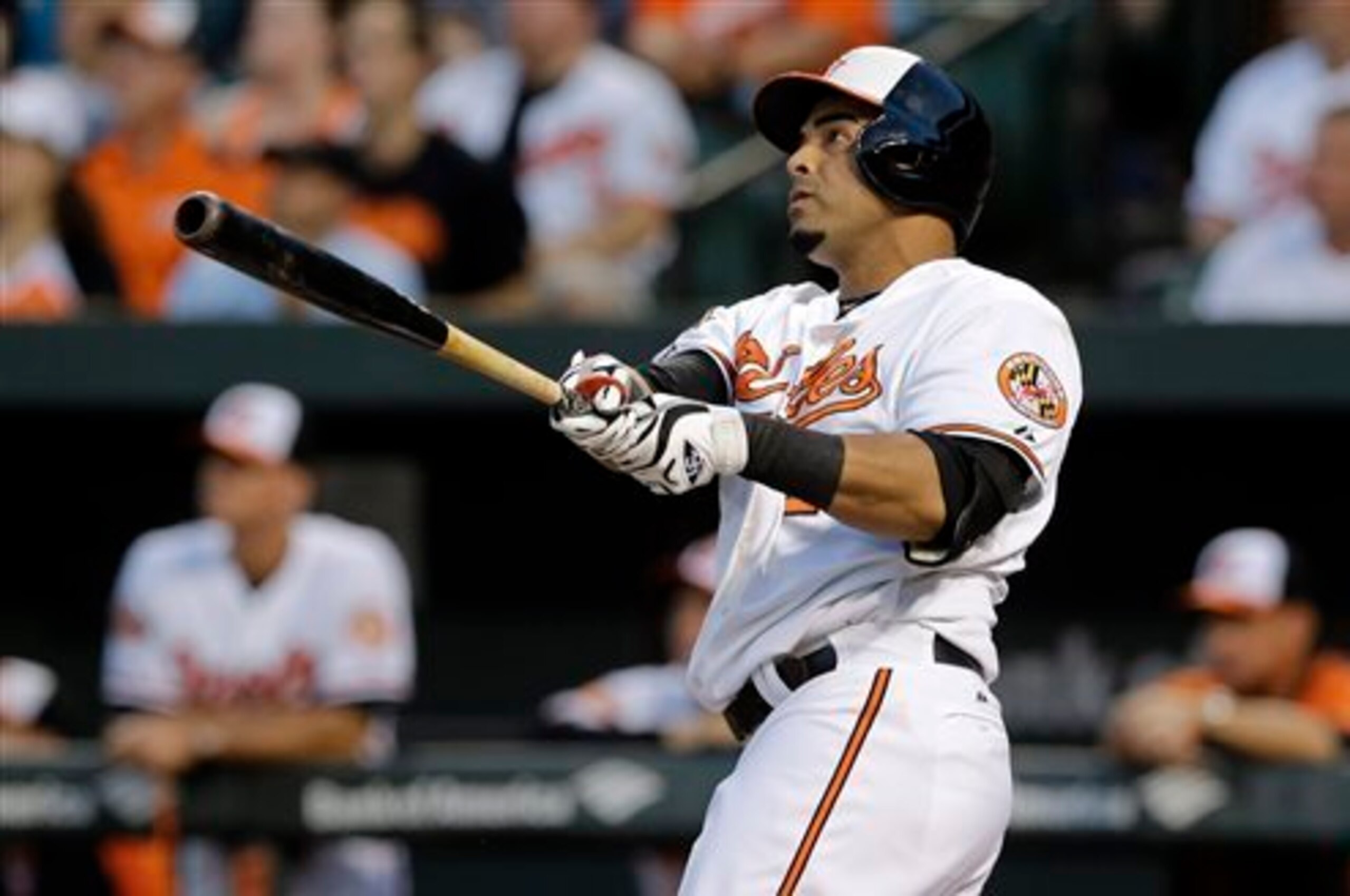
| Nelson Cruz | SEA | DH | 4 | $57,000,000 |
| Michael Cuddyer | NYM | OF/1B | 2 | $21,000,000 |
| Zach Duke | CHW | RP | 3 | $15,000,000 |
| Jason Frasor | KCR | RP | 1 | $1,800,000 |
| Ernesto Frieri | TBR | RP | 1 | $800,000 |
| Joel Hanrahan | DET | RP | 1 | $1,000,000 |
| Torii Hunter | MIN | OF | 1 | $10,500,000 |
| Adam LaRoche | CHW | 1B | 2 | $25,000,000 |
| Russell Martin | TOR | C | 5 | $82,000,000 |
| Victor Martinez | DET | DH | 4 | $68,000,000 |
| Hanley Ramirez | BOS | LF | 4 | $88,000,000 |
| Pablo Sandoval | BOS | 3B | 5 | $95,000,000 |
| Yasmany Tomas | ARI | OF | 6 | $68,500,000 |
| Chris Young | NYY | OF | 1 | $2,500,000 |
There you go. So far, a month's worth of free-agent signings have produced a guaranteed $574.6 million. For perspective, that's already way over a quarter of what was spent on last winter's market.
Now, determining whether this is money well spent is...well, complicated. But on the surface, we can agree that teams at least seem to have the right idea.
Of the 17 free agents who have signed, 11 swing bats for a living. Those 11 players account for nearly $550 million of the $574.6 million that's been spent, which tells us that clubs are very much attuned to baseball's current environment.
That's an environment in which nobody can score. Offense has been trending downward for a couple years, but it got really bad in 2014. The league's average of 4.07 runs per game was its worst since 1981, and the league's collective on-base percentage of .314 was its lowest since 1972.
"Offense is going to go back almost to the dead-ball era," new Chicago Cubs skipper Joe Maddon told Tyler Kepner of The New York Times in July. "You’re always going to have several really good hitters...but you’re going back to normal human beings playing the game, with none of the advantages.”
In an environment like this, it makes a lot of sense to go hard after capable hitters in free agency. And if we ignore the track record-less Yasmany Tomas, the hitters who have gotten the big bucks so far definitely qualify as "capable" based on their track records.
If we make things as simple as looking at their showings in the OPS+ (OPS adjusted for parks and leagues) category over their careers and in 2014, we see:
| Billy Butler | 119 | 95 |
| Nelson Cruz | 118 | 140 |
| Michael Cuddyer | 114 | 149 |
| Torii Hunter | 111 | 111 |
| Adam LaRoche | 114 | 124 |
| Russell Martin | 103 | 136 |
| Victor Martinez | 126 | 168 |
| Hanley Ramirez | 132 | 132 |
| Pablo Sandoval | 123 | 111 |
| Chris Young | 94 | 95 |
An OPS+ of 100 denotes a league-average hitter, so here we are looking at a collection of hitters that, Chris Young aside, have been above average throughout their careers.
To boot, the bulk of them were as good or better than their career rates in 2014. Billy Butler is the most glaring exception, but the Oakland A's could be doing far dumber things (make your "Yeah, like trade Josh Donaldson!" jokes here) than betting on his 2014 season being an outlier.
If focusing on track records is good enough for you, the takeaway here is that the many millions spent on hitters so far this winter have been spent largely on good hitters.
There is, however, an obvious problem with this perspective. When teams pay for free agents, they're not buying past performances. They're buying future performances. In the end, it's those performances that will determine whether a free-agent contract was worth it.
Since none of us can see the future, this puts us at a disadvantage in determining whether this winter's early contracts will be worth it. The best we can hope for is some kind of rough idea.
Fortunately, that's doable.
There's frankly no perfect way to narrow down what a player is actually going to be worth in the life of a free-agent contract. But as it usually is, Wins Above Replacement at least works as a useful guideline. So that's what we're going to use.
How we're going to use it breaks down to three steps:
- Use the Steamer projection system (via FanGraphs) for 2015 WAR projections.
- Since these are mainly veterans we're dealing with, take cues from FanGraphs' Dave Cameron and Jeff Sullivan and subtract half a WAR for each ensuing season in multiyear contracts.
- Take the likely cost of a win in 2015 and assume a 5 percent increase each year.
This might sound ultra-complicated, but it's really not. For example, here's Sullivan applying the model to Nelson Cruz's contract in just a couple of sentences:
"Let’s say an average win costs something like $6.5 million. Increase 5% a year. Steamer projects Cruz to be worth 1.5 wins. Decrease by half a win a year...Following those inputs, a four-year contract would be expected to be worth about $20 million.
"
Pretty simple, right?
Really, the only difficult part is narrowing down the cost of a win, as it's something that's up in the air at the moment. But $6.5 million is a solid estimate. Knowing that Cameron found the price of a win on last winter's market to be about $6 million, inflation could up the price of a win to $6.5 million this winter.
So then. Let's use this model take a look at what this winter's free-agent signees project to be worth:
| Belisle | 0 | 0 | $0 | $3,500,000 |
| Burnett | 1.7 | 1.7 | $11,100,000 | $8,500,000 |
| Butler | 1.3 | 2.4 | $16,100,000 | $30,000,000 |
| Cruz | 1.5 | 3.0 | $20,200,000 | $57,000,000 |
| Cuddyer | 0.8 | 1.1 | $7,200,000 | $21,000,000 |
| Duke | 0.4 | -0.3 | -$2,400,000 | $15,000,000 |
| Hunter | 1.1 | 1.1 | $7,150,000 | $10,500,000 |
| Frasor | 0 | 0 | $0 | $1,800,000 |
| Frieri | 0.1 | 0.1 | $650,000 | $800,000 |
| Hanrahan | 0.3 | 0.3 | $1,950,000 | $1,000,000 |
| LaRoche | 1.5 | 2.5 | $16,600,000 | $25,000,000 |
| Martin | 3.9 | 14.5 | $102,400,000 | $82,000,000 |
| Martinez | 2.7 | 7.8 | $53,800,000 | $68,000,000 |
| Ramirez | 3.6 | 11.4 | $79,000,000 | $88,000,000 |
| Sandoval | 3.6 | 13.0 | $91,600,000 | $95,000,000 |
| Young | 1.3 | 1.3 | $8,500,000 | $2,500,000 |
I've highlighted the players with projected contract values more than $5 million lower than their actual contract values. There are a few of those, and most of them are projected to miss by a lot more than $5 million.
And overall, the gap between projected value and actual value is quite big at over $90 million. That's big enough to overrule various quibbles we can get into with the projection model anyway.
Maybe that's surprising to hear after our brief glance at how things look in light of guys' track records. But looking into the future means taking the effects of aging into account, and using WAR as a measuring stick means looking at more than just hitting value.
To these ends, it's really not surprising that the highlighted contracts handed out this winter project to fall short.
To some degree or another, Billy Butler, Nelson Cruz, Michael Cuddyer, Torii Hunter, Adam LaRoche, Victor Martinez and Hanley Ramirez are past their primes and come with little to no baserunning and defensive value. This is not to mention assorted injury (Ramirez) and ballpark (Cruz and Cuddyer) red flags.
To be fair, the teams that signed these players could be glad they signed them anyway. Some might be happy just to have the offense. As for the long-term signees, maybe they'll perform well at the outset of their deals and have a big impact on their teams' success in doing so.
Still, what we're after here is essentially to determine if teams are going to get good bang for their buck. From an overall perspective, the projections indicate they probably won't
If there's a key to closing the gap between the projected values and actual values of the contracts handed out so far, it's what Tomas can do for the Arizona Diamondbacks.
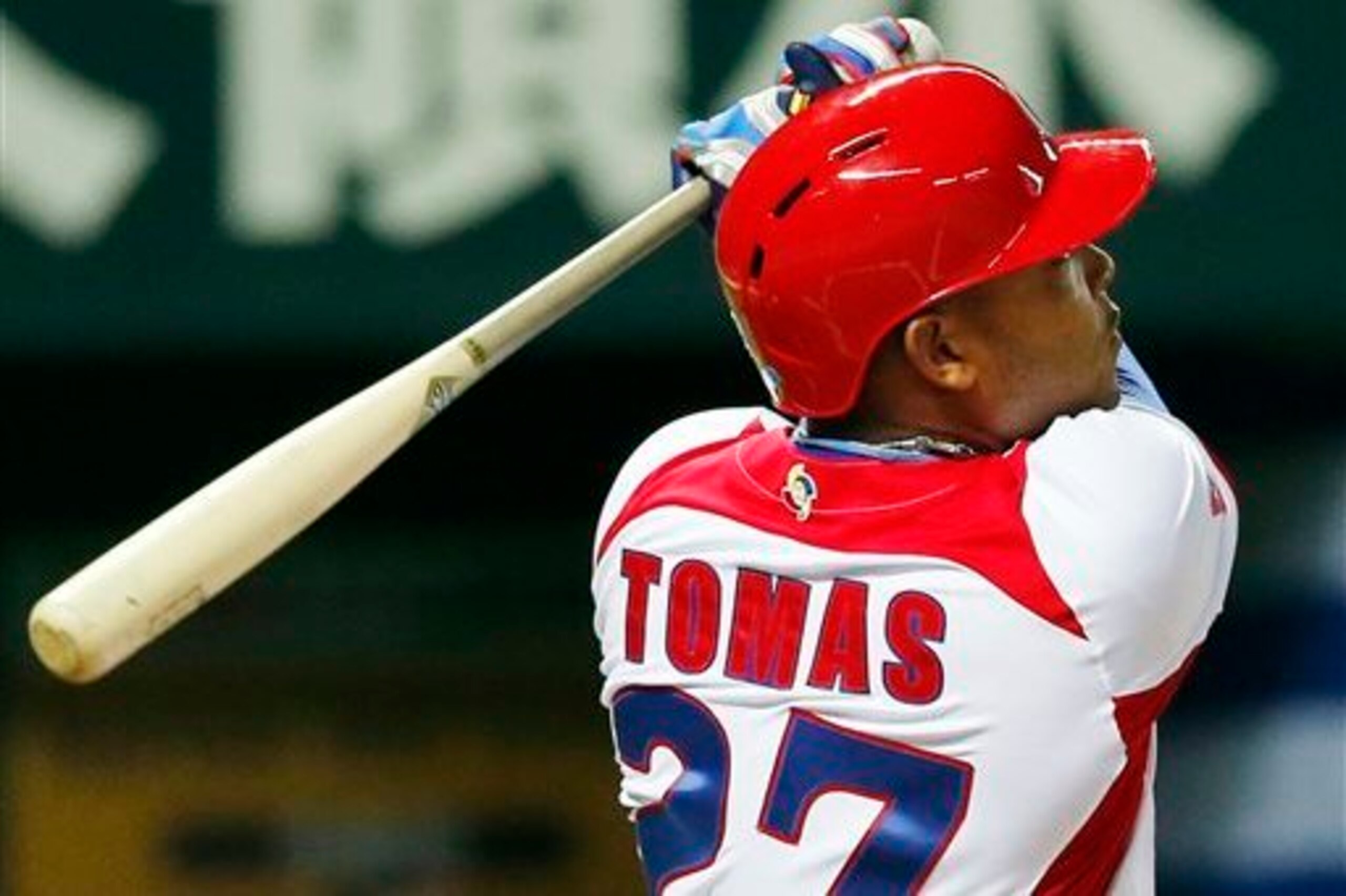
We don't have a Steamer projection for Tomas' debut season in 2015, but Jeff Sullivan had some solid reasoning behind his guess that Tomas could be as good as a 2.6-WAR player. And since he'll only be 24, it's OK to assume he'll be a 2.6-WAR player throughout the life of his six-year deal.
If he is, he projects to provide about $115 million in value over the $68.5 million he'll actually be paid. With that, the gap between the expected values and actual values of this winter's contracts shrinks from over $90 million to roughly $45 million.
Even still, that's still a sizable gap. It also hinges on Tomas becoming a solid regular, which is admittedly no sure thing. For that matter, Russell Martin being a bargain and Pablo Sandoval being a solid value aren't sure things. Martin's a 31-year-old catcher with a lot of mileage on his body, and it's only in October that Sandoval hasn't looked like a total enigma in recent seasons.
So let's just wrap things up with the following sentiment: As dandy as things look on the surface, the 2014-2015 free-agent market has consisted of a lot of money being spent on plenty of uncertainty.
We'll see if things will change once teams start dipping into the market's considerable wealth of pitching talent, a population that includes Max Scherzer, Jon Lester, James Shields, Francisco Liriano and Ervin Santana. If A.J. Burnett's solid deal is any indication, maybe some of them will end up being bargains.
But so far, the free-agent market is behaving a lot like it usually does. It's still not so much a place to find good deals as much as it is a place to simply spend money.
Note: Stats courtesy of Baseball-Reference.com unless otherwise noted/linked.
If you want to talk baseball, hit me up on Twitter.




.jpg?w=2560 "Malik Beasley Negotiating Plea Deal (AP)")
.jpg?w=2560 "Aikman Blasts Cowboys WR 🫣")

.jpg?w=2560 "Jonathan Taylor Landing Spots")