Klay Thompson, Jimmy Butler Gunning for Top of the NBA's Shooting Guard Class
It's been a while since we've seen a new shooting guard rise to the top of the positional hierarchy without a hostile takeover.
Michael Jordan seamlessly turned into Kobe Bryant, and though he and Dwyane Wade battled it out during the 2000s, there was another easy transition when both veterans started experiencing injuries and allowed James Harden to take over the throne. The bearded 2-guard still owns the crown right now, largely by virtue of his insanely efficient offensive play. But he's a naturally flawed player, and that won't allow him to rest easy when challengers come calling.
Harden, thanks to his three-point shooting and ability to draw contact, is a scoring phenom. He's also a gifted distributor, and his defensive play—much to the chagrin of those who insist on following last year's narrative and using circumstantial evidence to support claims that have become false in 2014-15—is at least adequate for the Houston Rockets. But he's never going to be a two-way standout, and that's what will allow for a pair of younger shooting guards to make a run at his title.
TOP NEWS
Jaylen Brown Calls Out Tatum 🧢
LeBron on President Trump's Criticism
Knicks Staff Didn't Get Rings 🤔
Right now, it's Klay Thompson and Jimmy Butler who are rising to the top.
Offensive Excellence
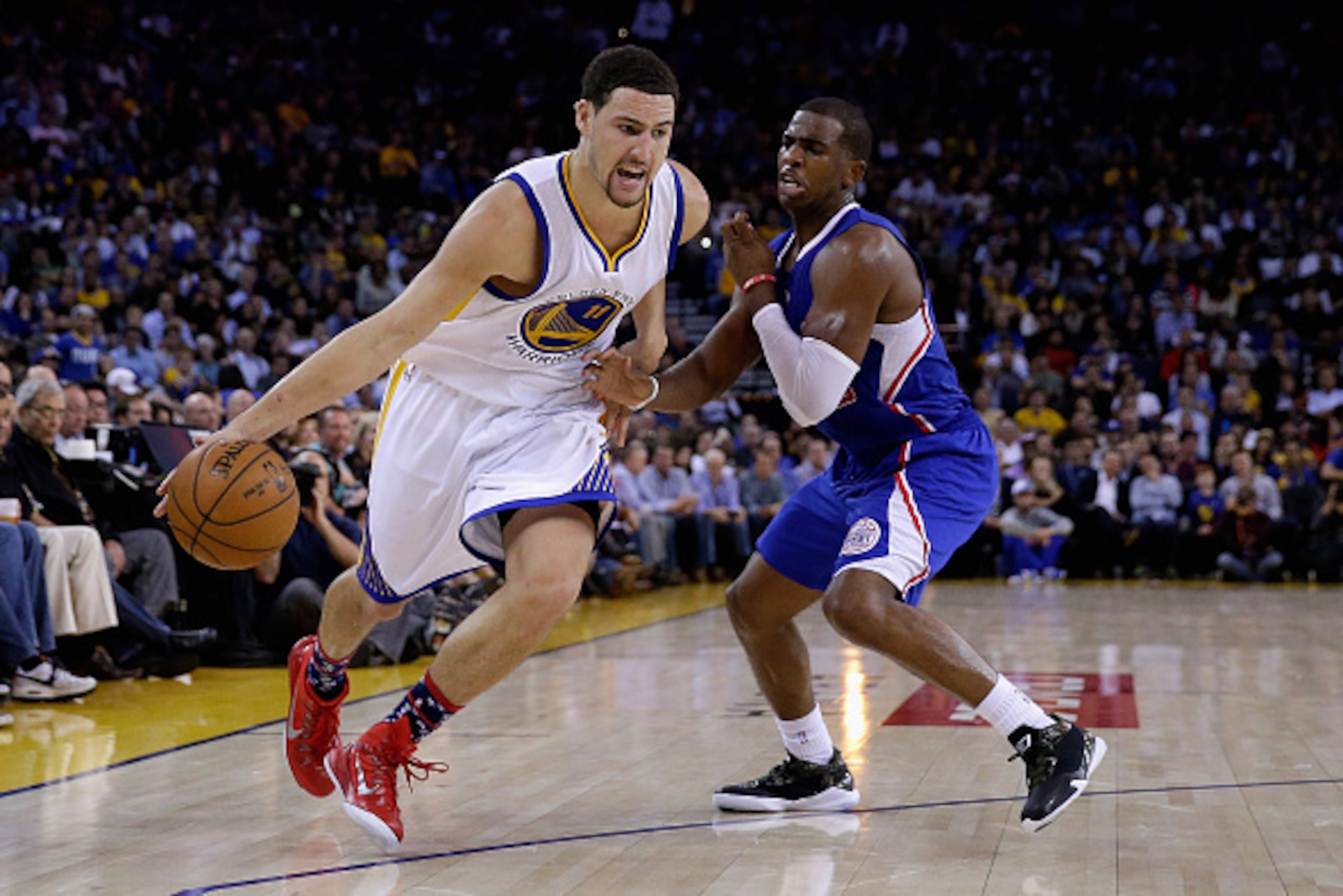
Through his first dozen games in 2014-15, Thompson is averaging 22.5 points and 3.3 assists per game for the Golden State Warriors, doing so while shooting 45.9 percent from the field, 43.4 percent from beyond the arc and 87.1 percent at the charity stripe. Not only is he more involved in the offensive proceedings, but he's creating far more of his own looks.
After a huge victory over the Miami Heat, Thompson was working as a solo artist on exactly half of his own shots from inside the arc. After requiring assists on 62.2 percent of his makes from that zone last season, he's dropped that number to an even 50, and his percent assisted from outside the three-point line has fallen 29 percentage points.
That improvement has allowed him to become a much more versatile player, operating as a featured player within Steve Kerr's more creative offensive schemes. But it's not as though he's the only one of the two who has improved.
Butler is averaging 21.6 points and 3.2 assists per contest, pretty comparable numbers to his counterpart from the Bay Area. And just as Thompson is, he's posting them in efficient fashion, hitting exactly 50 percent of his field-goal attempts, 33.3 percent of his downtown tries and 82.2 percent of his looks at the charity stripe. He's also creating a solid amount of his own offense and rarely turns the ball over.
It can be tough to compare these two players head to head in each category, but fortunately, Bleacher Report's Kelly Scaletta and I devised two metrics during the offseason that provide a one-number summary of scoring and passing abilities: scorer rating and passer rating. In each case, the higher numbers are better, as they indicate that a player is contributing more points by virtue of that facet of his game.
Now, to put those in better perspective, here's how each number would have left the two shooting guards ranked among the entire NBA in 2013-14:
Thompson's total rank would have been 95, while Butler outshines him and finishes at 86. But that's only a slight difference, and it's hard to hand the offensive belt to the Bull based solely on that information.
And now is where it's important to remember that this competition revolves around the future.

Thompson has already grown quite a bit this season, and much of the improvement has been rather unexpected. He wasn't supposed to create this many of his own shots so fast, and the added facilitating skills are certainly a nice bonus. But how much better can he get?
While he'll certainly keep improving, it's tough to see him taking on too much more responsibility on this side of the ball. He is, after all, a perimeter shooter who has thrived when a defense's attention is drawn by other members of his team.
Butler, meanwhile, seems to have a more limitless ceiling. He's an athletic specimen with youth working to his advantage, and he already seems to fly around the court and impact the game in more versatile ways than his Golden State competitor.
For that reason, we'll give him the slight advantage before switching sides of the ball.
Defensive Prowess
The beauty of both these players is that they're by no means limited to making an impact on one end. While each is an enormously beneficial player when their team is trying to score, they're also capable of shutting down the opposition.
That would be what's giving credence to the accolades both have received when called the best two-way 2-guards in the NBA.
"I'd put him up against anybody," Stephen Curry said about his fellow Splash Brother when asked if Thompson was the best two-way shooting guard, per Diamond Leung of the San Jose Mercury News. "I think he does what he does every single night. You saw what he did this summer, where he's taken his game these past three years. You can do whatever kind of ranking, scale or whatever. He's proven that it's not just talk, that he's definitely impactful on both ends of the floor."
And Curry is only echoing the sentiments of Thompson's agent, as Bill Duffy said the following to USA Today's Sam Amick:
"I don't want Kobe Bryant to go crazy, but there's some uncertainty as to who he is right now. But I think Klay Thompson right now is the top two-way, two-guard in basketball. I think when you look at his body of work, when you look at what he accomplished guarding point guards on a regular basis (last season), I think it's pretty clear.
"
However, it's not as though these claims are foreign to Butler's ears.
Every article about him these days is littered with phrases like "if Butler continues (subscription required) his All-Star-level two-way play," "Butler is having so much success is because he's playing the two-way role Deng thrived in under [Tom] Thibodeau" and "Butler, 25, is considered an excellent two-way player."
The praise exists for a reason, even if the Chicago shooting guard will staunchly deny that he's anything more than a role player. There's no way to measure defensive prowess, but in addition to saying both players pass the eye test, we can also use a few numbers. For example, here's how the defenses of the Warriors and Bulls have fared when their starting 2-guards are on and off the court:
It's Thompson surging into the early lead, but on/off splits can be quite misleading. They're largely dependent on who you play with, as well as who's coming off the pine to spell you. And that doesn't bode well for Butler, since Thibodeau's system ensures that quality defense is played regardless of who's on the floor.
So, do other metrics we have indicate that Thompson is superior as well? Let's leave nothing out.
Butler may have a slightly superior defensive reputation, but his numbers certainly aren't making his fellow 2-guard look bad. He's on pace to earn significantly fewer defensive win shares. And while his defensive box plus/minus (how many fewer points he helps his team allow per 100 possessions than a league-average player would) is ever-so-marginally more impressive, he's allowing much higher player efficiency ratings to his marks.
Versatility does work in Butler's advantage, but that's about it. He routinely switches over to tough assignments and plays against various positions, even when his man is bigger than he, but Thompson has been objectively better against the guards he so often faces.
Even last year, as Bleacher Report's Zach Buckley writes, "Thompson took on the Warriors' toughest backcourt assignment on a nightly basis, chasing track-star point guards one game and holding court with bigger, stronger shooting guards the next."
Just as Butler earned the offensive edge, it's Thompson gaining an advantage on defense. Except the gap between the two isn't quite so slim.
Bringing it All Together

So if Butler has been slightly superior on the offensive end while Thompson has been significantly better when trying to prevent points, does that make Thompson the winner?
Not necessarily. After all, context is crucially important.
But in this case, the context only helps out the 2-guard who suits up for the Dubs.
While Butler is probably the better fit for the Bulls' schemes, thanks to his versatility and ability to score from various portions of the court, he's been made to look better due to the absence of Derrick Rose and Joakim Noah. He's getting to handle the ball more often and function as the offense's true featured player, which isn't going to be the case on a dominant offensive team.
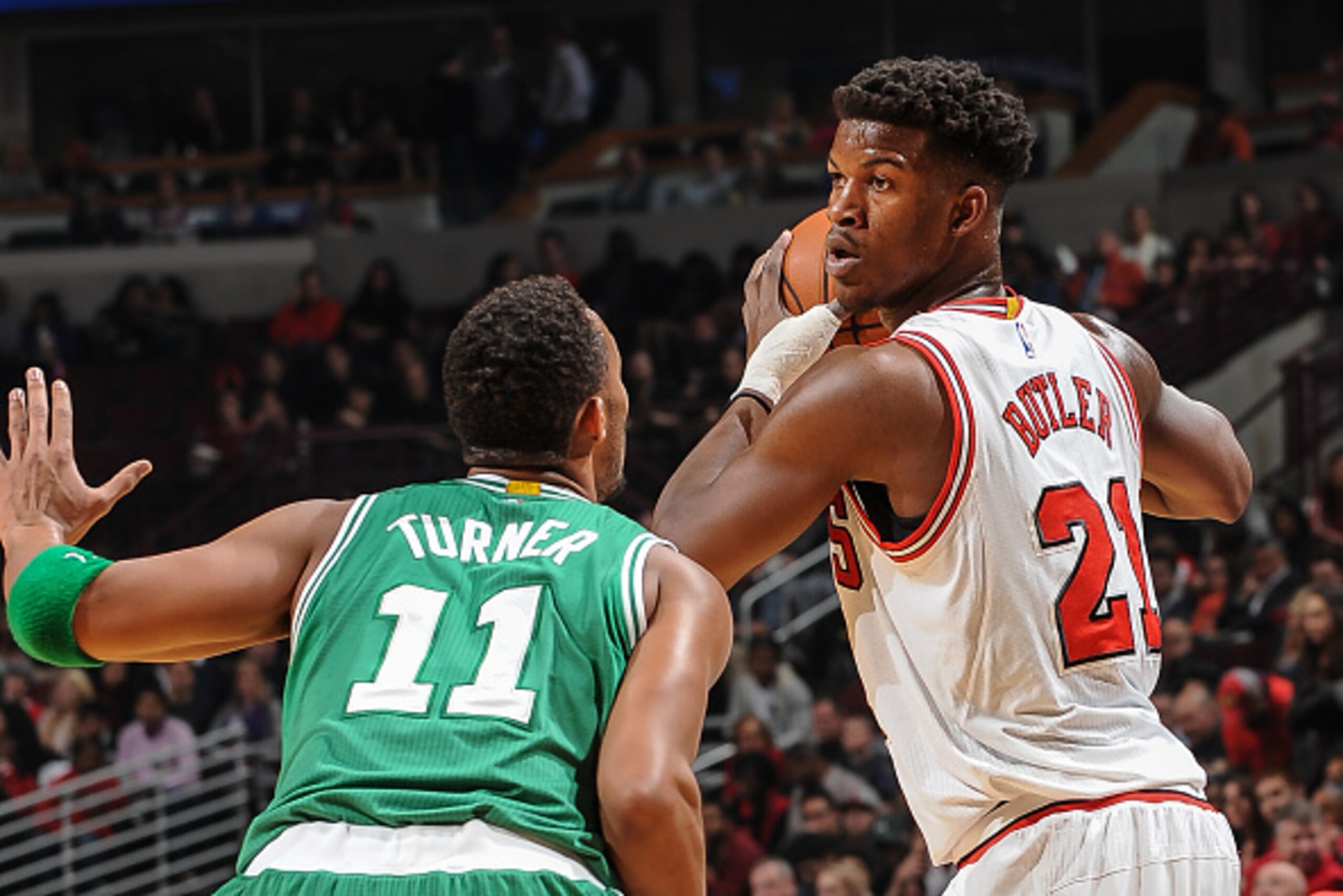
Meanwhile, Thompson is doing all this while playing alongside Curry, who handles the ball quite frequently and can do just about anything on the offensive end. Granted, this lures defensive attention away from the shooting guard—while Butler is conversely only attracting more—but it also makes it more impressive that he's producing these numbers as a second fiddle.
On more average teams, it's easy to see Thompson doing more and Butler taking a step backward. This year, at least.
It may seem like a cop-out answer, but picking the heir to the shooting guard crown is nearly impossible, as differentiating between these two players is so remarkably subjective and is largely going to be driven by schematic fits. Thompson is almost surely the better option at this very moment, but it's not as though that's guaranteed to remain true with any set of teammates, and Butler still seems to have more room for growth.
Neither player is guaranteed to come out on top.
Instead, why can't both eventually take over as the class of the position?
Note: All stats, unless otherwise indicated, come from Basketball-Reference.com and 82games.com. They're current as of Nov. 26.