How the Dolphins Offense Is Improving Red-Zone Efficiency
When the Miami Dolphins brought in Bill Lazor as offensive coordinator, an adjustment period was expected. It takes time for a new coach to learn about available personnel; their strengths, weaknesses and where the player wins most often.
Prior to the last two weeks, the Dolphins offense struggling dearly in one crucial part of the playing field: the red zone. The red-zone efficiency was not up to the level a playoff team should be operating at, ranking at 30th in the league with just 46.5 percent of all red-zone trips ending with a touchdown.
Placing blame on a single player wouldn’t make sense, as the Dolphins’ core of playmakers is the exact same as 2013, when the Dolphins finished with the 11th-best conversion rate under Mike Sherman’s guidance. The drop from 56.6 percent to just 46.5 percent was not only alarming but caused frustration in the Dolphins locker room.
TOP NEWS
Bears' Santos Wanted to Kick 58-Yarder
Picking Each NFL Division Winner 🔮
.jpg?w=2560)
B/R's Expert Week 7 NFL Picks 🔮
Dolphins wide receiver Mike Wallace had an accurate description that the offense was too inconsistent a few weeks ago, according to James Walker of ESPN.com.
"It's the same thing I tell you every week," Wallace said. "We have to find our balance, man. We can't keep doing this on offense. We can't be up and down to be the team that we want to be. We have to be able to finish football games."
Being unable to score six points instead of settling for three is a mark of a non-playoff team, as the best opponents are able to convert in the red zone more consistently than not. Miami’s repeated failures despite being yards away from the goal line has been a red flag every week and puts a lot of pressure on the defense to make stops in crunch time.
Moving the ball between the 20s hasn’t been an issue, but when the spacing of the offense is limited because of so little field for the defense to account for, Miami struggles.
One issue was never the root of the red-zone woes. When the Dolphins transformed their offensive line to feature Daryn Colledge, Samson Satele and Mike Pouncey, they took on a finesse identity that preferred athleticism to brute force.
That’s not exactly an issue, per se, but it’s a limitation that has shown itself in short-yardage situations time and time again. Even a power running back cannot create extra yards if the linemen are getting pushed backward by the time the ball is handed off. Miami was not adjusting well enough to this limitation with its play-calling and design.
Miami’s spacing with its receiver routes has been subpar as well. There have been instances where Miami’s receivers are too bunched together in a short space, making it easy for the defense to clog that area of the field. Without having an alpha receiver, Lazor has to call quick-hitting routes that depend on quick separation. This is a personnel and coaching issue.
But play-calling and design weren’t the only issues. Sometimes it was just execution by the quarterback, Ryan Tannehill, or his playmakers. Tannehill hasn’t been a bad quarterback inside the opponents’ 20-yard line at all, as he has the ninth-highest quarterback rating in that area this season. But he has thrown three interceptions in the red zone, forcing more throws than the Dolphins need.
Miami’s playmaker group has improved its consistency in recent weeks, but it still lacks a dominant presence at wide receiver or tight end. It takes great play design or high-level execution to get guys like Charles Clay wide-open in the end zone, and this wasn’t happening until the last two weeks.
The last two weeks have brought on a small revelation, though, and hope that Lazor’s offense is taking full effect at a critical part of the season. With the Dolphins likely needing to go 4-1 in their final five games just to be in the playoff mix, the red-zone execution must continue to play well.
Since the Dolphins lost against Detroit, Miami’s red-zone efficiency has risen to 25th in the league on the season at an even 50 percent. The better news is that the last three games have seen 53.3 percent of drives into the opponent’s 20 end in a touchdown. If Miami completed the entire season at that mark, it’d finish 18th.
So, where is Miami improving? We’re going to look at how Lazor has drawn up some excellent play designs and also how the players are making key plays in big moments.
Execution
When execution doesn’t go well, it’s easy to blame the coaching staff as well as the players who couldn’t execute the design. The reality is, however, that the coaches aren’t the ones on the field. Against the Denver Broncos, Miami shined in the red zone, going four of four.
The biggest reason for this success was overall play execution. On the Dolphin’s opening touchdown drive, the interior offensive line was much more effective in creating running lanes on Miami’s popular inside-zone run.
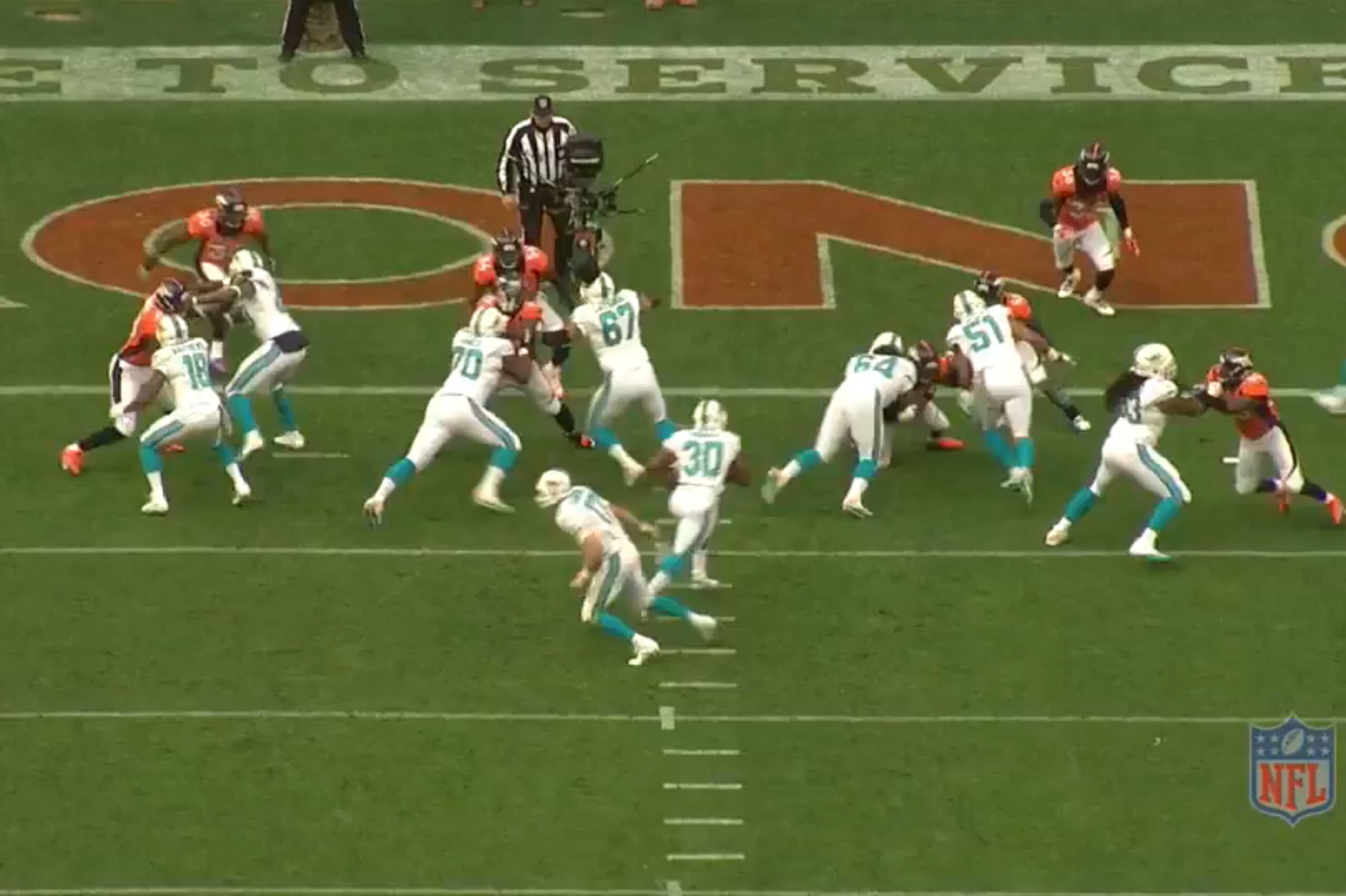
In the above picture, guard Daryn Colledge can be seen at the second level of the defense, ready to seal the block. Center Samson Satele and right guard Mike Pouncey already have their mitts on the defender and have the leverage advantage. With this much space, even Daniel Thomas can scurry in for a touchdown.
This level of execution has been absent throughout many of Miami’s running plays in the red zone, often forcing Tannehill to have one or two plays to force a pass in the end zone. With Miami’s personnel, that’s not an ideal situation.
Standout rookie Jarvis Landry had two touchdowns against the Denver Broncos that were excellent examples of quality execution. In the screen shot below, Miami starts the play six yards out and has two plays to score a touchdown. The routes ran by the receivers aren’t anything noteworthy; Landry just runs a quick slant.
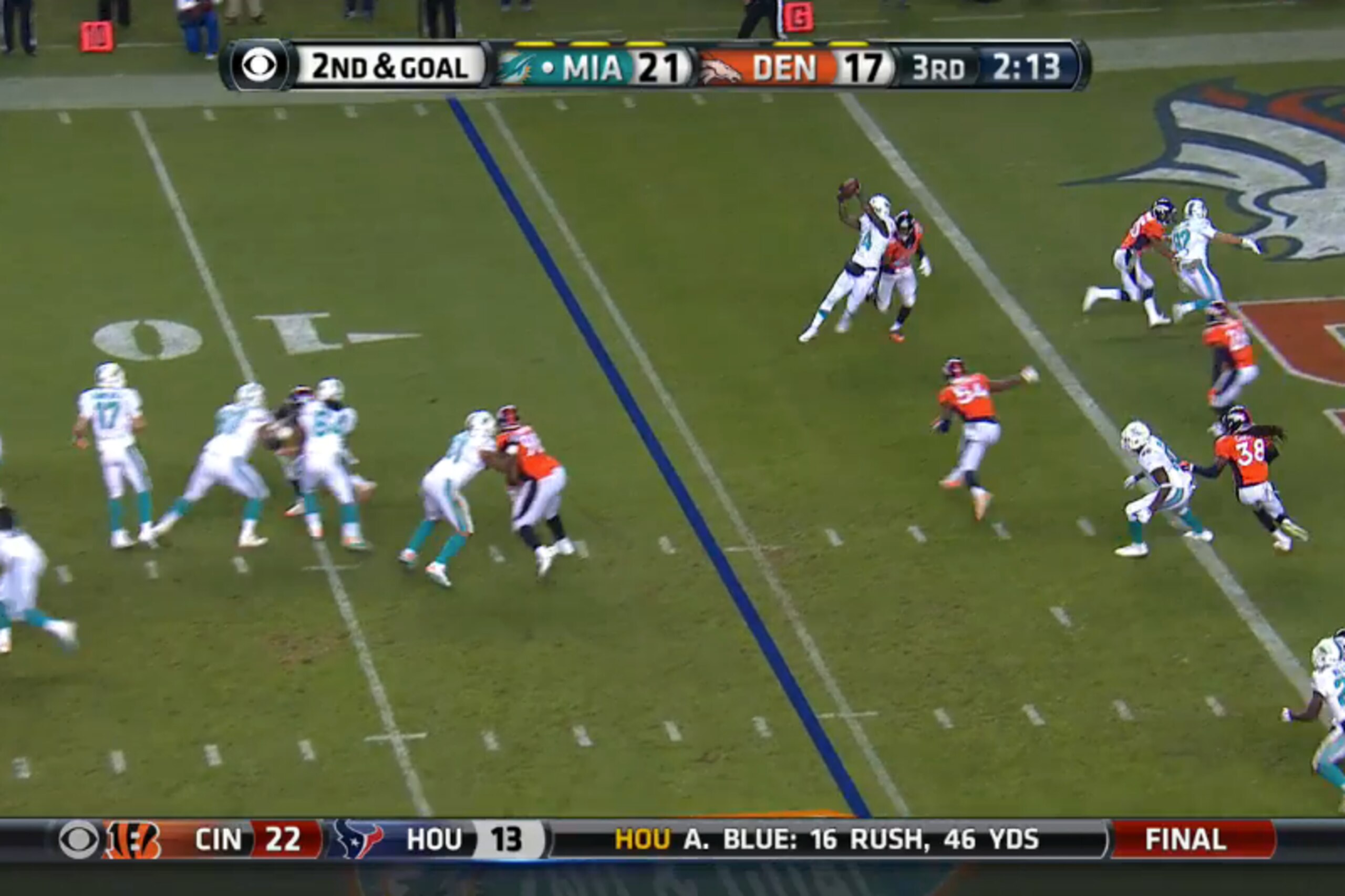
Rookie cornerback Bradley Roby has been solid this year, but he was unable to press Landry, so he got a free release and got the inside leverage on Roby. Then, it was up to Tannehill to deliver a catchable ball and Landry to haul it in and fall forward. We already know the result.
Later in the game, Miami put Landry into a bunched group of three receivers. With so much to account for, the defense doesn’t pick up Landry quick enough to stop a quick pass from Tannehill. Again, mission accomplished.
Play Designs
The work that Lazor has done to get his receivers into a position to succeed has been very impressive the last three games. His spacing in route designs has been more effective and still allows Tannehill to see the field quickly. That’s not easy for an offense with the personnel Miami has.
Lazor’s first gem of note came against the Lions. In Miami’s usual pre-snap motion, Mike Wallace sprinted from the weak side of the formation to where Miami already had Brian Hartline. With Hartline present and the Lions showing zone coverage, Wallace was one-on-one with a linebacker.

But Wallace was already sprinting in a straight line when he caught Tannehill’s pass. So Lazor basically told the linebacker, “Good luck." This is a manufactured touchdown that made everyone’s job relatively easy.
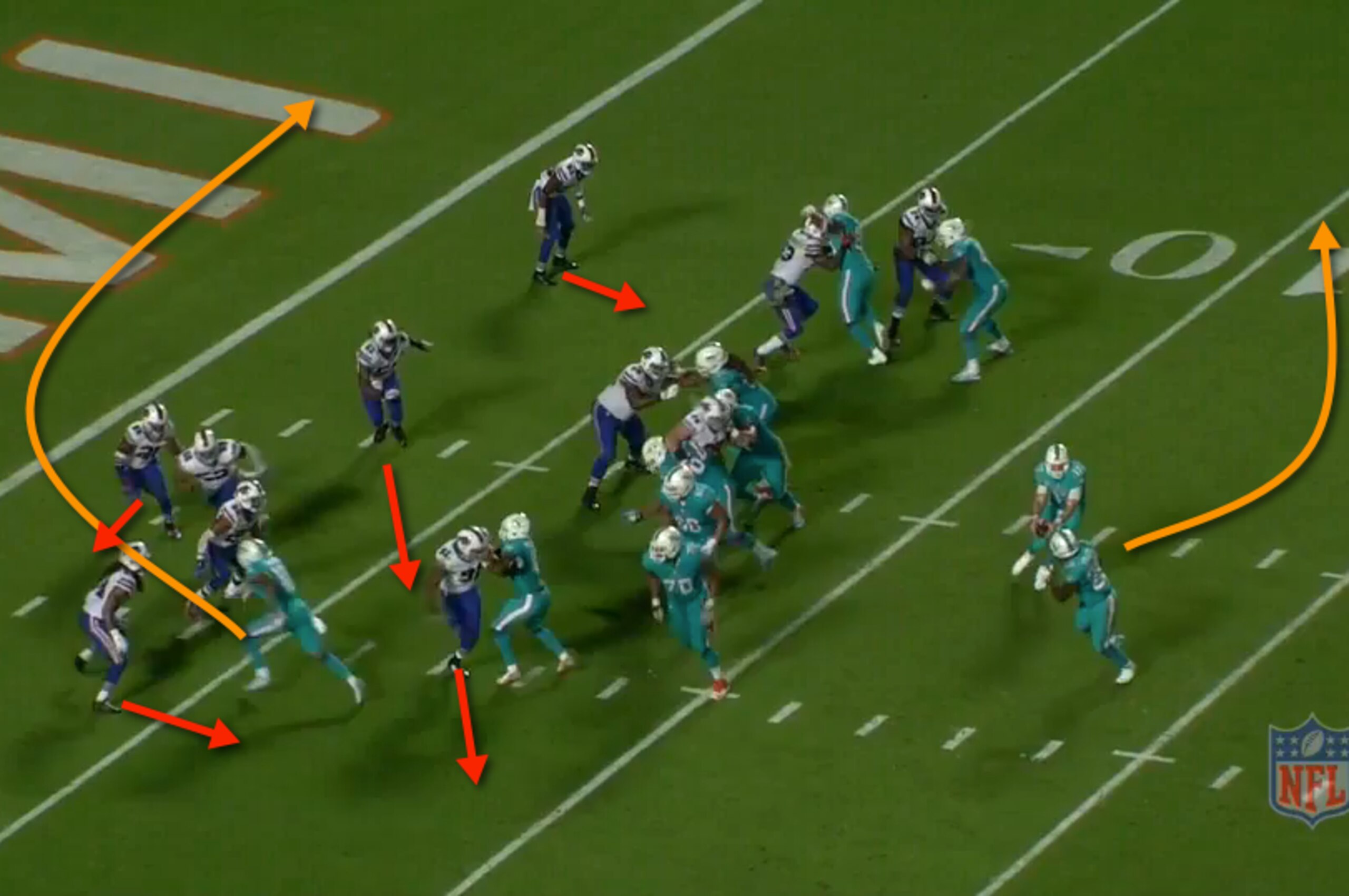
There hasn’t been a better representation of Lazor’s creativity and growth than against the Bills. Miami played to the Bills’ aggressive mindset on defense and sold a weak-side pitch to the sideline. Predictably, the defense completely bought the fake, and Brandon Gibson slipped through the cracks for a crossing route.
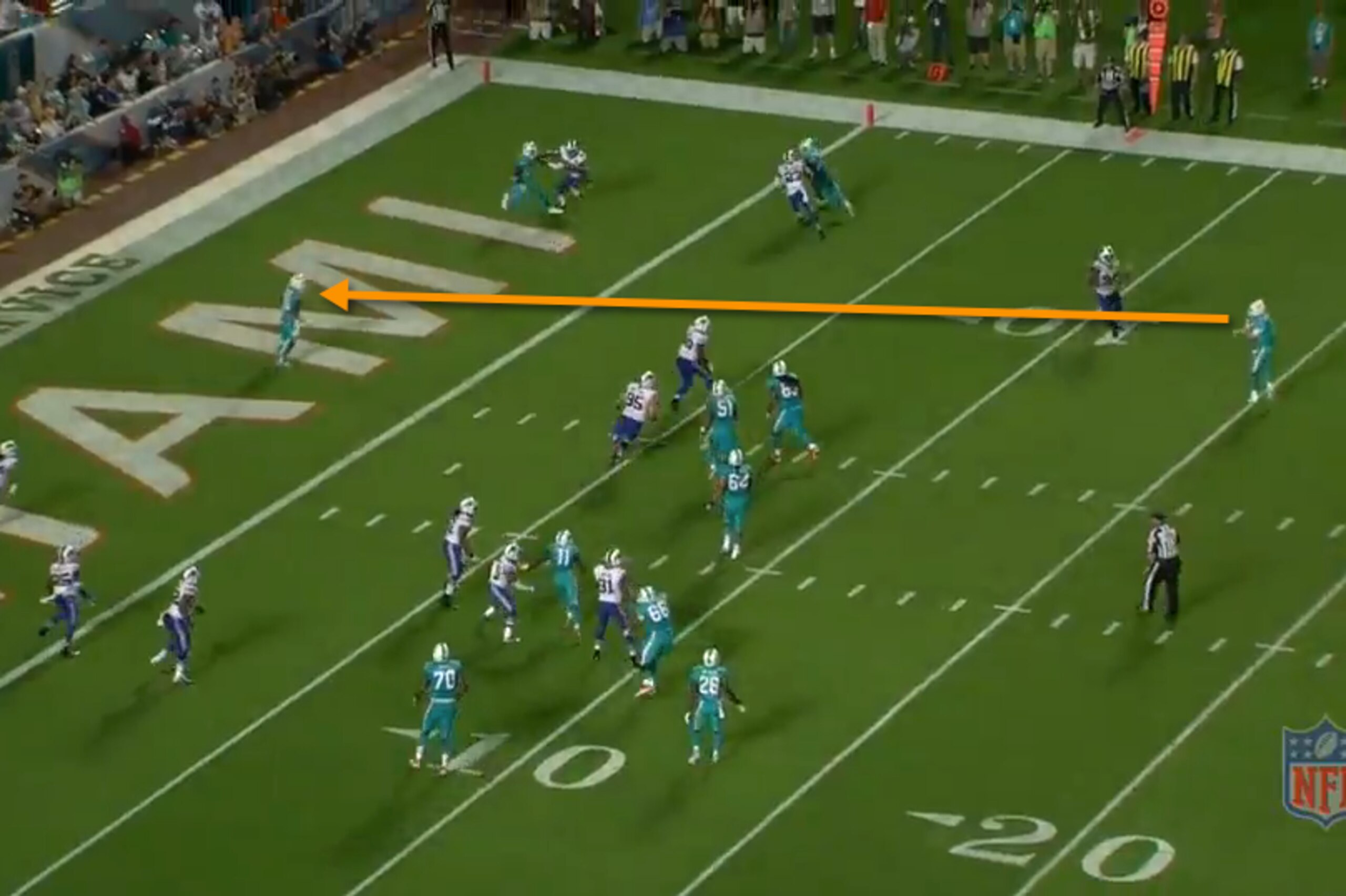
Tannehill ran his boot action back to the middle of the field and found Gibson wide-open to an easy pitch and catch. Miami used the Bills’ aggressiveness against them with the beautiful play design, making execution easy.
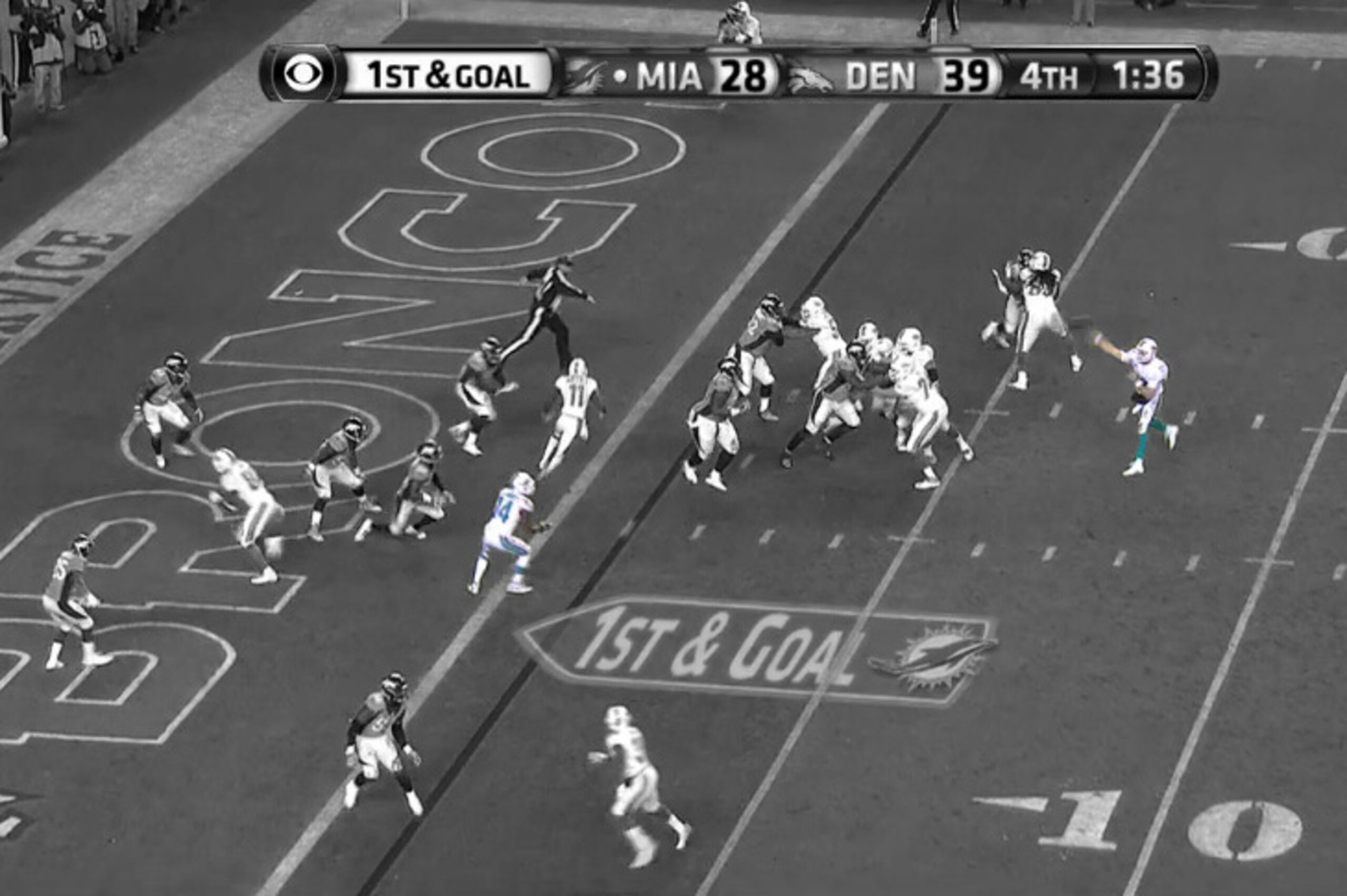
For the most part against Denver, the Dolphins offense put on a clinic on how to execute against a very good opponent. On Mike Wallace’s touchdown reception, there was a blend of solid play design and said execution. Let’s take a look at the play design.
With five options working together to create space, Tannehill has the opportunity to read whether Denver defends with man or zone coverage. Which one they choose is key for Tannehill’s read on this play.

On the right side, we see Brandon Gibson, Mike Wallace and Dion Sims in a bunch formation. Gibson is running a zone-busting route to the middle of the field. In a Cover 2, the safeties will split and theoretically, Gibson would have some space to sit in as the pass arrives.
Denver chose man, so Tannehill was no longer concerned with Gibson. Sims ran a quick out to clear out whoever was covering him, and in this case, it was the lower cornerback. That put Wallace in single coverage on a deep out route. With his speed and ability to cut so cleanly, Tannehill just had to lead Wallace to the pylon with a good throw.
Going Forward
As the Dolphins offense continues to grow and be more consistent, we are seeing the efforts of coaches, individuals and an entire unit playing more effectively. As glorious as individual accolades are, it takes team execution and success for accolades to be possible in the first place.
With five games left in the season, Miami’s offense is in full stride and showing no signs of slowing down. It might just be enough to get it into the playoffs.
All stats used are from sports-reference.com.
Ian Wharton is a Miami Dolphins Featured Columnist for Bleacher Report, contributor for Optimum Scouting, and analyst for eDraft.